Little Light, Orange Tree Theatre

Cast : Lorna Brown (Alice) Paul Rattray (Teddy) Yolanda Kettle (Clarissa) Paul Hickey (Simon)

Originally written for Exeunt.

Families are made from memories. Soft-focus, hard-edged, ossified by nostalgia. Collections of human beings linked by little more than blood and shared history reconstitute themselves through telling, unfurling mothballed reminiscences over the festive detritus of wine glasses and chocolate boxes. Remember the time your uncle got drunk at that wedding. Remember when granny mixed up the pies for dinner. Remember that year little Catherine sang the “Twelve Days of Christmas” for everyone. With all the actions.

In Little Light, those memories are painfully loaded, groaning under the weight of stultified tradition and unspoken grief. In a house by the sea, a couple make careful preparations for a once-a-year ritual of remembering. Teddy is desperate to let in the light, ripping down staircases and smashing through walls, while Alison clings stubbornly to the shadows. When her younger sister Clarissa arrives, heavily pregnant and with boyfriend unexpectedly in tow, the strange ceremony is ready to begin. But this year it’s not going to plan.

Alice Birch’s play – her first, though not performed before now – is an extended exercise in tension-building. On the evening I see the production I’ve come straight from a screening of Whiplash, which had me white-knuckled throughout its 90 minutes of sweat, blood and cymbals. What writer/director Damien Chazelle does with drumming, Little Light does with the dinner party. It’s a format freighted with dramatic history, but in the hands of Birch, director David Mercatali and the excellent cast of four it feels fresh, fleet-footed and horribly nerve-fraying.

As Teddy, Alison, Clarissa and Simon clink glasses and break bread, they commence a routine that is at once familiar and unsettling. All the codes of a shared family language are there: the repeated anecdotes, the practiced looks, the choreographed passing of dishes and wine bottles. But there’s something far more odd and sinister lurking beneath the repetition. Stories are told with blank eyes and laughs jump cheerlessly from strained throats. Remembrances are aimed like daggers under the ribs; a matted lump of hair turns up in someone’s fish pie.

The effect is one of discomfort tinged with horror. Imagine the feeling of anticipatory dread in a scary film: that extended moment of sickening tension just before you know something bad is about to happen. Now imagine that stretched out across more than an hour. Because Birch and Mercatali manage to leave us groping around in the dark, keeping everything in the gloom until the final minutes. The rehearsed interactions of the characters clearly mean something of horrible importance to them, but we are robbed of the means to decipher them, forced instead to remain puzzled and on edge.

While it may not have the same kind of breathless, rule-breaking, fuck-you audacity as Birch’s searing Revolt. She said. Revolt again, Little Light still manages to repeatedly trip an audience’s expectations, deploying the same playfully serious manipulation of form. I was reminded briefly of Martin Crimp’s In the Republic of Happiness, which takes an Ayckbourne-esque domestic set-up and mercilessly rips it apart at the seams, except Birch’s unnerving dinner party gnaws at its own format from within. What looks familiar enough at first glance turns out to be chewing on something a lot more grisly.

The performances, too, keep us guessing. As Alison, Lorna Brown is distant, icy and cruel, until suddenly she’s not. Yolanda Kettle’s Clarissa gulps down the bitter medicine she’s fed by her older sister, the implicit shades of guilt, resentment and reluctant loyalty in her brittle acceptance of the situation suggesting the jagged edges of so many sibling relationships, while Paul Hickey makes an appropriately disoriented newcomer as her boyfriend Simon. And Paul Rattray’s Teddy, hands quivering at his sides, seems forever on the brink of explosion or collapse.

Finally, the play too has to either erupt or crumble with the weight of its building, pervasive menace. It turns out to do a little bit of both. But even climax and catharsis do not unfold as we might expect, offering far more lyricism and far less resolution than the domestic dramas that Little Light takes its lead from. The scab that Birch picks at might finally break loose but, as in so many families, the wound remains open.

Photo: Richard Davenport.

The Mikvah Project, Yard Theatre

4_feb_2015_yard_theatre_049-WEB-copy-2

Note: the performance I saw was the second preview.

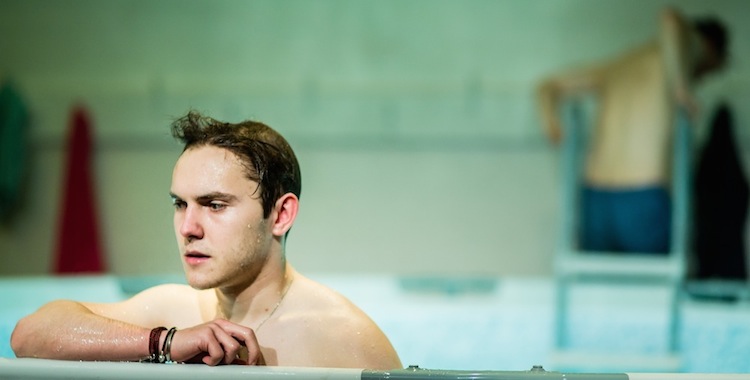
The first thing you notice is the water. The Mikvah Project has plonked a pool – “a massive fucking pool”, to quote Megan Vaughan – right in the middle of The Yard’s stage. It’s so dominating that there’s room for little else in Cécile Trémolieres’ design; just a row of hooks on the back wall and the tatty, functional, scrubbed-clean aesthetic of a public leisure centre.

The pool, tendrils of steam slowly rising from its surface, is the Mikvah of the title. If – like me before reading about the show – you’re wondering what a Mikvah is exactly, it’s a Jewish bath used for ritual immersion. It has associations of cleansing, transformation, rebirth. When Adam was banished from the Garden of Eden, he flung himself in the river that flowed from the perfect world he’d just left, desperately trying to wash away the stains of sin. The first Mikvah was born.

This space, saturated with ritual, religion and tradition, forms the constant backdrop of Josh Azouz’s tender two-hander. It becomes the focal point for the lives of its two male characters, 35-year-old Avi and 17-year-old Eitan, exerting an almost palpable gravitational pull. Even when the narrative positions them elsewhere, the Mikvah is still there.

The tradition, apparently, is to immerse yourself in the Mikvah three times, a nod to the three times it’s mentioned in the Torah. Avi, a man writhing inside his own skin, immerses nine times. He just can’t get clean enough. As for Eitan, well, he’s not sure he wants to wipe away his apparent sins.

Azouz’s play – and similarly Jay Miller’s production – takes its time. It unravels (and unravel feels like just the right word) at an unapologetically gradual pace. We learn a little about the characters: that Avi is married and trying desperately for a baby, that Eitan is still at school and has been kicked out of the synagogue choir. But more importantly we learn about their relationship, a vague acquaintance that through the shared ritual of the Mikvah delicately, almost imperceptibly shifts into something far deeper, far more intoxicating.

It’s immersion by stealth. Watching, at first it feels as though I’m treading water – ticking off items in a mental exposition checklist, trying to decide whether the delivering of lines into microphones is interesting or cliched. But slowly, inch by inch, and without me quite realising until it’s too late, I get dragged under. Soon I’m gulping for air and stretching my water metaphors too far in an attempt to sidestep what I can’t quite articulate.

A lot of it has to do with the understatement and delicacy of the performances. As the older Avi, Jonah Russell flickers with a near-constant edge of discomfort. He is the very definition of unsettled, both by Eitan and by his own reaction to this teenage boy. Oliver Coopersmith’s Eitan, meanwhile, struggles to contain everything he feels, his jittery impulsiveness threatening to overpower Avi’s ruffled sense of propriety. Their conversations carry all of this at the same time as being awkward, halting, weighted down with the baggage of the real world outside the Mikvah. Intimacy can only emerge at intervals. And by the time the orbit of these two men crashes together, we instinctively understand that the sweetness of their collision will be short-lived, painfully intensifying the joy of their coming together.

The whole production is similarly light of touch. On second preview, there are still some moments that unsurprisingly snag – the opening hasn’t quite got the clarity it needs yet, and generally the scenes set outside the Mikvah are less confidently realised than those within its walls – but the overall feeling is one of tender fragility. Unobtrusive projections flicker and ripple insubstantially on the back wall; small, murmured snatches of “Hideaway” and “Wicked Game” and looped, ritualistic humming provide the spare but evocative soundtrack. Then there’s the pool itself: ever-present, with all its heavy suggestions of the faith that binds the two characters, but at the same time playful and kind of joyous.

There’s also an interesting but not quite fully explored sense in which Avi and Eitan are telling their own story, alternately distancing from and drenching themselves in it. Outside the Mikvah, Azouz’s script plays around with the first and third person; at times, both men want to dissociate themselves from their actions and emotions, while at others teller and subject merge into one. These shifts could be exploited more, elaborating on the conflicted and altering attitudes both men feel towards their relationship – a relationship that they might occasionally want to scrub away along with everything else.

But they can’t. The Mikvah yields transformation, for sure, but it can’t cleanse Avi and Eitan of their desire or their pain. Like that very first Mikvah that Adam immersed in outside the boundaries of Eden, it fails to transport them back. Instead they’re left, stranded in this new world and struggling with what that means. Struggling, flailing, trying not to go under.

The Life & Loves of a Nobody, The Albany

Life-and-Loves-Rachael-Walton-credit-Marcus-Sarko-600x399

Originally written for Exeunt.

Anyone can be famous these days. Even a nobody. At least, that’s (part of) the premise of Third Angel’s new show, which wraps an unremarkable story in a skin of media lampooning. The problem is that The Life & Loves of a Nobody, like its double-layered structure, seems to be about two quite separate and not entirely reconciled things.

Here’s one way of looking at it. The Life & Loves of a Nobody is just what its title suggests, relating the humdrum story of unseen protagonist Rachel. Rachel is normal, or ordinary, whatever those words mean. She’s 36, we’re told, with a family and a job and a romantic history that are all more or less familiar. Aged 18 she tried to run away with the circus and ended up flipping burgers, which says all you need to know about the pattern of her life. She’s a thwarted dreamer, her eyes on the stars while her feet remain firmly on the dull, grease-splattered ground.

But that perspective ignores the telling and the reasons for it being told at all. Because we never hear from Rachel herself; instead, her narrative comes to us via Rachael Walton and Nick Chambers’ slick and slightly unsettling presenters. It’s established early on that we are the audience in some kind of controversial media spectacle – so controversial, in fact, that there are protesters apparently hurling shit outside. And at the centre of this contentious televised stunt, Rachel is what she’s always wanted to be: the star.

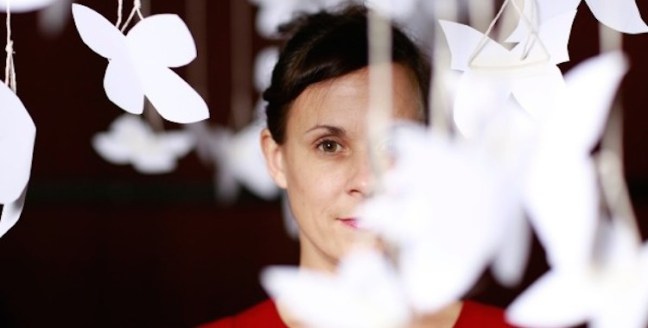
Her life up to this point, then, is framed as an X-Factor style backstory. Except it’s shown through sweet and slightly wonky storytelling rather than cannily edited video montage. It’s here that the whole concept starts to wobble a little, as the style and its ends sit awkwardly alongside one another. Just what are the motives of our two hosts? The presentation of Rachel’s life is by turns tender, mocking and disinterested, not to mention burdened by all sorts of pretty but cumbersome visual devices – a swarm of paper butterflies or a miniature, blinking tower block window. What’s the game here?

The show might hold its cards close to its chest, saving the big, explanatory reveal for the final moments, but the hand it produces fails to fully justify what has come before. Without giving everything away, the question asked is essentially: to what lengths will we go to achieve fame? And, fast on the heels of that, is it better to lead a life that is unremarkable and unremarked upon, or to sacrifice it all in pursuit of “immortality”?

A recent article in Aeon suggested that “what we perceive when we are reproduced in the cultural sphere” – be that as a statue, a name in the history books, or a face on TV – “is a kind of magical act of creation”. Just like so much that masquerades as magic, though, that promise of immortal fame is pretty flimsy when you actually take a look at it. The point is implicitly made at one point in Patti Smith’s book Just Kids, as she recalls the untimely demises of “27 club” members Jimi Hendrix and Janis Joplin in autumn 1970 in a matter-of-fact, grief-tinged tone. Their deaths are not romantic; they’re just wasteful.

The Life & Loves of a Nobody, however, gives only glancing attention to such ideas. Its interest feels torn, between the insidious influence of the media and the desire for fame on the one hand, and the question of whose stories get told on the other. Both are resonant, particularly the latter under a political elite determined to grind down and silence “ordinary people”, but they don’t fully align. The sensationalising media culture being clumsily skewered is all about elevating the ordinary, selling a populist ideal of stardom that is unattainable except for the very few. Whereas the spotlight pointed on Rachel’s life feels more aimed at an affirmation of all human experience, validating the extraordinary and mundane stories of everyone. Even the nobodies.

Ablutions, Soho Theatre

cropped-cropped-ablutions-poster-image1

We sometimes talk about theatre that intoxicates; performance that, like a drug, invades the senses. But how often does it really achieve the warmth, the fuzziness, the edge of nausea that comes from one (or two, or three) too many drinks? I’m not talking drunk acting, at which theatre can be both glorious and excruciating. I mean: how much theatre actually wraps us up in the inebriation it represents?

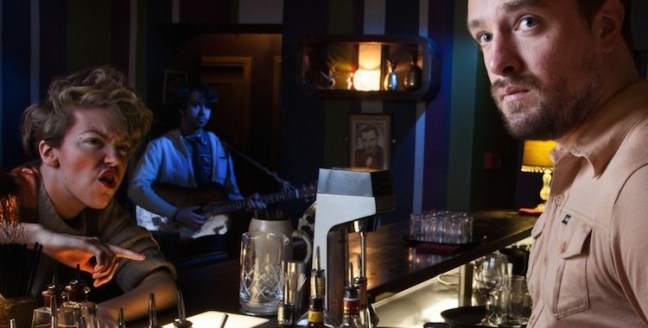
Ablutions, Fellswoop Theatre’s adaptation of the Patrick Dewitt novel of the same name, gets pretty damn close. Every ingredient of the production, from the woozily repetitive live soundtrack to the dim, occasionally throbbing lights, is swirled into a potent cocktail of intoxication and imagination. A hangover is a fierce snarl of electric guitar; the glitter and excess of Las Vegas materialises from little more than flashing lights and slurred Elvis.

Our guide through this blurred landscape is an unnamed, alcoholic barman, forever blankly pulling pints. Though actually, that’s not quite right. Because Ablutions maintains the key stylistic feature of Dewitt’s novel, relating all the action in the second person. You shoot the breeze with the losers propping up the bar, you drive home drunk to your furious wife, you clutch the pain in your side from your knackered liver. You’re the one retching silently yet again in the bathroom and reaching for the pills as you take a shower. And we, the audience, are oddly implicated.

The performances have the same giddy, swirling feel as the rest of the production. Eoin Slattery as protagonist-cum-narrator is the only fixed point, a slight slouch in the shoulders and all light extinguished from his eyes, while Fiona Mikel and Harry Humberstone orbit him as a wide surrounding cast of (often larger than life) supporting characters. People have a habit of drifting in and out of the story, dissolving as suddenly as they appear, like ghosts or drunken visions.

If the show sometimes feels like it’s turning in circles, it’s only apt. The haze of alcohol and drugs fucks up temporality – was that conversation last week? last month? just a moment ago? – and Dewitt’s protagonist is always moving without getting anywhere. Like the circular movement with which he interminably wipes pint glasses, his life (or should that be our life?) has been a constant carousel of drink, drudgery and disappointment. Even an aimless road trip to the Grand Canyon eventually brings him full circle, right back to where he started.

Problem is, this circularity doesn’t always make for engaging theatre. Initially the looping, echoes and repetition are intriguing and hypnotic, but it all feels stretched out just that bit too far, beginning to test the patience by the end. You also get the feeling that extended second-person narration works better in print than in performance, where it starts to labour. Walking out of the theatre and into the chill winter air, Ablutions quickly feels like the drunken daze it depicts: a dizzying, disorientating and ambivalent interlude.

Object Love, Vault Festival

ObjectLove_600w450h1 15.36.56

Originally written for Exeunt.

We invest objects on stage with a strange sort of magic. Just ask anyone who saw Kris Verdonck’s Dancer#3 and cooed over a jumping piece of metal (honestly, I defy you to watch the video without a single “aww” escaping your lips). In the same way as a person can stand in for something or someone else, objects take on a representational charge.

Which makes the theatre an interesting place for Chloe Mashiter’s examination of objectum sexuality. Hang on, objectum whatnow? Chances are, those two words won’t mean a lot to you. What if I say “the woman who married the Eiffel Tower”? Or “the man who has a thing for cars” (and not in a Jeremy Clarkson kind of way)?

That’s part of the problem that Object Love attempts to prod at. Those who identify as objectum sexual – OS for short – are generally either sidelined or mocked, made into exhibits by the tabloid press and the circus freakshow strand of documentary television. Mashiter, by contrast, approaches her subject matter with delicate yet curious compassion. The whole piece sighs with a frustrated desire to understand, balanced by an implicit recognition of the huge distance it is attempting to bridge.

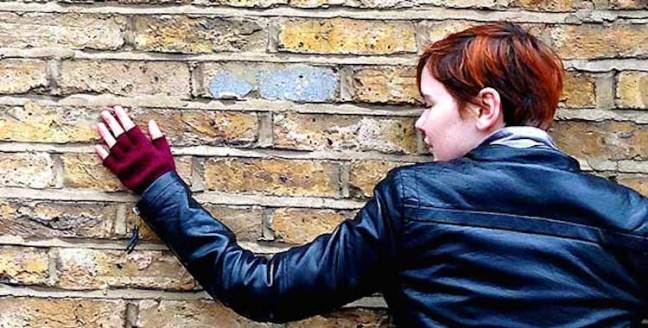
Drawing on interviews with a number of OS people, Object Love tentatively explores what it is to be in love not with a person but with an object – a building, a musical instrument, a camera. The “love” part of its title is essential: as portrayed by Mashiter and her small cast of three, these are not people with a snigger-worthy sexual fetish, but individuals who are head over heels for the objects they have chosen to spend their lives with. A teenage girl embracing her toy train is just as giddy as another might be with her first boyfriend.

But, you may quite reasonably ask, how does it work? How can that relationship be considered at all reciprocal? How do you have physical intimacy? And what do you say to people when they want to meet your partner? Mashiter anticipates all these questions and countless more, leaving room for puzzlement alongside empathy. No, says one character, I don’t have something wrong with me. No, I’m not going to talk about my sex life, another chips in. These are the moments when the piece is at its strongest, as the three OS characters bat away multiple unspoken queries about their orientation, always running out of time to explain themselves. Meanwhile, paper accumulates on the walls and floor, hinting at the reams of extra information that it is impossible to include.

Because – let’s be honest – a lot of what intrigues about Object Love is the unusual nature of its subject matter. It may be framed more sensitively, but Mashiter’s show is courting just the same kind of curiosity that draws viewers to the documentaries that Object Love‘s characters are so bruised by and scornful of. This is acknowledged, turning our inquisitive gaze at least partly back on ourselves, while at the same time recognising the limitations of theatre as a forum to discuss this. There’s only so much that can be done with some interview material and an hour of stage time.

For all its tender attempts at understanding, however, the piece still feels a little strained. Directness, in contrast to the manipulative techniques of documentary makers, is what works best, but still Mashiter feels compelled to break the startling openness of this style of address to stage small scenes from the characters’ backstories. Object Love might do better to simply confront us with the human beings and relationships it is interested in, daring us to understand.