The Changeling, Sam Wanamaker Playhouse

normal

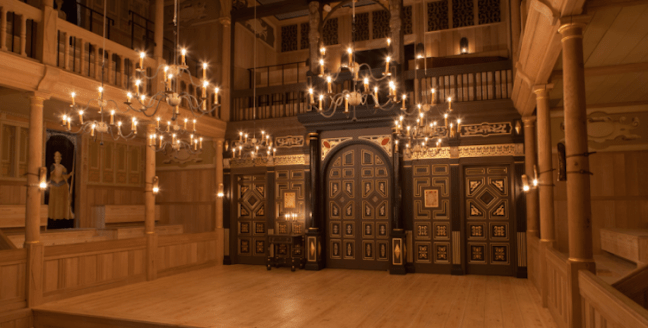
Putting on a play at the Sam Wanamaker Playhouse is the architectural equivalent of heartthrob casting. Forget what’s actually happening on stage; it’s an effort of supreme will just to stop perving on the carpentry and the detail and the candles – oh the candles. Three hours of fragile, twinkling candlelight and I begin to wonder why we ever bother illuminating theatres in any other way (sorry lighting designers).

The building, then, is the immediate star of any show it stages. Dominic Dromgoole’s production of The Changeling, Thomas Middleton and William Rowley’s gloriously bloody tale of murder, lust and deceit (the Holy Trinity of Jacobean drama), lightly accepts this, allowing the space to shine – or flicker – as much as the play that fills it. Pauses to appreciate the flame-pricked gloom or the delicate choreography of lighting the dangling chandeliers are just as important as the action they punctuate. The dim, moody atmosphere of the Playhouse, meanwhile, is forgiving of the gore and excess of Jacobean tragedy. What could be sheer Hammer Horror under the glare of bright lights seems no more than appropriately gruesome in this murky house of shadows.

Still, Dromgoole doesn’t exactly sidestep the more lurid aspects of Middleton and Rowley’s tale. Though a tragedy in name, The Changeling has its share of the ridiculous. The swift about-turns, the riotous madhouse subplot and the sheer volume of asides all lend the play to a blackly satirical, tongue-in-cheek interpretation, one that Dromgoole and co gleefully seize upon. Indeed, you begin to wonder whether The Changeling isn’t one big theatrical joke; a wickedly ironic comedy clothed in dark tragic garb.

When they wrench our attention away from the pillars and chandeliers, Dromgoole and his cast offer us a conspiratorial Beatrice-Joanna, a surprisingly dry Deflores and an unusually uncomplicated chorus of merry asylum inmates. What is the nature of madness, after all, in a fictional world where love seems to make madmen, fools and murderers of everyone? Desire is either a spur to bloodshed, in the case of Beatrice-Joanna and her servant Deflores’ swift dispatch of future hubby Alonzo in favour of new suitor Alsemero, or a cause for counterfeit delusion in that of asylum mistress Isabella’s would-be lovers. The only real constancy is the change of the title.

Dromgoole transforms it all – from the venom-laced insults Beatrice-Joanna hurls at Deflores to the gathering puddles of spilled blood – into comic potential. This Changeling is, first of all and unashamedly, entertainment. The obligatory closing jig, in which the blood smeared corpses rise and playfully skip around with their living counterparts, sneaking grins at one another and the audience, neatly captures the spirit of the whole. The many asides, so easily rendered as clunky interjections, are bursts of irrepressible, almost childish emotion. The often ditched asylum subplot is an unapologetic romp, with joyful turns from Brian Ferguson as fake fool Antonio and Pearce Quigley as a restless, wise-cracking Lollio.

But it’s the production’s take on Beatrice-Joanna that really makes it. Hattie Morahan – always a treat – has the audience on her side from the off. Whether giddy with infatuation after her first meeting with Alsemero, plotting the slaughter of doomed fiancé Alonzo, or wriggling her way out of the labyrinth that murder – and the reward of her virginity demanded by willing assassin Deflores – lands her in, there’s a glint in her eyes that seems to say “you’re with me, aren’t you?” Both her revulsion and attraction to Trystan Gravelle’s shruggingly sardonic Deflores, meanwhile, have a youthful impetuosity, her emotions plastered all over her face. Even when things are at their most desperate, Morahan’s Beatrice-Joanna is apt, like us, to contort her mouth into an awkward smile.

Who knew tragedy could be this fun?
Bull, Young Vic

“Yes, they say nothing comes easy. But if it was easy, it wouldn’t feel this good.”

Bull6web

Forget Patrick Bateman. Housing developer Redrow has reinvented the cold-blooded, psychopathic city hotshot for a rapidly gentrifying London. Their latest advert (scrapped after a hail of online criticism and ridicule) promises the ambitious City boy everything he could want – including one of Redrow’s perfectly proportioned luxury apartments – provided he’s happy to crush the competition. “Make the impossible possible,” the male (naturally) voiceover seductively intones. “To rise and rise.”

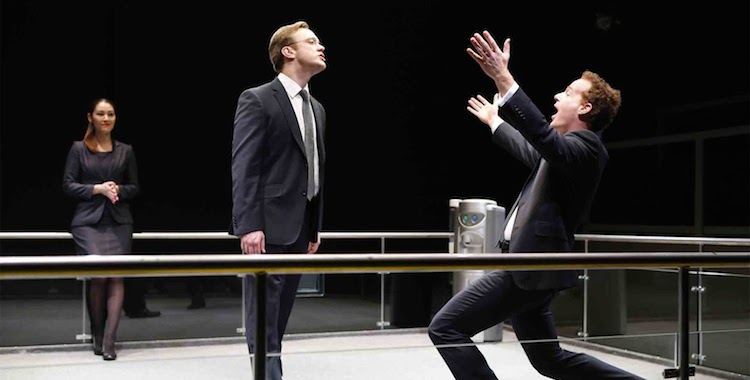
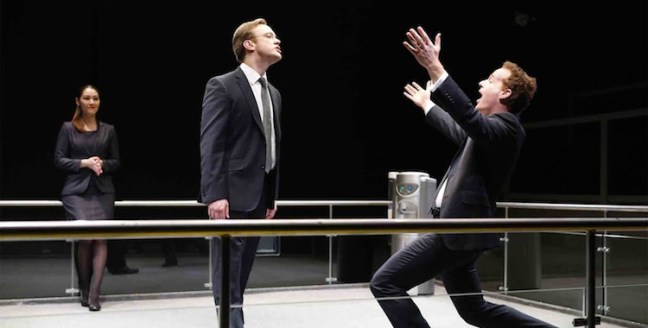
Redrow’s ad is the sleek, aspirational face of a cutthroat post-credit crunch Britain. Mike Bartlett‘s short but bracing play Bull is its grubby underside. The title is a reference to the bullfight: an intricate and bloody display of power. Bartlett’s corporate equivalent, staged by Clare Lizzimore and Soutra Gilmour in a spare, claustrophobic arena formation, is the desperate grapple for jobs in the face of downsizing. Three employees are waiting to meet the boss; only two can return to their desks. It’s the Hunger Games of office politics.

Bleak as it sounds, Bartlett’s play is viciously entertaining, just in the grim, guilty way that The Apprentice is entertaining. Tony, Isobel and Thomas circle one another like animals, sniffing for weaknesses and lashing out with language. The insults are often bitterly funny (“stop shuffling around like an autistic penguin,” Isobel snaps at Thomas), but Bull‘s laughs are just as likely to sour in the mouth. It’s hilarious until it’s not.

As the nervous one-upmanship escalates, it soon becomes clear which employee is primed for the chop. Thomas, ridiculed for everything from his suit to his receding hairline, is the weak one in the pack, and the Darwinian logic of the workplace – like that of the schoolyard – dictates that he has to be brought down. It’s playground bullying, pure and simple, but with higher stakes and sharper uniforms.

In the Young Vic’s taut production, this all unfolds in swift but tense fashion. Lizzimore directs the cruel back-and-forth at a machine-gun rattle, occasionally punctuating the rapid dialogue with precise, painful silences. The verbal equivalent of a staring contest, it’s all about who snaps first. That person is, inevitably, Sam Troughton’s tightly wound, helplessly jittering Thomas, a man on the verge of eruption. As his opponents, Adam Jones and Eleanor Matsuura are hard and shiny as glass, the former doing battle with superficial mateyness, the latter with icy manipulation.

Gilmour’s minimal, antiseptic design is as deliberately impersonal and unspecific as Bartlett’s office setting. The precise nature of the job these three individuals are fighting for doesn’t really matter; what’s important is the lengths they’re prepared to go to. As an audience, meanwhile, we are positioned uncomfortably close to the action, with those standing at the front placed near enough to see the perspiration. We could intervene, but crucially we don’t.

Anything and everything – family, trauma, physical appearance – can be used as a weapon in the armoury of advancement. Make no mistake, Bartlett’s characters are fucking brutal. But worst of all, it’s not just a simple tale of office bullying. Bull is a whole ideology in microcosm; a waking nightmare of ruthless individualism. Scrap that – it’s beyond individualism. This is a world in which, like the hero of Redrow’s video, you need to be “more than individual”.

Bartlett’s play depicts this world in nasty, close-up detail, but the savagery is only ever presented. In a reversal of usual dramatic logic, there is no twist; the inevitable simply ensues, swiftly and excruciatingly. Formally, the production – like the master matadors it places centre stage – doesn’t put a foot wrong. But in its calculated perfection, in its vicious portrayal of a game it leaves unchallenged, it’s both enraging and devastating.

The corporate dystopia of Bull represents the real “aspiration nation”. And those who do rise and rise will find at their feet not the world, as Redrow promises, but the crumpled bodies of the countless Thomases who have to be crushed on the way up. That’s the choice: heel poised to trample those below, or face down by the water cooler.

Well fuck that.

Photo: Carol Rosegg.

Nicobobinus

Screen-Shot-2014-12-22-at-15.02.59-600x393

Originally written for Exeunt.

’Tis the season for baddies, goodies, magic, adventure, fantasy, mythical creatures, song and dance … DumbWise and Red Ladder’s musical version of Terry Jones’s children’s book has them all, minus a chorus of “he’s behind you” but plus a whole host of narrative ingredients. Few family Christmas shows are quite so packed with plot.

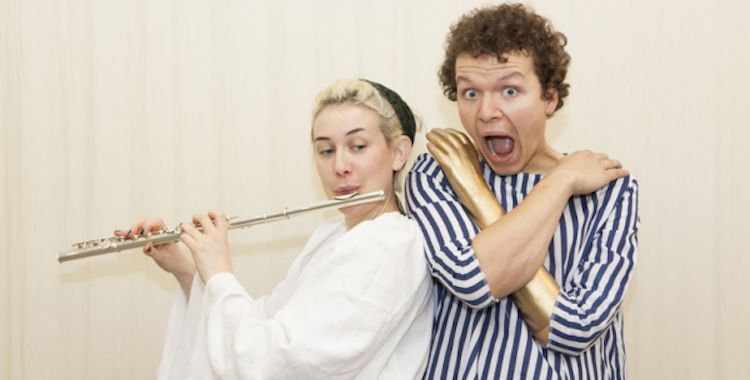
Our mouthful of a hero is Nicobobinus (Nico for short), a Venetian boy who can do anything – or at least so his best mate Rosie believes. These abilities are put to the test when his arm is turned to gold and he and Rosie set out on a quest to find the cure, following in the good old tradition of the magical voyage. Jones’s plot, though, is a whole lot more meandering than your average fairytale. Along the way, Nico and Rosie encounter pirates, gardeners, monks, kings, dragons, magical ships, moving mountains – the list goes on.

As in the fictional worlds of Roald Dahl, the adults we encounter are invariably greedy and vile, while it’s the kids who have the last laugh. From kidnapping pirates to hypocritical monks, everyone wants their share of Nicobobinus’s valuable limb, the covetous glint in their eyes rivalling its golden glimmer. These baddies are most definitely bad, but in a fashion that seems much closer to our own greed-led world than to that of cackling, crackpot villains. Think fantasy meets social critique.

The counterpoint to these grasping grown-ups is found in the friendship between Nicobobinus and Rosie, which is equal, guileless and loyal – and, of course, wins out in the end. Rosie (full of playful energy in Samantha Sutherland’s performance) is a gift of a female protagonist, given most of the guts and nearly all of the mischief in the pairing, while Nico (an equally enthusiastic Max Runham) cheerfully bounds headlong into the madcap adventures she sets them off on. And brilliantly, they both rescue each other; there are no damsels in distress here.

There is, however, almost every other fairytale element you can think of. While the page might be able to accommodate these many jostling characters, on stage it all feels a bit too busy, with a relentless “and then, and then” quality to the racing narrative. The songs inserted by Eilidh deBonnaire and performed by the cast of actor musicians, though often charming, only add to the cacophony.

If John Ward’s adaptation hesitates to bring out the scissors, it does capture something of the storybook in bringing Jones’s novel to the stage. The show is at its best when fiddling with the mechanics of storytelling, its performers doubling up as both narrators and characters. At moments, it is deliciously playful in its sly acknowledgement of the narrative tradition it slots into, offering plenty of arch looks to the audience and implicitly asking even the youngest of its viewers to think about how we share stories.

Kate Unwin’s simple but flexible set, meanwhile, contributes to the improvisatory feel of the performance, quickly being adapted – like the ragtag contents of a dressing-up box – for new uses in the twisting and turning narrative. Little is added, though, by ropey projections, which offer visual elaboration of what could more effectively be left to the imagination. Again, DumbWise and Red Ladder’s show suffers from a surfeit. And it’s here, despite its gleeful subversion of many tired tropes, that Nicobobinus might learn something from the fairytales it borrows from: sometimes simple is best.

Photo: Ellie Kurttz.

The Dragon, Southwark Playhouse

The-Dragon-Tangram-Theatre-@-Southwark-Playhouse-c-Alex-Brenner

Ever wondered what happens in the fairytale after the dragon has been slain and everyone has been handed their “happily ever after”? In Yevgeny Schwartz’s 1943 satirical play The Dragon – and now in Tangram Theatre Company’s clowning adaptation – villains aren’t quite so easily deposed and the victims of oppression aren’t all that eager to be rescued. Sound at all familiar?

Knight errant Lancelot is in the business of slaying dragons. In one of those many once upon a times, he stumbles into a small town which is – surprise surprise – being terrorised by one of the fire breathing monsters he specialises in. What he finds, however, is something he’s never encountered before: a population who are willing – no, positively delighted – to be ruled over by this reptilian tyrant. After all, they reason, what other monsters might move in if this one were to leave?

But our scantily clad, testosterone dripping hero isn’t one to back down. After promptly falling for resident damsel in distress Elsa (fairytale archetypes, our storytellers warn us at the outset, are all present and correct), who is due to be sacrificed to Dragon the next day, Lancelot insists on a fight to the death. What he fails to anticipate is that, in the absence of one source of power, others will be all too quick to grab the reins.

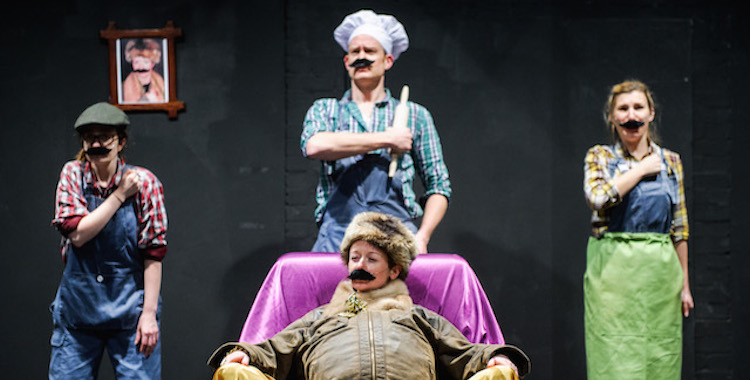
This is cartoonish satire, and Tangram revel in it. There’s cross-dressing, dodgy costumes and caricatures galore, perhaps the most entertaining coming in the form of Hannah Boyde’s nutty, power-hungry mayor, who swiftly steps into the void left by Dragon. James Rowland’s Lancelot is half-lad, half-superhero, leaping boyishly around the stage, while Justin Butcher makes a brilliantly hammy villain. And it’s all presided over by talking cat narrator Rob Witcomb, archly acknowledging that this is all really just fooling around on a stage.

Warming everyone up for panto (all together now: “he’s behind you!”), The Dragon has more than a healthy dose of silliness, villainy and audience participation. But smuggled in under the cover of cape-wearing knights, fake moustaches and bad Russian accents is a much more serious point – or rather points. Because the targets of Tangram’s satire are multiple, extending the show’s aim well beyond Schwartz’s original attack on Stalinist totalitarianism. Now we have extra shots at political apathy and the current political landscape, culminating in an earnest but awkward plea for us all to get off our arses and actually do something.

The problem is, Tangram’s sudden call to action just doesn’t feel earned. There’s definitely something to be said for sneaking in political content, clothing provocative points in madcap comedy and forcing laughs that sour in the mouth. But in its climactic political speech, as Elsa (Jo Hartland) berates us all for failing to act, The Dragon becomes more hectoring than galvanising. This sequence breaks abruptly with everything that precedes and follows it – and not in a useful way. Its jolt is that of a clunky gear change rather than of a sudden, rousing revelation.

That old adage of “show, don’t tell” shouldn’t always necessarily be obeyed. I’ve encountered plenty of theatre that makes an art out of telling. But here, the telling is just too explicit, dissolving a previously fun yet thoughtful piece of theatre into pure (if passionate) lecture. It would be enough to present us with the narrative’s cheerfully submissive townspeople, who already accusingly reflect back our own complacencies. My sympathies are absolutely with the message, but I don’t go to the theatre to be told outright what to think. There’s a line, if a fine and blurry one, between that which energises and that which preaches. Make me want to act, don’t tell me to act.

Photo: Alex Brenner.

Golem, Young Vic

10469371_10152723512523346_2141051808493943962_n

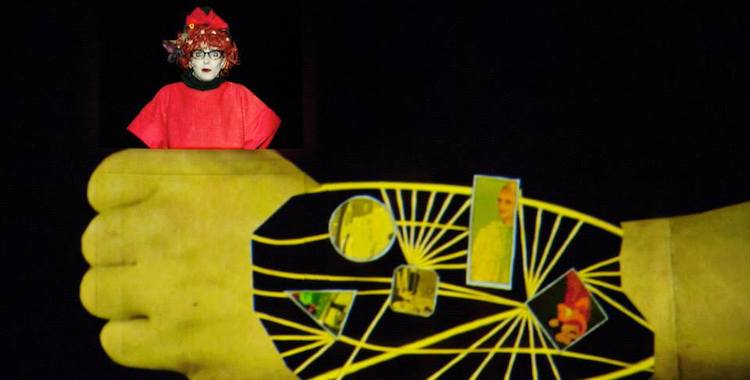
It’s easier, as the popular phrase has it, to imagine the end of the world than it is to imagine the end of capitalism. Perhaps the same now goes for the little glowing rectangles permanently glued to our palms, feeding us an endless diet of information and advertising. The one, of course, is wrapped up with the other, as technology binds us ever more tightly to the corporations that invisibly run our lives: promoted tweets, personalised ads, one-click shopping. All the choice in the world, as long as you don’t want an alternative.

1927’s previous show, The Animals and Children Took to the Streets, was eerily prescient in its anticipation of the 2011 riots. Golem is more responsive than it is prophetic, amplifying an experience of 21st-century living that is – despite the cartoonish cladding – instantly familiar. Instead of iPhones, 1927’s characters have the eponymous golems: clay men designed to do the bidding of their masters. But as with the similarly “time-saving” devices that our lives revolve around, the golems (and the ubiquitous corporation that promptly snaps up the invention) quickly begin to make silent demands of their own.

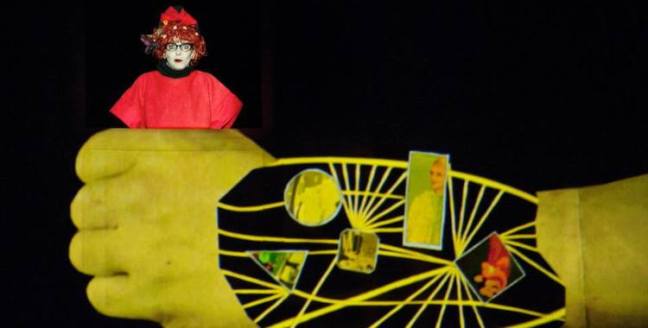
Ironically, the show itself is founded on the same technology that it regards with suspicion. The stage of the Young Vic is filled with nothing but screens and bodies, which meet seamlessly thanks to the witty detail of Paul Barritt’s projections and the precision of the performances. Awkward nerd Robert – demanding the full, gawky array of Shamira (Little Bulb) Turner’s elastic facial expressions – strides through animated cityscapes, seeming almost to dissolve into the busy backdrop of fast food joints and strip clubs. This is an every-city, a place of crumbling estates, boarded up shops and townhouses owned by absent billionaires.

Robert is, as his narrating sister Annie informs us, a nobody. He was bullied at school, he’s never had a girlfriend and he spends nine to five “backing up the back-up”, drearily pencilling 0s and 1s into ledgers. For fun, he plays in Annie’s band: a ragtag collection of thwarted punk rockers, who would be changing the world if it weren’t for their chronic stage fright. Even the way he stands, shoulders rounded against the world, is unassuming.

Then Robert buys a golem, the latest invention from his would-be entrepreneur friend. The clay man created to serve is borrowed from Jewish folklore, but 1927 are more interested in his 21st-century descendants. Golem doesn’t just cook and clean; he saves money by doing the food shopping online and helpfully suggests which new shoes to buy. Egged on by his new companion, Robert bags himself a promotion and overhauls his image. He’s no longer a nobody, but an everybody. And despite his supposed servility, it is soon the golem who begins to look like master, as Robert and his family fall under the influence of this wonky clay automaton and later his shiny, updated replacement (Golem 2.0).

This is storybook satire: bold, colourful, but not necessarily subtle. 1927’s targets – global corporations, political apathy, freedom sapping technology – loom large and unmissable, with a few potshots at the Daily Mail and anti-immigration rhetoric chucked in for good measure. There are even mentions for Boris Johnson and Benedict Cumberbatch (Robert’s golem is, hilariously, rather taken with the latter).

But if its message is as blunt as the advertising crowding the edges of our screens, Golem gets away with it by dint of sheer ingenuity. There is still something inexplicably joyful about the way in which bodies and images merge on stage, putting to shame the clunky projection seen in so many other shows. It’s the detail, though, that really makes it. From a portrait brought delightfully to life, to Robert’s deliciously Kafka-esque occupation, to a brilliant (and brilliantly observed) sequence on internet dating, nothing is wasted. And when the garish yellow branding of the golems begins to take over, it’s the small and silly quirks that we miss, be they wacky hairdos or idiosyncratic punk lyrics. No golem – or iPhone – can substitute for those.

Photo: Bernhard Müller.