War Correspondents, Stratford Circus

warcorrespondents-600x386

Originally written for Exeunt.

Helen Chadwick and her team have been keen to avoid the word “musical” in talking about their latest piece. You can see why. The grim realities of war don’t really lend themselves to toe-tapping and jazz hands. Of course, the musical form is capable of much more than silliness and schmaltz, but there is an atmosphere of meticulous care that surrounds this project, right down to the precision of the language used to describe it. As the journalists at its centre know, words are important.

Six years in the making, War Correspondents is an ambitious, wide-ranging piece of work. The performance consists of 29 songs, all crafted from the words of correspondents interviewed by Chadwick and from various poems on the subject of war. Taking in numerous conflicts, its focus is war in general rather than any one war in particular, while the subject of war reporters allows an examination both of conflict itself and its impacts locally and globally. We see the devastation and casualties on the ground, as well as the headlines around the world and the lasting psychological damage on those who bear witness.

But how do you represent something as destructive, as relentless and as complex as war? War Correspondents’ answer to that question is to highlight all of those qualities, refusing to make neat sense out of the material it is working with. Rather than following an elegant narrative arc, the action rises and falls. Hostilities escalate and melt away. Attempts to impose logic are confounded by often seemingly meaningless flashes of violence and brutality. And like war – to adopt one of the phrases used by war correspondent and interviewee Chris Stephen in the post-show Q&A – it slowly bleeds out, refusing the closure of a clear, conclusive end point.

This can make it occasionally difficult to watch. With little but the central thematic thread to tie the succession of songs together, the show has a tendency to meander – aptly, of course, but in a way that challenges the concentration of viewers. Chadwick’s music, meanwhile, is as slippery as her subject matter. While beautiful and haunting, it offers little to grasp onto, with melodies that swell and dissolve like the dramatic action. This all takes place against the virtually unchanging backdrop of Miriam Nabarro’s simple yet evocative design, suggestive of the constant cycle of conflict, as are Steven Hoggett’s understated, repetitive movements.

Though they might require a certain quality of concentration, the songs themselves grapple with an impressive array of issues, from the morally uncertain position of the bystander to the consequences of what is and isn’t said. There is not just one shade of grey here but many. What we get less of is what compels these journalists to do what they do in the first place. In the post-show discussion, Stephen guiltily confesses that part of it is the thrill of being in a warzone, an aspect of this picture that it would have been interesting to see explored further.

But perhaps that is an unreasonable criticism. The point is that a piece like this can never encompass the full, terrifying scope of war – or even one single facet of it. And Chadwick and her team are well aware of that. Instead, War Correspondents offers a rich texture of overlapping voices, a cacophony that echoes the noisy, complex, multi-layered nature of war itself.

Phenomenal People

Fuel_Phenomenal_People__2__by_Sheila_Burnett_512c9ec5c6e34

Originally written for Exeunt.

We need to tell different stories. It’s a need that I’m reminded of every day, as I flick past the same narratives written and dominated by the same people, usually attempting to sell readers something in the process. Most of the stories that have been handed down to us represent only a tiny proportion of those who encounter them, or where we are represented it is in pale, limited colours – a faded watercolour version of who we really are.

Phenomenal People is, in a small but important way, attempting to shift that. The project from theatre producers Fuel is aimed at celebrating the stories of women in a world crowded with male narratives. And by women they mean all women, from Emily Davidson to your nan. It primarily exists online as a collection of profiles, uploaded by Fuel and by anyone who chooses to nominate their own phenomenal person, but it is also appearing in a series of live incarnations around the country, including at Camden People’s Theatre over the weekend.

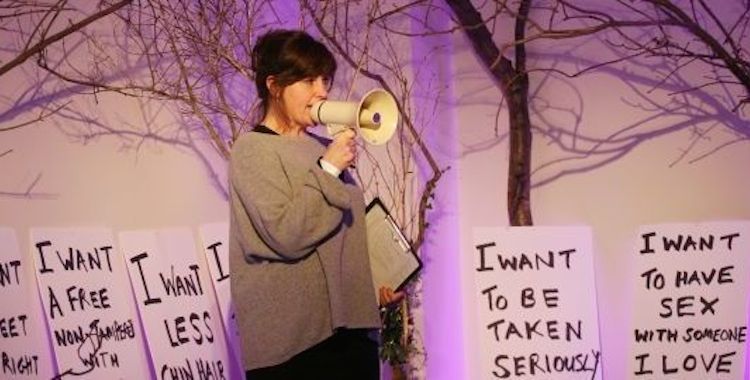
This live version of the project sits somewhere between installation, performance and immersive experience. Immersive because designer Lizzie Clachan has created a gorgeous, enveloping indoor garden in the basement of Camden People’s Theatre, entirely transforming the space. Real grass – or so host Nic Green assures me – lines the floor, while trees appear at every turn. This lush, comforting cocoon in the middle of the city is completed by soothing lighting from Natasha Chivers and a sound design by Melanie Wilson that blends music (by women, of course) with snippets of female voices, all burbling away in the background like a distant brook.

At tables dotted around the space, visitors can browse the growing online catalogue of extraordinary women on iPad screens, as well as adding their own. And punctuating the green tranquillity are performances from a range of women, each celebrating their own phenomenal person through the medium of art. We get poetry from Malika Booker, an entertaining, breakneck Powerpoint presentation from Rachel Mars and a puppet show from Akiya Henry. Melanie Pappenheim lends her voice to the latest women to be nominated, curling her improvised sounds around their names, while Jenny Sealey joyously closes the afternoon with a signed rendition of “I Will Survive”.

In the spaces between performances, I find myself thinking about all the phenomenal women who have inspired me. The teachers who insisted that I had something to say. The incredible writers – Angela Carter, Virginia Woolf, Rebecca Solnit – who fed and continue to feed my imagination. The voices that help to define the soundtrack of my life: Patti Smith, PJ Harvey, Kate Bush, Stevie Nicks, Regina Spektor, Debbie Harry, Nina Simone. My mum. My grandmothers. My astonishing great aunt, who just jumped out of a plane aged 80 to raise money for charity. Countless others whose art and words and acts comfort and motivate me.

It is this continuing proliferation of narratives that feels more important than the live event itself. In this form, Phenomenal People is a celebration and a spur, allowing us to toast the women who have been nominated so far and offering fuel (pardon the pun) for visitors to go away and celebrate the women who have inspired them. As an event it’s not perfect – the digital and sound elements don’t feel as smoothly integrated into the whole as they might be, and some performances are more fully formed than others – but as a project it is intensely hopeful and galvanising. And I challenge anyone to find a better way of ending the week than attempting to sign and dance along to “I Will Survive” with a room full of generous, talented and helplessly laughing women.

Nominate your own phenomenal person at www.phenomenalpeople.org.uk.

KARAOKE, Battersea Arts Centre

Sleepwalk-Collective-600x385

Try not to think of a stage.

Try not to think of a screen.

Try not to think of a boy and a girl.

Try not to think of a karaoke machine.

Try not to think about the end of the world.

To be completely honest, I’m not really sure how to write about KARAOKE. The first time I saw Sleepwalk Collective’s haunting, hallucinatory show was in Edinburgh, where I was emotional and sleep-deprived and found the whole thing quite mind-alteringly trippy. At one point in the show, the karaoke machine at the centre of it all describes the audience as “sort of woozy and credulous and sad”. Seeing it on the Fringe, I thought: yep. Yep, that’s me.

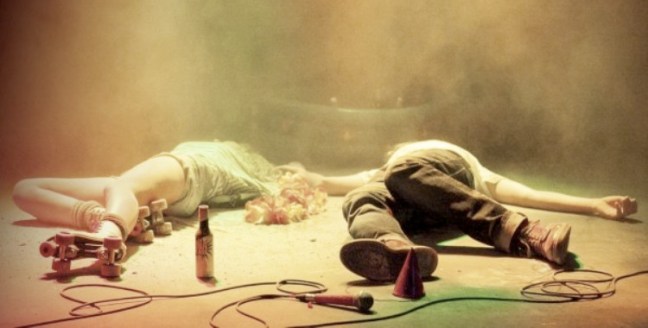
Inevitably, seeing it in the course of life’s more regular rhythms lends the show a different impact. It’s not quite so woozy, but no less strangely compelling. The central conceit is there in the title: performers iara Solano Arana and Sammy Metcalfe read aloud and obey instructions from a karaoke machine, all of whose text is projected onto a large screen at the back of the stage. They remain trapped throughout in some kind of nightmarish limbo, condemned to read from the tyrannical machine until the text stops – if it ever does.

There is, of course, a big old metaphor for text-driven theatre embedded in the form of the show. And at first, with its self-referential nods to audience and performance space, it seems like KARAOKE is just more theatre about theatre (not that I don’t love theatre about theatre). But at some point this meditative, deadpan, stealthily intoxicating show expands into something more. It is also about life and death and meaning and chaos and love and sex and birth and legacy and time and media and screens and pop culture and machines and catastrophe and apocalypse. The future is already written. Everything is inevitable. Read on.

The space that KARAOKE inhabits is somewhere in the join of things, in the cracks between the paving slabs. It highlights the gap between thought and feeling, between imagination and reality, between text and performance, between instruction and action, between the real and the performed. For the length of the performance, we too float somewhere in that space, text and images flashing relentlessly before our eyes. Time twists and warps and meaning feels like quicksand.

There is no singing in KARAOKE. But it shares with the best pieces of music that extraordinary, slippery ability to completely alter the mood of its audience. And as with songs, it’s impossible to pin down exactly what it is that’s so powerful. Somewhere between the deadpan delivery and the low hum of background music, between the coloured lights and the cloud of mist that cloaks the stage, the show takes hold and won’t let go. We, like the performers, are at the mercy of the karaoke machine. Read on.

P.S. Meg Vaughan and Mary Halton both played blinders on this one, so go and read their (much more interesting and inventive) responses.

P.P.S (and also *SPOILER ALERT*) Can those of us who have seen the show just pause a moment to appreciate that kiss?

The Last Adventures, Warwick Arts Centre

lastadventures-600x367

Originally written for Exeunt.

Stories, no matter how jagged, broken or twisted out of shape, have always been at the heart of Forced Entertainment’s work. In The Coming Storm, this preoccupation with storytelling approached something of a climax, as multiple narratives collided in a messy eruption of stage fictions. The Last Adventuresfinds the company playing in the wreckage.

Core company members Richard Lowden, Claire Marshall, Cathy Naden and Terry O’Connor are joined on stage by a host of guest performers, swelling the ensemble and preparing the ground for chaos. They begin seated in a classroom set-up, repeating learned knowledge by rote. As so often in Forced Entertainment’s work, the profound mingles with the banal mingles with the ridiculous. “Some people act like animals”. “This writing is not for people”. “Time cannot be saved”.

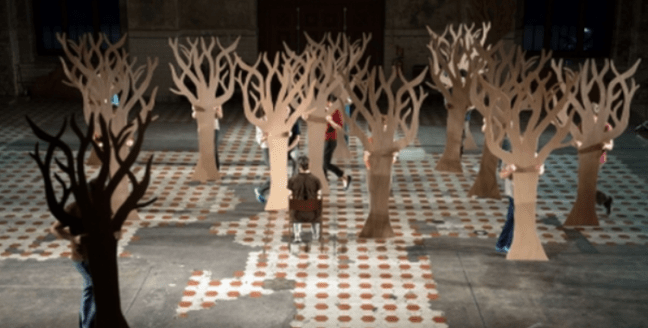
Where this new piece takes a less familiar turn is through the electronic soundscape created by collaborator Tarek Atoui and supplemented by an onstage improvised contribution from noise artist KK Null. Sound rips through the lesson, drowning out the monotonous repetitions, and performers peel off one by one, collecting cut-out trees from the back of the stage. Suddenly, everything shifts.

For the rest of the show, sound and image replace language. A moving forest of trees sweeps across the stage. Performers don colanders and dressing gowns, running at one another with broom handles. Noises attack with deafening force. A tree is chasing a man with an axe. A voice is trying to speak. A papier-mâché constellation of stars and planets forms and disperses. Princesses and sea monsters run past stricken soldiers. Sounds swell, shudder, jolt.

This is a world of fragments and echoes, of broken off splinters of images and truncated blasts of sound. It invites the eye and ear to dance over it, selecting from its rich, cacophonous overabundance of sensory stimuli. And many of those fragments are from Forced Entertainment’s own 30 year history. Skeleton suits recall Spectacular, while a cardboard crown briefly conjures And on the Thousandth Night. If Forced Entertainment are dancing in the rubble, it is formed from the detritus of their own back catalogue.

Time – as it has a tendency to in the company’s work – does funny things duringThe Last Adventures. At some moments it seems to accelerate to warp speed, while at others it painfully drags its heels. As a viewing experience, the show hovers somewhere between boredom and entrancement, its oddly hypnotic quality encouraging the mind to periodically wander and return. Each time my concentration refocuses, another image jumps out from a different corner of the stage, another story spins itself involuntarily in my mind.

As something of a mental exercise, Forced Entertainment’s multi-layered collage of images demonstrates once again how adept we are at constructing narratives from solitary building blocks. As a new piece of theatre, however, The Last Adventures falls short of the company’s best. In its chaotic exploration of stories it is almost a visual embodiment of The Coming Storm, perhaps best viewed as a companion piece to that earlier show. The usual exquisite silliness is all there, as are many other of the increasingly legible outlines of Forced Entertainment’s performance language.

If The Last Adventures extends the company’s vocabulary at all it is through Atoui and Null’s joyfully disruptive sound design. Sudden beats or new rhythms can distort stage images as soon as they form, contorting meaning and chasing the performers in circles. The theatrical meaning machine that Forced Entertainment have so revelled in tinkering with gains a new lever, perhaps not transforming it but, as the company celebrate their 30th anniversary, putting an interesting new pressure on its now familiar workings.

An Enemy of the People, Barbican

enemy-600x359

Originally written for Exeunt.

Anyone eavesdropping on the fourth act of Thomas Ostermeier’s An Enemy of the People might be forgiven for thinking that a vociferous public debate was taking place in the Barbican’s theatre. The German director’s take on Ibsen does not provoke discussion so much as demand it. For once, the audience – the people – are asked for our opinion. Well, sort of.

From the outset, Ostermeier’s interpretation is a decidedly 21st-century one. Well-intentioned scientist Dr Stockmann, younger than we are used to seeing him, is a leather jacket and jean clad member of the left-leaning intellectual class, with a cover-playing band and the last, frustrated vestiges of radical student politics. In dramaturg Florian Borchmeyer’s streamlined version of the text, a number of periphery characters have been cut, leaving Stockmann with just a young wife and baby son. He is, in other words, the epitome of 30-something reluctant bourgeoisie, struggling to reconcile his political principles with his desire for wealth and stability.

The same goes for many of the other characters, who are invariably caught between radical idealism and murky compromise. The bourgeois subjects of Ibsen’s plays translate remarkably well to a modern setting, delineating all the same middle class anxieties and hypocrisies that get regularly dissected today. When Stockmann discovers that the water feeding his town’s prosperous spa is riddled with disease, it is compromise and hypocrisy that win out, as one by one the local politicians and media agree to a self-serving cover-up. Even hipster journalists and fellow band members Hovstad and Billing relinquish their superficial ideals, which turn out to be just another designer accessory. Only Stockmann holds firm, intending to oust the conspiracy at a public meeting.

And here is where the otherwise familiar route takes its most startling turn. Partway into the scene, Stockmann’s usual rant segues into excerpts of French anarchist call to arms The Coming Insurrection, before the already dissolving fourth wall is entirely dismantled and we are invited to share our own political gripes. On the night I attend, perhaps unsurprisingly, the Scottish independence referendum and media bias are high on the agenda. Another lone, angry cry laments that we can’t put aside our differences and unite against the forces of capital that we have just heard so passionately condemned.

If this open forum elicits anger, then it yields embarrassment in equal measure. Uncomfortable laughs ripple around the audience, as does over-enthusiastic applause in response to statements like “stop tax avoidance” and “get rid of bonuses”. The problem, of course, is that we hear from those – like Stockmann – in the vocal minority. That’s not to mention that Barbican audiences for foreign-language work tend to have a fairly particular class and political make-up. We are no more “the people” than Ibsen’s privileged representatives are.

The other problem is dramaturgical. Unlike the outraged townfolk who usually hound Stockmann off the stage, the Barbican audience is largely in favour of the statements he puts forward. This is partly down to the crude measure of raised hands, which do not really allow for ambivalence. I suspect I was not alone in cheering many of the complaints against capitalism but feeling a whole lot more suspicious about the anti-democratic bent of much of what Stockmann suggests. But largely, the crowd is with him.

Which rather scuppers the rest of the play. The retreat back into Ibsen’s world, while brilliantly signalled by a pelting of paint balloons from the town Mayor and his cronies, feels like a dramatic anti-climax after the heady debate of the public meeting. Ostermeier and his cast keep the play on track, making allowances for the shift in public opinion, but it never regains quite the same tension or resonance that it had previously. Only in the concluding moments, which have been tweaked to offer a bleak final flourish, does something of the earlier boldness and mischief reappear.

There is an implicit question, both in this ending and throughout, over whether it is the blindly self-interested town majority or the political and economic system in which they participate that is Stockmann’s real barrier. Does the problem lie with people or with systems? Here, it seems to me, lies one of the central tensions of Ostermeier and Borchmeyer’s version, tangled up with the question mark raised over democracy. Stockmann might blame the “liberal bloody majority”, but the text that has been spliced into his speech offers an excoriating critique of capitalism and the cult of the individual. So how are we to read it?

While Ibsen’s use of Stockmann as the ultimate individual and The Coming Insurrection’s attack on social atomisation appear to be at complete odds, I wonder if there’s something more interesting going on in this juxtaposition. The contradiction between this anarchist manifesto of sorts and Stockmann’s belief that it is a few righteous individuals like him who should hold the power reflects a similar contradiction among Ostermeier’s intended audience – one that is immediately reinforced by the overwhelming support that Stockmann’s speech gathers in the auditorium. Firm belief in the correctness of one’s personal politics wrestles with the ideals of equality and democracy.

There is also a fascinating way in which the whole production complicates the notion of the individual. One segment of The Coming Insurrection, protesting the appropriation of the phrase “I am what I am” by advertising giants, acts as a sort of gloss for Ostermeier’s interpretation, projected onto a screen that comes down in front of the action. Even the self is not safe. And Stockmann’s own view of himself and his stand against injustice is coloured with personal vanity, a vanity that is present in the self-consciously stylish aesthetic of the production. Jan Pappelbaum’s design is all fashionably minimal furniture and elegantly limited colour palettes, carelessly cluttered with items of expensive technology. Even the music played by Stockmann’s band – reworked versions of David Bowie and Gnarls Barkley – is something of a pose. The blackboard walls, meanwhile, are a blank slate for ideas, but they are just as easily whitewashed by the powers that be.

And then there’s that public debate. Nowhere is Christoph Gawenda’s Stockmann more giddily drunk on his own rhetoric, breaking out of the previously delicate naturalistic acting style of the production and into something far more overtly performative. His speech is as much about him as it is about the ideas he is articulating. The interestingly flawed structure of this open forum, meanwhile, speaks to the limited systems in which both Stockmann and his audience are trapped. Discussion is quickly closed down because the structure cannot hold it, a collapse that feels like as much of a comment as a straightforward theatrical failure. Seen in this light, the problems I held up earlier take on a far more interesting character.

Like Ibsen’s plays, it strikes me that Ostermeier’s production is both about and for the middle classes. The Barbican’s audience might not be “the people” in any representative sense, but it is that audience and its counterparts around the world at whom this version is squarely aimed. Here, hypocrisy penetrates all levels of the drama, as even systemic critiques rest on an unacknowledged belief in the individual – a belief that eventually strangles political conviction. Ultimately, what Ostermeier throws out to us is not a liberating opportunity to speak up, but our own inability to effect the change that we debate so passionately in our nicely appointed living rooms.

Photo: Arno Declair.