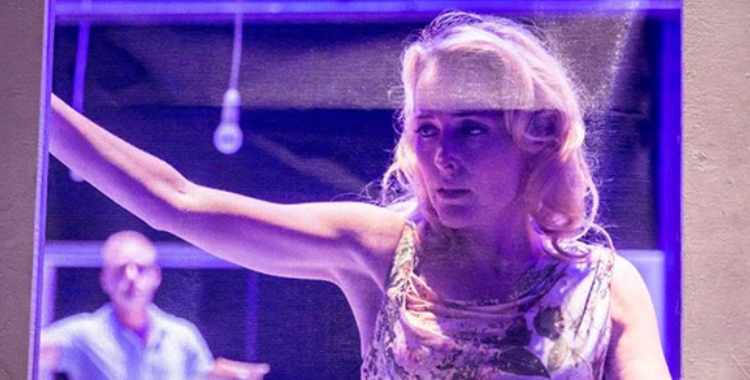
A Streetcar Named Desire, Young Vic

ben-foster-and-gillian-anderson-in-a-streetcar-named-desire-89975

“I don’t want realism. I want magic.”

In Secret Theatre’s version of A Streetcar Named Desire, Blanche’s famous line raised a light, knowing chuckle from the audience. The character might have been referring to her inclination towards fantasy and illusion, but her words could well have been a mantra for the production, which turned Tennessee Williams’ play and all its well-worn visual tropes inside out. Those words, spoken in that context, also posed an implicit question. Why, on the stage, do we settle for realism when we could have magic?

I’m reminded of the frustrated words of Eugene Ionesco: “I personally would like to bring a tortoise onto the stage, turn it into a racehorse, then into a hat, a song, a dragoon and a fountain of water. One can dare anything in the theatre and it is the place where one dares the least”. In theatre, where one thing always stands for another – when the relationship is one of metaphor – why do we still insist that those two things look alike?

Partly liberated by the secrecy bound up in the project (show titles are not released in advance), Secret Theatre’s Streetcar somehow freed the play of all its – and particularly Blanche’s – baggage, presenting us instead with its exposed innards. It understood theatrical representation as metaphor in its most playful sense; chunks of watermelon stood in for poker chips, and Blanche’s endless glasses of liquor became liberal drenchings of water. It was not quite magic, but it certainly wasn’t realism.

By comparison, Benedict Andrews’ new production feels sort of drab, dull even. First, let’s be clear: Andrews’ take on Streetcar isn’t exactly realism. There’s a stylishly skeletal revolving set, garish washes of coloured light, scene changes underscored with Swans and Chris Isaak. But in between the vivid flashes of colour and music, it’s naturalism by another name. Matt Trueman has coined the perfect term for it: “realishism”.

That “ish” is apt. This Streetcar is interesting-ish, elegant-ish. It puts a slight spin – both literal and figurative – on Williams’ play, but never enough to leave us giddy. Or put it this way: if you were expecting another classic done in the same vein as Andrews’ storming, vodka-fuelled Three Sisters, prepare to be disappointed.

On the main stage of the Young Vic, Stella and Stanley’s cramped, claustrophobic apartment is a metal husk of a building. Magda Willi’s set strips out walls, leaving only the framework of the rooms through which an audience can peer. The characters are at one level exposed and at another trapped. This is the cage that Blanche knocks against, that Stella has no desire to get out of.

Andrews’ production sets this space in almost perpetual motion, turning it clockwise, anti-clockwise and back again on the wide revolve. It’s slightly reminiscent of Ian MacNeil’s smoothly spinning set for A Doll’s House on the same stage, but while that design offered fleeting, cinematic tableaux between scenes, this keeps everyone queasily turning throughout. The sensation is one of constant shifts, but the only direction in which any of it can go is round in dizzy circles.

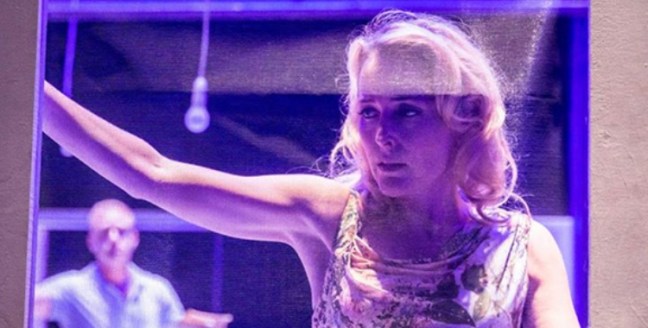
Like any repetitive cycle, however, this one begins to get boring. In the first half, the pace is swift and the tension tight, coiled like Stanley’s unpredictable temper. But the momentum drops away after the interval as the production follows increasingly familiar tracks. Andrews might half-heartedly update Williams’ play, kitting it out with Ikea furniture and skinny jeans, but Gillian Anderson’s Blanche is just as we expect her: flirtatious, fragile Southern belle, all carefully composed but rapidly cracking mask. Her downfall is competently conveyed, but never quite tragic.

While Anderson fails to break the mould as Blanche, Ben Foster’s war-damaged Stanley is an intriguing take on the role. Rather than picking up the obvious cues from Williams’ descriptions of the character as primitively animalistic, Andrews and Foster seize on Stanley’s military history, suggesting a man broken by conflict. When his first major outburst arrives, it is truly explosive because it seems to come unbidden; this is not a man of naturally violent passions, but one shot through with an anger he is unable to control.

Stanley’s reconciliation with Vanessa Kirby’s Stella, immediately following this scene, is another of Andrews’ successes. Their bodies meet in a rush of passion, their movements adopting a tango-like quality under the hot red glow of Blanche’s Chinese lampshade. The production is studded with little moments like this, small scenelets that elevate the quality of the rest. They are too sparsely positioned, however, to entirely rescue the bland expanses in between.

It’s unclear, meanwhile, just what Andrews’ updating achieves. His Three Sisters wrenched Chekhov’s play out of any specific temporal context, brilliantly locating it on a timeless, abstract plane. The setting for Streetcar, on the other hand, is recognisably modern, but with few concessions to that modernity in Anderson’s performance. What the time shift does highlight, however, is the play’s gender politics. Watching, I’m more aware than ever of the limited borders of Blanche’s horizon. As she says at one point, her role as a woman is to entertain, to be beautiful. And the beer-drenched masculinity of Stanley’s poker games is not much of an alternative, trapping men within a system of rules and expectations that is just as restrictive, if endowed with a bit more power.

These hints at an implicit gender critique, however, dissolve into obvious and borderline offensive imagery. To leave us in no doubt of either Blanche’s troubled mental state or the pressures of femininity heaped onto her, Andrews puts Anderson into a candy pink dress and wonky tiara, hair ruffled and face smeared with make-up. Southern belle transformed into dishevelled Barbie princess. It’s the crashingly unsubtle culmination of a dismayingly uninventive telling of this character’s trajectory, casting little light on its themes of mental health and sexual politics. From a director whose interpretation of Three Sisters was so bursting with invention, it’s a bitter disappointment.

Photo: Johan Persson.

Beyond Caring, The Yard

Beyond Care

Originally written for Exeunt.

We all know the basic facts about zero hours contracts: the headlines, the numbers, the controversy. Wisely, Alexander Zeldin and his cast don’t attempt to repeat any of this. Instead, this knowledge flickers in the background of the piece they have devised together, its political intent very much implicit but no less furious for it.

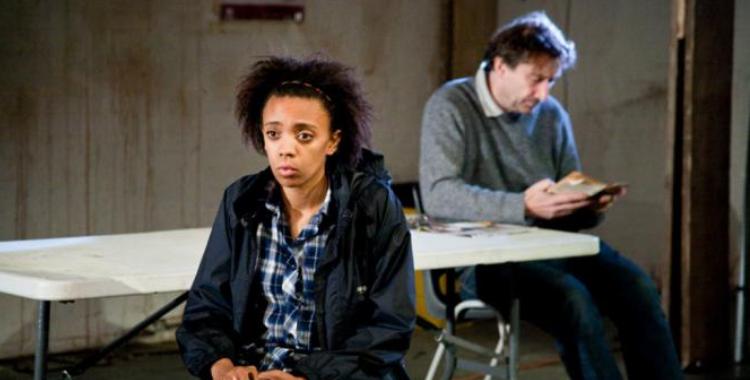
Beyond Caring depicts just five individuals caught in the ruthless cycle of modern employment and unemployment. Three women arrive for a fixed term cleaning contract at a factory, carelessly dispatched by temp agencies. One has been forced into work by Atos; it is hinted that another might be homeless. Working alongside them each night as they scrub down floors, walls and machinery is full-time cleaner Phil and boss Ian, who compensates for the disappointment of his job with small and occasionally cruel displays of power.

In presenting us with these determinedly ordinary characters, Zeldin asks us not to watch as audience members, but to look on as fellow human beings. It’s a subtle but crucial distinction. It’s also a form of spectatorship that takes a while to settle into. The punishing night shifts of the play unfold in uncompromising hyper-naturalism; silences, stutters and stumbles are all preserved, presenting us with human interaction in all its awkwardness and inarticulacy. Harsh, anaemic fluorescent strip lighting illuminates both audience and stage, thrusting us into the same drab and unforgiving world as that inhabited by these workers.

Falling into step with this sluggish, unpolished delivery demands an initial outlay of concentration, but it’s an approach that cumulatively builds in its power. By stripping away theatricality as we are accustomed to it, Zeldin focuses an audience’s attention; deprived of the dramatic conventions of naturalism, we are temporarily disorientated and made to look – really look – at these seemingly undramatic scenarios. While most stage realism aspires to a tidied up version of reality, this aspires to reality itself, jolting it out of its usual trappings and slamming it down in front of an audience.

As the piece goes on, repeating the relentless routine of shift after shift, the fine, accumulating detail becomes quietly devastating. Each performance is minutely textured, slowly amplifying the nuance of every last shrug and smile. A single gesture becomes infused with tragedy, while the corporate absurdities of a staff appraisal (“I am absorbed with ideas – agree or disagree?”) are as crushing as they are comic. Layered with Josh Grigg’s excellent sound design, which like the performances builds to an almost shattering intensity, the effect is one of blackening despair.

And yet. Somewhere in amongst the desperation and the drudgery and the alienation, there are still traces of tenderness. The title – at least in one sense – turns out to be something of a red herring; far from being beyond caring, these are individuals longing to care. The state might not give a shit, but they painfully, heartbreakingly do. And perhaps it’s there, in the foolish optimism and fleeting moments of connection, that we begin to glimpse just the tiniest splinter of possibility.

Wot? No Fish!!, Battersea Arts Centre

Wot-No-Fish-2_Credit-Malwina-Comoloveo-600x399

Originally written for Exeunt.

History. It’s just one fucking thing after another, right? Wrong – at least if Danny Braverman has anything to do with it. In Wot? No Fish!! Braverman depicts history as a helix: spiralling steadily upwards, seeming to return again and again to the same place, only to discover that in fact the world has changed. The past can be present, but never in quite the same form.

The same goes for the art that sits at the centre of Braverman and director Nick Philippou’s show. Wot? No Fish!! tells the story of Braverman’s Great Uncle Ab, a Jewish shoemaker raising his family in the East End of London. Ordinary enough, you might think. What is extraordinary about this particular family history, though, is the astonishing document of his life that Ab left behind. For almost 60 years, Ab drew weekly pictures on his wage packets for his beloved wife Celie; love letters in another form, sketching both the ecstasies and tragedies of their life together.

Wot? No Fish!! is their story, played out against the tumultuous backdrop of the early to mid 20th century, and the story of Braverman discovering these images decades later. As Braverman sifts through Ab’s wage packets, the past is located in the now, revealing that what we are so often looking for in history – particularly family history – is a trace of ourselves. The way in which Braverman shares these drawings with us, pointing out details and making gentle speculations, makes the piece about him and about us just as much as it is about Ab and Celie. With so much of this relationship inaccessible to us, we like Braverman are left to colour in around the edges.

The drawings themselves are tiny yet oddly exquisite. As Braverman shows them to us one by one, we can observe Ab developing as an artist, starting with basic doodles of kitchen utensils and graduating to acutely observed scenes of domestic life. We see Ab and Celie as newlyweds in the 1920s and then as the parents of two sons; we see them battle through the relentless anxiety of the war years; we watch as they grow old together, Celie barely ageing a day in Ab’s loving depictions of her. And perhaps most extraordinary is the compulsive honesty of Ab’s art, which is as likely to show heartache as joy.

Given the huge scope of Braverman’s inheritance, this show can only ever be a fragment – a partial image, like Ab’s drawings. But the care taken in the selection and crafting of the piece is palpable. Braverman welcomes us warmly into his family history, making the audience feel like family by extension. We could all be part of one massive Friday night dinner, trading anecdotes over the fish balls (yes, contrary to the exclamation of the title, there is fish). Community, a quality that theatre so often reaches for, is created simply and unfussily.

Like two strands of a double helix, simplicity and complexity are bound together. Yes, on one level this is just about one family, laughing and crying and struggling like us all. But through this one family and the particularities of their everyday life, Wot? No Fish!! opens out into ideas that are much bigger than itself: love, the value of art, the movement of history, the finding of meaning and hope in narrative, and how, even when the path stretches treacherously ahead of us, we find the optimism to go on.

Photo: Malwina Comoloveo.

The Ted Bundy Project, Ovalhouse

Greg_Woheadmain1

Originally written for Exeunt.

The title of Greg Wohead’s show would have us believe that it is about Ted Bundy, the notorious American serial killer. And, in a way, it is. Wohead relates details from Bundy’s life, reproduces his confession tapes, teases out tiny details around the murder and decapitation of one of his victims.

But really, The Ted Bundy Project is about Wohead and about us.

At first glance, it might seem like an odd pairing of performer and subject matter. Wohead is so warm, so genial, so smiling. But then so, apparently, was Bundy. Wohead tells us that he was known for being a nice guy – or appearing to be, at least. He lured in his victims by quickly building up trust. He was handsome and friendly. He seemed … normal.

Wohead too seems normal, friendly, trustworthy. He opens the show by welcoming and thanking his audience, telling us a bit about Bundy, diffusing the tension with some nervous laughter. We hear a few details about Bundy’s life: his childhood, his education, all the familiar details of an unremarkable existence. And then Wohead comes sharply to the point.

“I guess you want to hear the juicy stuff.”

This desire for “the juicy stuff” is the real focus of Wohead’s show. He repeats and interlaces a number of different narrative strands: the murder of one of Bundy’s victims, the killer’s confession tapes, Wohead’s experience of listening to those tapes, a seemingly innocent memory of summer camp. By weaving together facts about Bundy and personal recollections, Wohead increasingly blurs the line between the two, gradually exposing the submerged violence in him and in his audience.

The whole thing is a dare to our dark side, a teasing appeal to the Ted Bundy in all of us. How much do you want to see? How much gore are you willing to stomach? How many of the gruesome details is your mind luridly colouring in? Like the complicity of imagination created among the audience in The Author, Wohead cannily leaves it up to us to manufacture the nastiest of the images he describes. On stage, there is not so much as one drop of blood, but our minds are bathed in horror.

Two devices are particularly striking. One is the density of fact and speculation surrounding the crime scene that Wohead constructs around one particular murder, blandly repeating the phrases “what we know is …” and “what we don’t know is …” It’s the precise, careful language of police investigations, but also the language of curiosity, of meticulously combing through details. It leaves us disgusted and yet fascinated, morbidly eager to hear more.

The other is a “reaction video”, a genre familiar to anyone who has spent a bit of time on YouTube. The video being reacted to is provocatively titled “one lunatic, one icepick”. You can probably guess the rest. But what Wohead smartly achieves by repeatedly projecting this reaction video – which shows a group of young men recoiling, covering their eyes and mouths, and in one case vomiting – is to hold a mirror up to his audience. The attraction to images of extreme violence is one we can all recognise, whether it comes from bestgore.com (visit at your peril – though I guess that’s the point) or movies like Saw and The Human Centipede.

In the end, it’s up to us to turn away or to keep on looking.

Photo: Alex Brenner.

Mr Burns, Almeida Theatre

Mr-Burns-77-the-cast-by-Manuel-Harlan-FB

Originally written for Exeunt.

Remember the one with Cape Fear? The parody of the film – the one with Robert De Niro, not the other one. There’s something about a tattoo. Maybe two tattoos? And a court case, there’s definitely a scene in a courtroom. Anyway, the Simpsons end up on a houseboat. They’re running away from something … Bart is receiving death threats, that’s it. They’re written in blood – no, tomato ketchup. Sideshow Bob is trying to kill him. Or is it Mr Burns?

This is the kind of stuttering, stumbling salvage that forms the patchwork fabric of Anne Washburn’s play, which mutates one iconic episode of The Simpsonsthrough a game of post-apocalyptic Chinese whispers. It’s cultural memory as mash-up. Gilbert and Sullivan by way of Bart and Lisa.

In the aftermath of an unspecified, civilization-splintering disaster – the hints suggest part pandemic, part nuclear catastrophe – a group of survivors are clustered around a fire. For comfort, they turn not to religion, but to pop culture. As flows and eddies of misinformation swirl around them, The Simpsonsbecomes a collective life raft. Memory is salvation.

Seven years later, as society is starting to wonkily slot itself back together, the television programmes (and commercials) of Before are big business. The characters we met in the first scene are now a makeshift theatre troupe scratching a living from the sale of nostalgia – and competition is fierce. Arguments erupt about which wine is most unchallengingly evocative (Chablis, apparently) and which pop hits to include in the ad-break music medley.

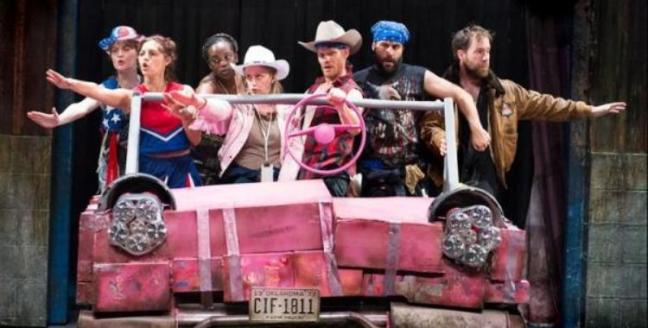
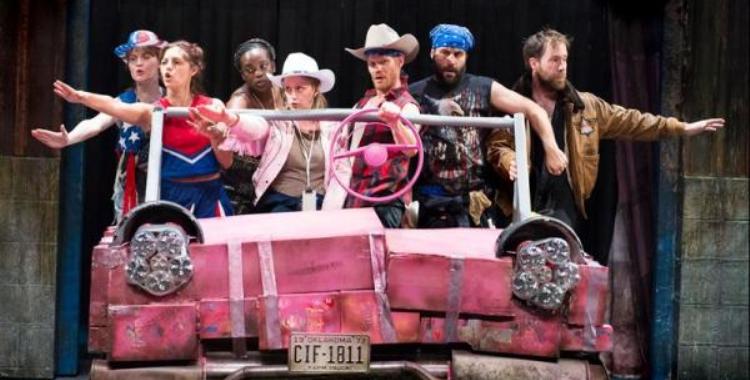
By the final act, which fast forwards another 75 years, the campfire story has gone through countless iterations and its batshit crazy telling has become a giddy whirl of cultural fragments. Director Robert Icke and designer Tom Scutt construct a teetering edifice of narrative and aesthetic bric-a-brac, from tattered scraps of Americana to oddly distorted movie allusions. Opera bleeds into Livin La Vida Loca. Eminem meets Britney. It’s blink-and-you-miss-the-reference fast, equal parts dazzling and disorienting. Where was that snippet of a melody from? Was that a nod to Peter Pan? How does the rest of that line go?

This kind of chaotic cultural bricolage will be familiar for 21st century viewers, but here it receives a crucial twist. Mr Burns is, as per its subtitle, post-electric rather than post-modern. There is no irony; this is a society earnestly retelling its founding cultural myth. And while some may shake their heads at the idea that it is The Simpsons rather than Shakespeare that survives the fall of civilization, Washburn has found a canny focus for teasing out the ways in which humans recycle and repurpose stories – a habit as old as the species. It’s just another kind of Homeric epic.

And there’s some intellectual weight behind the cultural cutting and pasting. Washburn’s imagined post-apocalypse is both a hymn to and an uncomfortable indictment of the artistic detritus that resiliently endures. Civilization, Mr Burnssuggests, is built on stories – but so is commerce and exploitation. Narrative sells.

It’s a thread that could be stretched further in Icke’s production, which sometimes gets distracted by its surface. The overwhelming range of references can obscure the fascinating cultural mutation at work, while the closing act is so shimmeringly strange that it is easy to get lost amid the woozy throng of pop culture. But while it may be a head-rush of a show, its ideas remain fizzing away for long after.

Photo: Manuel Harlan.