Joan, Contact

Originally written for Exeunt.

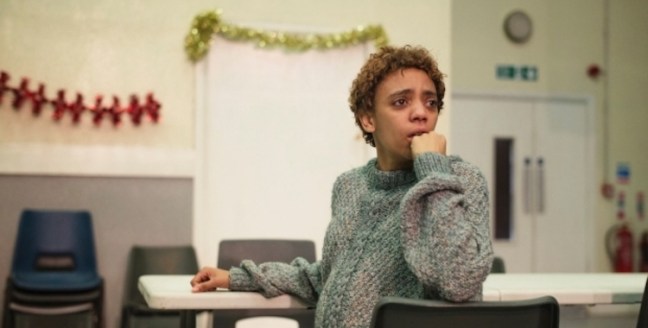
As we take our seats, Lucy Jane Parkinson’s Joan of Arc is a smiling, awkward bundle of nerves. This warrior and saint-to-be rounds her shoulders, crosses an arm protectively across her chest, sneaks furtive, sideways grins. She’s uncomfortable in her own skin, itching to shrug it off.

JOAN is less about the historical rise and fall of its eponymous heroine and more about the courage involved in asserting one’s identity – especially if that identity challenges society’s neat but stifling boxes. The extraordinary thing is that this one-woman show from Milk Presents, written and directed by Lucy J Skilbeck, covers the historical ground while also tracing a much more contemporary journey of discovery, all dressed up in a shimmering cabaret wrapping.

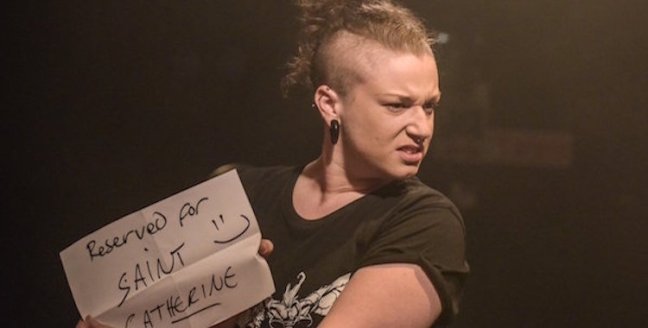
All the key historical moments are there, just skewed at an angle. We first meet Joan as an awkward and disappointing daughter, facing up to her father’s fond bafflement. Soon she’s witness to her mother’s murder by the English and boldly takes up Saint Catherine’s call to reclaim France. This turning point, though, is framed in terms of self-realisation as much as patriotic heroism. When Parkinson’s Joan talks about her communication with the heavens and “that voice that feels like sunrise”, face lit with joy and wonderment, it’s less about religious fervour than a fervent sense of belonging. In Saint Catherine’s eyes and in men’s clothing, Joan finds a new confidence. The word “ease” keeps falling from her lips as it drips from her gestures.

In her new disguise, Joan rocks up at Charles VII’s castle and convinces him to provide her with an army to drive the English out of France. Through military leadership, this Joan finds purpose and joy. From here on in we’re swept breathlessly through battles, victories, defeats and trials, all closely focused on Joan’s defiance of gender norms and growing sense of self. Emma Bailey’s simple design, which seats the audience in an intimate cabaret formation – all the better to facilitate the beautifully judged moments of interaction – is flanked by four full-length mirrors. This is unquestionably about identity.

There’s a persuasive musicality to Parkinson’s performance as she skilfully guides us through the show. It’s not just that she sings songs – which she does, brilliantly. The rhythms of the whole piece are delicately orchestrated, each beat falling with precision. Parkinson is able to conduct us from supreme silliness – willingly joining in with a giggling crescendo of war-drums and braying horse impressions – to stillness and solemnity. It’s only afterwards that the impressive control of these transitions becomes apparent; in the moment, we’re simply carried along by the changing cadences of Parkinson’s storytelling.

And like Ira Brand’s remarkable Bruce Springsteen performances in Break Yourself, JOAN is also a stunning bit of drag. Parkinson (herself a drag king champion) transforms into a series of very different men – Joan’s father, the Dauphin of France, the judge presiding over Joan’s trial – with little more than a change of jacket and the application of facial hair. But she also demonstrates how all gender is, at root, performance. Early on, it’s with humour, as she stuffs her bra down her shorts and struts around imitating the walk of a game male member of the audience. Later, as Joan is ordered to renounce cross-dressing or lose her life, it’s with a painful straining towards stereotyped femininity.

In these later scenes, JOAN takes an unexpected lurch into emotional territory. Again, the dramaturgical control is impressive, keeping us teetering between humour and heartbreak. Each knockout gag has a bruising follow-up. It’s a masterclass in managing both atmosphere and audience from everyone involved, but ultimately this is Parkinson’s show. And it’s her hopeful, spotlit figure that leaves a lasting impression, as the expectations that hemmed Joan in finally lie discarded on the floor.
Narvik, HOME

Originally written for Exeunt.

Water, for all its teasing, fluid insubstantiality, can have a tight grasp. Get caught by the wrong current and the water might never let you go. And memory, as Narvik tries to demonstrate, works in much the same way. If you’re not careful, it’ll pull you under.

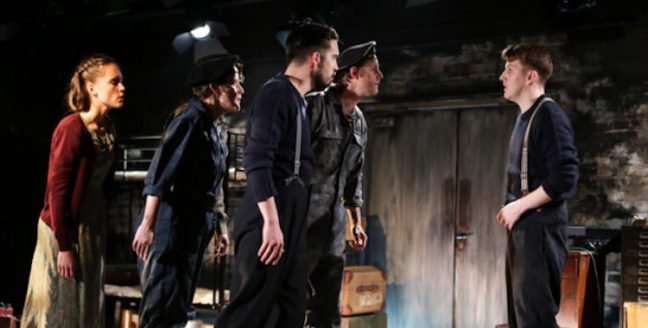
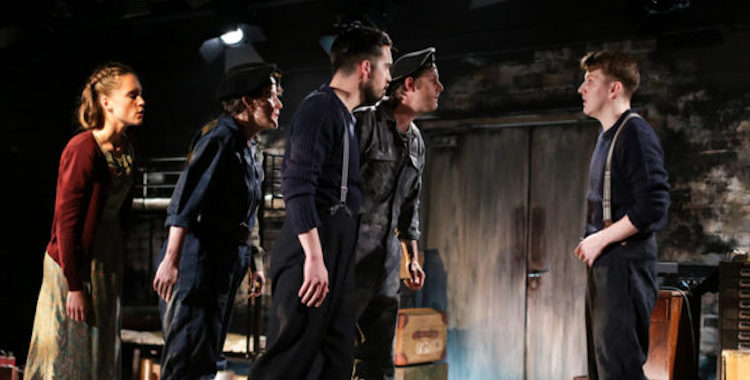
Lizzie Nunnery’s song-studded play revolves around one of the lesser known chapters of the Second World War: the role of the British Navy in the waters around German-occupied Norway. The focus is Jim (Joe Shipman), a Liverpudlian radio operator who starts out working on fishing boats and ends up on warships. Over the time-hopping course of this 80-minute show, we are shown his pivotal relationships with mysterious Oslo schoolteacher Else (Nina Yndis) and troubled fellow radio operator Kenny (Lucas Smith), as well as brief glimpses of the paternal influence that was abruptly cut off when his father abandoned him as a child.

The shifting tides of time are cleverly accommodated by Katie Scott’s compact design of interlocking pipes, around which actors and a three-strong band duck and weave. Water – Jim’s home and Else’s phobia – is a constant suggested presence, invisibly rushing around them. The fraught shifts that Jim and Kenny spend listening out for signals, meanwhile, are lent a claustrophobic intensity by the metallic structure that hems them in, enhanced by Richard Owen’s moodily atmospheric lighting design.

It’s just a shame that such intensity is lacking elsewhere in Hannah Tyrrell-Pinder’s production. Much of the play hinges on Jim’s romance with Else, a fleeting pre-war encounter that somewhat implausibly stokes a long-burning passion. After meeting at a dance in Oslo, where Jim is stopping over on a job, the pair embark on a fling that becomes a long-distance epistolary relationship. It’s Else, waiting for him somewhere across the icy waters, who keeps Jim going through the horrors of war.

But there’s not a sufficient spark between the two to sustain the illusion of this long-held flame. We don’t see enough of the characters together to truly care about their relationship, while there’s more awkwardness than chemistry between Shipman and Yndis. And it doesn’t help that the early letter-writing sequences, which strive so hard to be heartfelt, are staged by Tyrrell-Pinder with a kind of stiff unease.

Jim’s tumultuous friendship with Kenny is more convincing. Theirs is a relationship forged in the fear and forced intimacy of conflict, forever simmering with tension and occasionally boiling over. In some of the play’s strongest sequences, they wonder what it is they’re fighting for after all, and talk about the impossibility of those at home ever understanding the cold and the dread and the death.

The framing device that holds it all together is what appears to be Jim’s own impending death, several decades later in the undignified surroundings of his basement. As he lies prone on the floor after a fall, the subterranean space slowly filling with water from the leaking pipe he was attempting to fix (another reference subtly absorbed by Scott’s design), wartime memories flood back to him.

The result is neither clear enough to simply convey the story nor enigmatic enough to suggest the unexpected swirls and eddies of memory that the piece seems more interested in. The ‘man’s life flashing before him’ conceit is hardly novel and it’s weighed down by some laboured old-man-acting from Shipman, who’s better as the youthful dreamer. A more effective evocation of the past and its pull on us is the incorporation of music. Songs, as Nunnery and composers Vidar Norheim and Martin Heslop recognise, so often have the power to transport us back to long-forgotten moments. Yet even this soundtrack of haunting, folk-style tunes never feels quite as integral as it should, often chivvying the scenes along rather than working hand in hand with them.

Perhaps unfairly, I left wanting more of what was concealed and less of what was shown. Else, who during the Nazi occupation makes a terrible compromise, strikes me as by far the most interesting character of the central trio. Yet we’re never allowed to glimpse her motivations or confront the bleak circumstances that make impossible choices possible. Though there’s something to be said for leaving things unexplained and unresolved, much of Narvik’s broad scope remains frustratingly obscured, while the snippets that do appear on stage too often fall short of the show’s compelling promise. Memory might be arbitrary, its currents taking us in unexpected directions, but here it fails to really grip.

Photo: Alex Mead, Decoy Media.

LOVE, Birmingham Rep


The corner of a strip of wallpaper is curling off the wall. Hard plastic chairs cluster around tables. Dirty, chipped tiles line the ceiling and damp blooms in corners. A lone picture – one of those mass-produced prints you see in office lobbies and faded B&Bs the country over – is the one splash of colour on the walls.

Writer and director Alexander Zeldin’s aesthetic is less gritty realism than grubby realism. For this latest show, Natasha Jenkins’ set is meticulously stained and scuffed, careful to scrub away even the slightest veneer that might coat LOVE’s depiction of the crowded and run-down temporary accommodation in which an appalling number of people are forced to live. In aid of exposing this bleak reality, both stage and production are hyper-naturalistic. Kettles really boil. Toilets really flush. People pause and stutter and share awkward silences.

The situation that provides the premise for LOVE is perhaps even grimmer than that of the zero-hours cleaners at the heart of Zeldin’s previous show, the slowly devastating Beyond Caring. The grey, soulless space created by Jenkins is the communal area of a hostel where homeless families are crammed suffocatingly together, at the mercy of the council’s faceless bureaucracy and seemingly endless hold music. Stuffed into tiny rooms, sharing a broken bathroom and a basic kitchen, there is no privacy here. Even when all the doors are closed, the place hums with voices.

As with Beyond Caring, the action is all played out under bright house lights, with the audience bleeding into the stage. When I reviewed that earlier show, I wrote that Zeldin “asks us not to watch as audience members, but to look on as fellow human beings”. I’d argue that the same is true of LOVE, but I want to worry away just a bit at that distinction. Especially during some of the more wrenching scenes, in which characters are cruelly stripped of their dignity, I wondered whether I wasn’t just being made into a voyeur after all. Poverty porn is an ugly, ugly phrase, but I couldn’t help feeling a bit uncomfortable about my position as a privileged, middle-class spectator (a demographic that’s probably not too atypical of the audience as a whole). What are the ethics of presenting this to us?

Despite my discomfort, which I couldn’t entirely shake off, I do feel that there’s something subtle but crucial about Zeldin’s choice of staging. We as the audience are never wrapped in the comforting anonymity of darkness, gawping unseen at those less fortunate than us. Simply by placing us in shared space and shared light, Zeldin involves, perhaps even implicates us. There’s no solid wall of difference here. And when we are – finally, briefly – acknowledged within the drama, it’s with an overwhelming weight of emotion and responsibility.

For the most part, though, the fourth wall remains in place, if permeable. Through it, Zeldin offers us a glimpse into an eclectic selection of lives. The most seasoned residents are Colin (Nick Holder) and his ageing mother Barbara (Anna Calder-Marshall), for whom he cares with a mixture of blokeish reluctance and surprising gentleness. Tharwa (Hind Swareldahab), arrived from Sudan, mostly keeps herself to herself, emerging from her room to make cups of tea and find phone signal. And desperately hoping to be rehoused by Christmas are Dean (Luke Clarke), his two young kids and his heavily pregnant partner Emma (Janet Etuk). Inevitably, they all impinge on one another’s lives, for better and for worse.

It doesn’t take long to see where the title fits in. Love throbs through this place. It’s not romantic love, not pretty love, not idealised love. Often, it’s love in its most unlikely manifestations; it’s love trying and failing and trying again to be expressed. It’s the kind of love that’s found in getting by or in cleaning up. It’s sudden, unexpected moments of tenderness and even, sometimes, sudden, unexpected moments of anger.

This kind of theatre demands patience. If nothing else, it’s a reminder of how false and constructed theatrical ‘realism’ typically is and how rarely we see an accurate reflection of everyday life, warts and all, on the stage. These characters move at actual rather than dramatic pace. While that might make the action feel initially sluggish, the reward is in a rhythm and a precision that is unshowily exquisite. Zeldin and his performers have a musical sense of pace, allowing each beat to fall just so. And the detail of small movements is everything in this production, creating character through brushes of the hand and twitches of the mouth. It is, aptly for the subject matter, an incredibly compassionate style of performance. Everyone here is flawed, but everyone here is human. You might say the two are one and the same.

Often it’s what lurks at the edges of the show, hidden or only partially shown, which is most powerful. Like quiet Syrian refugee Adnan (Ammar Haj Ahmad), who swiftly appears and disappears, suitcase in hand. His fate remains unknown, but now more than ever you sense it can’t be good. Or like the unseen children of reserved Tharwa, on the other end of the phone and miles and miles away in Sudan. These stories of refugees, while not at the heart of the narrative, feel even more important now than when the show first premiered less than two months ago. The question of why we don’t see more of these characters has nagged at me since stepping out of the theatre, but perhaps their accusing presence on the sidelines is itself a comment on how we marginalise those who come to us seeking shelter.

Shelter is something that’s in short supply for everyone here. The invisible villain throughout is the stripped back, struggling state, with its irrational sanctions and its lack of social housing. Dean and Emma are punished for missing a job centre appointment on the same day they were being turfed out of their home by a rent-raising landlord, while Colin and Barbara have been caught in the limbo of temporary accommodation for a year or more. The piece never turns into a full-on polemic, but then it doesn’t need to. As with Beyond Caring, LOVE simply shows us the indignity of how cruel systems treat human beings, forcing us to really, properly look. And once you have looked, it’s hard to look away.

Photo: Sarah Lee.

Morale is High (Since we gave up Hope), HOME

morale-is-high-image-628x460-600x439

Originally written for Exeunt.

I’ve been struggling with hope recently. So, it would seem, have Powder Keg. Even with my stubborn optimistic streak, 2016 was a tough year in which to remain hopeful about the state of the world – and 2017 might well prove even tougher. This is essentially the starting point for Morale is High (Since we gave up Hope). The title’s a bit misleading – hope hasn’t entirely flown, or at least it didn’t seem that way to me – but it’s certainly a show that’s worrying away at recent global events and how the hell we as (small, flawed, ineffectual) human beings respond to them.

That anxiety is expressed through a fraught back-and-forth between two mates, Ross McCaffrey and Jake Walton. In spite of the subject matter, the pair make an affable double act: Jake’s chirpiness counterpoints Ross’s anger, while Ross challenges Jake’s shrugging attitude to current politics. The catalyst for their fragmented discussion is an unlikely bit of time travel. Ross has made a trip to 2020 and back – he even has the shiny, sequinned Primark jacket of the future to prove it. So what does the world look like at the (probable) time of the next general election?

Morale is High is less about glimpsing possible futures, though, than it is about questioning where we are now. The different snatches of stories that Ross brings us from the future are just as confusing as the present and prompt the same sort of knotty, unanswerable questions. Loose ends gather, flapping, at Ross and Jake’s feet. At odd intervals, meanwhile, the guitars at the back of the stage are snatched up for bursts of song, abruptly cutting off the intertwined narratives. This is theatre in an argument with itself; a scrappy dialogue between anger and apathy and guilt and despair. It’s messy, sure. But it also feels a lot like the inside of my head at the moment. This is an uncertain piece of theatre in uncertain times.

There’s a sense, too, that events in the last few months have overtaken outlandish predictions, leaving Powder Keg grappling – in more ways than one – with current affairs. The show can’t help but buckle a little under the pressure of recent events. I’m reminded of a line from Ali Smith’s recent book Autumn, about people in the wake of the EU referendum checking their phones “to catch up on the usual huge changes there’ve been in the last half hour”. It captures brilliantly the runaway feeling of the news over the last year – a feeling that Morale is High also recreates, even if it’s through the sense that Powder Keg themselves are racing to keep up with everything unfolding around them.

Amidst all the complex, tangled argument, there are odd clunky moments – a joke about the Second Coming, a visual gag with a water bottle – that seem like hangovers from the rehearsal room. On the whole, though, Morale is High is a piece of sophisticated if appropriately provisional thinking. It is suspicious of easy answers and of the action that it seems at times to be advocating. At a time when the UK is visibly divided, Powder Keg are starkly realistic about the things that hold us apart. Even the intoxicating sense of community generated by a protest march has to be manufactured. “You can’t just get rid of the things you don’t like,” Ross sneers at Jake, reminding him of the violence and the tear gas. His words nod, too, to the parts of our own nations and communities that we might prefer to disown or ignore: the racism and intolerance that, following the referendum, can no longer be swept under the carpet.

But Morale is High is no simple expression of nihilism (though the seductive temptation of nihilism is certainly in the mix). In Hope in the Dark – a life raft for many, including me, after Donald Trump’s election – Rebecca Solnit offers a nuanced definition of what she means when she talks about hope:

“It’s important to say what hope is not: it is not the belief that everything was, is, or will be fine. The evidence is all around us of tremendous suffering and tremendous destruction. The hope I’m interested in is about broad perspectives with specific possibilities, ones that invite or demand that we act. It’s also not a sunny everything-is-getting-better narrative, though it may be a counter to the everything-is-getting-worse narrative. You could call it an account of complexities and uncertainties, with openings.”

An account of complexities and uncertainties, with openings. That sounds a lot like Morale is High. Unusually for a time-travelling narrative, Powder Keg’s show asserts that actually the future is unknowable; we are not offered the comfort of visiting and as a result changing our collective tomorrow. Not knowing, though, is itself an opportunity of sorts. The gaps for action and change might be small, but they are there. As Solnit puts it, “hope locates itself in the premises that we don’t know what will happen and that in the spaciousness of uncertainty is room to act”.

And in the end, we’re not alone. As Ross confesses, the simple expression of anger – raw, unsophisticated, screaming at the top of its lungs – is a way of feeling better. But so is seeing someone else on stage being just as angry. Neither of us is the only one struggling with hope, and that, in a strange sort of way, feels hopeful.

World Factory, HOME

world-factory-photo-by-david-sandison-600x400

Originally written for Exeunt.

A few weeks ago, I visited Manchester’s Museum of Science and Industry. Like so many museums, it has a studied, uneasy ambivalence towards the past. This is a place that celebrates the technical ingenuity of the Industrial Revolution while seeking to mark its human costs. The awe and might of huge machines are placed next to black-and-white photographs of the overworked and undernourished humans who operated them.

But this isn’t a narrative that can be bracketed away in the past. As METIS’s show World Factory demonstrates, the human costs of modern consumer culture never went away, they just got pushed further and further out of sight. Or, perhaps, we chose to blind ourselves to them.

Because here’s the thing: we all kind of know about the exploitation and mistreatment and waste that World Factory exposes. We’ve seen documentaries about the textile industry in China or headlines about factories in Bangladesh. Very few of us can claim complete ignorance of how our clothes are produced. Yet, much like climate change (of which fast fashion is a not insignificant cause), it’s something that most of us live our day-to-day lives in a sort of denial about.

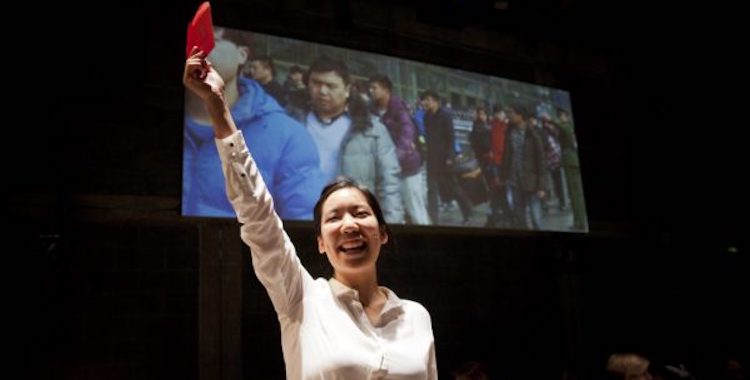
World Factory, then, isn’t necessarily telling audiences anything new. What it is doing, though, is placing theatregoers at the heart of a production process that they generally elect to ignore. Rather than presenting us with a drama about Chinese clothing factories, METIS transform the theatre itself into a Chinese clothing factory – or, rather, a series of factories. Split into teams and directed by the four performers in the guise of our “dealers”, we take on the role of factory managers, plotting different paths through the show based on the decisions we make. It’s all fashioned as a game, complete with a stack of Monopoly-style money.

The choices we as players are offered are starkly binarised. Sack half the workers or cut everyone’s pay? Improve conditions for workers and quickly go under, or keep wages low and stay afloat? From within the game, this can feel limiting, but as a dramaturgical strategy it’s inspired. On the one hand, it generates fraught ethical and political discussions, forcing us to speculate on the other possible (but unavailable) options and on the unspecified ramifications of our decisions. On the other hand, it’s a powerful formal illustration of the apparent lack of choices experienced under fast-paced consumer capitalism. We don’t just see the ethical conundrums faced by factory owners; we experience them.

There’s something queasy about the gamifying of experiences that are so very far from a game for so many people – but then again that’s the point. World Factory both encourages audiences to play along, sucking us in with the thrill of making a profit, and intermittently jolts us out of the fantasy and into the real world it’s mimicking. The more we’re absorbed in the game, the more wrenching it is when we’re pulled out of it. The more we play ruthless capitalists, the more bitterly we reflect on our decisions when forced to take pause.

The alternating pace of the game is crucial. As co-director Zoë Svendsen has noted, “ethical practice takes time” – time that both World Factory and consumer capitalism offer little of. The team I’m on makes relatively few choices in the hour allotted for the game (and is repeatedly hurried along with barks of “time is money”) because we keep finding ourselves torn between pursuing our own ethical principles and “playing the game”. Our shoddy compromises make us both bad capitalists and bad employers. Everyone loses – a message that World Factory drives home with force.

One of the quieter, more melancholy moments of the show implicitly mourns the loss of the craftsmanship that used to go into garments that would be worn and loved and repaired. Now, by contrast, fashion is throwaway. I found myself reminded of Richard Sennett’s book The Craftsman, which argues that “the craft of making physical things provides insights into the techniques of experience that can shape our dealings with others”. Craft, for Sennett, offers ethical possibilities, while the opposite seems to be true of the fast, cheap fashion that suppliers like our imaginary factories serve.

Informed by a complex tapestry of research and offering seemingly endless possible permutations, World Factory is itself a piece of master craftsmanship, meticulously constructed. Beyond its function as a performance, the project is a rich and vital resource, complete with an online “Digital Quilt” of references. Unlike some participatory shows, which operate mainly on a surface level and offer empty promises of audience “empowerment” or “emancipation”, you can sense the depth that lies beneath World Factory, which uses the disempowerment of its participants as a provocation to delve further into the tangled threads of global capital.

Towards the end of the show, there’s an unexpected echo of Trump, as one of the performers calls on us to invest in manufacturing closer to home and “make Britain great again”. Whether or not this has been added since the US presidential race, it certainly resonates (however horribly) with the present moment. It also points to the relevance of this piece beyond the global fashion industry that it directly interrogates. The questions raised by globalised clothing production are also questions about the economy, about politics, about the nature of work in the twenty-first century, and about the future of our planet under a system that’s designed to keep devouring resources and producing waste.

“This is where it all began,” performer Lucy Ellinson reminds us – an aside from the main performance, but a significant one. Manchester, the home of the Industrial Revolution and the heart of the textiles industry in the nineteenth century, is an apt destination for World Factory at the end of its tour. This is the city once nicknamed ‘Cottonopolis’. This is the city where Engels wrote The Condition of the Working Class in England. But these are not just static markers in our national history, to be carelessly skim-read in museum displays. Sure, the world has changed, but the inheritance of those mills and factories – and the increasingly brutal form of capitalism that they helped to drive – remain with us. The real question is: do we keep closing our eyes to it?

Photo: David Sandison.