The Dead Dogs, The Print Room

dead-dogs-600x319

Originally written for Exeunt.

There is a lot of “yes” in The Dead Dogs. Peppered throughout the circling, repetitive conversations of Jon Fosse’s characters, the affirmative is used not just to answer questions but to introduce, to punctuate, to evade. This sharp, deceptive syllable takes on the character of Pinter’s pauses, standing in for communication and connection. What is nominally acquiescence instead comes across as refusal; an apparent positive is scrubbed out by its bleak opposite number.`

This is characteristic of a drama in which deliberately bland language acquires sinister, unsettling overtones. In the Norwegian playwright’s opaque tale of a family pushed to breaking point, dread creeps up like fog off the fjords. Its first hints come in the form of a missing dog, whose eventual fate might be guessed from the title. Its owner, an isolated and blankly uncommunicative young man living alone with his mother, refuses to go out and look for it; his mother is more concerned about stocking up on coffee for the arrival of her daughter, who is making a rare visit with her husband.

As the lines of this family are sketched with broken speeches and anxious glances, the suspicion of something rotten begins to pervade the unhurried drama. Why is the young man so deeply attached to his dog? Why has his childhood friend suddenly returned? What keeps his sister away? And why is there such hostility towards her husband? These questions and countless others dissolve almost as soon as they are formed, forcing an audience to keep guessing. As one character observes, “there’s something that’s not quite right”, but the precise nature of this wrongness is stubbornly elusive.

The taut, promising tension of early scenes, however, is allowed to fall limp in Simon Usher’s tentative production. Seemingly uncertain about how to stage Fosse’s puzzle of a play, his lacklustre, uneven interpretation gives in to bewilderment. On the page, Fosse’s spare dialogue – all shorn sentences and punctuating pauses – has a spiky sort of poetry. In this version, though, its unfinished statements and looping repetitions become cumulatively deadening, relieved only by long, lingering silences.

The tone is part domestic turmoil, part surreal, heightened discomfort. It is as though a naturalistic family drama has lost its way and found itself in a scorched Beckettian wasteland, unsure of how to proceed. Certain performances, such as Jennie Gruner’s delicate portrayal of the sister, cling fast to emotion despite the alienation of the dialogue, packing each last look with unspoken meaning. Danny Horn’s young man, on the other hand, is oddly compelling in his withdrawn silences, becoming an uncanny presence, while there is a jagged edge of desperation to his increasingly fraught mother in the hands of Valerie Gogan.

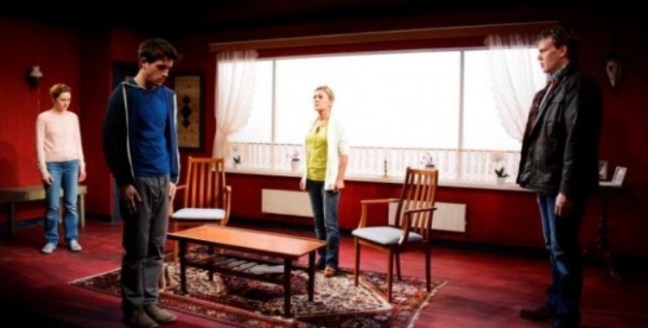
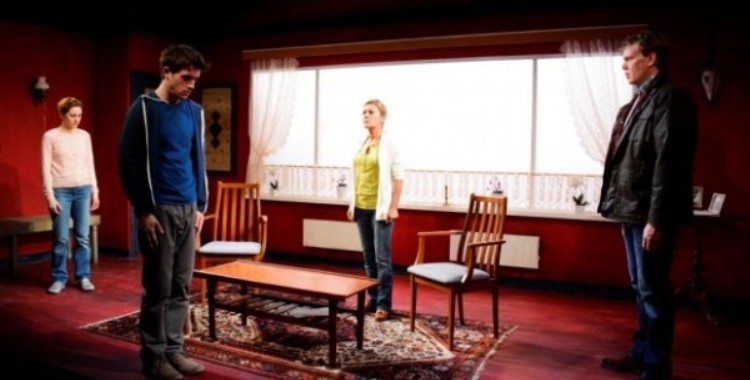
A similar sense of confusion haunts Libby Watson’s design, which places clunky, outdated furnishings against garish red walls. The colour choice is almost painfully loud; paired with the bright, blank white light glaring in from the large window, it makes for an eye-watering sort of purgatory, immediately gesturing towards the play’s uneasy psychological landscape. But its textures, like those of the performances, clash in a way that is ultimately more frustrating than it is interesting. There is more than a hint of fascination in Fosse’s odd, perplexing play, but this production makes it increasingly difficult to fasten upon.

Chewing Gum Dreams, National Theatre

chewinggum-600x432

Originally written for Exeunt.

The image of chewing gum is a vivid, evocative primer for Michaela Coel’s miniature powerhouse of a monologue. It’s sweet, insubstantial, the stuff of adolescence; its bubbles, like the dreams of Coel’s teenage protagonist, are light as air. But they are also fragile and punctured at the lightest touch, leaving behind little more than a sticky mess, swiftly discarded and trodden underfoot.

14-year-old Tracey Gordon, Coel’s spiky, outspoken narrator, is the sort of girl who teachers roll their eyes at and adults edge away from on the bus. She passes the journey into school mercilessly taunting her cousin and whiles away maths lessons with talk of tits and condoms. Yet for all her swagger and gobbiness, she is also just a teenager, smarting from the world’s cruelties and buzzing with the experiences it offers up. Life is the sharp slap of a hand and the melting gaze of a boy.

Coel’s giddy, fast-paced narrative is a jumble of contrasts. In one moment, a friendship that has been built over years crumbles in seconds; in the next, a crush explodes into life with firework intensity. These violent shifts in tone, far from derailing Coel’s play, beautifully convey the instability of adolescence and its hormone-fuelled careering from ecstasy to despair. Likewise, Coel is adept at realising the internal contradictions of her young characters, capturing with razor-sharp accuracy both the vicious cruelty and fierce loyalty of teenagers.

The vitality and charm of Coel’s performance more than matches the observational flair of her writing. The central figure of Tracey is sketched with detail and compassion, while the cast of supporting characters are inhabited with a vividness that simultaneously brings them to life in their own right and suggests Tracey’s own talent for mimicry and delight in performing. With her mean turn of phrase and killer comic timing, Coel’s teenager clearly relishes her position in the centre of attention.

What ultimately makes the piece, however, is the vulnerability and lack of self-worth that peeks through the bolshy exterior. Young, black and trapped in a cycle of poverty, Tracey has no illusions about her position in life: “I’m not smart enough to be someone; I’m just smart enough to know I’m no one”. Beneath the broad comic strokes of Tracey’s anecdotes, Coel colours in a world of abuse, neglect and withheld opportunities, where aspirations are barely whispered. Told by her boyfriend that she should aim higher, Tracey responds with blinking incomprehension.

Despite this bleak injection of reality, the dead-end despair is tempered with humour, friendship and a fragile note of optimism. It is rare that a piece of theatre can wear its social critique so lightly and yet with such fierce, damning intent. Coel never lets her targets off the hook, but her characters continue to embrace life in spite of its injustices, stubbornly and good-humouredly getting by. As Tracey would say, chin raised defiantly, “life goes on, innit”.

I’d Rather Goya Robbed Me of My Sleep Than Some Other Arsehole, Gate Theatre

goya-600x339

Originally written for Exeunt.

If stress is the number one modern malady, sleeplessness might just be a close second. Distracted by technology, preoccupied with work and perpetually pumped with caffeine, it is harder now than ever to get a good night’s kip. This is certainly the experience of Rodrigo García’s restless narrator – hence the cumbersome title of this slender, slippery monologue. Railing against the tedium of insomnia and the spectres of capitalism that keep him up at night, García’s unnamed protagonist is adamant that “you have to do something”.

His idea of doing something is blowing his life’s savings, shipping over a fashionable philosopher and breaking into Madrid’s Prado museum out of hours to gaze at Goya’s Black Paintings. An unlikely brand of rebellion. Along for the ride are his two young sons, who in Jude Christian’s bold production take on a startling, scene-stealing form. Joining lone actor Steffan Rhodri on stage are two small, cute and surprisingly loud piglets, greeted with a ripple of excitement from the audience. Immediately, we are in surreal territory.

Like the piglets, who wriggle and squeal in Rhodri’s arms, García’s play is difficult to get a grip on. The furious, fidgety stream of thought goes round in circles – or, perhaps more accurately, spirals, as we never return to quite the same place as before. The narrator is at crisis point, that much is clear, his words a wounded howl against the plastic deities of Coca-Cola and Disneyland. There are hints at a fractured family and a lifetime of disappointments, but all we can be certain of is an underlying queasiness towards the modern world. As our protagonist succinctly puts it, “life’s a bloody mess”.

If modern existence is a cesspit, then we are all rolling in the filth. This is perhaps the point of the piglets, who also stand in for the animal urges and images of gluttony that crop up periodically in García’s text. When the animals’ unpredictable bathroom habits play momentary havoc on stage, it seems apt that Rhodri is literally cleaning up shit. But beyond these obvious associations, the piglets also have a distancing effect, enhancing the protagonist’s dislocation from his sons, the world around him, and possibly even his own existence.

The strange inner world of García’s narrator is strikingly drawn out by Christian’s production, which has created a captivating visual and aural landscape. The show opens with Rhodri’s tall form crammed into a grubby miniature kitchen mounted on the back wall, which suddenly begins to turn on its axis; the world is off-kilter and the protagonist is a hamster trapped inside an ever-turning wheel. This visual fluency is characteristic of Fly Davis’ design, which hems Rhodri and the piglets inside a clinical white space, surrounded by toys as brittle as the happiness they promise. Adrienne Quartly’s uneasy sound design, meanwhile, presses in on an already beleaguered mind with a tumult of heartbeats, ticking clocks and blaring sirens.

At the centre of this bewildering, claustrophobic world, Rhodri makes a compellingly embattled anti-hero. In spite of the anger, self-destruction and unsavoury streak of misogyny glimpsed in the character written by García, Rhodri renders him surprisingly sympathetic – more of a bitter lost soul than a listless misanthrope. There is also a sense, supported by the visual language of the piece, that his response to the modern world is the only one left available; even if his pursuit of Goya ultimately lacks meaning, it’s better than the Disneyland his sons would prefer. García’s short monologue might be a frustrating, evasive slip of a thing, but this arresting production makes its searching, impotent fury feel uncannily resonant.

Each of Us, Tristan Bates Theatre

Ben-Moor-Each-of-Us-2-600x400

Originally written for Exeunt.

Why do we tell stories? Perhaps, as the narrator of Ben Moor’s monologue suggests, we simply don’t have a choice. Reaching for ways to explain human connection, Moor invents the “narrative gene”, a newly discovered strand of our DNA that compels us to create. Storytelling, then, is a reflex. A way of making sense of the world that is coded into our very being.

It is this process of making sense and of constructing an identity that sits underneath the meandering narrative of Each of Us. When we first meet Moor’s narrator, he is bruised from a recent marriage breakup – “paralysed from the heart forward”. Talking us through parties and therapy sessions, wit and heartbreak going hand in hand, he slowly navigates the emotional wreckage, mining it for meaning or maybe even treasure. While still deciding what to erase from his own story, a chance encounter leads him careering into an enigmatic group of memory collectors, all of them convinced of the purpose held in the fragments of self that they choose to hold on to.

The strange, familiar yet unfamiliar fictional world that Moor (who also performs the piece) crafts with his words is one in which the everyday rubs shoulders with the absurd. Like so many stories, it borrows magpie fashion, snatching snippets of pop culture and sci-fi. This is a London in which David Lynch directs live sports game footage and car bombs explode in slow motion. And it is all underscored with a faint, uncanny sense of wrongness; something in this world is catastrophically out of place, but no one wants to look directly at it.

The linguistic landscape of this universe is rich, perhaps too rich for performance. On the page, Moor’s writing is dense with detail, each paragraph an avalanche of description. Performed, however, that avalanche hits an audience at a devastating pace, leaving only a few twisted fragments of debris in its wake. Odd words and phrases snag on their way down, but the vast majority is lost, sliding past before it can be taken in. It is only reading it back later that it is possible to luxuriate in the vivid images and razor-sharp quips.

There is, if you can catch it, much to be savoured in Moor’s poetic, intricately detailed text. An aching emptiness is contained in the image of “air spooning”, tracing absence by the gaps that it leaves in a life. Elsewhere, a character is likened to a semi-colon – “rare, occasionally in the wrong place, but when you saw her confidence, you knew more would follow”. The show is also frequently funny, though it can be hard to tell if there is any purpose behind the conspicuously clever jokes. Moor knowingly riffs on the ubiquity of postmodern irony, but what he ends up with feels a little like a pastiche of a pastiche; postmodernism squared. And, like all the best postmodernism, it manages to wriggle out of making many sincere, meaningful statements.

The one unifying idea of Each of Us is this notion of connection, both as something we seek and something we construct. In this sense, theatre is the perfect medium for Moor’s subject matter, as it is a space in which we can be both alone and together at the same time. As directed here by Erica Whyman, however, the piece does not fully convince that it is better off on the stage than the page. It’s entertaining, to be sure, but the tone of gentle stand-up-meets-storytelling rarely engages with its own liveness in a way that might kick it up a gear, instead leaving Moor’s anecdotes ambling around in circles. It is, like the cinematic masterpiece of one of Moor’s periphery characters, “a montage of montages”; each beautiful in its own right, but never fully assembling into a whole.

Photo: Mae Voogd.

We Are Proud to Present …, Bush Theatre

??????????????????????????????????????????????????????????????????????????????????????????????????????????

For as long as art has sought to represent, the limits of that representation have been pushed and questioned. From Plato’s concerns that representing something betrays its essential truth, to Adorno’s famous claim that to write poetry after Auschwitz is barbaric, it is a debate that has preoccupied artists and thinkers down the ages. Where does one draw the line between what can and can’t be represented? And without representation, how are we to share human experience and history?

In Jackie Sibblies Drury’s sharp, unsettling play, the impulses to represent and to remember repeatedly butt up against one another. Contained within their conflict is an implicit, knotty, unanswered question: is it better to attempt to represent history and risk misrepresentation in the process, or to remain respectfully silent and allow that history to be forgotten?

It is the question, rather than its resolution, that We Are Proud to Present a Presentation About the Herero of Namibia, Formerly Known as Southwest Africa, From the German Sudwestafrika, Between the Years 1884-1915 (titles don’t get much more belligerently unwieldy than that) stages. Drury’s play centres on a group of naive actors, engaged in an ill-judged attempt to address the subject matter of the title. As we are informed in a problematically pithy “overview” at the start, the German settlers in Southwest Africa carried out a brutal genocide against the people of the Herero tribe during the period in question, exterminating 80% of the population. Using the evidence that has been passed down to them – the vast majority of which comes from the German perspective – the six actors (three white, three black) spend the remainder of the show fumbling, arguing and improvising their way through this horrific chapter of colonial history.

The performers stage improvisations around letters home from German soldiers, bicker about how to represent the Herero, and increasingly slide into uncomfortable racial stereotypes. There is much debate about who can represent what – can a white actor portray a black character? and vice versa? – and about what does and does not need to be told. The action reveals as much about theatre as it does about history, lightly mocking popular acting technique (“I don’t know what my active verb is!” cries one character) and the pitfalls of collaborative creation. Through this, however, it approaches the difficult questions at its heart, becoming more and more preoccupied with heritage, identity, race and representation. Whose story is being told? Who has the right to tell it? And where do we draw the line between pretending to do something and actually meaning it?

There is, when discussing a play such as this, a danger of latching onto what it is superficially “about”. Michael Billington’s review in The Guardian, for instance, laments the fact that the show ends up focusing more on the theatrical process than on the genocide that is supposedly its subject matter. But I would tentatively argue that the only way this play can even begin to approach the topic it is nominally about is through a frame which acknowledges the impossibility of ever simply creating a piece of art “about” such subject matter. We Are Proud to Present … is not “about” the Herero, or the German settlers, or the genocide, or the impossibility of representation, or cultural appropriation, or the constructing of history, or the process of theatremaking, or notions of truth, or modern identity politics. It is about all of the above, none of which are easily extricable from one another.

Another issue that rears its head is that of relevance, that quality so beloved of theatre programmers, marketers and critics. There is a nagging desire on the part of the actors involved to relate to the story they are telling and to enhance its relevance for modern viewers – an impulse that many adapters will be familiar with. What this production cleverly manages to do, however, is to problematise that process, implicitly critiquing the drawing of parallels. In one sequence, an improvised encounter between a German soldier and a Herero man segues into a series of different accents, highlighting the similarities between this and other conflicts, at the same time as its distinct edge of discomfort reminds us of the dangers of eliding the historical specificity of each invoked parallel. The homogenising of history, to which Drury’s characters all too often fall prey (“they’re all the same – the names aren’t important”), is cast as a constant, dangerous spectre.

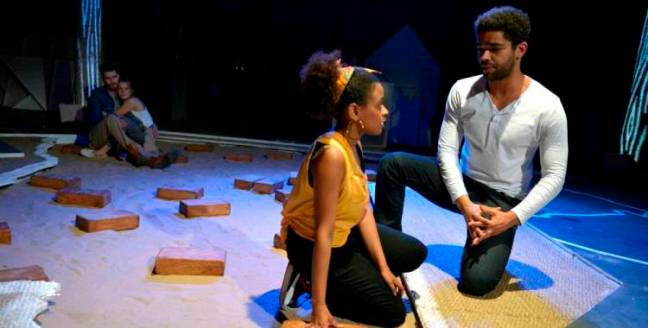
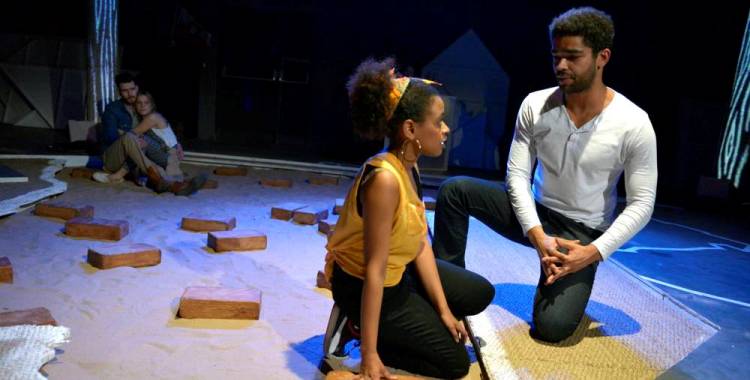
This particular production at the Bush adds an unsettling proximity to Drury’s play, particularly as it reaches its conclusion and we are made increasingly aware of our presence as an audience. Although the majority of the action is carefully scripted and (interestingly) does not stray far from Drury’s text, Gbolahan Obisesan’s direction and the performances of the uniformly strong ensemble manage to effectively evoke the unpredictable spirit of rehearsal room improvisation. Lisa Marie Hall’s set, meanwhile, is a versatile playground for the performers – emphasis on playground. With its movable pieces and gradually revealed sandpit, there is something distinctly childlike about the design, bringing in an aesthetic that jars interestingly with the content. Beyond the design, the playfulness of the whole production is at once wickedly entertaining and decidedly queasy.

But it is only in the final, quiet moments, after the action has reached an overblown, feverish pitch of excitement, that We Are Proud to Present … achieves the impact that justifies its early impishness. While the show’s climax is overdone, its wordless aftermath is a swift, unforgiving punch to the gut, leaving its questions hanging troublingly in the air.

Photo: Keith Pattison.