put your sweet hand in mine, Battersea Arts Centre

put-your-sweet-hand-in-mine-wings-600x475

Originally written for Exeunt.

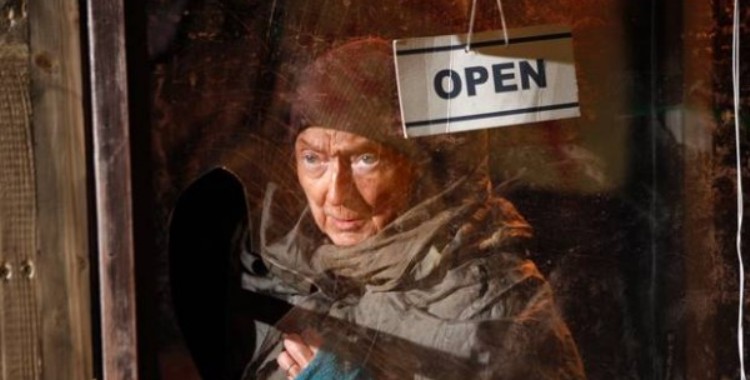
There is something both seductive and unsettling about eye contact. That flicker of glances across a busy train carriage; embarrassed yet oddly conspiratorial sidelong looks while standing in a queue; the jolt of meeting a performer’s gaze from the darkened safety of the audience. It is these awkward glimpses of one another, and the awkward bodies that accompany them, that are at the fluttering heart of Andy Field and Ira Brand’s new show. In their fragmentary, dreamlike journey through the landscape of love, the desire to look is always tied up with the impossibility of really seeing one another.

At the end of Nicholas Ridout’s book Passionate Amateurs, there is a sentence that struck me with the quiet sadness of its truth: “The theatre protects us from full communication”. And I wonder if therein lies its appeal. The theatre is a space in which we are forever straining towards those moments of connection and intimacy, safe in the knowledge – loathe as we may be to admit it – that genuine intimacy, the kind of intimacy that leaves us raw and exposed and vulnerable, is always deferred. We can get tantalisingly close to it, but it is ultimately closed off to us. Unlike love, which involves a breathless moment of letting go, in the theatre we can remain teetering on the precipice.

But this isn’t the whole story. Ridout goes on to suggest that this shielding from communication is perhaps why the theatre “is one of those odd places outside the most intimate of personal relations where it is possible to attempt such communication”. put your sweet hand in mine, in its delicate collision of bodies and gazes, feels like one such attempt. Inscribing intimacy in its staging, the piece sits audience members in two rows facing one another, separated by a distance similar to that down the middle of a tube train. We are invited, from the very beginning, to contemplate the face of the individual opposite, in much the same way as commuters snatch occasional looks at one another. But it is as much about our awkward failure to meet eyes, our failure to connect. It is surely not for nothing that Field and Brand’s pair of lovers are seated at different ends of their respective rows, only ever coming face to face when separated by an insurmountable distance.

The strange, startling discomfort of direct eye contact, a possibility that is played with throughout, is enhanced for me by finding myself sat opposite Field, who determinedly locks eyes with me as he delivers his lines. I am reminded of the long, stretched-out moments in Uninvited Guests’ Love Letters Straight From Your Heart in which audience members are instructed to gaze into the eyes of the stranger opposite for the duration of the song “First Time Ever I Saw Your Face”. As then, the performative situation highlights for me the revealing nature of this simple act; despite myself, my eyes occasionally drop, a small, embarrassed smile stealing across my face.

Seated in this uncomfortably close, immediately charged formation, we are treated to fleeting snippets of a love story, or many love stories, depending on how you take it. Looks are exchanged in the anticipatory moments before a show; shy sentences are traded in a Metro carriage in Paris; bodies hold each other close in the dark and cold. I am tempted to say that there is more to put your sweet hand in mine than romantic love – because there is – but its gentle interrogation of everything love might be tangles these different possibilities together. The giddy, pulse-quickening head rush of infatuation, for instance, is evoked by a barrage of sensory information, part of which invites us to imagine a city torn apart by riots, bleeding together revolutionary passion and romantic desire.

For all the uneasiness and the determined stares at floor and ceiling, Field and Brand cradle their audience within the piece, making any discomfort productive rather than distressing. And the show they have crafted is playful as well as reflective, setting us at ease with gentle humour. Even as we laugh, however, it is underscored with a subtle hint of loss. The most affecting of the show’s metaphors – which are also invariably the simplest – are all to do with a sense of slipping away, a diminishing of possibilities. Melting ice is held tenderly in cupped hands, water dripping to the floor with the steady inexorability of tears.

In another of the show’s most dazzling moments, in which it is held unnervingly taut between playfulness and desolation, Foreigner’s “I Want to Know What Love Is” begins to play, greeted by a ripple of soft chuckles from the audience. On one level it’s a joke, one that trades on the groaning familiarity of the power ballad and its inflated packaging of emotion. But at the same time it feels overwhelmingly apt. Those well known lines, as overblown as they are packed with yearning, represent the unresolved, reaching note on which the show inevitably departs. I want to know what love is. I want you to show me.

The One, Soho Theatre

600x600.fitdown

“It’s kind of funny. And it’s kind of sad.” These are the words of Harry, one half of the nightmarish pairing at the centre of Vicky Jones’ prickly debut play, but they might as well act as a strapline for this story of vicious lovers. That blend of the bitter and the hilarious, along with its uneasy ambivalence, neatly characterises Jones’ narrative of two individuals who are terrifyingly adept at pushing one another’s buttons. It’s equal parts side-splitting and jaw-dropping (not necessarily in a good way) to watch, repeatedly juxtaposing giggles and winces, all the while underscored with the sense of something queasily problematic.

It’s clear from the start that the piece – particularly as directed here by Steve Marmion – is out to ruthlessly skewer romantic cliches. After sitting through a medley of cheesy love songs while the rest of the audience file into the space, the lights go down to reveal a star-studded backdrop at the rear of Anthony Lamble’s minimal living room set, and the opening strains of “Music of the Night” from Phantom of the Opera (a show with a dubious romantic hero if ever there was one) usher on Phoebe Waller-Bridge and Rufus Wright as couple Jo and Harry. The pair embrace, only for the Hollywood romance to abruptly give way to a perfunctory, joyless fuck. Porn plays in the background and Jo throws Wotsits into her mouth.

Given the scenario and the distinctive, charismatic presence of Waller-Bridge, comparisons with Fleabag – the performer’s fearlessly filthy solo show, directed by Jones – immediately invite themselves. This might as well be one of the countless sexual encounters described in that show, where the addition of Wotsits would be one of the least surprising aspects of its catalogue of promiscuity. And like Fleabag, The One insistently pushes at the boundaries of acceptability. It has a “did they really just say that?” quality about it, not to mention the same razor-sharp comedy, impeccably delivered by the ever-extraordinary Waller-Bridge. Yet, while Fleabag also traded on discomfort and fired out laughs that quickly soured in the mouth, there is something altogether more knotty and unsettling about The One.

The action of the piece is claustrophobically confined to the one room, in what could be seen as a jaded, ironic take on the drawing-room comedy. Waiting up for news of the impending birth of Jo’s niece, the bored couple tease, taunt and torment one another, occasionally including Harry’s friend, colleague and old flame Kerry in their sparring. Both Harry and Jo are fiercely intelligent, each using their frustrated intellect and intimate knowledge of the other to push at their limits. The gender politics are complicated by the knotty student/teacher relationship between the pair: English professor Harry is ten years Jo’s senior and taught her at university, suggesting that something lightly exploitative – or at the very least illicit – was in play right from the beginning.

Harry and Jo’s interactions throughout the play, which takes place across the one night, explore varying levels of transgression within relationships. How far would you go to hurt the other person? And how far is too far? There are repeated, rapid descents from playfulness into something far less savoury, testing that delicate tipping point between OK and not OK. It is clear that they both derive a perverse pleasure from abusing one another; at one point Kerry asks “who wants to live like this?”, but evidently they do. Their relationship is a constant competition, in which both of them are desperate to win.

Too often, however, the effect of all this back and forth – no matter how witty – is the sense of a series of rehearsed arguments and provocations. There is a flavour of the thought experiment to certain scenes, with the characters acting merely as ciphers. This is not to say that the theatre is not a place for thought experiments, but when conversation progresses onto a troubling preoccupation with rape – replete with the sort of rape jokes that abound in lad culture – the emptiness of its musings becomes seriously problematic. The play, like its characters, is interested in button-pushing, but I wonder if ultimately it takes its tactics a little too far without offering anything to justify them.

I suspect that a good portion of this ambivalence and discomfort is as much a product of Marmion’s production as it is of the play that Jones has written (although that suspicion, of course, depends on a potentially disingenuous separation of the two). Other than standing it up on stage, Marmion does little to engage with or interrogate the stickier aspects of the piece, and the interventions he does make feel odd and uneven. The aforementioned skewering of romance (the stars, the music, the low lighting between scenes) is an obvious choice, but one that is increasingly out of step with the play. This is clearly about far more than simply unmasking the sham of a particular idea of romantic love. The half-heartedly choreographed movement between scenes is painfully awkward in its sort-of-abstract suggestions of erotic game-playing and sexual violence, while some unnecessary pouring away of wine and fiddling with clock hands seems calculated to do little more than inform us that time has passed.

Meanwhile, as unfailingly brilliant as Waller-Bridge may be, I’m not sure that casting her in this play – which, even without seeing the note in the script, we might quickly deduce has been written for her – is entirely helpful. For a start, it makes that connection with Fleabag, through the lens of which Jones’ play is then inevitably viewed. And then, because of that unbearable yet electric quality that she brings to the role, the character of Jo dominates the stage; it becomes her show. Of course this is partly down to the fact that Jones has written the piece with Waller-Bridge in mind, but it would be fascinating to see what a different actress might bring to that central dynamic. Along with different direction, it might also allow the play to breathe a little more.

Seeing as comparisons with Fleabag are unavoidable, there is one more that feels worth drawing. The real kick in the guts of that piece was the way in which its humour attacked the audience. We laughed – great big guffaws of laughter – and then caught ourselves in the act of laughing, made suddenly aware of just what it was we were laughing at. We were made to feel complicit. The One reaches for the same reaction, but comes up a little short. There’s still unease, certainly, and the laughter is still barbed, but it feels as though we are let off the hook slightly. If that sharp humour and thorny complicity is the aim of the game, it needs to be executed a little more cleverly than it is here.

Yet despite all my uncertainty about – and in some cases anger towards – the play, I can’t just go ahead and dismiss it. The One has, for better or worse, lodged itself in my brain, still picking away two days later. It certainly has something to say, or some provocation to make, even if I can’t quite pin it down. Perhaps its slipperiness, its very resistance to being pinned down, is preciously the point.

I also find myself wondering if it’s trying to do something smarter than I’ve given it credit for. One of the most striking things about its resolutely unpleasant characters is the extent to which they are fixated on individual desires. Which makes me reflect that the title might refer not so much to “The One” in the mystical sense of one’s soulmate (though this is clearly one inference), but to the isolated number, the atomised modern individual. I’m reminded, via Andy Field, of the quote from writer and director René Pollesch: “I would like to talk to the capitalists about money, but they only wanted to tell love stories”. The One is not a love story – not in any traditional sense, anyway – but it is a damning display of the way in which the constant pursuit of and obsession with love and sex are intimately tied up with a society which places focus firmly on the self. Jo and Harry, locked into their hermetically sealed relationship, are perfect portraits of apathy; they barely leave the house, they don’t know where their lives are going, they are so bored that all they can think to do is tear strips off one another. This, perhaps, is where an obsession with “The One” – in both senses of that phrase – ultimately leads.

Superior Donuts, Southwark Playhouse

Superior-Donuts-600x437

Originally written for Exeunt.

Arthur Przybyszewski’s donut shop, a relic of an American dream past its sell-by date, is being taken away from him piece by piece. In this UK premiere of Tracy Letts’ 2008 play, Fly Davis’ deliberately dilapidated design is falling away at the edges, its grubby walls at once sturdily worn and precariously fragile. It’s the sort of place that radiates the permanence of having been around forever and yet might disappear tomorrow, stamped out by the unstoppable advance of Starbucks.

Such is the contemporary America of Superior Donuts. The context of Letts’ drama is rootedly specific, making frequent reference to its surroundings in Chicago and taking the donut shop of the title as a focal point for the lives of those who pass through it, but it equally speaks to a wider sense of modern malaise. Arthur, an ageing hippie nursing the failures of his idealistic youth amid the ruins of his family business, exhibits a paralysis that seems to typify contemporary apathy. There’s a stubbornness to his resistance to change, but also a weary resignation that can be read in every gesture of Mitchell Mullen’s performance. Here is a man who greets life with slumped shoulders.

Into these stale surroundings, where most of the donuts go to a pair of passing cops and an old wino who never pays a penny, enters the requisite young American dreamer. Jonathan Livingstone’s infectiously energetic Franco is a bundle of enthusiasm, ideas and audacious ambitions, both for the “great American novel” that he has penned in dog-eared exercise books and the donut shop that is falling apart around him. The set up, and subsequently much of the action, is typical clash of the generations, old-cynic-meets-young-optimist stuff, as the new employee grapples with his jaded boss in his attempts to ring in the change. Superior Donuts rehearses a familiar and distinctly American narrative, one littered with the wreckage of dreams but faintly illuminated by friendship and hope.

And yet, hard as it is to pin down, there’s something more to it than that. Letts’ play – and indeed Ned Bennett’s production – has a way of sneaking up on its audience. It is delicate, meandering and unapologetically slow, its rhythm capturing the ebb, flow and occasional eddies of everyday life in this fading staple of uptown Chicago. The pace is slowed even further by the occasionally frustrating interjection of Arthur’s introspective monologues about his past, which have more of a literary than a theatrical quality. Just as the itch comes to check your watch, however, you discover that the play has somehow grabbed you – ever so gently, mind – right by the scruff of the neck.

It is possibly down to the characters, who are deftly captured by Bennett and his cast. Mullen and Livingstone in the central pairing are particularly compelling, their relationship endearing without giving in too much to sentimentality, while Sarah Ball’s policewoman packs a world of yearning into a few snatched glances. Each of the individuals who passes through Arthur’s donut shop, however fleetingly, feels convincingly, compassionately sketched.

But perhaps it has more to do with the play’s relationship to hope, a relationship that is more complicated than it might appear at first glance. Bennett has described the piece as “hugely optimistic”, which it is in many ways, but neither the play nor this production are quite that straightforward. Just as Davis’ design has stripped whole panels from the walls, this is a world in retreat, being dismantled bit by bit in the wake of corporate expansion. It’s telling that even the great dreamer enthuses in marketing speak, discussing poetry readings in the same breath as brand identity. There is optimism to be found, not least in Letts’ determined use of the future tense, but even hope is shown to have its limits.

A Trio of Tragedies

thebes-2-600x400

Originally written for Exeunt.

In this year’s rep season from The Faction, there are a hell of a lot of corpses. Across the span of the trio of tragedies – Hamlet, Thebes and The Robbers – the body count is staggeringly high. If one were to characterise the company’s third season of work in a few words, dark, violent and bloody immediately jump to mind.

Reductive as this is, there is something about death, both as an abstract idea and a concrete reality, which haunts all three productions. When I spoke to The Faction’s artistic director Mark Leipacher about this new season, he explained that the company did not have any overarching theme or narrative in mind when they put together the programme; their priority was simply to find work that engaged and excited them. Still, the simple placing of these plays alongside one another invites a dialogue between them, a dialogue which is repeatedly preoccupied with mortality.

There is perhaps no more famous theatrical consideration of life and death than Hamlet’s “to be or not to be” soliloquy. Hamlet’s fame and familiarity are often albatrosses to sling around the shoulders of new productions, all of which must fall under the burden of the play’s reputation. The Faction’s interpretation, directed by Leipacher, suffers a little from this predicament. Compared with previous productions of theirs, there is an uncharacteristic timidity to their approach; few moments match the visual boldness of their best work, and there is the sense that each actor is deeply aware of the weight of the words falling from their lips.

That said, there are some intriguing touches to this Hamlet. The characterisation of the procrastinating protagonist himself is perhaps the most striking departure, as Jonny McPherson plays the Dane less as a conflicted hero and more as a whining egotist. Amidst tentative attempts to wrench something new out of the play, this comparatively brave choice stands out, offering novel and occasionally unexpected resonances to Shakespeare’s words. The ever-compelling Derval Mellett, meanwhile, makes a fascinating and nuanced Ophelia, adding vivid colour to a role that can often feel lightly sketched.

The season really hits its stride, however, with Thebes, Gareth Jandrell’s ambitious attempt to slot together the full story of the Oedipus dynasty from the plays of Sophocles and Aeschylus. It stands out as the clear highlight of this year’s programme, offering this most famous of classical sagas in a form that makes it feel thrillingly fresh. What adds the sense of urgency and momentum is primarily the production’s shift of focus; as signalled by the title, it is the city and its beleaguered people who become the heart of the narrative. This city is both Thebes and nowhere, The Faction’s non-specific updating dislocating it from time and place and positioning it instead as a potent metaphor for power, corruption and revolution.

Following the template established by McPherson’s moody Hamlet, The Faction are unafraid to highlight the tragic flaws of their privileged but doomed characters, who are increasingly detached from the seething masses they rule. Lachlan McCall brings arrogant swagger to the ill-fated Oedipus, while his two sons are suitably vile, self-centred and ruthless in their competition for the throne. This is an elite who are either blindly wrapped up in their own problems or coldly fixated on power. Cary Crankson – another performer who impresses across all three productions – epitomises this calculated power-grabbing with his Creon, a supremely slippery politician who soothes with one hand as he snatches with the other.

The pulse of the piece, however, lies firmly with the people. In Rachel Valentine Smith’s production, the Chorus are transformed into a writhing, revolutionary mob, variously whispering, sighing and stamping at the edges of the action. When gathered together in this crowd, the ensemble move fluidly as one, exploiting the physical vocabulary that they have developed over years of working together. This is where the muscularity of previous work returns in force, creating a population to be reckoned with and a sparse but captivating visual aesthetic to match Jandrell’s lyrical, punchy script.

Following the epic scope and revolutionary fire of Thebes, the scrappy, overblown drama ofThe Robbers feels like a significant step down. This is a remounted production for The Faction and forms a key part of their project to stage the complete works of Schiller, but it is far from the playwright’s best, lacking the tense political machinations of Mary Stuart and Fiesco, which were showcased in The Faction’s last two rep seasons. Here, instead, the drama is centred on a father and his two sons, the younger of whom attempts to usurp his older brother. It is all blood and passion, heightened to the extent that it frequently tips over into melodrama.

There is still the muscular approach of The Faction’s preferred aesthetic, alongside some inventive visual devices. Chalk is a key material, used first to compose the letters that seal the fate of cast out older brother Karl and later by Karl’s band of rebels to strikingly tally up the men they kill on their numerous rampages. It is in the scenes between these eponymous robbers that the production is at its strongest, once again playing on the group’s strength as an ensemble to build a convincing sense of camaraderie. At their centre, overshadowing conflicted Karl, is Crankson as the cocksure, rebellious Spiegelberg. Yet even Crankson’s undeniable charisma flags in the final scenes, as the bodies stack up and the overwrought emotion becomes wearing in its relentlessness.

After the slightly more cluttered sets of last year, this season wisely reverts to The Faction’s bare, stripped back minimalism, using the New Diorama’s black box studio and their own bodies as canvas and paint. The bare black wall is particularly well used, whether seemingly being held up by the defending soldiers of Thebes or treated as a giant blackboard in The Robbers. In this largely empty space, the brilliant work of lighting designers Chris Withers (Hamlet and Thebes) and Matthew Graham (The Robbers) is crucial in carving up the scenes, skilfully offering both shape and atmosphere. Light spills in from offstage, casting interesting shadows, or glows dimly from a single, dangling light bulb. In line with the morbid subject matter, gloomy visual landscapes abound.

This is now the third year in a row that I have attended The Faction’s annual rep season, allowing a line to be traced through their work over that time. In many ways this year feels like a return to the company’s essential aims and aesthetics, focusing on the kinds of text and staging that most enthuse and inspire them. There is also, of course, the return to one of their landmark productions with The Robbers, but this fails to match up to the best of what they have created since. It is instead in Thebes, arguably The Faction’s most ambitious work to date, that the company’s aspirations and strengths are found in their purest form: a bare but thrilling staging, an approach to classics that makes them feel like they were written yesterday, and an unshakeable faith in the power of the ensemble.

Photos: Richard Davenport.

Happy Days, Young Vic

image1

“The function of utopia is a critique of what is present.” – Ernst Bloch

I find myself thinking a lot about utopia, optimism, hope and idealism, as well as theatre’s place in that matrix of positivity. Perhaps it’s because, at heart, I think I’m an essentially optimistic person. As an optimist (most of the time) and as a theatre lover, it’s unsurprising that I invest the theatre I see with the possibility of hope, however small. Whether it’s Jill Dolan’s infectiously passionate Utopia in Performance, which greeted me like an embrace after weeks of burying myself in theory which all seemed to disavow theatre’s radical and optimistic potential, or the hopeful striking of a match at the end of Lucy Ellinson’s border ballad, it’s those slivers of optimism which always catch my attention.

Predictably, then, I was struck by that opening quotation from Ernst Bloch. It dragged my mind back to a discussion that Dan Hutton and I had on Exeunt a few months ago, in which we jumped off from Andrew Haydon’s (slightly disingenuous) positing of hope and critique as two sides of a dichotomy, opening into a consideration of hope in the theatre we were seeing at last year’s Edinburgh Fringe. One of our shared conclusions was that there can in fact be critique within a hopeful narrative, a point that Bloch’s statement succinctly nails. The same, I think, might be said of discourses steeped in optimism. Just as utopian thought can function as critique, so too perhaps can optimism.

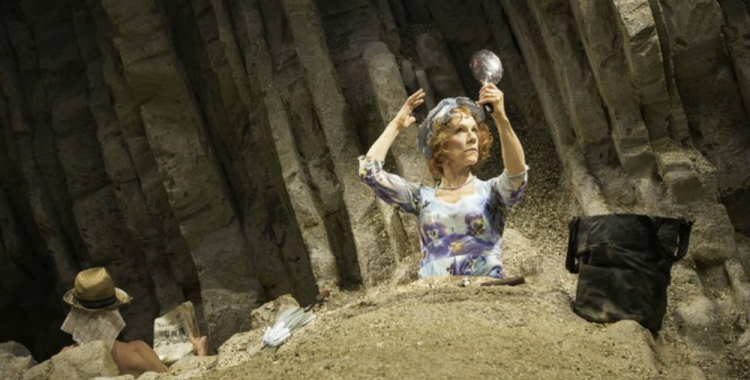
The scorched world of Samuel Beckett’s Happy Days is clearly not a utopia of any description. Indeed, it would not be much of a stretch to describe it as a dystopia. In Natalie Abrahami’s new production at the Young Vic, the striking prison of earth in which Winnie is trapped is less a mound of sand and more an inhospitable, rapidly eroding rock face, sloping sharply down towards the audience. Within Beckett’s demanded limitations, Vicki Mortimer’s design draws out both the precarious nature of Winnie’s predicament and the yearning, upwards movement that pulls in vain against her cruel, unexplained confinement. Add to this sound designer Tom Gibbons’ chillingly discordant “bell”, slicing Winnie’s time into regimented portions of waking and sleeping – not to mention the encroaching possibility that the sand will soon completely bury her – and it looks like a fairly hopeless situation. So what are we to make of Winnie’s stubborn optimism?

Optimism, according to the Oxford English Dictionary, can be defined in two distinct ways. The first, more commonly used definition is hopefulness in a forward-looking sense; the placing of hope in a future outcome. The second definition, however, is the belief that “this world is the best of all possible worlds” – optimism grounded in the here and now. By this definition, as I look around at the grim state of the world we presently live in, I would class as a pessimist. Winnie, however, with her repeated, irrationally cheery “this will have been a happy day”, is an optimist by any definition.

Or is she? Her refrain, significantly, is “this will have been a happy day”, not “this is a happy day”. The happiness is always contingent, always deferred. This statement is often followed, after a pause, by the qualification “so far”, again haunting her contentment with the spectre of future calamities (unsurprisingly, one might argue, given the ever-present threat of suffocation by sand). Time itself is manipulated throughout the play, as in much of Beckett’s work, further complicating matters. Winnie seems, at certain points, to have destroyed the notion of change and the passage of time as a sort of coping mechanism. She insists, illogically, that “nothing has occurred”; even when her umbrella bursts into flame, she calmly observes that it will be back in its old place by tomorrow. Yet there is a definite routine to the way she lives out her days, and a habitual gesturing to both past and future. Her experience of time is less a stretched out, purgatorial present as it is a fluid, mutable marker of existence, and thus her brittle optimism cannot find a firm foundation in any tense.

Juliet Stevenson’s remarkable performance in the Young Vic’s production highlights every last nuance of Winnie’s complex, ambivalent relationship with optimism. Her first expression is an almost grotesque grimace of joy, her face stretching to form a strained mask. There is, proceeding from this moment, a certain deliberateness to Stevenson’s movements, at times becoming an almost mechanical precision. Held static, the thwarted physicality of the rest of her body is channelled through her arms, which she holds like those of a dancer. Each calculated flick of a finger seems invested with some unspoken emotion.

There is something similarly deliberate about Stevenson’s speech – appropriately, for a woman whose existence balances hazardously on words. There is always an effortful edge to her insistent pronouncement of the word “wonderful”, while another of her stock phrases, “the old style”, veers in delivery from cheery to wistful to mournful, eventually becoming stained with desperation. One of Stevenson’s great skills is her ability to load words with heavy yet never overstated meaning; “wife”, rolling laboriously from her lips, is invested with multiple accusations, sighs and hopes. At other times, by contrast, there is an ironic relish to her sentences and a wry ring to her laugh. Out of the bleak, Beckettian gloom, Stevenson’s humour glints brightly.

The overwhelming impression created by Stevenson’s performance is of a woman assaulted by feeling yet grimly determined to remain in control. Her delicate, virtuosic hopping from emotion to emotion is always wrenched back to a dogged cheerfulness, as she fixes her smile with the same care that she fixes her hat. Even her crying is contained, her hands pressing tears back into her eyes. Winnie’s optimism, at least in this production, is not blind or ignorant, nor is it the babbling of a woman who has lost her mind. Optimism emerges as a choice, but it is an unstable one. It has to be worked at.

The more I think about it, the more Winnie’s optimism (if indeed optimism the right word) feels like an apt comment on the situation we find ourselves caught in, particularly at this present moment. Returning to those two definitions, the optimism that many of us feel right now is firmly future tense. We believe, or at least we hope, that things will one day be better; therein lies the critique, as for the situation to improve it must first be flawed in some way. Yet to get by from day to day we, like Winnie, must find some optimism in the present. The system thereby bends us towards the second definition of optimism and the acceptance that ours is “the best of all possible worlds”. Unable to fully resign ourselves to this, perhaps we also hover somewhere between the two, determinedly injecting our lives with cheer and deferring, along with conflicted Winnie, our own happy days.

For another consideration of optimism in Happy Days, see Dan Hutton’s essay

Photo: Johan Persson.