L’Après-Midi D’un Foehn, Platform Theatre

photo1

Originally written for Exeunt.

A plastic bag, a pair of scissors, a circle of fans. These are the modest opening ingredients for the surprise hit of last summer’s Edinburgh Fringe, a new version of which is now being shown as part of the London International Mime Festival. The buzz around Compagnie Non Nova’s show in Edinburgh was improbable to say the least. The show, described in a tone of breathless yet ridiculous wonder by those who were lucky enough to stumble across it, essentially involves a chorus of dancing plastic bags. Not the most auspicious of premises.

But the giddy superlatives thrown at L’Après-Midi D’un Foehn in Edinburgh turn out to be wholly justified. It is rare, as an adult and particularly as a regular theatregoer, to be truly knocked out with wonder, but Compagnie Non Nova achieve this feat with the least likely of materials. Plastic bags, fluttering in the bare branches of trees or skittering along the pavement with leaves and cigarette butts, have become almost emblematic of rubbish. A symbol of throwaway consumer culture – the ultimate trash. So it is doubly surprising how beautiful they are rendered by Compagnie Non Nova’s ingenious transformation. Floating, falling, spinning in balletic poses, the flimsy stars of L’Après-Midi D’un Foehn are absurdly gorgeous to look at.

The show opens with performer Cécile Briand alone in the gloomy circular space, slowly and meticulously cutting and sellotaping a pink plastic bag into a vaguely humanoid shape. Briand’s unhurried precision is oddly captivating in itself, inspiring a still hush of expectant attention. So quiet and unapologetically dawdling is this beginning that when the plastic bag that Briand has carefully placed in the centre of the stage begins to rustle, billow and finally pirouette, the magic and delight are all the greater. Gasps and giggles ripple through the audience as this delicate plastic figure leaps and twirls, later joined by partners, playmates and antagonists, all of whom dance enchantingly to the strains of Debussy’s ‘Prélude à l’après-midi d’un faune’.

The piece feels so beautifully effortless that it is easy to underestimate the artistry involved. Thanks to some cleverly directed gusts of air (huge credit to Pierre Blanchet’s “wind design”), these plastic bags take on movement, grace and even emotions, inspiring the same sort of gooey, irrational affection as Tom Hanks’ ill-fated volleyball companion in Castaway. The combination of simplicity and ingenuity is remarkable; never did I think I would be able to say that I was emotionally invested in the fortunes of a plastic bag. As well as demonstrating the skill and invention of Compagnie Non Nova, this is equally testament to the extraordinary ability of music to invest the simplest of scenes with compelling drama, and to the inspiring power of the imagination.

There is, of course, the danger that – despite its undeniable beauty – this all becomes as insubstantial and throwaway as its fluttering protagonists. After all, how many different ways is it possible to manipulate plastic bags with just one performer and a few fans? There are a handful of moments in which the wonder begins to fade and the piece sags a little, but the company pull out just enough surprises to keep their audience enraptured, while the short running time is cannily judged. Carried on the undulating currents of the piece, my mind skips throughout between themes such as imagination, love, power, the creation and fragility of life – all lightly hinted at by Compagnie Non Nova’s fleeting images before being lightly blown away. The enduring impression, however, is of the beauty that art is capable of finding in the most unlikely of places.

The Nutcracker, Nuffield Theatre

nutcracker2-600x400

Originally written for Exeunt.

As Chris Thorpe acknowledged while discussing Northern Stage’s Christmas show, there is something about this time of year that feels intimately tied up with stories. Whether it is fairytales, stories of Santa or the tale of the nativity itself, the festive season is drenched in narrative. The story chosen for this year’s family show at the Nuffield Theatre is one so familiar that it has become part of the cultural fabric of Christmas, but the creative team have approached it from a slightly less familiar angle. A play with songs rather than the well known ballet, this is a Nutcracker with no Sugarplum Fairy and rather more back story, taking its lead from ETA Hoffman’s original tale.

Unfortunately, the story is the very element that lets this production down. Here, young Clara’s journey into the Land of Sweets and the central battle between the Nutcracker and the Mouse King occupy only a fraction of the stage time, the greater portion of which is taken up by exposition and scene-setting. The darker elements of Hoffman’s short story are welcome antidotes to what can be a queasily saccharine tale, but their incorporation into Hattie Naylor and Paul Dodgson’s script is decidedly laboured. We find out plenty about the curse of the Nutcracker and how he came to be the enemy of the wicked Mouse King, but all in a series of scenes that play out like an extended prologue. The first act ends beautifully, with an image to send chills down the spines of the children in the audience, but there is a niggling feeling that it is only just getting to the heart of the narrative.

This adaptation is also one that suffers from something of an identity crisis. The conventions of audience interaction are called upon early on, as the performers enter through the auditorium and talk to the kids on the way, but from this point onwards the piece is torn between fourth wall storytelling and pantomime style involvement. The narrator figure is an odd fit with the rest of the show, while the recruiting of the audience to hurl foam balls during the battle scene – while undeniably great fun – jars awkwardly with the action that has preceded it. Neither simple storytelling exercise nor riotous panto romp, The Nutcracker wants to be both at once, but struggles to knit the two genres successfully together.

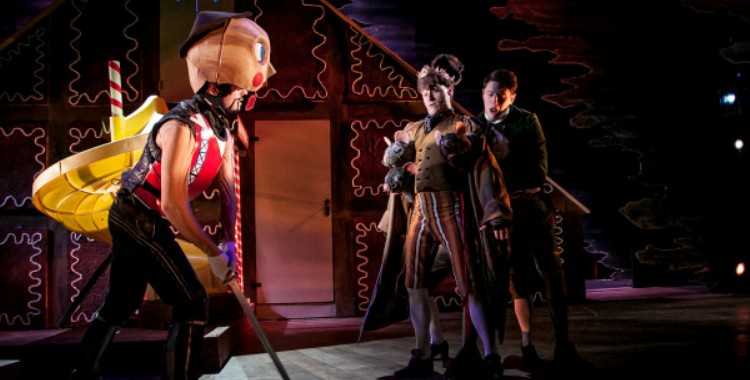
There is, however, a fair sprinkling of magic in Blanche McIntyre’s production. The opening scene is a delight, pulling out all the tricks of the stage to establish a mood of enchantment and wide-eyed wonder, while raising several gasps from its young audience in the process. These moments of dazzled awe are the most rewarding, reminding adults as well as children just how magical theatre can be. Rhys Jarman’s design does a lot of the legwork, offering a series of charming transformations, while the cast bring an infectious energy to the range of roles they are asked to adopt throughout the twisting narrative.

The production is at its best when playful, whether that is the deliciously hammed up villainy of the Mouse King or the cheekily self-aware conclusion. At the end, the characters leave us deliberately in doubt about the nature of what we have seen, embracing the more uncertain and dreamlike qualities of Hoffman’s tale. Implicit in this ending is a question about stories themselves – why we tell them, what they mean to us, and when they become real. It is only a shame that it takes this long for the storytelling to come into its own.

The Night Before Christmas, Soho Theatre

Craig-Kelly-Craig-Gazey-and-Navin-Chowdhry-Photography-Sheila-Burnett-600x400

Originally written for Exeunt.

Recent years have produced countless claims to the “alternative” Christmas show, promising respite from glitter, jingle bells and cries of “he’s behind you”. Soho Theatre’s offbeat contribution is one of the few to really deliver on this promise. Sure, all the hallmarks of the festive season are here, but this is no cosy, tinsel-decked affirmation of the sentiments we hear spouted from all directions at this time of year. Anthony Neilson and Steve Marmion’s show, while pumping out the laughs at a breathless rate, also recognises that – whisper it – Christmas can sometimes be a bit shit.

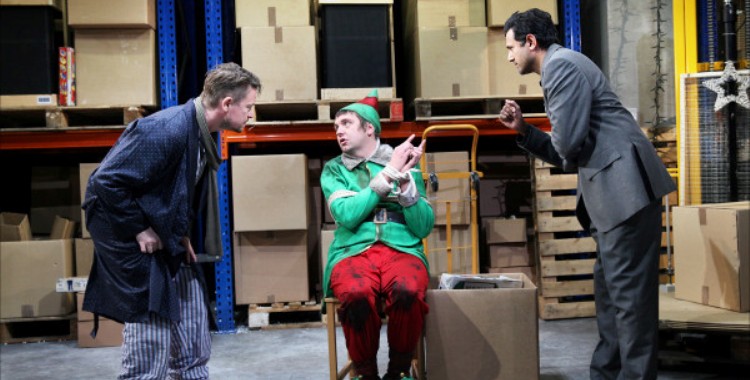
This is a bitter recognition for Gary, a one-time City boy who is now flogging knock-off toys and spending Christmas Eve alone in his warehouse. Or at least he was alone, until a man claiming to be an elf broke in, pleading innocence and begging to return to his sleigh. As Gary is joined by old mate and fellow substance abuser Simon and single-mum prostitute Cherry, the unlikely trio apply scepticism, snark and suspended disbelief to the problem of the red and green clad man tied up alongside the fake Furby Booms and dust-gathering Gary Glitter outfits.

Every last detail of this Crimbo car crash is a calculatedly crappy alternative to the festive magic promised by parents and advertisers alike. Snow is replaced by showers of polystyrene packaging; fairy dust is swapped for cocaine; instead of a red-faced, rotund Santa, we get an elf with track marks up his arms. Yet, for all the detritus of broken dreams and long lost childhoods, Neilson and Marmion still tease us into believing. Against logic and evidence, we’re desperate to tell ourselves that this dishevelled figure in his pointy hat is not a quick-thinking junkie but a bona fide resident of the North Pole.

This is thanks to the stubborn ambivalence of tone that is courted throughout, repeatedly upending an audience’s expectations. Craig Gazey’s “Elf” is a lesson in ambiguity, answering the interrogations of his captors with responses that are by turns assured, desperate and downright bonkers, yet always governed by reasoning that somehow makes a strange sort of sense. Elves don’t deliver the presents, apparently – they “enhance” them. Remember how much fun you had as a kid with all the cardboard boxes and wrapping paper on Christmas Day? That would be because the elves’ magic won’t work on synthetic materials; the plastic presents confounded them, so they enhanced the packaging instead.

Touches like this demonstrate all the surreal ingenuity of Neilson’s writing at its best, complemented by the wacky, determinedly shoddy songs he has written with composer Tom Mills. The lyrics are all clumsy festive schmaltz, the singing unapologetically atrocious. And it’s oddly brilliant, slicing right through the queasy sentimentality that reigns elsewhere. But even with the satire, we are rarely on solid ground. The myth of Christmas is dismantled, the magic of childhood abandoned, and still this production manages to inject a surprise dose of that addictive Christmas feeling.

The result of all this tonal variation, however, is a number of sharp and sometimes jolting handbrake turns. While the pace of the first third is zippy and sitcom-esque, throwing out joke after joke, cracks begin to appear when the emotional tenor shifts. Neilson turns out to be a gag-machine to rival the best panto writers, but the momentum of these early exchanges is tricky to maintain and the show visibly flags somewhere around the middle – a bit like Christmas Day itself.

Despite its flaws, though, the dark humour and brilliantly bizarre flourishes ultimately rescue the piece, just about keeping it on that tightrope between worn cynicism and childlike delight. For anyone who has ever suspected, like me, that Christmas as an adult is two parts nostalgia and one part alcohol, The Night Before Christmas nails both the joy and the disappointment that the festive season can involve.

Photo: Sheila Burnett

Gastronauts, Royal Court

700x650.fit

Originally written for Exeunt.

Anything that addresses its audience as “intrepid eaters” asks to be approached with a touch of apprehension. Gastronauts, dreamed up by April de Angelis, Nessa Muthy and Wils Wilson, is teasingly tight-lipped in its marketing material, explaining only that the show will offer a range of tastings for its “brave dinners”, along with the details necessary for them to make informed choices about what they eat. Probably not for fussy eaters or the squeamish, then.

Led into a dimly lit holding chamber in the upstairs theatre and instructed to drink from glasses of lurid Alice in Wonderland-style potion, the automatically tentative stance seems justified as we prepare to throw ourselves headlong down the rabbit hole. But for all the uneasy mystery and foreboding hints, the Royal Court’s surreal theatrical dining experience lacks the bite it so tantalisingly promises.

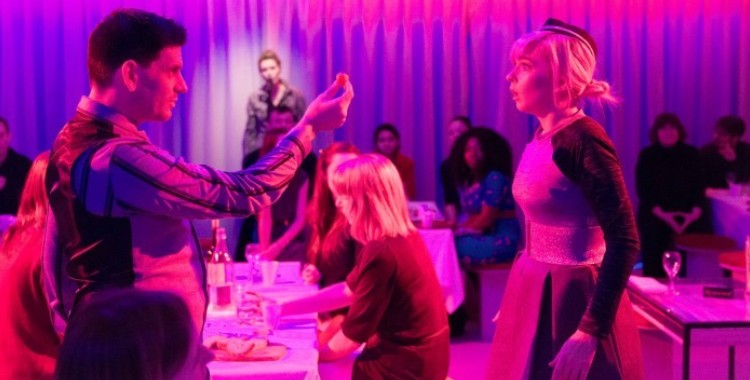
The basic concept of the show is contained within its title: we are travellers, embarking on a flight towards the flavours of the future. Once seated at our tables on board Lizzie Clachan’s futuristically reconfigured performance space, the cast of four gamely point out the nearest exits, while Alasdair Macrae as our pilot and maître d’ is a deliciously oddball host, at once strange, charismatic and lightly threatening. He reassures us, with a twinkle in the eye, that “nothing here will harm you – in the normal sense of the word”. His introduction, as it turns out, is a fitting primer for the show itself: quirky, kooky and charming, laced with just a dash of menace.

In keeping with the modest courses brought out one by one to delight our taste buds, the show itself is divided into small, bite-sized portions. The performers slide in and out of their roles as waiters to present short sketches on everything from derivatives trading to family dinnertimes, punctuated with Macrae’s brilliantly wacky songs. The audience watch all of this from our tables, eating and drinking throughout. There are, as one expects, a few surprises served up on our plates, but none that are particularly unpleasant or challenge our consciences too taxingly. Even one seemingly unappealing dish ends up being surprisingly innocuous, the tense frisson prompted by its arrival quickly settling into grinning relief.

And herein lies the problem. As a novelty dining experience, Gastronauts ticks most of the boxes: idiosyncratic waiting staff, eccentric host, a range of dishes that assault and confound the senses. As a meditation on our species’ messy relationship with food, however, the Royal Court’s creation is disappointingly uneven, movingly clumsily from madcap comedy to cutting critique while trying too hard to cover all bases. One impetus for the show was the recent horsemeat scandal, which brought the question of where our food comes from right to the fore of the public consciousness, offering more than enough material to chew on. Rather than focusing attention here, however, the show distractedly casts its gaze in all directions, also offering nods to eating disorders, food banks and the communal ritual of eating together.

Taken – like the menu – as a set of tasters, there is plenty to relish. Visions of food crisis offer a bitterly entertaining satirical portrait of the unappetising future we are potentially heading towards, while there is a mad, hallucinatory joy to watching the cast don cow masks and sing about how we’re all fucked. But for all its playfully provocative statements, the appetite for probing critique is left unsatisfied, even if our hunger is appeased. Instead of making us think twice about what we blithely gobble down, Gastronauts hands us a spoon and urges us to dig in.

Photo: Johan Persson

The Lady’s Not for Walking Like an Egyptian, Ovalhouse

lady-ovalhouse-600x374

Originally written for Exeunt.

“Can we finally be post-Thatcher?” asks nat tarrab, arms flung out in a gesture of frustration. The performer, one half of Mars.tarrab, doesn’t want to make a show about the Iron Lady; the duo already made that show earlier this year for Ovalhouse’s Counterculture 50 season. Then, just six weeks after the run, Margaret Thatcher died. But, contrary to tarrab’s hopes, Maggie’s legacy is far from departed.

This simultaneous presence and absence persistently haunts Mars.tarrab’s reworked version of The Lady’s Not for Walking Like an Egyptian, which – like the country itself – can never quite shake off the ghost of Thatcher. Bounding onto the stage in neon lycra and legwarmers, Rachel Mars and nat tarrab promise to transport us back to the 1980s, the decade of Madonna, monetarism and the mega musical. But these are not the “plastic fantastic” 80s, tarrab insists; this is a decade of monumental political struggles and shifts. As Mars.tarrab go on to demonstrate, however, the two are not necessarily distinct.

The driving tension at the centre of the piece stems from the two women and their very different experiences of the decade they are attempting to evoke. For Mars, who was a child of ten at the close of the 80s, it represents the era of Cats, lycra cycling shorts and Jennifer Rush’s “The Power of Love”. Tarrab, on the other hand, was eighteen by the end of the decade and actively protesting against the destruction wreaked by Thatcher’s policies. At the outset of the show, their experiences of the 80s are mapped out on their bodies with coloured tape, a playful but knowingly inadequate visual representation of the dramatically different but equally lasting impressions left on them by the decade. They are both, in contrasting ways, Thatcher’s children.

This tension, established early on, remains taut throughout the show. Mars.tarrab have the appealing, combative chemistry of a double act: Mars short, playful and frenetic, tarrab tall and full of righteous rage. Their competitive dynamic and apparently incompatible views of the 80s act as a motor, powering the piece forwards at a furious pace through the Faulklands, the free market economy and Section 28. The inspired framing device of the show, meanwhile, is also born through a kind of conflict, as Thatcher’s speeches are spliced up with lyrics from songs by female artists of the decade. Monetarism meets “Material Girl”, while homophobic rhetoric enters a head-on collision with Whitney Houston.

Out of this structure of conflict and juxtaposition emerges a show that is equal parts hilarious and heartbreaking. The utterly bonkers joy of the two performers on space hoppers jars painfully with the sinking of the Belgrano; tarrab’s deeply felt objections to representing Thatcher are silenced with a showering of milk. There is, both in the positions represented by each of the artists and the string of contrasts throughout, a duality that reflects the problematic legacy of Thatcher and the decade she dominated. One is given the impression, despite the resistance to this idea, that there is no going back to before – before Thatcher, before the free market, before everything that is now so embedded in our society – and that Mars and tarrab’s opposed experiences will never quite be reconciled. Even at the show’s beautifully judged climax, which recognises and seemingly relents to the seductive power of nostalgia and sentimentality that 80s pop culture understood so well, tarrab stubbornly reminds us that this is no straightforward resolution.

The troubling ambivalence of the decade as seen through the eyes of Mars.tarrab is perhaps best summed up in one moment: Mars as a riotously zealous Thatcher announcing Section 28, while tarrab perches precariously on a teetering pile of chairs, speaking the words of “I Wanna Dance With Somebody” as an anguished appeal to the audience. Like the show itself, it’s a simultaneous punch to the gut and the funny bone, with a queasy aftertaste of discomfort.