The Anatomy of Melancholy, Ovalhouse

melancholy3-small_460_575_95_s

Anyone remember that Russell Howard skit about everything the Daily Mail has reported as increasing your chances of getting cancer? It lands a fairly easy punch, reeling off the ridiculous and frequently contradictory list of factors that have been warned against in the paper over the years. You’re more likely to get cancer if you’re a man, if you’re a woman, if you don’t eat a certain food, if you do eat a certain food – you get the picture. Unexpectedly, it was this video that I found myself thinking of while watching Stan’s Cafe’s The Anatomy of Melancholy.

The book of the same name by Richard Burton on which the show is based is essentially a litany along the same lines as that issued by the Daily Mail, multiplied a few times over. First published in 1621, this 1,424-page tome attempted to comprehensively outline understandings of melancholy and its causes, symptoms and cures at the time. The problem, of course, is that not everyone agrees. One philosopher or scientist recommends one course of action, while another flatly contradicts this. We are recommended exercise, but not too much exercise; study might be a cure, unless our melancholy is born of “overmuch study”.

From this description alone, it hardly sounds like a text that is begging for a stage adaptation. It’s interesting to discover, therefore, that this production is the result of a challenge by a fellow theatremaker to stage a text that would be considered by many as unstageable. And, though The Anatomy of Melancholy is an undeniably unwieldy text, the premise is promising. Both the marketing material and the initial set-up suggest that Stan’s Cafe will be engaging not so much with an adaptation itself but, far more interestingly, with the whole idea of adaptation. How does one even begin to stage a book this long and intricate? How can it possibly be faithful to the sheer volume of information in the original? What does it even mean to be faithful when transforming a work for the stage?

This, however, turns out to be a red herring. There are certainly gestures towards a meta-theatrical framing; the four performers, who don’t seem to have fully agreed on how they are going about the staging, hold scripts in hand, occasionally debating over digressions and scribbling out lines. There is also something intriguing about the decision to distribute Burton’s reflections between more than one performer and emphatically employ the collective pronoun “we”, suggesting the internal discord that is perhaps the source of Burton’s own melancholy. But this device never goes anywhere, taunting us with the unfulfilled promise of flipping the whole piece on its head.

Instead, what we get is a fairly straightforward walk-through of Burton’s text, progressing from causes to symptoms to cures, with particular examples, such as love, highlighted along the way. The whole thing is littered with paper, from the seemingly never-ending flipcharts that line the back of the stage – amusingly recalling both the school and the conference presentation – to the many quotations that are displayed to the audience. This crowded, untidy knowledge is mirrored in Harry Trow’s set, which is, like the studies of most academics I know, a book-filled portrait of ordered chaos. It’s a fitting representation of the mind itself, and Burton’s mind in particular: messy, cluttered, jammed full with competing ideas.

In the process of sorting its way through this jumble of information, the central problem of Stan’s Cafe’s adaptation is that it cleaves too closely to the content of Burton’s book rather than to its spirit. There are plenty of oddities among Burton’s outdated theories, some of which are treated with a light touch of silliness, but it strikes me that there is far more interest to be found in the figure of Burton himself, his compulsion to write of melancholy to escape the melancholy that he himself felt, and the challenges inherent in bringing this work to the stage. By largely ignoring all of this and faithfully conveying Burton’s arguments, Stan’s Cafe assault the audience with a deadening barrage of information, delivered with little variation in pace or tone. The programme warns us that it is natural to drift off, but the show offers little to wake us up again.

The one angle that Stan’s Cafe do seem to take on this material is an attempt to draw attention to certain contemporary resonances. While we can laugh at Burton’s description of the humours, his observations about the prevalence of melancholy and the desperate human desire for a quick fix are equally relevant to us today. In a society where rates of depression are rising and the government is obsessed with “happiness indexes”, there is certainly a case for the prescience of Burton’s text. Money, food and thwarted love are all causes of distress that have persisted down the centuries, while Burton’s description of life as a prison could have been plucked right out of Discipline and Punish.

Rather than shedding any significant light on our present day maladies of the mind, however, The Anatomy of Melancholy seems to shrug its shoulders with an attitude of “twas ever thus”. What we leave with is the same knowledge that we brought in, that unhappiness is an unfortunate but unavoidable fact of human existence. I did find myself contemplating, as I shifted restlessly in my seat, whether it might all be an ironic demonstration of its subject, inducing in its audience the same melancholy that it monotonously dissects. If so, then it unquestionably succeeds.

Billy the Girl, Soho Theatre

600x600.fitdown

Clean Break have forged a strong reputation for shining a light on the criminal justice system, offering vital female perspectives on stories that are often hidden. Katie Hims’ new play for the company, however, suggests that the most difficult aspect of incarceration might not be prison itself, but the challenge of adjusting to freedom.

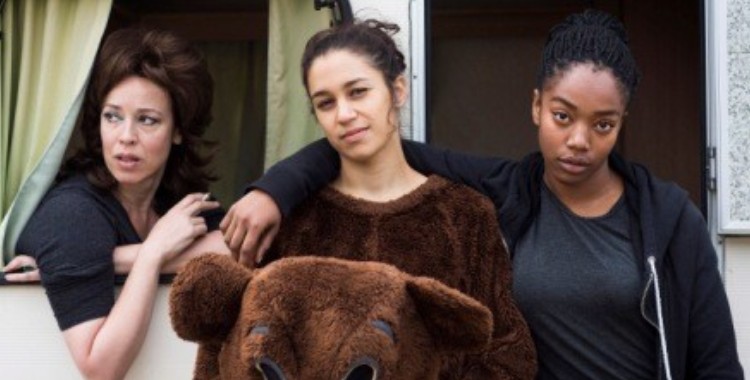
The eponymous Billy is fresh out of prison – not for the first time – and determined to turn her life around. Brandishing fruit and rhapsodising about her new fitness regime, Billy has a “positive mental attitude”. Unfortunately, her positivity fails to extend to the mother she goes home to, for whom the return of her wayward daughter is the last thing she wants. Banned from crossing the threshold of her family home, Billy instead finds shelter in the caravan pitched up outside, from which she does battle with the past and tries to cling onto hope for the future.

Hims’ play is essentially a family drama, tightly focused around Billy, her mother Ingrid and her younger sister Amber. At its best, it explores the complex, fraught and occasionally tender relationships between the trio, all of whom defiantly refuse to conform to straightforward definitions of ‘good’ and ‘bad’. Billy teeters between infectious optimism and a dangerous urge for self-destruction; Ingrid is vulnerable one moment and manipulative the next; Amber is an apparent angel who goes shoplifting when she should be at choir practice. There is certainly love somewhere between them, but it is surrounded by the detritus of blame, resentment and regret.

This messy tangle of personalities and emotions would be material enough for a rich exploration of life after prison, but Billy the Girl is restrictively wedded to a structure of secrecy and revelation. The play tantalisingly brushes against moments of raw emotional truth, before frustratingly abandoning them in favour of the punch of a final twist. This denouement, while satisfying the narrative arc that we have come to expect from plays of this kind (damaging secrecy, dropped hints, climactic confession), feels unnecessarily contrived – a trick calculated to inject a fresh burst of drama rather than a revelation that feels truthful to the characters that have been so carefully crafted.

Rather than the uneven plot, it is through these characters, convincingly fleshed out by Hims, director Lucy Morrison and the cast, that the play really compels. Billy in particular is relentlessly, almost exhaustingly captivating at the centre of events. As played by Danusia Samal, she seems to feel with every last sinew, investing both hope and despair with unsustainably explosive energy. Christine Entwisle’s Ingrid is her polar opposite, each movement sighing with the fatigue of the years, while Naomi Ackie as Amber ricochets between the two, cheerfully but frantically attempting to reconcile them.

The emotional baggage heaved on stage by the three characters is reflected in Joanna Scotcher’s detailed, conspicuously cluttered design. The back garden of Ingrid’s home, dominated by the structure of the caravan where Billy takes refuge, is full of stuff. At first glance it seems straightforwardly naturalistic, but as the play goes on the boxes upon boxes that crowd the stage make their presence increasingly felt; this is no normal backyard mess, but rather a space that resonates with the conflicted states of mind of the women who populate it. The caravan too is loaded with meaning beyond its practical use, becoming a self-contained but flimsy symbol of escape – suggesting movement while ironically rooted to the spot.

Speaking as part of a panel discussion after the show, Hims explained that it was important to her that the play, despite all its heartbreak, should offer a hopeful note. This is evident both within the plot and – more successfully – at the level of character. Whatever its other flaws, Billy the Girl offers us three female protagonists with humour and resilience; characters who are allowed to be vulnerable without ever feeling like victims and who come messily, complicatedly and brilliantly to life on stage.

1984, Richmond Theatre

19841-600x374

Originally written for Exeunt.

George Orwell’s chilling dystopian novel is best remembered for the features that have seeped into our contemporary cultural consciousness: Big Brother, Room 101, the Thought Police. But perhaps the real key to Nineteen Eighty-Four lies in its final, often overlooked pages. In Headlong’s bracing new version, adaptors Robert Icke and Duncan Macmillan use Orwell’s typically discarded Appendix as a means of re-examining his entire narrative, offering – in what sounds like a perfect instance of doublethink – an extraordinarily faithful transformation of the text.

Orwell’s dry, formal Appendix, entitled ‘The Principles of Newspeak’, begins with the seemingly innocuous words “Newspeak was the official language of Oceania”. Realising, like Orwell, the huge difference contained in a change of tense, Icke and Macmillan latch onto that crucial “was” and hang upon it their entire adaptation. In their nightmarish rendering of this dystopia, past, present and future are slippery, fluid categories, bleeding into one another before our eyes. What we are left with is the blank, continuous present that the Party envisioned, where the notion of history has been all but abolished.

This is achieved through the canny addition of a framing device, which tackles the troublesome Appendix by way of a book group interrogating Winston Smith’s tale. Imagining Orwell’s novel as an artefact, this structural flourish puts Winston’s experiences in direct dialogue with the future he hoped to speak to when starting his diary. And yet, in a conundrum that reveals the central problem of the Appendix itself, this textual artefact is not in fact Winston’s diary, but a third person account of his rebellion and suppression. How, then, has this document survived? Who has written it? And if it really has survived, who has allowed it to survive?

These questions are persistently posed by an adaptation that strikingly reconfigures Orwell’s text in service of a searching examination of what it is doing. Through an unsettling temporal slippage, the future framing of the narrative exists directly alongside Winston’s hatred for the party, his ill-fated love affair with Julia and his horrifying ordeal at the hands of the Ministry of Love. The world this structure creates is one where no firm foothold can be made on either the past or the future, one where uncertainty is the only constant, one where – most importantly – no document can be trusted.

The theatre, where a kind of doublethink is constantly in play, is the perfect arena for this dizzyingly intelligent interrogation of truth and fiction. Here, we are always caught in the process of accepting that an object on stage is at once one thing and another, a function of theatrical metaphor that Icke and Macmillan’s production repeatedly exploits. Mark Arends’ haunted, disorientated Winston always creates the impression of being both here and not here, dislocated from linear time. “Where do you think you are?” he is repeatedly asked, to which the answer is always bewilderment.

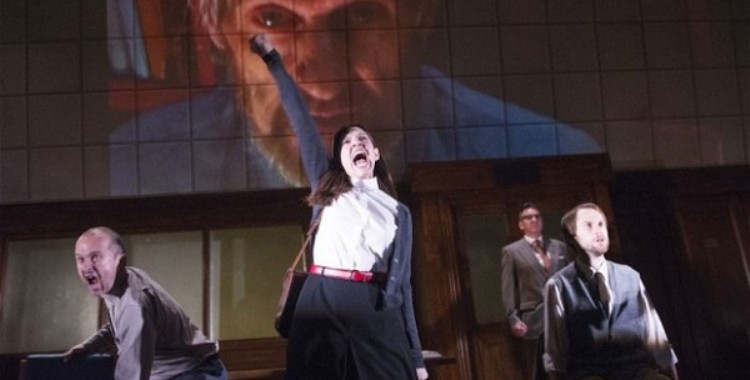
As well as the crossover between temporalities and characters, Chloe Lamford’s inspired set design epitomises this relentless doubling. The first part of the show is contained within a bland office space, all non-descript chairs, wood panelling and boxes of files. This serves as both the setting for the book group and the backdrop of Winston’s existence, demanding metaphor in order to function within the narrative. The only area external to this space is Winston and Julia’s short-lived retreat, which is at once hidden and exposed; it exists off stage, beyond our immediate gaze, but it is revealed to us via video footage on screens, putting us in the position of the ever-vigilant eye of Big Brother. In the final third of the show, meanwhile, this design achieves a breathtaking transformation, stripping away tangible referents in a process that mirrors Winston’s struggle to hold onto memory and reality, yet still refusing to fix itself on just one, determinable location.

And it does not stop with the design. Every last element of this production, from the discordant strains of Tom Gibbons’ sound design to Natasha Chivers’ accomplished lighting, which ranges from the unsettlingly anaemic to the blindingly bright, contributes to a disquieting atmosphere of uncertainty and uprootedness from time. We, like Winston, have nothing solid to grasp onto.

With Chelsea Manning, the NSA and Edward Snowden still dominating headlines, we hardly need reminding of the continued and disturbing resonance of Orwell’s 1949 novel. Headlong’s startling new production, however, suggestsNineteen Eighty-Four’s prescience in another, deeper way. Orwell’s vision, Icke and Macmillan reveal, penetrated beyond the structural framework of surveillance, right down to the disorientating experience of modern life under late capitalism. Like all the worst nightmares, its chill emanates from its uncanniness.

People Show 121: The Detective Show, Old Red Lion

detective-600x355

Originally written for Exeunt.

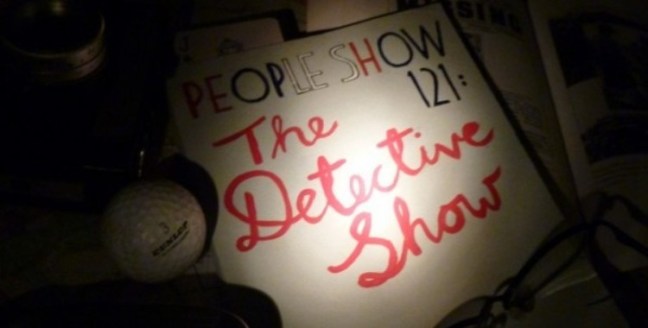
In The Coming Storm, Forced Entertainment’s latest offering, some critics saw an even greater self-reflexivity than usual; it was suggested that the show was in some way concerned with the company’s legacy and with deconstructing its familiar dramaturgical strategies. In the new piece from The People Show, an experimental company with a considerably longer history, there seems to be a similar focus. People Show 121: The Detective Show (the sheer accumulation of work indicated by the title alone is quite extraordinary) is as much a reflection on the company’s own techniques and its far-reaching influence as it is a dissection of the much-loved detective genre. It’s less whodunit, more how was it done.

Having been around since the 1960s, it’s hardly surprising that The People Show’s influence has rippled out to countless other theatremakers over the years. Now, however, the company is faced with the strange dilemma of being placed alongside the work it has spawned, much of which has caught up with – if not overtaken – its taste for experiment. As a way of acknowledging and negotiating this, People Show 121 makes no attempt to ignore or overcome the company’s history, which is immediately hinted at on stage by the presence of tireless original member Mark Long. Their techniques are flagged up, exaggerated, even lightly mocked for being hackneyed. As one performer apologetically explains, they are – like so many of the companies who were inspired by them – “just trying the postmodern thing”.

Here, the “postmodern thing” proves to be a knowing deconstruction of both detective narratives and the mechanics of theatre. In the rambling, charmingly chaotic plot, a hapless jobbing actor falls for an Agatha Christie obsessive with a dangerous secret to hide – a secret that soon sees her sprawled out inside the cartoonish chalk outline on the floor. Within the frame of this murder mystery, the structure of the show also manages to support a surreal game of Cluedo, a dancing Poirot and a hilariously hammy Italian waiter, along with plenty of over-the-top mime and some deliberately self-conscious narration.

It’s an intentional shambles, riffing on familiar detective genre tropes to generate laughs, while at the same time nodding to the now popular technique of presenting failure on stage. Performers Long, Gareth Brierley and Fiona Creese bicker between scenes, undermine each other’s performances and at times almost bring the whole piece crashing down around them, only to pick up the fragments of the show and carry on. It’s deliciously silly fun, effectively skewering a tactic of contemporary performance that has now become so prevalent it is danger of congealing into cliché.

Belonging to one of the generations created under the influence of The People Show rather than having direct exposure to the first shocks of its innovative approach, my perspective on this work is inevitably coloured by coming to it through its theatrical progeny. For me, however, the postmodern mickey-taking of People Show 121 – for all its undoubted fun – ultimately lacks any real bite of its own. Instead of offering the sort of bracing, experimental approach that has made them such a force over the years, The People Show attack an aesthetic that is all too familiar.

The Events, Young Vic

events-600x336

Originally written for Exeunt.

“It’s important to turn dark things into light,” says Claire, the anguished figure at the heart of David Greig’s new play, not quite convincing herself. The Events,Greig’s response to his conflicted feelings about the Norwegian massacre committed by Anders Breivik, is driven by a similar desire and tempered by similar doubt. As much as its protagonist, The Events searches for understanding, redemption, hope. What it finds is nothing so straightforward, but it is all the more compelling for the complexity it excavates on stage.

While sparked by a discussion between Greig and director Ramin Gray following the Breivik atrocity, this is not about what happened in Norway in July 2011. Instead, the events of the show have ripped apart a small, unspecified seaside community, where a boy has shot and killed several members of a local multicultural choir. Claire, the leader of the choir and a survivor of the massacre, is searching for answers. How did this happen? Why did it happen? Did the perpetrator have a reason, or must his actions be put down to “evil”?

Through the character of Claire, played with compassion and complexity by Neve McIntosh, the play prods at the insistent human desire to understand. Without understanding, Claire’s rage is impotent, directionless. In search of either an object for her hatred or an explanation that might pave the way to forgiveness, Claire hunts everywhere for answers, interrogating in turn the murderer’s father, his schoolmate, the leader of the right-wing political party whose ideology he laid claim to. But the more details are added to the sketch, the more the picture is obscured.

The succession of individuals questioned by Claire in her search for the truth are all played by Rudi Dharmalingam, who also represents the perpetrator of the central atrocity. This canny choice by Greig and Gray can be read in a number of ways. On the one hand, Claire seems to be seeing the face of the murderer in every place she looks, unable to escape him even in the embrace of her lover. The playing of all other roles by one actor also creates an intriguing quality of slipperiness; the killer is both everywhere and nowhere, inhabiting each last crevice of her consciousness while at the same time taunting her with his elusiveness. The ambiguity is enhanced by Dharmalingam’s performance, which meets Claire’s desperation with a refusal to emotionally engage, delivering each line with the same blank, lightly mocking intonation.

The impression we receive is that of a woman caught in a self-constructed labyrinth of questions, finding herself more and more lost with each new turn. There’s a certain disjointedness to the scenes, an apt sense of confusion and dislocation that hints at the incomprehensibility of what Claire is trying to piece together. Claire is a woman unmoored; unmoored from her faith, from those around her, from a previously solid sense of reason and logic. Buffeted by the currents of grief, rage and an utter failure to understand, she is alone in a sea of uncertainty.

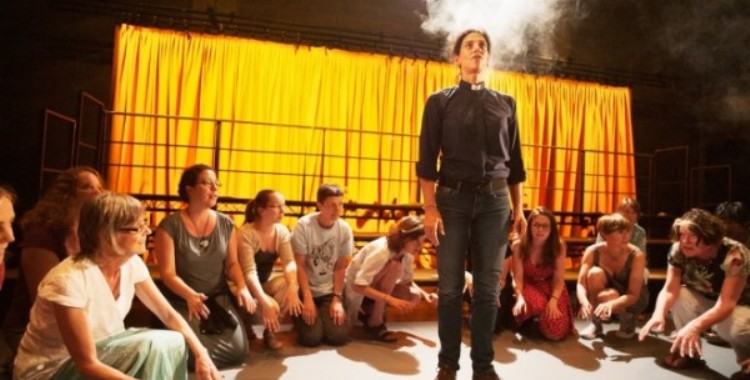
Claire’s struggle is reminiscent of certain strands in Chris Thorpe’s There Has Possibly Been an Incident, both in the subject matter – Thorpe’s play also features a massacre with hints of Breivik – and in its staging. In There Has Possibly Been an Incident, individuals are isolated down to the level of voice, which speaks against the blank, bland backdrop of Signe Beckmann’s minimal design. Here, Chloe Lamford’s set is similarly, masterfully simple. The stage is relatively bare, furnished only with a few rows of benches, a garish orange curtain, a piano, stacks of plastic chairs and tables loaded with teacups. The visual cues that this design offers are all painful reminders of the choir rehearsal room, but more important is the yawning empty space in its middle. In this space, McIntosh’s tormented Claire searches for ways to fill the gap, not just investigating but also acting, playing out different outcomes and solutions.

Sharing the sparsely furnished stage with McIntosh and Dharmalingam throughout the show is a local choir, different every night. This touch, which on paper has the sound of a gimmick, is in fact the production’s masterstroke. On the level of the play’s narrative, their role is one of haunting, suggestive of how something – the soul, God, the accusatory whispers of the dead – can remain present even in its absence. The choir’s presence and the songs they add to the piece also nod towards the potentially redemptive and community building power of music, which at first has a flavour of bitter irony, but eventually sweetens into something like hope.

On the level of the production, meanwhile, the choir does something even more interesting. Arranged on a bank of seating directly opposite that in which the audience is arrayed, the singers act as witnesses; mirroring the audience, they struggle alongside us to grapple with the questions the play poses. Their lack of slickness or preparation also adds a vital roughness, a slightly messy and unpredictable edge that makes the piece all the more truthful and affecting. At one moment during the performance, I notice one of the choir members raise a hand to her mouth, an involuntary but striking movement that focuses my attention on the theatrical dimensions of the event – the fact that we are sharing a public space and collectively processing this effort to understand.

In his introduction to the playtext, Gray writes that “Every act of theatre revolves around a transaction between two communities: the performers onstage and the improvised community that constitute what we call an audience”. His choice of the word community is no accident. The Events is all about communities – or “tribes” – with no small amount of tension contained in that notion. Community in the sense encapsulated by Claire’s choir is overwhelmingly positive, yet it is also in the name of community, or of protecting a certain community, that atrocities like this are committed. Greig’s intricate, finely tuned arguments have a habit of sharply pivoting, challenging our assumptions and once again subjecting everything to knotty ambivalence.

In the end, how these events and their wounding repercussions read is down to each of the individuals in our improvised community, the audience. It is easy to take despairing doubt from what we are presented with, but it’s equally possible to seize on hope. Near the end, a crucial moment in the narrative is suddenly ruptured by the intervention of a choir member, who reads from a script explaining the different between chimps and bonobos. While chimps solve conflict with violence, bonobos prefer sex to aggression, greeting their enemies with embraces. Humans, we are told, share exactly 98% of our DNA with each species. Which, therefore, do we most resemble? The implication, like that of the whole production, is that it for us to decide.

Photo: Stephen Cummsikey