Puffball, The Yard

PUFFBALL-11

Originally written for Exeunt.

Caroline Williams is inundated with owl paraphernalia. Bags, cushions, figurines stuffed with stale potpourri. Owl faces peer out from all corners of the stage, eyes wide and unblinking, feathers a variety of colours. All that’s missing is a link to a YouTube video and the hashtag “cute”.

But Williams’ show, unlike the twee figurines that she passes around the audience, only flirts with whimsy. The painted owls are the echoes of a real one, the eponymous Puffball, who Williams looked after and nursed back to health a few years ago. After she and Puffball finally parted company, Williams tells us, friends and family suddenly flooded her with owl themed items, from soft furnishings to pieces of jewellery. The problem is, she doesn’t really want them.

This flurry of well-meaning but unwanted gifts is an apt metaphor for the darker, fast-beating heart of the show, buried beneath the fluffy feathers. At the same time as Puffball was recovering from his injuries, Williams was also trying to get better, although her wounds were not visible ones. Somewhere between the laughter, the figurines and the charmingly simple Microsoft Paint illustrations that are projected onto the back wall of the Yard, Puffball obliquely but painfully conveys the experience of depression. The owl offerings – simplified and infantilising versions of the real thing – can be read in this context as misguided attempts to understand the tangled complexities of mental illness; given with the best of intentions, but unhelpful nonetheless.

This is never quite as simple, however, as a human story seen through that of an anthropomorphised animal. True, Williams offers Puffball an acute, troubled consciousness, evocatively narrating his emotions – from the paralysing terror of falling from the treetop canopy to the numb apathy of his slow recuperation. But this is countered with an insistence that what we are being told is purely the “truth” about owls, an insistence that is reiterated by punctuating the show with a series of “owl facts”, delivered in the forcefully exuberant style of a children’s nature documentary. Williams implicitly acknowledges the absurdity of projecting human experience onto an owl, an acknowledgement that gradually folds the narrative back onto her.

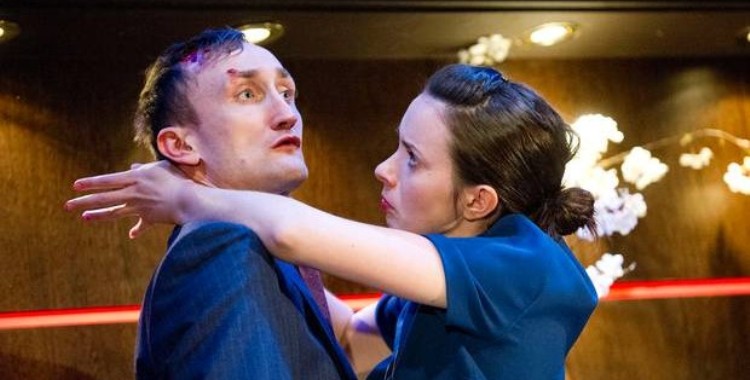
Despite the personal proximity of events, which seeps through in brief but heartbreaking moments of vulnerability, Williams is a warm and involving presence, effortlessly recruiting her audience to take part in some of the show’s sillier sequences. One such scene involves us all standing up and flapping our arms, feeling at once daft and oddly joyous. The participation can at times seem clumsy and slightly detached from the piece as a whole, but perhaps this dislocation is fitting. We are kept at arm’s length from the experience of depression, itself an isolating illness. The most powerful point in the narrative arrives when Puffball and his human carer look at one another, recognising what the other is, but neither can hear the other’s words. In one devastating moment, connection is suggested, attempted and cruelly denied.

Photo: Paul Blakemore.

RIOT, National Theatre Shed

RIOT

Originally written for Exeunt.

On 10th February 2005, in the early hours of the morning, around 6,000 people pushed, kicked and shoved their way into a newly opened retail store. The reason? Cheap sofas and cut-price candles. The story of the riot at the Ikea store in Edmonton is a strange and disquieting one – a troubling illustration of just how far we’re willing to go for a bargain. As a critical lens on modern consumer culture, it makes a striking premise.

This is a starting point that the aptly named Wardrobe Ensemble attack with energy and wit, but also with indecisiveness. Their show, a vivid mash-up of physical theatre, music, comedy and critique, feels torn between two different – and not entirely compatible – stories. The first is that of the riot itself, shining a discount Swedish lamp on the insidious greed that drove the mounting chaos. Is it the bargains, the shoppers or the culture itself that is to blame? Wedged alongside this, like the ill-fitting joints of a flat-pack bookshelf, is a warm and witty comedy about the employees of the store, whose awkward romantic entanglements are rudely interrupted by the hordes of frenzied shoppers trampling through the show-rooms.

These two separate narratives are never quite slotted together; as so often with flat-pack furniture, a vital screw is missing. Despite this incongruity, however, The Wardrobe Ensemble offer much to delight in throughout this fast-paced hour long show. Their physical work is sharper than many other young companies in a similar vein, constructing precise and often hilarious stage images. The lighting – all Ikea lamps, naturally – offers an ingenious and surprisingly slick take on the DIY aesthetic, while the music provides a riotous soundtrack for both comedy and chaos.

It is only a shame that the intellectual muscles beneath are not as flexed as those of the tireless performers. There are many intriguing elements of this scenario that remain underexplored: the responsibility held by the Ikea store for its aggressive price-slashing, the sense of entitlement bred by a society that always promises newer and better, the invasiveness of 21st-century consumer culture, our increasing detachment from the production and value of the objects we buy, the contextual position of this event just a few years prior to the financial crisis. While they could do with further unpacking, however, the germs of these thoughts can be glimpsed, in some moments more clearly than others. The nuance might need work, but the ideas are definitely there.

And how brilliant that a young company like The Wardrobe Ensemble have the chance to showcase their work at the National Theatre – with flaws, yes, but also with energy and passion and invention. The current Limited Editions season offers a perfect demonstration of the advantages of The Shed as a temporary space and the freedom of its programming to support both young artists and young audiences. There’s a youthful excitement in the auditorium and in the bar afterwards that, if nothing else, is a fantastic thing to see. The real test will be if that can stretch into the main building after The Shed’s bright cladding is dismantled.

Cheese, 29-31 Oxford Street

Cheese-credit-Conrad-Blakemore-600x400 (2)

Originally written for Exeunt.

As fanSHEN’s creative director Rachel Briscoe commented in a blog for The Guardian, “starting points matter in theatre”. Unlike others, who may interrogate the damage done by our resource-hungry society through content and even form but leave the structures that support them unexamined, sustainability is at the very foundation of fanSHEN’s work. However powerfully it delivers its punch, it’s hard not to watch a technically accomplished show like Earthquakes in London and wonder cynically where the energy is coming from; in the case of Cheese, fanSHEN’s new site-specific look at the financial crisis, there’s no need to wonder.

Every last element of this production is influenced by its relationship to the company’s sustainability aims. Joshua Pharo’s unusual but striking lighting design is a necessity of limited energy, all of which is provided by electricity generated in local gyms and community centres; the DIY aesthetic and unmasked theatricality are a consequence of constraints set by the company on the materials it uses. Because these limitations are there from the beginning, embedded right in the heart of the company’s philosophy, they end up closely married to the work. As well as practising what they preach, fanSHEN’s dedication to sustainability is reflected off every facet of their work, both informing and supporting it. This is theatre that recognises its role in making as well as showing, enacting at the same time as it represents.

Unfortunately, however, the different strands of the show itself do not gel quite as cohesively. Nikki Schreiber’s play adopts an absurdist approach in order to take a sideways look at the financial crisis, creating an allegory that substitutes cash with cheese. Protagonists Joe and Freya seem pretty cosy in their Emmental house, but when their supply of cheddar, brie and gruyere suddenly dries up overnight, they are forced to reassess their existence – and their diet. Freya is quick to pursue a new life, while Joe stubbornly clings to the vestiges of the old one until disillusionment and hunger send him on a journey in search of fresh flavours.

The central story of Joe and Freya’s rise and fall is a cannily plotted exploration of the predicament we now find ourselves in, using a metaphor that functions both as a lucid explanation of the financial crisis and a means of highlighting the absurdity of the actions that caused it. The surrounding narrative, however, is not so tight. Joe’s journey, despite offering a series of entertaining encounters, takes a decidedly meandering route. At one point, for instance, he finds himself talked into participating in a psychological experiment, the outcome of which offers a telling and unsettling diagnosis of our response to perceived authority. While this sequence is sharp, disturbing and theatrically compelling, however, it serves as a distracting digression from the main trajectory of the piece, addressing a question that is fascinating but tangential.

The play proper is also framed by another reality, which is where the site-specific element of the piece comes in. The fictional setting of this very ordinary office space on Oxford Street is the London Mortgage Company, which is having its last post-liquidation hurrah by putting on this deeply apt bit of theatre for its departing employees. This device acts as an explanation for the potentially temperamental power – the company haven’t been able to pay their electricity bill – and for the deliberately shoddy props. With simple and often hilarious flourishes of ingenuity, elastic bands become pieces of cheese and bulldog clips stand in for tomatoes.

This framing is the source of much of the piece’s humour, as the cast get to relish in some of the worst excesses of am-dram and theatrical tricks are stripped back to their bare basics. But Rachel Donovan, Jon Foster and Jamie Zubairi are all far too good to consistently convince as awkward novice thesps, while the truly beautiful theatrical moments that emerge from the enforced simplicity are undermined by the implicit mockery. The relationship between frame and image also feels regrettably underexamined. Why are the employees choosing to put on this play? Are they aware of its shattering resonance with their own predicament? The dissolving layers of meaning would seem to suggest so, as distress and anxiety bleed both ways, but the interaction between the two concepts demands further scrutiny.

Despite these criticisms, however, there is much that the piece offers by way of obliquely insightful political comment. The impulses that invisibly motor our society are unveiled through the distance offered by metaphor, while the possibility of resolution is complicated by an astute critique of localism and a recognition of our continuing desire to protect our own interests first and foremost. But there is still hope. Alongside sustainability, central to fanSHEN’s work is a belief that imagination, not fear, is the pathway to change. So, despite the underpinning of self-interest and the ambivalent attitude towards the wider world, we are ultimately offered a chink of much needed optimism. This too is inherent in the very mechanisms of the work, which makes its own change. If fanSHEN can shift the way in which their structures operate, then why can’t we?

Photo: Conrad Blakemore.

Fleabag, Soho Theatre

Fleabag-at-Edinburgh-2013-DryWrite-courtesy-Richard-Davenport-41-600x399

Originally written for Exeunt.

“It’s not fucking funny,” retorts Phoebe Waller-Bridge at one point in her blistering one-woman show, slicing through the audience’s laughter. But Fleabagis funny. Very funny. A riotous clash of confessional stand-up and exposing monologue, the brilliance of the piece is in its ability to land a joke at the same time as shaking its foundations. It leaves you laughing one moment and questioning your response in the next.

As well as funny, Waller-Bridge’s play is audaciously filthy. Her uninhibited protagonist reels off a giddying litany of wanks, threesomes and one night stands, heedless of boyfriends or menstrual cycles. The eponymous Fleabag – she is never offered another name – flits seemingly carefree from encounter to encounter, always on the lookout for the next no-strings-attached fuck. These brief liaisons are at once joyous and grubby, walking a fine tightrope between sexual liberation and humiliation – and not without the odd wobble.

The real power of all this X-rated content, hilarious as it often is, lies in the surprising lack of shock that Fleabag’s confessions provoke. It’s uncomfortable, yes, and the unflinchingly dirty anecdotes necessitate the odd sharp intake of breath, but there is little that really, substantially shocks. In a mirror image of Waller-Bridge’s disturbingly blank expression as she searches through every last genre of porn – gay, Asian, anal – we have ceased to be surprised by the sex that seeps into every last corner of modern society.

It is this over-sexualised society that Fleabag is the ultimate product of. She might have a distressingly one-track mind (“I’m not obsessed with sex,” she protests, “I just can’t stop thinking about it”), but if she does it is as a direct result of the world in which she has grown up. And if this pervasive presence of sex was not enough, the play also hints at the conflicting roles in which women are cast by society. Sexual freedom is popularly portrayed as a cornerstone of gender equality, in a through line that can be traced straight from Sex and the City to its ironic, grittier younger sister Girls, but at the same time women face criticism for pandering to the sexual fantasies of men. Does being a “slut” or disliking one’s body make a woman by default a “bad” feminist?

This is the sort of question that the piece is careful not to answer – at least not definitively. The complex ambivalence of the tone is personified in Waller-Bridge’s dazzling realisation of her protagonist, an individual who is both defiant and damaged. Beneath the swaggering sexual bravado, we see vulnerable glimpses of grief and loneliness, but as soon as she begins to soften Waller-Bridge complicates matters again with another jagged edge, another comic flourish. Just as the script is scattered with perfectly formed gags, Waller-Bridge’s comic timing is flawless, speaking of an impeccable control that is at odds with the spiralling chaos of the life she narrates.

And in the end comedy is the play’s killer weapon. Waller-Bridge brashly defies any claims that women aren’t funny, but Fleabag’s ability to make others laugh is intimately and troublingly tied up with the gathering wreckage of her personal life. The stylistic nods to stand-up are no accident; this is a woman who makes a stand-up routine out of her life, craving laughter almost as much as she craves sex. Through her relentless joking and her pushing at the boundaries of what can be joked about, Waller-Bridge is finally able to turn the piece on its audience, confrontationally folding a personal narrative outwards to make us squirm in our seats. After all, we’re the ones laughing.

Photo: Richard Davenport.

The Ritual Slaughter of Gorge Mastromas, Royal Court

The-Ritual-Slaughter-Of-Gorge-Mastroma-620x340

The repeated central question of Dennis Kelly’s dark allegory, emblazoned in giant letters at the back of Tom Scutt’s set, is a troubling one: “goodness or cowardice?” Are supposedly moral decisions just a case of taking the easy road? Is a decision really the “right” one if no “wrong” alternative occurs to you? Are virtue and fear simply one and the same? But beneath it, running in a thick, throbbing artery through the metabolism of the play, is an even more troubling question: is there really any such thing as truth?

In an interview with Maddy Costa for The Guardian, Kelly states his preference for plays that ask questions over those that provide answers, admitting that he’s “not really sure” what The Ritual Slaughter of Gorge Mastromas is about. I would, for the most part, agree that asking questions is more productive – not to mention more interesting – than offering solutions. A question leaves audiences thinking, while a firm conclusion can immediately alienate those who don’t agree with it. When everything is questioned, however, the provocation to look for answers is neutralised. Why search for a version of the truth if all truths are exposed as relative and ultimately meaningless?

Life’s stark absence of meaning is a revelation that forms the hinge of Kelly’s play. His eponymous protagonist, Gorge Mastromas, starts out as an essentially moral human being. When offered a choice, he takes the decent option, be it standing by a mate at primary school or remaining faithful to hastily voiced promises. Kelly and director Vicky Featherstone offer us this series of early incidents in Gorge’s life via an extended sequence of collective storytelling: the six cast members sit in a line of chairs at the front of the stage, sharing the history of Gorge’s life from the moment of his inadvertent conception. And my use of the word “history” is no accident; this simple but striking opening deliberately foregrounds the construction of historical narratives, offering a fragmented, unreliable and polyvocal account of Gorge’s life, told from a perspective that is never quite acknowledged or qualified.

Our protagonist’s Faust moment arrives when a ruthless businesswoman briskly informs Gorge that life is not what he has until that moment believed it to be – “it is not fair, it is not kind, it is not just”. But if he’s willing to sell his soul to the demons of cutthroat capitalism and merciless self-advancement, he can have whatever he wants: power, money, sex. The trick is simply to lie from the bottom of his heart, heedless of the consequences of those falsehoods. Embracing this new philosophy with only the lightest flicker of hesitation, Gorge is swiftly mounting the ladder to unimaginable wealth and power – an unstoppable capitalist juggernaut. Be it a company, a house or a woman, Gorge always gets what he wants. What follows is acquisition at the expense of all else, painting a sorry picture of our society’s trajectory and the lessons it implicitly instils in us.

It’s an old story, but one that is drenched in the giddily unfettered capitalism of the 80s and 90s, playing on the myth of indefinite growth and the conviction that everything is there for the taking if only individuals are willing to grab it. The main commodity to be traded, however, is not property or shares, but narrative itself. Gorge is a spinner and seller of stories – most explicitly with his fabricated bestselling memoir, but also in the fibs he blithely tells those around him in order to get ahead. And people want to believe these fictions. When speaking of “people”, that necessarily extends to the audience, all of us eager to grasp onto something solid, some narrative structure that makes sense of this world. By drawing attention to this, and to the lies that even our narrators are incessantly telling, the play makes us immediately doubt anything it tells us, as well as doubting our own interpretations of these versions of the truth.

The shifting ground of Kelly’s play is shaken further by this production – if, indeed, we can speak of the two separately, which is always a slightly disingenuous project. The dynamic division of Gorge’s story between the cast, delivered with an edge of irony, is reminiscent of now ubiquitous techniques of poststructural performance, at once bringing to mind the likes of both Forced Entertainment and Martin Crimp (useful reference points for the disruption of meaning and narrative). This engaging, teasing mode of delivery is contrasted with the far less compelling – and often overlong – “scenes” that pepper the play, offering an ever-so-slightly heightened variation on naturalism. Which offers the picture that is closest to the truth is left down to us, as the performance style of each in turn subverts its own stated veracity.

The figure of Gorge himself, meanwhile, is a tight knot of contradictions. When Tom Brooke first shrugs on the role of the anti-hero, he is a quivering, deferential employee, eager to please and anxious of hurting. After offering such a detailed portrait of this meek, decent man, it is difficult to dismiss his ghost, which hovers over all of Gorge’s subsequent deceptions. Never is he quite as convincing as when still in possession of his morals. Alongside the fleshed out emotional detail that Kate O’Flynn’s compassionate performance offers Louisa, the unlucky object of Gorge’s affections, Brooke’s mercenary entrepreneur is a skeleton of a character, at times nearing a caricature of capitalist greed. Yet this thinness seems oddly apt; it could be argued that it shows up the absurdity of this Game Theory style of self-serving logic in both life and drama. Human beings are strange, irrational creatures, and to drain them of that irrationality – be it by a capitalist logic of acquisition or a notion of drama that is built upon clear character motivation – leaves only empty shells.

The empty facade is also a recurring feature of Tom Scutt’s intelligent, thematically excavating design. His self-contained naturalistic spaces, which form the backdrop for the correspondingly “realistic” scenes, always offer a hint of superficiality, from the calculated blandness of a corporate office to the moneyed sheen of a hotel suite. By the time the scene shifts to Gorge’s lakeside palace and a dilemma that will test just how far he’s prepared to go to protect this painted paradise, any attempt at substance is abandoned, leaving only a flat simulacrum of a landscape on a screen behind the actors – the shimmering mirage of Gorge’s life, concealing only emptiness. Elsewhere in the design, the stubborn search for a pattern is offered visual expression: the constellations of a life are brightly dotted on an image of the night’s sky, paper is pinned to the walls in imitation of the detective’s evidence trail, and neon lines are traced over a graph.

Through this kind of detail, The Ritual Slaughter of Gorge Mastromas offers much to chew and puzzle over, for the most part sustaining intellectual vitality over its testing two hour and 45 minutes running time. That hovering question mark over truth, however, niggles at me throughout. While I have other doubts about the piece (it’s far longer than it needs to be, for starters, and Gorge’s moral descent lacks the punch that I suspect it’s reaching for), my main concern is prompted by its political position; or, rather, how it seems to politically let itself off the hook. The questioning of truth is interesting in itself and follows the thread of much poststructuralist/postmodern (depending on how you like to define it) thought in suggesting that there is no foundational reality that we can appeal to, but it is equally in danger of rendering all truths equally invalid, thus making any attempt at morality pointless.

My mind is dragged back to the recent discussion Dan Hutton and I had about hope in theatre, which strayed into similar territory. In that dialogue I borrowed from Liz Tomlin’s new book Acts and Apparitions (a text that I increasingly think could be a vital reference point in navigating post-postdramatic performance practice), and it feels appropriate to return to Tomlin now. Her book traces the postmodern thought mentioned above and considers the possibility of making a radical gesture in theatre today, when any notion of the true or the real has received a thorough battering. To demonstrate how she grapples with this, I want to quote part of the text:

“Accepting that every narrative is implicitly ideological does not equate to the acceptance that any given narrative is thus beyond ideological analysis or distinction. The artist or critic’s choice to propagate one narrative over another will still result in a ‘real’ impact on the artists, the audiences and, to some degree at least, the ideological shape of the historical period in which the work is situated.” (pp.6-7)

In other words, the version of the truth that we choose to tell has an effect, whether or not it can appeal to some original, authoritative, universal truth. This version of the truth might even have the power to change the world, a power about which Gorge Mastromas feels distinctly ambivalent. Individuals such as Gorge can change things, but only for their own gain; beyond the certainty of lying, the universe is portrayed as cold, cruel and chaotic. If we choose to present an image of the world in which there is no truth, only lies, then perhaps there is a responsibility towards the “real” impact of that image. By seemingly refusing that responsibility and falling back on relentless uncertainty, Gorge Mastromas – for all its merits – feels like a bit of a cop out. If the question is “goodness or cowardice?”, I would tentatively suggest that Kelly errs towards the latter.

Photo: Tristram Kenton.