The Ghost Hunter, Old Red Lion Theatre

The-Ghost-Hunter1

There’s something coincidentally apt about seeing The Ghost Hunter the day after making the trip down to Brighton for Peter Reder’s The Contents of a House. Reder’s show, following the guided tour format that has stitched a fruitful thread through his past work, takes audiences on a journey around the luxurious parlours and creaking back corridors of Preston Manor, sharing snippets of history and spinning stories about the house’s former inhabitants. The piece both copies and undercuts the form it has appropriated, asking implicit questions about how such guided tours select and present their material for the benefit of curious visitors. So, by sheer serendipity, tourism is on my mind.

Dick, the protagonist of Theatre of the Damned’s new show The Ghost Hunter, adopts a role not all that different from Reder’s. The word “hunter” is deceptive; really, Dick is a storyteller, spooking the tourists and schoolchildren of York with fabricated spirits. He runs a ghost tour, capitalising on the city’s crushing weight of history – Viking invasions and massacres, devastating outbreaks of plague – for the sake of a quick buck. He ransacks local history guides for material, dreams up new yarns over pints in local pubs, and knocks together a Ghostbusters-inspired “communication” device from tinfoil and an old wireless. Punters listen avidly to the white noise, Dick tells us, convinced they can hear voices from the afterlife.

Despite the inclusion of a couple of spine-chilling narratives, Stewart Pringle’s one-man play is less about the art of scaring than about why we tell ghost stories in the first place. Tom Richards’ compelling tour guide, sporting full Victoriana and a rather impressive pair of sideburns, is a failed actor with a drinking problem who fell – quite literally – into the job. It’s an easy enough way to make money, he explains, in a city built on ghosts. Lightly playing with the format of which Dick is a master, the intimate set-up places its audience in much the same position as the tourists who come in their hordes to hear about headless women and restless poltergeists, implicitly questioning the desire that drives this trade. And it is a trade – a roaring one, in fact. Gruesome tales are “contagious”, while ghosts are an “intangible resource”. The ghouls never dry up.

But unlike Reder’s upturning of the guided tour format (which at one point acknowledges our love of a good haunting, asking the staff of Preston Manor to share their supernatural experiences), the focus here is on the storyteller rather than his listeners. What makes a person pursue a living selling terror? Switching skilfully from the charismatic gloss of Dick’s “ghost hunter” persona to the wide-eyed confessional of a man grappling with a different kind of haunting – all the while slurping his pint – Richards reels us in bit by bit, lending a melancholy fascination to Pringle’s slowly unfolding monologue. If ghost stories really are, as Dick’s one-time boss says, “a place to put things you’re too scared to look at any more”, what psychological scars might impel the ghost hunter’s strange art?

Sitting beneath all this is an acute awareness of how ghost stories work, their delicate mechanics. While it takes its time to tighten its icy grip, once the plot has us by the throat it isn’t in any hurry to let go, teasing out small details at just a brisk enough rate to keep its audience engrossed without ever giving too much away. Hints are slyly dropped, stories started and abruptly truncated. Pringle’s script is always knowingly holding something back until the end; the “headliner”, as Dick brands it. There might be rooms along the way that we want to linger in – the exploitation of history and memory for profit, for instance, could do with further investigation, and it would be nice to see more of the sharp humour that punctuates the horror – but the show follows the wisdom of the ghost tour in keeping the journey tightly focused. Like the tourists lusting after their souvenir slice of blood and gore, you won’t want to look away.

The Universal Machine, New Diorama Theatre

Universal-Machine-600x400

Originally written for Exeunt.

Can machines think? It’s a question that captivated mathematician and code-breaker Alan Turing, a life-long obsession with the mechanical that is signalled in the very title of this unlikely but intriguing new musical about his life. Here, the desire for a more machine-like existence – one without aging or change or any of the messy complications of being human – is a central and recurring if not fully excavated theme. The desire might be there, but its full implications resist exploration.

Turing’s life and particularly his complex, pioneering work are not easily reducible to a concise two hour show, making writer and director David Byrne’s careful process of pruning and selection an impressive achievement in itself. He has taken as his focus this wistful fascination with machinery, a fascination that is contrasted with Turing’s few valued human relationships; his mother, portrayed in a moving turn from Judith Paris, is a constant background presence, while a youthful infatuation with close friend Christopher Morcom is shown to haunt the rest of Turing’s life and all his intellectual endeavours. He yearns for the uncomplicated existence of the machine, yet he wrestles with emotion that is far from coldly mechanical. It’s significant that when Turing looks to the future, predicting the rise of artificial intelligence, he speaks of machines that will be capable of love.

Just like Turing, Byrne’s show can’t entirely shun the sentimental in favour of the mechanical, but for the most part this production avoids over-playing the tragic elements of its protagonist’s short life. Instead, attention is given to his extraordinary mind, its workings and its memories scrawled out on the stage of the New Diorama Theatre. Bare black walls, occasionally used to host projections, suggest the scholarly blackboard, while the near-constant presence of desks cements an atmosphere of sometimes feverish concentration. As Turing looks back over his life – a device of speaking across time that provides a useful if occasionally clumsy frame – a carefully selected range of props acquire the traces of memory, hooking the narrative into the next scene.

As so often with the musical form, there’s the danger of a complex narrative being stripped down to a series of neat plot points, significant moments that offer the opportunity to break out into song. Dominic Brennan’s music is at its best when reflecting the mechanical workings of Turing’s mind, clicking along with a rapid pace reminiscent of the turning cogs of both machinery and mind as the Bletchley Park cryptanalysts build the bombe, the machine Turing designed to help break the Enigma code during World War II. Elsewhere, however, its use is not entirely clear, sometimes serving a plot function, sometimes offering emotional illumination – as with Sara Turing’s heart-breaking attempt to come to terms first with her son’s homosexuality and then with his suicide – sometimes simply providing a few laughs. Early on there’s the suggestion that the musical genre could intelligently unpick Turing’s painful difficulty connecting with the world, the song of those around him highlighting his own alienation, but this possibility quickly fades away.

The production does, however, manage to convey a sense of a man out of place in his own time, a man who might well seek solace in machines when the human world disappointed and baffled him. In this central role, Richard Delaney is a quiet, awkward presence, still but for his habitual fidgeting, while the rest of the cast whirl chaotically around him. Turing might be at the centre, but he avoids the spotlight, remaining the fixed focal point of a narrative that becomes just as much about those around him. Fitting as the enigma of Turing’s personality might be, the fictionalised insight that the piece promises remains just out of reach. Turing’s story never fails to compel, but it leaves us frustratedly searching for more.

Table, National Theatre Shed

table11-600x399

Originally written for Exeunt.

It seems appropriate that the first show in the National Theatre’s new, temporary performance space on the South Bank should announce itself just as plainly and unassumingly as its venue. Table, the world premiere christening The Shed, is about just that, using a tough wooden dining table as the focal point for a domestic tale that straddles the generations. Tanya Ronder’s play, tracing 115 years of one family’s tumultuous history, zooms in on the stains that can’t be scrubbed away, the grit that remains lodged in the grooves of the wood and the messages carved indelibly on its surface. Her eponymous piece of furniture is living history, speaking just as loudly as its human owners.

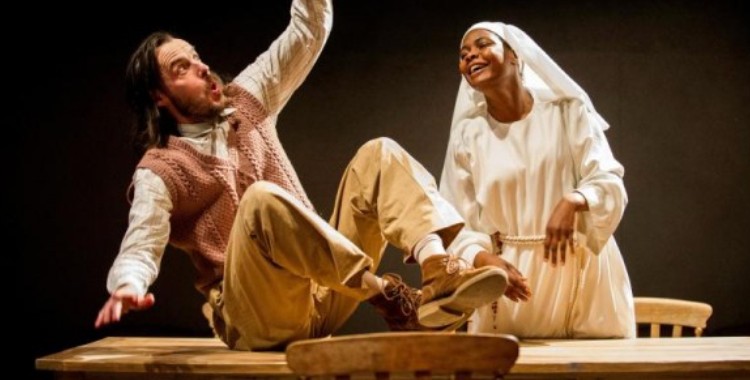
Katrina Lindsay’s design furnishes the intimate interior of The Shed with not one but two tables, the raised wooden space of the stage mirroring the sturdy domestic linchpin that sits upon it. Hewn with love and breathless hopes for the future, this stubbornly resilient item of furniture begins life as the creation of carpenter David Best, made to sit in the home he makes with his wife in late nineteenth-century Lichfield. From here, it is passed down from generation to generation, journeying first to a convent in Africa and then back to England and a hippy commune in Herefordshire, before finally ending up as the battered, beloved centrepiece of a family home in South London. Along the way it witnesses sex and betrayal, deaths and births, the grime and the mess and the joy of human life.

Ronder packs a lot into the play’s two hours and 20 minutes, at times resorting to the crowbar. From troubled nuclear families to a convent of missionary nuns, from a commune dedicated to alternative living to a gay couple with a half-Asian daughter born through a surrogate, there is a determination to portray as many different living arrangements as possible over the span of six generations. While this tactic provides colour and continual interest, the limits of plausibility are occasionally stretched, and some scenes – such as the painfully stereotypical commune, complete with goat’s milk and bed-swapping – seem inserted purely for laughs. The first half of the show is tight and cannily plotted, engaging the emotions with impressive rapidity, but as the narrative goes on the grip progressively slackens.

Although Ronder’s plot may run away from her, Norris’ sensitive, precise direction offers up some heart-catchingly beautiful moments: the presciently precarious, delicate image of David’s short-lived bride ascending a row of chairs in her wedding gown; the use of the table as a womb giving birth to the next generation, from which a protectively curled performer tumbles, Bambi-like, all helplessly flailing limbs; the gorgeous sequences of song that cradle the piece, smoothly linking scenes while nodding to ritual and familiarity. The production also benefits from a set of uniformly committed performances from its cast, who wring extraordinarily vivid characterisations from Ronder’s series of fleeting snapshots.

For all that this journey through the generations might be contrived – and, make no mistake, it is – the slightness of its meandering plot is balanced by a charm that begs forgiveness for its flaws. But when the smile fades, this production still leaves us wondering what it might be saying about the family, a unit of living that receives just as much of a bashing over the years as the table that unwaveringly anchors it. Are we damned by what we inherit, both in terms of the traits passed down to us and the upbringing we receive? Ronder’s generation game would seem to suggest so, as each successive member of the Best family kicks against what has come before but inevitably makes similar mistakes; generation upon generation of children knowingly or unknowingly wronged by their parents. And by the end, even our old friend the table is endangered, at threat of being replaced by a sleekly functional sliver of glass from Ikea. History might be deeply ingrained, but we are all too good at forgetting.

The Seagull, Nuffield Theatre

????????????????????????????????????????????????????????????????????????????????????????????????????????????????????????????????????????????????????????????????????????????????????????????????????????????????????????????????????????????????????????????

There’s a canny, twisting circularity to this bold new version of Chekhov’s gloomy masterpiece. In an early conversation between lovesick young writer Konstantin and his uncle Sorin, a throwaway reference is made to Escher – master of the impossible image. As the play progresses, this glancing allusion becomes something of a metaphor; as in the artist’s famous staircases, Chekhov’s melancholic characters climb only to descend, walking round in hopeless, navel-gazing circles until the paradox of existence itself becomes inconceivable. Here the beautiful is also entrapping, leading to a dead end or a sharp drop.

Headlong’s take on The Seagull was never going to be blandly traditional, but this new interpretation by playwright John Donnelly and director Blanch McIntyre injects Chekhov’s play with impressive vigour, achieving the often promised but rarely delivered feat of rendering a classic totally fresh. The production applies a new lens to the text by wisely resisting the urge to wrestle it into contemporary trappings – the troublesome horses are still firmly present, alongside vaguely modern dress – instead embracing its vaunted timelessness. Much as the Young Vic’s recent version of Ibsen’s A Doll’s House lightly played with temporality, displacing the narrative enough that it could seem somehow both period and contemporary, Chekhov’s characters are knocked out of their time.

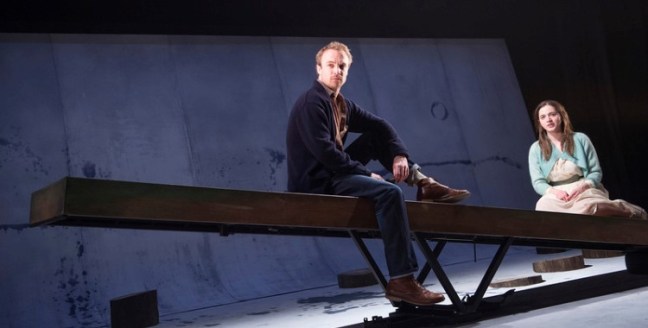
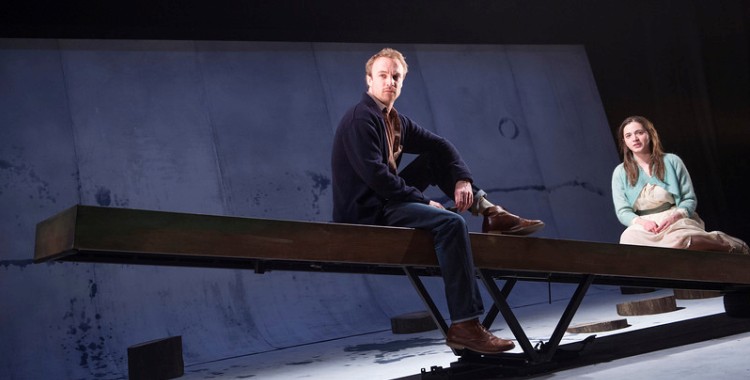
This temporal displacement works across direction and design; Laura Hopkins’ empty grey shell of a set, virtually robbed of visual reference points, could almost be the post-apocalyptic landscape described in Konstantin’s play, the occasion for which Chekhov’s cast of ennui-stricken bourgeois characters are initially gathered. Throughout the romantic entanglements and artistic trials that follow, a long seesaw becomes the striking centrepiece of the stage, visualising the delicate and ever-shifting balance between the various characters. As one individual ascends, another is dumped unceremoniously back to earth.

As well as drawing attention to its own fragile equilibrium, this production is self-aware in other ways. McIntyre’s approach is deeply concerned with the latent theatricality present within the metabolism of the play, making the characters – in particular the aspiring young artists Konstantin and Nina – sporadically conscious of their own appearance before others, turning to address spectators in sequences that raise the house lights on the audience. Writing, meanwhile, leaves its physical trace on the back wall of Hopkins’ set, vividly animating the act of invention that sits at the play’s core. Essentially, McIntyre reveals this as a play about art, about how the artist sees both themselves and the world.

These particular artists, however, are frequently unlikable in their existential angst, schizophrenically veering between egotistical vanity and brittle, crippling despair. In one pivotal scene featuring Gyuri Sarossy’s quietly self-absorbed Trigorin, the writer’s mental masturbation is strikingly paired with its physical counterpart – a wanker in every sense – as he brings himself to climax while Irina hails him with a verbal assault of praise. Alexander Cobb’s whining Konstantin is little better, weakly reaching for a transcendental ideal that is quickly overshadowed by jealousy, while the excellent Abigail Cruttenden as his narcissistic mother incessantly struts, preens and flirts, the consummate actress in love with her own performance.

For all that stultifying stasis is foregrounded – stillness is central to the make-up of the scenes, while McIntyre is a director unafraid of onstage silences – there remains a certain muscularity to this production, a momentum beneath the lethargy. This is largely down to the vital aggression of Donnelly’s text, fuelled with much the same expletive-laced energy as Benedict Andrews’ revelatory, vodka-drenched Three Sisters, yet equally capable of subdued introspection. Chekhov’s characters might be in love with talking, favouring philosophising over action, but here no words feel wasted. As one character sardonically puts it, “there’s an art to tedium”, and it’s one that this production masters with fresh, fierce, invigorating intelligence.

Photo: Tristram Kenton.

Orpheus, Battersea Arts Centre

DSCF3847-600x497

Little Bulb’s latest show, opening a season that will go on to celebrate the theatre’s prized Scratch format, is Battersea Arts Centre through and through. A product of Scratch itself, Orpheus was conceived following an approach from the theatre asking the company to create a piece in response to the building; a beautiful, sprawling, shabbily grand space, with as much rickety charm as Little Bulb themselves. Sharply propelling themselves from the small, delicately observed pieces they’ve crafted in the past, the company have chosen for inspiration not just the imposing Grand Hall, but also its vast organ, partially restored in time for this production. Rather than treating the room as a challenge, an obstacle to navigate, it embraces it.

Alongside the stunning space in which it is staged, the other key inspiration at the heart of this madly ambitious gypsy jazz opera is the music. The fusing of the Orpheus myth with the music of Django Reinhardt, while working extraordinarily well, gives the impression of resulting from the company’s giddy love of these songs rather than from any natural link between the two. Music has always been at the heart of Little Bulb’s work, and here they stage a passionate love song to the art form. The concept at the centre of this musical celebration is a story within a story: the tale of Orpheus’ descent into the underworld to reclaim his lover Eurydice mounted as a lavish entertainment in a 1930s Parisian music hall, with Reinhardt in the title role of the tragic poet.

Little Bulb’s multi-talented – and in many cases multi-instrument playing – performers find plenty to play with in this set-up. For all the epic, operatic glamour, the company still hold tight to elements of their homemade aesthetic, at their best when cheekily undermining their own creations and poking fun at the genres they simultaneously invoke. In a style that seems somehow spontaneous and precise all at once, the company use the meticulously observed conventions of the silent movie to wordlessly convey the narrative, engaging with and occasionally subverting the gestural and musical basics of how we share stories. There are sequences that threaten to become over-long and self-indulgent, but these are always rescued by a timely interjection of sheer charm – an archly clowning expression, a piece of dazzling invention, a gorgeously silly item of costume.

Extending this playful care and precision, the beautiful space of the Grand Hall and its adjoining bar space are used just as thoughtfully as the content. Cabaret tables cluster around the stage and spill over into the room next door, wrapping audience members in another era as Eugenie Pastor’s glorious, wine-swigging hostess weaves between chairs. The whole evening is crafted as an end-to-end experience, a joyous tumble head-first into the world of the jazz club and the music hall. I for one would happily install wine and cheese as a regular feature of the interval, even if there is something a tad cynical about bringing the bar right into the performance space (well, if Shunt can do it …)

The downside of thinking so big, however, is that it has stripped away some of the miniaturist ingenuity of the company’s smaller work. The ramshackle charm of shows like Operation Greenfield has been sacrificed in favour of something slicker but at times less compelling. The emotion, too, suffers slightly on this larger scale. If Operation Greenfield unabashedly wore its heart on its sleeve, Orpheus wears its bright red, centre stage and decked in fairy lights. This is a story about love, and God forbid we should forget it.

But as ever with Little Bulb, objections begin to feel churlish and after a time resistance is futile. Amidst the epic ambition, there are still some gorgeous little gems: in one hilarious scene the performers don cardboard noses and hooves, instantly transforming into a mad menagerie of gambolling animals; in another, a merry-go-round of appearances and disappearances conjures a vivid picture-book of Paris, sending up its clichés as it goes. And the music, honed through night after night performing together as a jazz band, holds the piece and its audience together, all singing to the same infectious tune. Once Little Bulb’s playing has you in its toe-tapping grasp, it’s increasingly hard to break free.