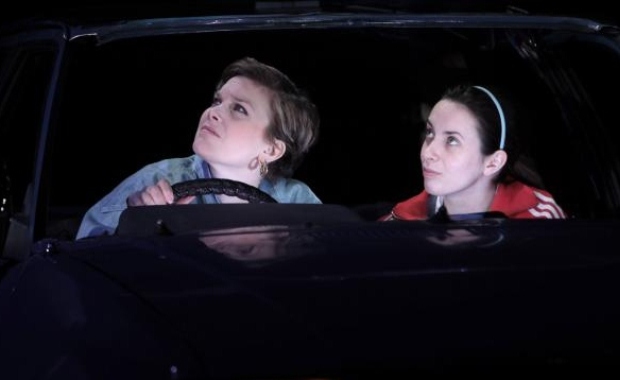
Port, National Theatre

port1

Originally written for Exeunt.

There’s a striking moment, towards the end of this nostalgic, grit-flecked portrait of Stockport, when the concrete-clad surroundings perceptibly shift. Protagonist Rachael, back in her home town after several months away, remembers once gazing up at the clocktower as a soaring skyscraper, a local landmark of immense proportions that in adulthood has dwindled to a mere speck on a vast world. It’s a simple moment, but one that speaks to the shifting space in which we play out our lives, the contours that seem to move and blur as we grow older, the once huge monuments that now feel inconceivably small.

Geography – or more accurately psychogeography – is central to this story of growing up in Stockport, which announces its preoccupation with place in its very title. Rachael, who over the course of the play transforms from a gobbily precocious eleven-year-old to a bruised but optimistic woman of 24, fighting fiercely all the while to get out of the place that has spawned her, is trapped in a town populated with ghosts. First Rachael’s mother and then her grandfather make swift exits from her life, leaving behind traces in the frayed urban fabric. Past exists alongside present in a way that is reflected in the circumstances of this production, a revival of the play’s 2002 premiere at the Royal Exchange Theatre headed by the same creative pairing of Simon Stephens and Marianne Elliott, equally haunted by their own memories of the shared home town that shaped them.

While the naturalistically rendered environment of this nostalgia trip vividly conjures the bus stops, battered cars and hospital waiting rooms of Rachael’s world, the space of the Lyttelton stage is engaged in more than a simple one-way exchange with the piece. Between the play’s collection of snapshot scenes, Lizzie Clachan’s beautifully constructed designs conspicuously dismantle around the perceptive central character as she very deliberately looks on, participating in her own transformation at the same time as the space transforms with her. This is habitat as clothing, old haunts shrugged off like school jumpers; the landscape seismically shifting within the perspective of the protagonist whose eyes we see it through as she struggles with family crises and collapsing relationships. Light, from anaemic fluorescent tubes to a heart-catchingly hopeful sunrise, is more than just illumination – it is frustration and desire.

This eloquent dialogue with the content stretches from the way the production looks into the way it sounds. Just as the concrete pulses with the pop music of a decade that played to the soundtrack of The Stone Roses and Oasis, so the structure of the play as a whole jitters and jumps to an almost musical score. The pace, beginning at a frustratingly slow patter, speeds and slows across the eight distinct scenes, with occasional furious rises in pitch that rip through the rhythm of the drama; repeated themes – home, childhood, fear of death – loop back around in refrains, or perhaps more like tracks that keep returning on shuffle. The whole is sometimes frustrating, sometimes catchy, but with a chorus that climbs insistently into the ear.

Amid all this movement and sound, it’s hardly surprising that Rachael repeatedly refers to the world as “mental”, with the double implication of inconceivable, unjust madness and a psychological dimension to the version of Stockport that we are presented with through her experience. Rachael is a challenge and a gift of a role, a complex, wounded but resolutely optimistic figure, who in the hands of Kate O’Flynn is unceasingly engaging. So captivating is this central presence that the characters around her often feel lightly sketched, faded and drab alongside her vivid outline, barely less ghost-like than the gaping absences in Rachael’s life.

While the grim realities that Port portrays have not evaporated, the nostalgic tint of the production is a reminder that today’s world, more than a decade after Rachael’s closing look at her home town, is in many ways a very different place. There is a heavy sense of this particularly in the play’s build-up to the turn of the millennium, at which Rachael ponders whether this break represents a beginning or an end. Thirteen years later, as this production is inevitably refracted through subsequent events, it’s a question we still seem to be asking. Just as the play’s cyclical structure rewinds the track back to the beginning, we often end up in the same place we started in.
Metamorphosis, Lyric Hammersmith

Metamorphosis

Originally written for Exeunt.

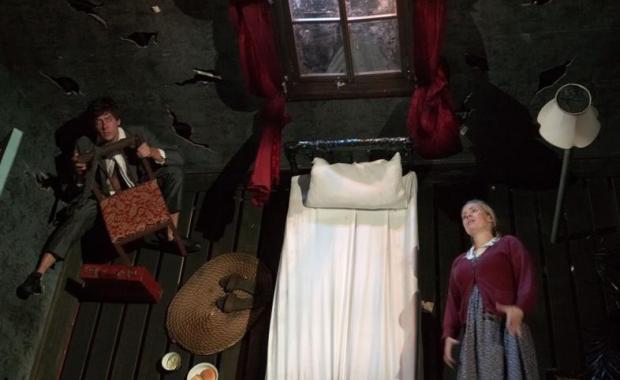
A performer dangles upside down, supported only by the strength of his own body; visual perspectives shift and skew across the split level set, distorting reality; a family home cracks open, metaphorically and literally, at its very centre. There is no question that this production, now six years old and making its fourth visit to the Lyric Hammersmith, remains thrilling in every sense of the word. What is so heart-stopping about the Lyric and Vesturport’s visually virtuosic rendering of Kafka’s nightmarish tale, however, is not the dazzling disbelief that such images be thought to provoke. Instead, the most chilling horror at its core is all too plausible.

Just as the true awe that is inspired by loose-limbed performer Gísli Örn Garðarsson derives from the sheer ease with which he flings himself about the set rather than the gravity-defying spectacle of his acrobatics, the real sting of the piece lies in its incisive diagnosis of the human capacity for evil. In the shell-shocked aftermath of Gregor Samsa’s titular, unexplained metamorphosis, his bewildered family grope around their shattered domestic haven in search of coping mechanisms, slowly surrendering to the most brutal of self-preservation tactics. It is a grim metaphor for society’s fear of the other and its destructive impulse to exterminate perceived threats from within.

Extending this metaphor, Vesturport’s telling of Kafka’s disturbing novella is as much a retrospective dialogue with the tale as it is an interpretation. Armed with the knowledge of twentieth-century European history, parallels with the dehumanising rhetoric of totalitarian regimes readily present themselves; a line such as “work will set us free” uttered today immediately summons the echo of Auschwitz. Most strikingly, David Farr and Garðarsson’s production presents us with a distinctly human Gregor, eschewing any attempt at physical deformity. We know that this character has transformed into a monstrous creature, but all we see before us is a man, making the monstrosity all of our own creation; the audience find themselves complicit in the same horrifying division between human and inhuman that the Samsas finally pursue.

Alongside the production’s thinly veiled allusions to Nazi Germany, money emerges as an equally sinister force. It is less Gregor’s physical state that provokes his family’s disgust than the loss of his income, while the tantalising promise of a wealthy lodger sends the Samsas physically giddy. A human being who is no longer economically useful, this version darkly hints, is no longer considered human. Every creative force at the production’s disposal unites in this act of considered excavation, from Börkur Jónsson’s mind-bending set, physically setting Gregor and his family at opposing, disjointed angles, to the steadily darkening clothing, to Nick Cave and Warren Ellis’ painfully haunting music.

But for all the intellectual and visual inventiveness at play, the piece’s greatest triumphs are also what threaten to soften the devastating punch it seeks. Precise rather than visceral, each movement is so delicately, meticulously calculated – from the contained physical effort of outward domestic perfection to the seductive power that emanates from a wad of bank notes as they are slowly handed over one by one – that the raw intensity of the horror gives way slightly to an unsettling but clinical choreography. As the final, stunning image imprints itself on the stage, however, such objections seem churlish. Mingling beauty with terror, it is in these closing moments that the rotten heart of Kafka’s tale finally bursts from the production’s finely polished chest.

No Quarter, Royal Court Theatre

no-quarter

Originally written for Exeunt.

Ever since J.M. Barrie first gave us the boy who never grew up, Peter Pan figures have consistently captured the imagination. Robin, the damaged, boyish figure at the centre of Polly Stenham’s new play, is a direct descendant of this tradition, a self-declared “landed gypsy” whose not so magical but no less mythical Neverland is an old country house populated with faded rugs and creaking suits of armour.

Tracing a recurring theme in Stenham’s work, Robin’s isolated kingdom is a world dominated in turn by the suffocating presence and crippling absence of an intoxicating, unstable parent. His mother, wild, untamed novelist Lily, has brought up her youngest son in rural isolation, schooling him at home and feeding him on a diet of nature and art. Horrified by the glowing smartphones and information onslaught that he finds in London, the musically gifted Robin has returned home, drink and drugs in tow, to a childhood paradise that is being steadily snatched away from him. In this world of teetering privilege, property, land and identity are all inextricably wound up with one another, as the fight for a threatened way of relating to the world becomes inseparable from a desperate battle to hold onto the family home.

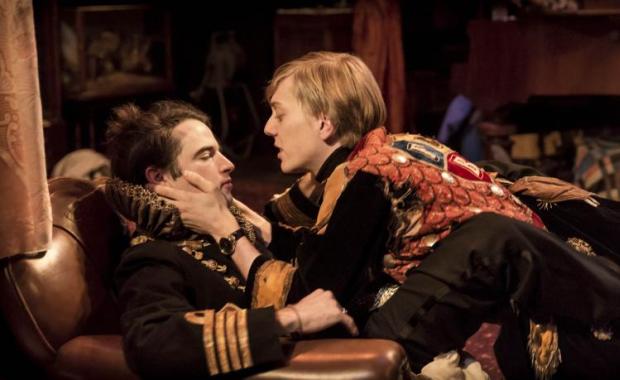
For all the domestic tumult and personal pain, however,No Quarter seems also to chant a eulogy for Britain, for a green but fading land of wild stags and lost boys, for a fled and empty mythology. A Jerusalem for the bare-footed, bohemian upper classes, there is a mingled air of both scorn and mourning for a way of living that was never really any more than a pretty story. Like the stuffed animals that clutter Tom Scutt’s meticulously detailed set – a haunting, gloomy shrine to taxidermy – this hermetically sealed rustic utopia is simply a mirage, death dressed up in the feathers of life. Every detail of Jeremy Herrin’s production hints at the same sense of slowly shattering illusion, right down to the dressing-up chest and the repeated use of Eurythmics’ ‘Sweet Dreams’; all an ephemeral reverie, an alluring narrative of a way of life and a nation that is drawing inexorably to its close.

Delicately linked to this atmosphere of illusion, there is also an intriguingly self-reflexive note to a piece of art that is essentially about artists. In the opinion of Robin’s elder brother Oliver, a politician who has fled the chaotically creative nest, caring only about art is just another way of caring about oneself. This immediately invites reflection on the potentially indulgent nature of what we are observing, a comment on the world that faces accusations of being just as futile and self-serving as Robin’s petulant hedonism. At times Stenham seems to conspicuously revel in her language, breaking the spell of the action with long and often beguiling speeches on the state of the world beyond these four walls; Herrin and actor Tom Sturridge give Robin as much bohemian swagger and jagged broken edges as the role can contain, crafting a young Rooster Byron for the crumbling halls of privilege; Scutt’s design, a hoarder’s heaven, is a lesson in excess.

Yet Robin – who for all his self-absorption and glaring faults remains the fiercely beating heart of the piece, particularly as brilliantly realised in the wiry, charismatic figure of Sturridge – strikes a blow against such charges. Making things, he protests, is the opposite of death; a way of revolting against the ugliness of the world. This argument recalls Simon Stephens’ observation that, however bleak the content, making theatre is an essentially optimistic act – an act in which this particular production is ultimately engaged. While the piece never quite seems to settle on either Oliver’s or Robin’s way of looking at the world, the final chord that it strikes is, despite everything, a mutedly hopeful one. Its vision of today might be dark and muddled, but it frames the receding myths of the past with a hint at the possibility of a better future.

Hancock’s Half Hour – The Lost Episodes, White Bear Theatre

??????????

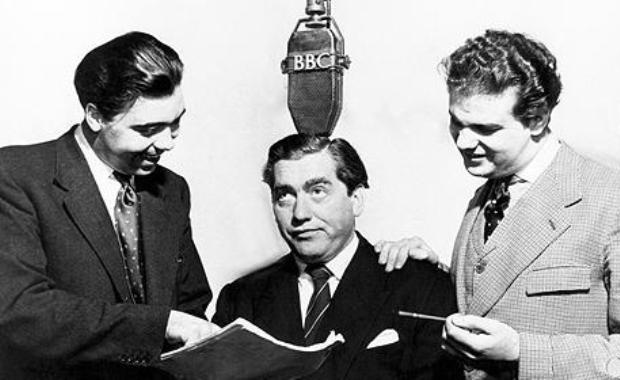
Robert Wilson spoke of his ideal theatre as a marriage of the silent film and the radio play – an odd artistic aspiration, perhaps, but one that appealingly harnesses the scope of imagination necessary in experiencing each of those mediums. There is something equally odd and yet fascinating about the staging of a radio play, where the imaginary scenes conjured by the interplay of voices and sound effects are collided with the overt artifice of the recording studio. It is this strange collision that audiences are offered in the first of two staged episodes of Hancock’s Half Hour, providing a dusty but quaintly endearing trip back in time.

Reviving two of Ray Galton and Alan Simpson’s scripts from the 1950s and 60s comedy, Hambledon Productions contrast one of the early radio episodes with a later episode written for television, both of which were thought to be lost until the original scripts were retrieved from Galton’s cellar. The pair of standalone, unrelated plot lines are pure, predictable early sitcom; the unlucky protagonist first unsuccessfully attempts to take a fortnight’s holiday in Brighton in the depths of winter, then is thwarted in his aim to hire a housekeeper. It is gentle, dimly familiar and inevitably of its time, conjuring an age of comedy that now seems as grainy as the pictures it was first broadcast in.

With this qualification, however, and whether or not the slightly creaking comedy is to everyone’s taste, the piece undeniably succeeds in its own aims. John Hewer uncannily captures the comedy persona of Tony Hancock, down to every last grimace and sigh, while the production around him might as well be a time capsule. Having taken the leading role in the West End production of Round the Horne Revisited, director Jonathan Rigby has previous experience with this museum-like process of re-assembling, creating a meticulous portrait of a now extinct style of comedy. While it neglects to interrogate its material, if simply regarded as faithful yet cheeky homage the production is difficult to fault.

Although the television episode – complete with grinning asides and carefully observed set – elicits more laughs from the audience, it is the radio recording that most successfully entertains the museum-specimen fascination of this rewinding of time. Clutching scripts and standing at mics, the cast exchange little looks and playfully half act out the scenes, flirting with the layers of imagination and theatricality at play. This never moves beyond flirtation into a full excavation of the form, however, content for the most part to re-enact rather than question. Like Christmas television repeats played to the belly-laughing delight of slightly inebriated grandparents, Hancock’s Half Hour is nostalgia several times distilled; smile-kindling and comforting, but departing with the faintest trace of disappointment.

Pack, Finborough Theatre

pack

Originally written for Time Out.

The winner of last year’s Papatango New Writing Competition, Dawn King’s ‘Foxfinder’, conjured a haunting vision of a world built on the cultivation of fear. This year’s offering from Louise Monaghan explores fears and prejudices that lie much closer to home, bravely grappling with the thorny racial tensions that persist in modern Britain.

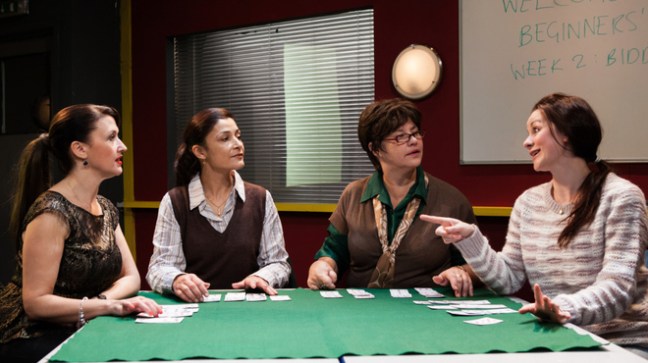
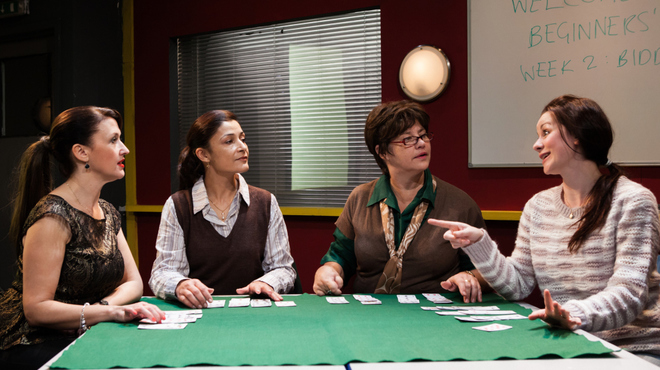
Monaghan’s quartet of female protagonists gather each week to master the rules of bridge, while beyond the walls of the community centre they are locked in a game in which the cards always seem to be dealt against them. Widow Deb struggles to raise her wayward teenage son, while her lifelong friend Stephie juggles a friendship with fellow bridge player Nasreen and her souring marriage to a bitter BNP supporter. As the bridge classes intensify, so too do the external strains.

Confined to the classroom, the piece wisely settles on an intimate setting in which to slowly rachet up the pressure, but Louise Hill’s direction visibly labours to bring the urgency of the outside world into this neutral space. As escalating events occur offstage, including the brutal racist beating of a young Pakistani boy, there is an inevitable atmosphere of reportage; someone is always running through the door slightly out of breath.

The evocative single syllable of Monaghan’s title suggests both a deck of playing cards and the gangs behind racist crime, but it also hints at a pack in the sense of a communal group. Appropriately, when the complexities of the play’s subject are most delicately handled, it is through the friendship that cuts across colour and creed.