Born to Run, Traverse Theatre

Originally written for Exeunt.

Fresh out of the patriotism-drenched self-congratulation of the Olympics, it’s not as if we are in need of further excuses to hear Vangelis’ iconic, now numbingly ubiquitous theme to Chariots of Fire. Gary McNair’s play, however, casts a new and markedly less heroic gloss on the activity of running. Born from the idea that even the most exercise-shy of us are running either away from or towards something, this piece projects running as both symptom and cure, a way to escape and a way to get to where you want to be.

For McNair’s protagonist Jane, running is her salvation. Diagnosed with epilepsy and struggling to cope, she discovers that going for a jog can stall her seizures, leading her to plant trainers around her house, in the office, tucked away in her handbag – at any moment, she can run away. Framed within the context of a mammoth 110 mile ultra-marathon across the North American desert, the piece opens a window into Jane’s mind as she steadily eats up the miles while desperately reaching for a decision that eludes her.

In an impressive display of stamina, Shauna Macdonald performs the entire show on a treadmill, pounding the act of running further into her identity with every step. Running is not just something Jane enjoys, it is a part of who she is – “it’s what I do” – replacing her crippling condition as a vital fragment of her identity.

What McNair has created is essentially a psychological study of his protagonist, drawing both on the scientifically and anecdotally proven power of running to clear the mind and on ideas of mental refuge and escape. As Jane repeats, “it’s amazing what you can do if you don’t put your mind to it”, a throwaway assessment of human thought processes which could be given further examination.

Giving rein to Jane’s thoughts and memories, McNair’s staging is fittingly simple, leaving the space around Macdonald empty save the treadmill she is running on. The only intrusions into this space are slickly executed projections which fire out questions and scroll through internet pages, visualising the ultra-connected anxiety that plagues the modern consciousness in a world in which every illness can purportedly be diagnosed through Google. Alone with her thoughts, Jane’s sole interaction is with her running app, a poisonously smug electronic voice that counts down the miles.

While Macdonald is an engaging and fiery performer, the piece as a whole is oddly unsatisfying, limping off with aching muscles and minimal lasting impact. As a personal story it is absorbing while it lasts, but in a way that is not far removed from the inspirational profiles that make convenient news programme fillers; impressive and often poignant, but easily switched off at their close. Its main power is derived from its near-universal resonance, the ability it allows for every spectator to identify with Jane’s struggle. After all, “everyone runs, don’t they?”

Oh, The Humanity and Other Good Intentions, St Stephen’s

Originally written for Exeunt.

A sports coach with a struggling team. Two internet daters desperate not to be alone. A spokeswoman without a script. A pair of photographers trying to capture something intangible and a couple without a clue as to where they are going. This seemingly unconnected assortment of characters all have something to get off their chests, something occasionally profound and messily human.

Will Eno’s series of short plays function like streams of consciousness, hyperreal vocalisations of the rambling, irrational, uncertain and sometimes mad thoughts that incessantly rumble through our brains. This familiar yet unfamiliar world, evoking an oddly disturbing Freudian atmosphere of the uncanny, is seemingly one in which lies are unthinkable. From the broken, ageing sports coach to the rambling lonely hearts, these characters are all helplessly compelled to tell the truth, as the private, the taboo and the mutedly mundane all trip indiscriminately from their mouths. By stripping back all artifice and laying honesty bare, Eno’s writing startlingly reveals just how many little lies and omissions cloak our everyday conversation, leaving his lines unsettlingly naked by comparison.

And the nakedness of the piece does not end with the writing. Layer by layer, Erica Whyman’s direction peels back the illusion of stagecraft, pulling away the curtain concealing the magician’s secrets. Between each of the scenes, the transitions are increasingly conspicuous, until eventually the panels of the set swing back fully to reveal the hidden, inner workings. The experience is that of watching a piece of theatre fall gloriously apart, until we are left not even with characters but with individuals dislocated in time, floating somewhere between fiction and truth. Realism disperses to unveil the reality beneath; a car dissolves back into two chairs and characters misplace their back stories.

The admission that recurs most frequently within Eno’s heightened bubble of veracity is “I don’t know”. In interrogating what it means to be alive, the piece recognises that one of the defining features of our humanity is our uncertainty, our ability to weigh possibilities and conclude the calculation with a question mark. There is also something beautifully indecisive about the performances, which can suddenly segue from calm containment to passionate outburst, as recklessly demonstrative as the emotions we suppress. Lucy Ellinson in particular, whether as frantic spokeswoman or wistful singleton, has a constantly searching, anxious quality behind her gaze that speaks of the terminal human quest for meaning.

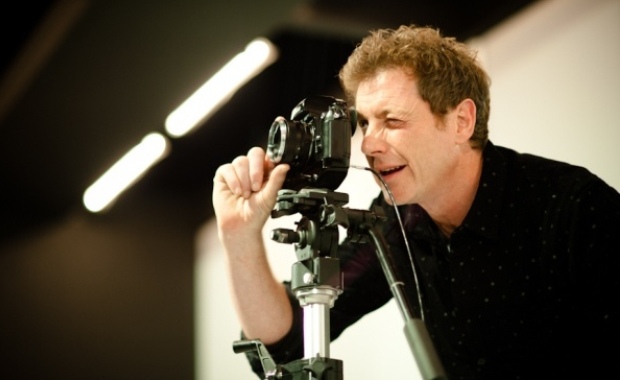
Of the fractured scenes that we are witness to, the splinter that protrudes most strikingly at the show’s centre is the scenario featuring the two photographers, their lens focused firmly on the audience. Eno’s witty, surreal study of idiosyncrasy is swiftly turned on its spectators as Ellinson gently asks us, eyes stretched wide: “how do you want to be remembered?” Because, as the structures of theatricality drop away and the divisions between performer and audience break down, the piece’s perceptive observations extend to us all.

Dirty Great Love Story, Pleasance Dome

Originally written for Exeunt.

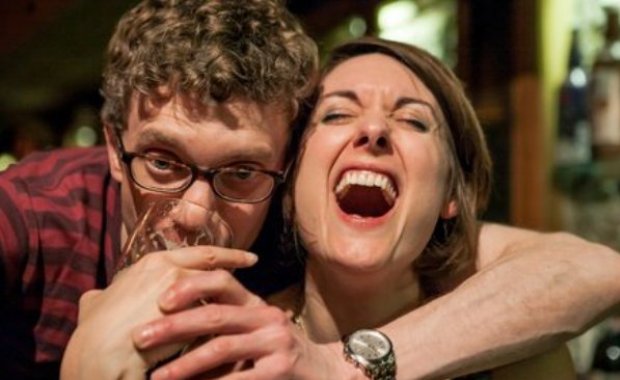
You know the one about boy meets girl, right? A drunken romantic encounter, ensuing awkwardness, years of near misses and friendship and dancing obliviously around one another. Dirty Great Love Story, the sharp new two-hander from writing and performing duo Richard Marsh and Katie Bonna, ticks all of these boxes, but with enough charm, wit and everyday poetry to transcend its predictable romcom trappings.

As the pixellated heart emblazoned on a banner at the back of the stage suggests, this is a distinctly modern vision of love. If it was a Facebook relationship status it would read “it’s complicated”. Richard is short-sighted, socially inept and afflicted with a clumsy sense of humour; Katie is just out of a messy break-up, with a “stabbed up heart” and a short dress. Their pairing on a boozy night out, shoved together by their tipsily crowing mates, is as inevitable as it is cringe-inducing.

The comedy that this seemingly clichéd set-up generates, however, has the intelligence to surprise and delight. Cruder than your average Richard Curtis film, Marsh and Bonna incorporate all the groaningly familiar embarrassments of contemporary single life, from cloakroom fumbles to untimely vomiting, all related through unlikely poetry. A sparkling fusion of drama and spoken word, the pair’s ingenious rhymes – owls and bowels, anyone? – span the ridiculous and the romantic, remaining deliciously sweet while refusing to sugar-coat the often bewildering, humiliation-ridden world of 21st-century dating.

For all that it resembles the much maligned romcom, Marsh and Bonna’s show also unveils the many lies implicit in the genre that it owes its creation to. Romance is skewered by realism; as Richard eventually tells Katie, “I love you realistically – I wouldn’t die for you”. There is a playful, teasing commentary on the familiar story arc, with one periphery character knowingly remarking that the turn of events is “just like a movie”. Wisely, Marsh and Bonna never taken themselves or the show they have created too seriously.

But the piece’s greatest charm lies in its unfashionable note of hope. Despite all the binge-drinking, apathy and casual sex that are usually held up as indictments of modern twenty- and thirty-something life, Marsh and Bonna find optimism rather than gloomy inevitability in the position of their generation. As they put it, “fucked up is just fine” and slightly ugly romance can be every bit as intoxicating as the airbrushed kind. Just as poetry can sometimes be clumsy, unconventional and a little bit dirty, so can love.

I ❤ Peterborough, Pleasance Courtyard

Originally written for Exeunt.

Love is a feeling that you can’t describe in a word, not really. That is the real reason, Joel Horwood’s quirkily beautiful new piece argues, why we draw anatomically inaccurate symbols on Valentine’s Day cards and tacky tourist T-shirts. We struggle to say it in words, so we make it into a picture.

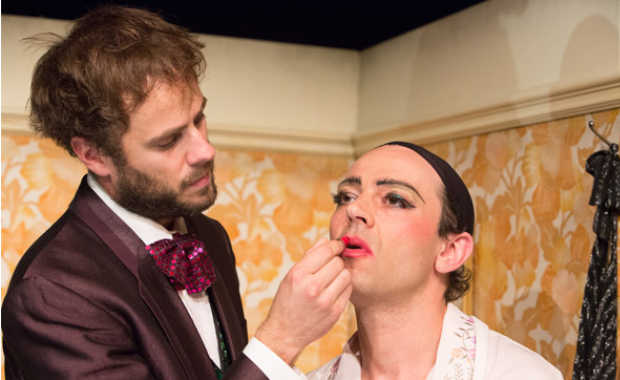
The love that Horwood’s play paints is romantic love, parental love and the strange, unconditional love mingled with hate that we often feel for the place we come from. In the unlikely surroundings of Peterborough’s cul-de-sac ridden suburbs, Michael – or, as he’d prefer us to call him, Lulu – applies his lippie and slips on his ruby red heels. He is in pursuit of love and happy endings, but that love arrives in a somewhat unexpected package when his teenage son Hew arrives at his doorstep.

As the ruby slippers hint at, for Lulu and Hew there’s no place like home. Their small, chintz-decked abode is a refuge from the jeers and stares of the town, of the eyes that would “take bites” out of them. Within this gaudy sanctuary, father and son work on a double act, escaping the world’s cruelties through the retreat of music. Jumping off from this platform, Horwood, who also directs, is able to flirt playfully with form, clashing drama with cabaret and throwing occasional meta-theatrical winks to the audience.

A keyboard sits at the back of the performance space, at which Jay Taylor’s awkwardly gentle Hew plays musical accompaniments and lends his voice to Lulu’s stories. It is these stories which form the real heart of the piece, with Milo Twomey’s warm, overtly theatrical presence as Lulu spreading across the stage. Yet beneath the brash persona there is a strain of brittle vulnerability and viciously protective violence, a violence that is reflected in Horwood’s words.

Love is often meshed with pain, with fists and bites, while recurring interruptions remind us of the people blowing each other up around the globe at the same moment the onstage events are occurring. It is a shade of darkness pasted with glitter that colours the entire piece but is not fully interrogated. Tenderness, it is perhaps suggesting, can never come without scars.

Horwood’s writing offers up phrases like candies, sweetly rolling on the tongue. He is a creative master of the simile; love feels like “driving over humpback bridges too fast”, while a girl’s face “trembles like a pond”. Grit-flecked poetry is crafted from the soulless concrete, proof that anything can be beautiful if it means enough. In this way, Peterborough slowly becomes a mirror for these two damaged inhabitants. They might be odd and occasionally ugly and difficult to love, but the possibility for love still remains.

Photo: Mike Kwasniak

Bring the Happy, St Stephen’s

Originally written for Exeunt.

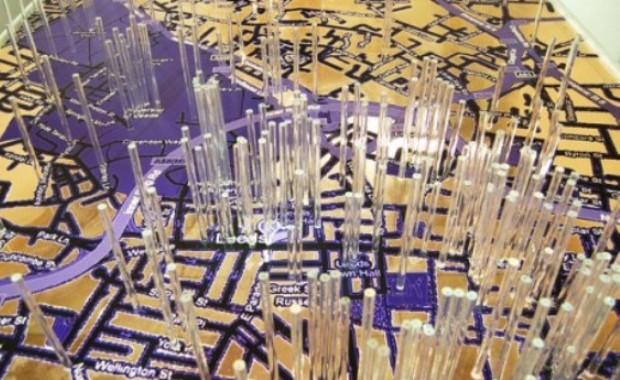
As Oscar Levant famously said, “happiness is not something you experience, it’s something you remember”. This way of viewing happiness is particularly pertinent to Invisible Flock’s latest project, an undertaking to map the happiness of an entire city. Setting up a hub at the centre of Leeds, for a period of two months this group of artists collected happy memories from local people, recording them and plotting them onto a 3D map. What emerges is as much sadness as happiness.

The performance that Invisible Flock and accompanying band Hope and Social have created from this vast compendium of memories, however, is about as joyous as theatre gets. Memories, from the mundane to the sublime to the ridiculous, are recited by the performers and projected onto a screen at the back of the stage, backed by alternately raucous and contemplative music. There are odes to the hundreds of babies born in local hospitals and to the chemically enhanced euphoria of going out and getting wasted. We wave glowsticks and sparklers and are invited to waltz with strangers.

Despite this encouraged silliness and unapologetic delight, more serious threads are plucked through the fabric of contemporary happiness. There is something inherently poignant about happy memories; the very fact that they are memories indicates that those moments must be in the past and in some sense lost. For this reason, the happiest of recollections on the map are often born from the most moving of circumstances. There is also an intensely personal quality to Invisible Flock’s creation. While being specific to the city of Leeds – a city I have never visited – the piece has the gentle power to summon memories of the places that hold happy memories for you wherever you might come from, providing a delicate diversion via reminiscence.

Unsurprisingly, however, not everyone embraced the idea in the same way as the audience at St Stephen’s. The question that Invisible Flock were most frequently asked by irritated passersby was simply “why?” Why spend time doing something so twee, so ridiculous and so seemingly without a purpose? Why sugar-coat a city rather than address its problems? Why – the most aggressive complaint – is this being funded? In the time since Invisible Flock began this project, their reasons have been vindicated, though possibly not in the way they would have hoped for, by the government’s concern with happiness in modern Britain. Unlike David Cameron’s falsely smiling initiative, however, there is something profoundly heartfelt about what Invisible Flock are doing.

It is also easier than it might initially seem to conjure valuable reasons for this project. As much as it is, on the surface, about happiness, asking questions about what makes people happy also seems to inevitably reveal what makes them unhappy, uncovering more truths about modern society than might be imagined. The project presents a way of understanding how we live today and how we lived yesterday – a living document of a city.

And, of course, there is the simple but not to be underestimated joy that Invisible Flock’s resulting creation is capable of engendering. Leaving with a smile like a stain that can’t be scrubbed off my face, it’s difficult to demand any better reason than that.