Theatre Uncut in Edinburgh

Originally written for Exeunt.

Against a backdrop of crisis, cuts, turmoil and disillusionment, theatre seems to be reclaiming its place as an art form at the heart of popular protest. Only a few days after the widely attacked sentencing of Russian punk band Pussy Riot, a verdict whose announcement was marked by a day of protest across the world – including an event at the Royal Court Theatre – an embryonic glimpse of this year’s new international incarnation of Theatre Uncut is seen at the Traverse Theatre. It is the sort of protest that feels rough, messy, alive.

The series of short play readings, a taste of what to expect from the full autumn event, takes place not in the auditorium but in the theatre’s bar. We are told that this is to demonstrate that these plays can be performed anywhere; the hope is that this November they will be given life by hundreds of people in village halls and cafes, pubs and community centres. Beyond this straightforward aim, the bar feels like an open, sociable space, a space where audience and performers are not divided by an invisible barrier but where we are able to feel like simply one group of people gathered together with a common interest.

Extending this united messiness, none of the work that is presented is in anything near a finished state. Everyone’s time is given free to Theatre Uncut, meaning that actors assembled from across the festival have had only one hour in which to rehearse and still clutch scripts in their hands. There is something appealingly untidy about it, lending the event a fitting air of urgency. A more slick and polished product would take something from the importance of its message; here the potency lies entirely with the writing.

The pieces that are showcased at the morning event all take differing approaches to the political stimuli, a recognition of the multiplicity of voices and perspectives to which Theatre Uncut is responding. Anders Lustgarten’s The Break Out is succinctly metaphorical. A scene between two women given the chance to escape a benign prison and offered a choice between being “comfortably miserable or scarily free”, it confronts our apathy-inducing state of comfort and the illusion of freedom that can be so easily cast.

Meanwhile Blondie, written by Royal Court Young Writers’ Programme graduate Hayley Squires and absolutely nothing to do with Debbie Harry, takes the dystopian route. Playing with the cult of personality that has dominated politics in recent years, reaching its apex with Blair’s brand of “Cool Britannia”, Squires paints a portrait of a leader elected on pure, blonde-haired appeal. The brutal lesson that this leader then teaches the country – to “get a grip” – is lacking in subtlety, but lands a few painful punches on our greedy, fiercely consumerist lack of perspective. Dire as the situation here may seem, Squires reminds us, it is much worse elsewhere.

The most striking piece of the morning, however, is Clara Brennan’s Spine. Heartbreakingly performed by Rosie Wyatt, it tells the tender story of an unlikely friendship between a frail old woman and a teenage girl, while also writing something of a love letter to our dying libraries. It is a delicately multi-layered monologue, touching upon the deep and damaging cuts, the concept of political power and the idea that there is “nothing more terrifying than a teenager with something to say”, but its primary cry is one for compassion. Politics has forgotten people, something that this deeply moving piece does not allow us to do for a moment.

The morning is closed by two pieces even more ad hoc than the rest. In recognition of the Pussy Riot trial that has provoked so much protest around the world, and as a sort of epilogue to the event at the Royal Court at which the defendants’ testimonies were read, three actresses pull on balaclavas while we listen to the sentencing of Nadezhda Tolokonnikova, Maria Alekhina and Yekaterina Samutsevich. This is then followed by a rapid response piece by David Greig, written over a matter of days and inspired by recent news. This move towards immediacy is one which helps to solidify the ideas that have been floating shapelessly around the room, firmly reminding us that this is an event connected to and speaking out against very real problems.

But there is also an awareness that this is not enough. Sitting in a room listening to and talking about political issues is not quite action in itself. As Marco Canale’s candid monologueThe Birth of My Violence recognises, putting pen to paper instead of placard can be interpreted as an act of cowardice, an evasion of genuine action in favour of weak intellectualising, and perhaps it is.

What Theatre Uncut lacks in this current presentation is what makes it what it is: the element of mass protest. Performed in a closed space to a few dozen gathered people, these pieces can feel like cursory gestures. But when taken ownership of by people all over the country in a unified raising of voices, these short plays have the power to be much, much more.
Me and Mr C, St Stephen’s

Originally written for Exeunt.

This show, we are told from the outset, might be a bit shit. It’s improvised, you see, and performer Gary Kitching can’t make any promises. Some nights it’s good, some nights it’s bad. Unlike most theatre, we are encouraged to start from a position of deflated expectations.

To review this piece of theatre, therefore, is to tell a small lie. The performance I saw was unique to the specific number of audience members in the space, the personalities and experiences that those audience members brought into the room, the particular mood of Kitching as a performer and the thoughts that floated to the fore of his mind in that 50 minutes. It might be argued that every performance is specific to the performative moment, but improvised performance is more specific than most. So, acknowledging my limitations at the off, I would like to follow Kitching’s lead and lower any expectations from this piece of criticism.

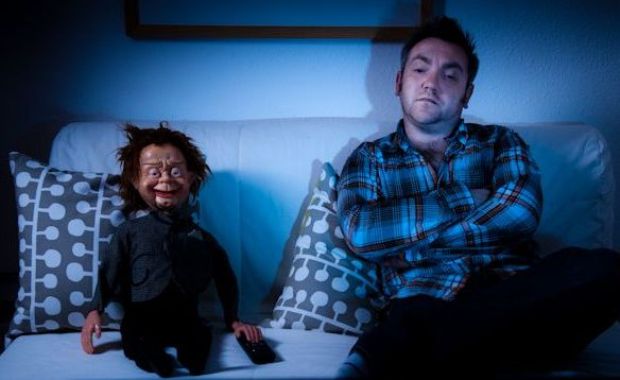
Of two things, however, we can be fairly certain. The “me” of the title is Kitching, emerging as a lonely wannabe comedian, and the Mr C is his fiery haired ventriloquist dummy, possibly the most terrifying prop to grace a stage at the fringe this year. This pairing is a nod to comedy convention, following in the tradition of Keith Harris and Orville, but that is where the piece’s conformity ends.

Kitching’s principal trick is to upturn expectations, both comedic and theatrical. As Kitching ever more despairingly attempts to engage in conversation, the ventriloquist dummy, usually the loquacious linchpin of a comedy double act, remains obstinately silent. During the comedy club interludes in which Kitching’s aspiring stand-up comedian is steadily broken, the audience is actively invited and even taught how to heckle – in fact, we are told, we will ruin the show if we don’t – inviting ever more inventive jeers from the crowd.

The extent to which the audience truly determines the piece is, unsurprisingly, limited. There is a sort of formula to the show that Kitching has shaped, one that relies on certain inputs but that calculates these into an answer that one suspects does not greatly vary. The audience interaction that Kitching does cultivate, however, slots fluidly into the piece and rarely falters thanks to a performance that puts us oddly at ease but never lets us switch off.

Where the role of the audience really becomes interesting, though, is when the piece takes a darker turn. Viciously plucking at the sinister undertones that have lingered throughout, Kitching car crashes closer and closer to destruction, releasing a raging torrent of self-hatred. With startling suddenness, the flavour of the audience’s involvement shifts without prompting, as sensitive a barometer as any to the mood of the work. Within moments, what has thus far been lightly, intelligently entertaining is transformed into an altogether blacker and more poignant proposition. It might not smash the low expectations that Kitching sets us, but it certainly exceeds them.

What I Heard About the World, St Stephen’s

Originally written for Exeunt.

What do you think of when someone mentions Brazil? Israel? How about Korea? The concept behind this collaboration between Third Angel, mala voadora and Chris Thorpe is born from the partial knowledge that we can now boast about all the far-flung corners of the world, dinner party trivia that slots together into a fragmented vision of the globe. As Thorpe puts it, “the more we know, the bigger the world gets”, and the more knowledge is accumulated, the more that the gaps in our knowledge glare out at us.

Creating a colourful theatrical map, Thorpe, Third Angel’s Alexander Kelly and mala voadora’s Jorge Andrade relate stories and quirky snippets of facts from around the world, communicated through direct narration, through pen-scrawled pictures, through roughly assembled sketches and through electric guitar accompanied music. Eschewing the indifferent wisdom of statistics, their charming and disturbing anecdotes all veer on the wacky side of odd, from cardboard cut-out figures issued by the American military to the families of servicemen and women, to a confession hotline that promises to cleanse you of your sins at a reasonable rate.

It rapidly becomes clear that what all of these stories share is their focus on artificiality. In a newspaper in Singapore, the editors photoshop suits onto obituary photographs; in Brazil you can hire mourners, while in Germany paid-for protestors are a booming commodity. Most staggeringly, a couple in Korea allowed their own baby to starve to death because they were so fixated on caring for their virtual child that they forgot they had a real one. Everywhere, it seems, signs and substitutes abound, and anything can be bought if you know who to call. The piece skilfully traces a map of an increasingly connected yet dislocated globe, around which revolves a Baudrillardian precession of simulacra.

As a backdrop to this carousel of eccentricity, the stage at St Stephen’s is packed with paraphernalia both homely and exotic – an apt accompaniment to the driving thoughts behind the piece. A fish tank and a sofa sit in the same space as a poolside life-belt and a paper plane, speaking of a yearning for both adventure and hearth. It is, as the piece recognises, essential to our self-identity to have a sense of place, a sense of place that is as much defined by stories of the “other” as it is by the idea of home.

As Thorpe, Kelly and Andrade repeatedly emphasise, the stories they tell are all true, collected through a formidable process of research and reassembled in different formulations for each of the show’s incarnations, but the very theatricality of the piece inherently begs us to question this truth. And, of course, we are right to. For these can only ever be constructions of the truth, ephemeral simulacra in the same way as the photoshopped suits or the donkeys painted as zebras in Gaza zoo. As soon as a piece of information is passed on, it gains a new identity, clothed in a thin film of fiction.

Yet, as inaccurate and incomplete a cartography as they draw, there is something oddly comforting about the stories that this production collects in cupped hands. As one woman from the anecdotes recognises, stories are a way of staying alive, of passing down a legacy that might cross mountain ranges and oceans. Simple facts, like national borders, can melt, change and die away, but stories are ever present.

Bottleneck, Pleasance Courtyard

Originally written for Exeunt.

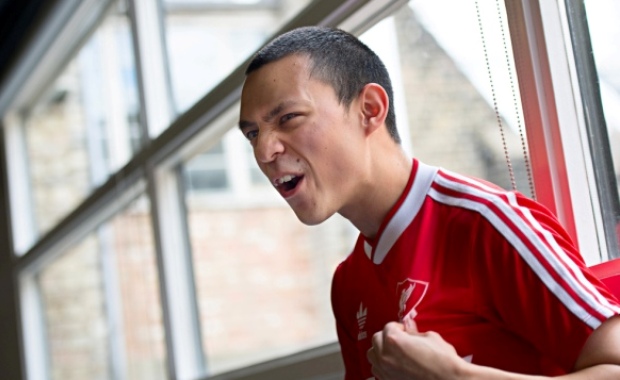
Greg is almost fifteen, almost a man. For him, manhood means a moustache and a swagger; it means John McClane in Die Hard, not taking shit from anyone. It’s nearly his birthday, and despite a lack of cash and the best efforts of his dad, he’s going to find a way to watch the Liverpool match. The world, full of girls and footie and best mates, is out there waiting for him. But sometimes the experiences that really mark the transition from youth to adulthood are also the experiences that scar for life.

Luke Barnes’ latest play is packaged as coming-of-age tale, but unwraps into something far more devastating and complex. The writing is nuanced and intelligent enough to keep its devices hidden and its direction obscured, until the destination suddenly appears on the horizon with gut-ripping inevitability. Without undoing that nuance, it is enough to say that its shattering denouement treads familiar ground, walking along a recognisable narrative with unblinking new insight. In its careful use of history, the piece can rely on the structure of the audience’s collective knowledge to hold its fragments together, while simultaneously smashing that scaffold apart.

Unlike other pieces that insist on reopening old wounds, Bottleneck feels urgent, fresh, full of rage. This is partly down to Barnes’ razor-sharp writing and partly down to a blistering performance from James Cooney, whose every coiled muscle seems to hum with barely controlled aggression. He is constantly hopping from leg to leg, never still, channelling the nimble footwork of Greg’s red-shirted heroes. Resisting any idea of the solo show as static, Steven Atkinson’s direction is ever moving, ever generating and radiating energy.

In this production’s appropriately bare presentation, the monologue is played out in an empty performance space below two glaring floodlights, which alternately flicker, die and burst blindingly into life. As well as effectively conjuring the space of the sport with which Greg so closely identifies, the stark quality of this lighting has the effect of the laboratory microscope, an unforgiving illumination under which this tortured specimen struggles and squirms.

As microscopic as Barnes’ focus appears, however, this muscular piece is not limited in its ambition to the singular narrative of its protagonist. Greg, as intensely drawn as he is, emerges as just one symptom of a wider problem. As youthful optimism becomes steadily jaded, the creaking escalator of social mobility shudders to a halt and Greg’s story becomes yet another instance of a life being determined by the inescapability of birth. If you come from the wrong place, this furious snarl of a play argues, then you’re fucked.

Photo: Bill Knight

A Strange Wild Song, Bedlam Theatre

Originally written for Exeunt.

Songs of war provide the background score for this latest addition to Edinburgh’s ever-growing Lecoq contingent, devised by emerging physical theatre company Rhum and Clay. In a piece that delicately shifts between modern day Britain and the bomb-ravaged landscape of France during the Second World War, a man is transported back to the past through the medium of a single roll of film recovered from his grandfather’s wartime camera. What it reveals is an extraordinary and unlikely encounter between the soldier and a trio of abandoned young brothers.

Warfare, dream and play are all intermingled in the scenes between the soldier and the three boys, in which a lost boy aesthetic is thrown like a grenade into the heart of the battlefield. Taking refuge from the horrors of battle, there is a creeping sense of regression into the innocence and imagination of childhood, enhanced visually by the playing of the children by three adult actors. Avoiding many of the hackneyed techniques that often plague dramatic portrayals of children, the performers fully inhabit these young roles with all the clumsy physicality and uninhibited charm of childhood.

For all this charm, however, the piece as a whole feels oddly, uncomfortably exploitative, using the drama lent by atrocity in order to create something indulgently beautiful. The choice of subject matter certainly enables some stunning moments of creativity; in the process of gameplay, a ramshackle aeroplane stutters through the air, given movement purely by the impressively controlled bodies of the performers, while in another beautiful moment a red balloon floats above the rubble, appearing seemingly from nowhere.

But where this gorgeously assembled style soars, it leaves its half-baked plot with its feet fixed firmly to the ground. Ideas about memory, war, childhood and imagination lie scattered like shrapnel, casualties of the painstakingly crafted aesthetic. More than a matter of style over substance, Rhum and Clay’s creation is naggingly problematic due to the very particular historic make-up of the substance it fails to fully engage with.

Clothed in all the now clichéd trappings of Lecoq-inspired theatre that seem to abound at the fringe – physically controlled clowning, inventive use of props, the seemingly obligatory accordion – this all feels a little twee for the environs of war-torn France. Of this spreading rash of physical theatre, Rhum and Clay prove themselves to be among the best, demonstrating exciting potential, but they are in need of a better vehicle for their ingenious visual style. Whimsy and war do not make comfortable bedfellows.