The Prize, Underbelly

26936_article

Originally written for Fest Magazine.

It’s not the winning, it’s the taking part that counts, right? Maybe not for the hundreds of determined Olympic hopefuls we have anxiously watched compete during London 2012. It is this passion and intense desire to succeed that is explored in this delicately constructed verbatim piece from Murmur and Live Theatre, drawing on interviews with British athletes past, present and future. For them, failing is simply not an option.

Performed by a cast of five on an almost bare stage, the power and the poignancy rightly lies with the voices of those interviewed, their experiences communicated through the actors. Murmur has spoken to a huge range of athletes, from a female diver who competed in the 1950s, when the honour really was the taking part, to athletes with ambitions for this year’s Olympics and Paralympics.

The carefully selected and assembled snatches of the resulting interviews reveal the athletes’ drive, dedication and struggles without ever tipping into the trite sentimentalism that the media around the Games has often fallen prey to. The principal emotional manipulation comes courtesy of projected text revealing whether or not those speaking qualified for the Games, a device that could be intrusive and heavy handed but is here executed with heartbreaking simplicity.

Propelled by the energy of the Games’ success and looking towards the Paralympics, The Prize resonates perfectly with current national feeling. But by being so of the moment, it is difficult to envisage much of a future life for the piece. Beautifully formed though it is, it feels—much like the sporting triumph it revolves around—fleetingly ephemeral.

Uninvited, Bedlam Theatre

26944_article

Originally written for Fest Magazine.

In the festering heart of suburbia, behind the neatly trimmed privet hedge, an intruder lurks. Or does he? This new piece by Fat Git Theatre, adapted from Peter Mortimer’s novella of the same name, prods at human neuroses with the blackest of humour, as one man finds his secure haven gradually transfigured into an anarchic nightmare.

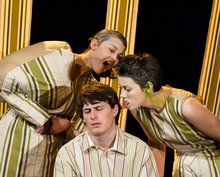
Fat Git’s surreal and grotesque performance aesthetic finds its perfect partner in the swirling, dreamlike paranoia of Mortimer’s protagonist. Managing his single household with obsessively meticulous care, his control-crazed movements are watched with boredom and amusement by the wallpaper, until a distraction is found in the sudden appearance of a whistling stranger. As the lone bachelor struggles to maintain the order he clings to, things progressively fall apart.

The care taken in the crafting of this piece is evident, from the precisely judged looks with which the three wallpaper figures curiously regard the audience to the sinisterly dissonant sound effect of a finger skimming the edge of a wine glass. Menace infects the piece, generated by both the oddly ominous nonsense of the text and the choreographed strangeness of the performances.

As suffocatingly strange as Fat Git’s bizarre creation can be, this peculiarity traps the audience within the same unsettling nightmare world as the unravelling man at its centre. It also makes us think. Despite the dreamlike unreality of this world, it taps into something psychologically, uncannily true about loneliness and anxiety, remaining wedged in the mind long after it departs.

Punch & Judy, Pleasance Courtyard

26902_article

Originally written for Fest Magazine.

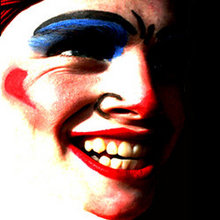
In the midst of a festival where puppetry is back in vogue, Tea Break Theatre is pushing against the tide. This ramshackle rendition of the traditional seaside favourite trades puppets for actors, with three performers taking on the roles of Punch, his put-upon wife and the wide cast of supporting players.

All the usual suspects are present, from the sausage-guzzling crocodile to the incompetent constable, rolled out in a constant, chaotic merry-go-round of costume changes. Making little attempt to break away from the show’s groaningly recognisable conventions, Punch encounters these characters one by one in an anarchic succession of scenes, piling up the bodies as he goes but achieving little else along the way. Even the sitting duck of the banker gets off with the lightest of satires.

If, by swapping puppets for humans, Tea Break Theatre has aimed to give this sprawling farce any real life contemporary resonance, it is almost impossible to detect. The early scenes are so packed with below-par slapstick and strained humour that when events do take a turn for the darker, any sense of menace is unearned. Only in the dying moments, as desperation cracks his pasted on smile, does the image of Punch gain anything approaching potency.

“If you be happy,” Punch says to the audience as the show opens, “me be happy too.” By these standards, Punch’s smile is not about to return any time soon.

The Pride, Underbelly

26906_article

Originally written for Fest Magazine.

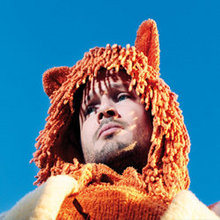
Three, as they say, is a crowd. This observation is certainly true for married couple Bruce and Linda, whose over-friendly next door neighbour James gradually wedges his way between them. So far, so familiar. The only difference being that Bruce, Linda and James are lions.

This funny little oddity from Australian company Perth Theatre is a surprising comedic treat. It only takes the performers to emerge in their fur-adorned onesies to conjure a grin, and from thereon in the quirky comedy carries the piece through. Initially arriving as an extra hand for Bruce’s home renovations, James shows an increasing interest in his neighbour’s life, leaving the alpha male scrapping for his pride in every sense of the word. It is—a lot like the increasingly desperate Bruce—a bit rough around the edges, but its charm begs forgiveness for its faults.

The offbeat humour also reveals small, quietly poignant truths. As newlywed infatuation melts into dull routine, something as simple as the transition from energetic high fives to resigned handshakes speaks powerfully of the fading shine of marriage. The seeming obsession with the feature wall jointly assembled by Bruce and James, meanwhile, is a hilarious but acutely observed comment on our impulse to acquire and improve, and a warning against DIY if there ever was one.

There is little particularly new or memorable being said here, and the running time could easily be tightened without much loss. But even if its only lasting image is of a grown man moonwalking in a lion onesie, it’s an image worth the flaws.

US Beef, Pleasance Dome

26912_article

Originally written for Fest Magazine.

Ever wondered how your burger got from cow to cardboard container? It’s certainly not the first time the ethically dubious practices of fast food corporations have been on the agenda, but Missing String Theatre Company manages to broach such issues with fresh laughter in this satirical take on America’s fiercely consumerist obsession with cheap meat.

Central character Buck, our narrator of sorts, starts at the bottom of the fat-oiled corporate ladder as a door to door meat salesman for the oddly unsavoury sounding Meatbox, a corporate monster promising a pseudo-democratic vision of meat for the masses. Through his personal story of grubby corporate climbing, Missing String deploys its satirical barbs using a wacky blend of comedy, drama and country music. From soulless marketing speak to the hypocrisy of the supposedly ethical consumer, little emerges unscathed.

This is also a satire in which the consumer, and therefore the audience, is deeply implicated. As one fast food outlet employee accusatorily tells us, we are “the cog that turns this machine,” the demand that drives the increasingly unethical supply.

This dirty complicity, however, is not taken as far as it could be. By making only half-hearted attempts at addressing spectators, Missing String neglects an opportunity to make the audience squirm and, as a result of that discomfort, think. It might make you pause before tearing off that next chunk of meat, but this is unlikely to create many vegetarians.