Puppet. Book of Splendor, Summerhall

Originally written for Exeunt.

The title of neTTheatre’s hypnotic physical theatre show is a little misleading. There is, throughout this compelling hour and twenty minutes, a distinct scarcity of puppets. Instead, channelling the work of Tadeusz Kantor and excavating dense Jewish scripture, this is a non-linear, disorientating journey through the realms of life and death. Viewing the human condition through the lens of cabalism, director Pawel Passini’s creation is a contorted compendium of dreams, desires and nightmares, as captivating as it is bewildering.

We are given a road map of sorts, a projected schema studded with words such as “beauty”, “justice” and “understanding”, through which the performance can be refracted but never quite clearly seen. This, we are warned, is to be expected. In one of several deft nods to the artifice of theatre, the knowing voice of the director cuts in to tell the audience that we will probably struggle to follow what we are about to see and that we might not enjoy it; this is “sit down tragedy”, not “stand up comedy”.

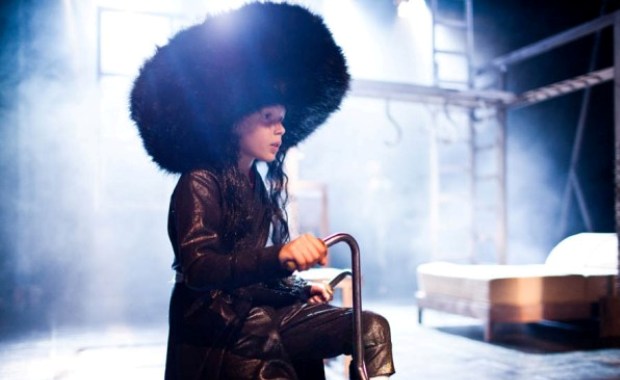
The piece, however, is as visual as it is intellectual. Rich and sometimes ridiculous images compete for attention, from dreamlike projections to a host of angels in white wigs and hipster glasses. In the midst of Passini’s assault on the eyes, it is the alternately graceful and vicious physicality of neTTheatre’s performers that captures the gaze. A man and woman, cast as Adam and Eve figures, move fluidly as one body, arms hemmed together inside the same shirt; another woman spits the Hebrew alphabet, the letters bodily wrenched from her diaphragm as her torso spasms.

The screaming succession of startling images summons questions, tumbling feverishly one after another. Who is the silent artist figure, seeming to paint the world into creation around him? What is reality and what is dreamed? Does the gaping emptiness of a figure made from clothes – one of the production’s few instances of puppetry – suggest that God too is just a void clothed in empty faith?

Questions, however, are deflected by both text and performance. We are told that “to know is to pose questions”; questions breed questions in the same way as Passini’s baffling imagery, with none of those insistent “why’s” bringing us any closer to understanding or satisfaction. The answers that we seek are repeatedly evaded. In this way, neTTheatre grasp us by the hand and roughly guide us to the relinquishing of linear logic that is required to experience their performance as intended – as an experience.

And as an experience it is exhilarating and exhausting. There is perhaps too much going on, certainly too much to fully absorb both the surtitles and the stage language, but this seems to be the point. A fraction of enlightenment is all that we can hope for. But understanding is not everything. As a Rabbi in the show says of the young daughter who insists on reading from cabalist teachings, “she understands nothing, but it pleases me”.

Gatz, Noel Coward Theatre

A small disclaimer: the performance I’m writing about was technically a preview, though Elevator Repair Service have in fact been performing this show since 2004. This also seems a slightly superfluous disclosure considering that I don’t expect what follows to be a “proper” review in any conventional sense. If either of those two statements displease you, probably best to stop reading now …

As I probably don’t need to tell you, the headline-grabbing aspect of Elevator Repair Service’s Gatz, currently visiting the West End as part of LIFT 2012, is its length. A performance in which every last word of F. Scott Fitzgerald’s The Great Gatsby is read aloud, this sort of anti-adaptation is eight hours long. Eight hours.

Except that’s already a slight lie. Intervals factored in – including a fairly generous dinner break – this is actually more like six hours of stage time in total. And in fact, astoundingly, the length is probably one of the less extraordinary things about Gatz. People arrive prepped for an act of endurance; the group next to me seemed to have packed an entire picnic and, to my slight envy, a flask of tea. Twitter reveals more of the same, some theatregoers even arming themselves with pillows. But, with the minimal aid of caffeine top-ups, this is far less of a marathon than it appears. More of a pleasurable and mildly tiring fun run, perhaps.

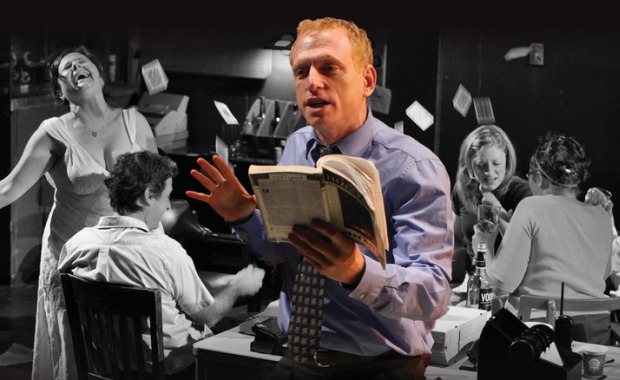
The concept is brilliantly simple. A bored office worker, the staggeringly excellent Scott Shepherd (more on him later), arriving at work to find his computer on the blink, stumbles across a copy of The Great Gatsby on his desk. He begins to read, and continues to do so for the following eight (minus intervals) hours. I say read, but in a mind-boggling feat of memory, Shepherd knows the whole thing off by heart, *spoiler alert* as he stunningly proves during the final 45-minute sequence delivered entirely without the prop of the book. *end spoiler alert* Although I’d happily be lulled by Shepherd’s strangely hypnotic voice alone, he is also joined one by one by other figures in the office, who gradually take on roles within the novel.

And that, essentially, is it. Except it’s also so much more. Elevator Repair Service’s staging seems like a good place to start. The entire thing takes place in a typically stale and soulless office, naturalistically rendered down to each last biro. My immediate assumption, though this isn’t confirmed by any period-specific references, is that we’re in the late eighties or early nineties, based mainly on the appearance of Shepherd’s faulty computer. I can’t help wondering if this vague, recent-ish setting has a calculated resonance with Fitzgerald’s novel; though we’re far from the steel and glass of Wall Street, the implied era is that of the sort of greed and excess so grotesquely satirised by Caryl Churchill in Serious Money, a world not dissimilar from the pre-Crash extravagance displayed at Gatsby’s parties. The expensive calm before the storm.

Beyond the usual office paraphernalia, the only thing out of the ordinary in Louisa Thompson’s set is an onstage sound deck, which later becomes key to the subtle evocation of the world of Fitzgerald’s novel. Visually, this is the antithesis of Baz Luhrman’s forthcoming film, the trailer for which is all glitter and no grit. In the decidedly drab surroundings of Elevator Repair Service’s production, the responsibility for the glitter lays entirely with the text, which dazzles all by itself. I suspect that I was in the majority among the audience in having already read the novel, albeit several years ago, but even for those familiar with the book this is something of a journey of discovery.

The beauty of this unconventional method of staging a novel is that it becomes so much more about the literary work at its centre than any traditional adaptation ever is. Fitzgerald’s prose is both protagonist and creator; everything is born from the words. I hadn’t really thought about it before, but for such a celebrated classic The Great Gatsby has a remarkably slight plot. Condensed right down, it is essentially the classic spiky love triangle (or love square, perhaps, if we’re including Myrtle). Illicit romance, the return of an old flame, betrayal and jealousy – nothing ground-breaking. What’s more, if you’re purely focusing on events, Nick barely features, lingering perpetually on the sidelines.

All of which is exactly why Gatz works so brilliantly. There is of course so much more to Fitzgerald’s novel than a hackneyed love story and so much more to its narrator, who is revealed in the prose as a central character in his own right. In a normal adaptation much of this is lost, whereas Elevator Repair Service have not only preserved this but actually enhanced it. As Jay McInerney pointed out recently in the Observer, “Fitzgerald’s prose somehow elevates a lurid and underdeveloped narrative to the level of myth”. In reinventing the act of reading on stage, I would go as far as to suggest that Gatz elevates this (no pun intended) a level further.

The literary junkie’s ultimate high, the only way to really, accurately describe Gatz is as reading intensified. It’s that fevered devouring of a novel without all the cheating, not allowing you to skim through sections that seem unnecessary to the story, and in the process revealing those bits as absolutely necessary. Such a treatment obviously wouldn’t work for every book, but for The Great Gatsby it’s perfect, polishing every last buried gem in Fitzgerald’s language and lending his prose a heightened poetry through Shepherd’s mesmerising tones.

We also glimpse before our eyes that slipping away of the real world as the world of the book takes its grip. Piece by piece the office morphs into the glamorous parties of the twenties; hedonism is casually evoked by a fistful of papers tossed in the air, while the sounds of jazz gradually infect the stage. I was beguiled by the way in which reality and fiction are ever fluid, meshing with one another and then suddenly jarring, until by the end, *spoiler claxon* as Shepherd lays down his book, it is no longer clear which is which. In the way that only a great novel can, Fitzgerald’s world has engulfed all around it.

And as I mentioned already, we are treated to many little discoveries along the way. It may have simply been that at the age of sixteen, when I first read the novel, I was spectacularly unobservant, but this presentation of the text revealed to me several new facets of Fitzgerald’s tale. This time around, perhaps influenced by the current state of the world, the novel’s attitude to capitalism seems even more scathing. For many of the characters, love and money are almost synonymous – the attraction of Daisy’s voice is that it rings with wealth. Elevator Repair Service’s concept underlines this obsession by placing it within the context of a space where making money is the main objective, generating only monotonous drudgery. Against this dull office setting, the American Dream is just that – dreamlike, insubstantial, and incompatible with the drabness of reality.

With a jolted remembrance of Jean Baudrillard’s “hyperreal”, it suddenly seemed to me while watching that even in 1925 The Great Gatsby was oddly anticipating postmodernism, whispering of the substitution of the real with signs of the real. Nick describes how his mysterious friend experiences “the unreality of reality”; to Daisy, Gatsby – already concealed behind a false identity – resembles an advertisement; the all-seeing, bespectacled eyes of the same advertisement become an oddly sinister capitalist substitute for God; the treasured photograph of Gatsby’s lavish mansion is more real to his father than the house itself. The addition of another few layers of simulacra in the form of performance only serves to enhance this.

Which brings me back to the performance itself. Much of what I’ve written so far makes it sound as though Gatz is purely concerned with literature, but Elevator Repair Service also incisively interrogate the workings of theatre. The conventions of representation get a comical prod, as what we are offered visually often directly contradicts with what we are being told. Jim Fletcher is a particularly unlikely Gatsby in his mismatched pink suit, and there is a beautiful moment when Shepherd reads the line about girls rubbing champagne in his hair and pauses to look incredulously at the balding figure opposite him.

There is much more to Gatz than can be contained in one blog post without stretching to ridiculous lengths, but Shepherd deserves a special mention before I reluctantly leave the experience behind me. His performance would be extraordinary for the memorising of the text alone, but this is much, much more than an impressive act of recall. It’s difficult for me to pin down quite why he makes such a compelling presence, but I think the closest I can get to articulating it is that he lives the book. When he reads those final, gorgeous sentences, we don’t quite want to leave him and the story he has told behind.

Tipped out onto the pavement after several hours in the novel’s company, I felt dazed and dazzled, slowly emerging from the deep submersion of Elevator Repair Service’s storytelling, blinking against the glare of the outside world. As I finally finish writing about it almost three weeks later, it still hasn’t fully relinquished its grip on me. And that pretty much says it all.

Utopia, Soho Theatre

Visions of Utopia have a knack of falling flat on their face, so it seems only appropriate that this new collaborative theatre project should recruit clowns to conjure its perfect worlds. In this partnership between the Soho Theatre and Live Theatre in Newcastle, six fools fumble through flawed blueprints, searching in vain through all of humanity’s failed efforts for a reliable model of perfection. These blueprints come courtesy both of a long line of thinkers, whose words are revealed to us via projected quotations, and of an assembled group of writers who have all produced their own responses to the central theme.

Which all sounds great on paper, but is underwhelming in its execution. In the hands of joint directors Steve Marmion and Max Roberts and their diverse team of writers, big concepts are rendered bafflingly small and an idea that is fascinating by itself becomes marred by its own realisation. Looked at a certain way, this is all ironically apt given that the piece is dealing with the desire for and impossibility of a utopian world, but this is not quite enough of a justification to excuse what more often than not simply feels like clumsiness and poor scene selection. A frustrated question kept nudging at me as I watched: are these really the most interesting utopian visions we could dream up?

There are admittedly some nice pieces (the word nice chosen here precisely for its very bland variety of praise). ‘The Presentation’, created by Thomas Eccleshare, Josh Roche and director Marmion, is a witty interpretation of perfection in our material culture, showing us Utopia as Steve Jobs might have imagined it, shiny and pocket-sized, but there is little depth beneath the slick cleverness. There is also a startling moment in Chi Onwurrah’s gameshow-inspired ‘Humanity’ when one character unexpectedly reveals the selflessness that human beings are capable of, while Janice Okoh’s vision of a world where medical science has been perfected and death is purely by choice is one of the more compelling scenarios.

One of the most fascinating, thought-provoking and disturbing scenes is not produced by any of the collection of writers, but instead by another dangerous utopian dreamer. Partway through the second half, we are confronted with a rousing election speech stuffed with rhetoric promising a better future – we half expect Obama’s mantra of “yes we can”. But with a startling sideswipe of anti-Semitism, this vision is smashed and it becomes horribly clear just whose words these really are. It is a stark, extreme reminder that one man’s idea of paradise is another’s vision of hell, and also that utopia and dystopia can be just a hair’s width apart.

As this overlong creation nears its end, however, there is the danger that intellectual investigation is abandoned in favour of emotional release. While the regrets of a now elderly ex-politician and the poignant attempts of a widow to “make the best” of her situation with the aid of a bit of over-50s zumba add moments of tenderness, they seem also to dilute the evening’s purpose. Fortunately Simon Stephens’ beautifully simple speech, spoken between the six actors, is suffused with enough grounded normality – the simple dream of drinking without getting a hangover, or of finding the perfect cup of coffee – to stall the decline into trite sentimentality.

Thinking back over the production, my complaints are admittedly not so much to do with this piece of theatre as it stands alone. It is frequently amusing and occasionally intriguing; it draws committed and energetic performances from its cast, particularly a sparkling Laura Elphinstone; it flirts playfully with form; there is a bubble machine, which tends to immediately raise most performances a few notches in my book. It is rather Utopia’s failure to meet the potential of its fascinating premise that makes it such a staggering disappointment. The level to which this wastes a brilliant concept makes me almost angry.

I can’t help but feel that many of the production’s problems arise not from its concept, which is an undeniably intriguing one, but from the way in which it has been assembled. As contributor Eccleshare politely and diplomatically hinted at when I spoke to him a few weeks ago, creating a co-authored show by having those authors each write in isolation is a tricky process. Had I not known about the technique of piecing this together, I think I would still have suspected a lack of dialogue between the writers. Utopia never really feels like a conversation.

I wonder if a truly collaborative approach (by which I mean bringing the contributors together at the writing table and even in the rehearsal room, shaping the piece while writing it) might have produced something far more interesting, as it is often when different utopias collide that the most fascinating discussions occur – a fact that Marmion and Roberts surely recognise, considering their central aim to provoke debate. It seems, then, an odd choice to have pieced together the show in the way that they have done, creating separate entities, smashing these apart and gluing their jagged edges together.

When mixed with the text of historical and literary utopias, the two directors have a deluge of content to channel into a finished piece, which seems partly to be the point but also makes for an inevitably messy production. Marmion and Roberts’ project is still to be admired for its aim and ambition alone; it is a beguiling idea, and one that is given a fittingly democratic treatment by mingling so many voices, if not entirely successfully. Perhaps, just like its subject, any attempt to tackle the concept of Utopia without isolating a single vision of perfection is doomed to fail.

In the end, it all just feels like a bit of a shame. Look at how good we could have made it, Utopia tries to say. Yes, quite.

Borges and I, New Diorama Theatre

This is not quite, as the title might suggest, a play about Argentinian writer Jorge Luis Borges. In Idle Motion’s acquired style, factual inspiration is shaken up and fitted back together into something familiar but new, recognisable yet lightly startling. Here, instead of standing solidly at its centre, Borges instead infects the piece like a ghost – fleeting, insubstantial, but hauntingly present.

Borges’ life story, or at least parts of it, is told through his own words and through those of Alice, a candidate interviewing for a job at the prestigious Bodleian Library. Intertwined with this appropriately elusive and magical narrative is the rather more ordinary story of Sophie and Nick, a couple who meet through the now achingly familiar social set-up of the book club. As might be expected, it is all tea, mild social embarrassment and smiling competitiveness, allowing acres of room for gentle observational humour.

The connection between these two narrative threads initially seems tenuous, stitched together by little more than a love of literature, but as Sophie and Nick progress from tentative, awkward flirtation to tender relationship, the disparate elements become more closely knit, if never quite fully meshed. The proximity of the pedestrian and the extraordinary creates a delicate frisson, the scene transitions reminiscent of that pleasing jolt between the world of the everyday and the fantastical worlds of fiction as a novel first takes its grip on the imagination.

While this is essentially a love story, and an absorbing, quietly moving one at that, the real love affair portrayed by Idle Motion is the one that we entertain with literature. We are told that when Borges learnt that he was losing his sight he returned to his childhood books, implying that, as with any affair, it is the heady beginnings that are the most seductive. Lines are also drawn between literature and immortality; books can be both painfully ephemeral and eternally enduring. Meanwhile, both the devised text and the gorgeous lighting design hint at themes of darkness and illumination, ideas with a dual meaning for Borges and his progressive blindness.

In what is fast becoming Idle Motion’s trademark, but fortunately shows little sign of wearing thin just yet, objects continually take the audience by surprise. Scraps of paper shower from an opening umbrella; books transform into birds, aeroplanes, skyscrapers; a projected tiger dances across rippling pages. The book is fittingly the central prop, with piles of the things littering the stage and stacked up on the set’s two large bookshelves. When the narrative folds back into Borges’ biography, the transfiguring of books into the objects and creatures that populate his life is aptly evocative of the imaginative power of fiction, in which ink and paper are the only physical props needed to conjure vast palaces of the imagination.

Visually, this is a thing of beauty, inventive but unshowy, creating a lot from sparse resources. When I spoke to the company earlier this year, they told me that they actively put “boundaries” on themselves to enhance their creativity during the development process. “If you limit yourself with your use of props,” said company manager Grace Chapman, “it actually increases your flow of ideas”. This method of constraints has certainly worked for them with this piece, inspiring ever more ingenious uses of the books surrounding them. If books are, as Idle Motion suggest, remembered with all the senses, then ours are feasted generously.

Yet for all this creativity and visual flair, Borges and I still feels somewhat slight. It is pretty but slender – a paperback rather than a hefty tome. I was left wanting more, which is no bad thing and says much for Idle Motion’s innovative charm and delicate storytelling, but was ultimately just a little disappointing. Although when I think about it, even that recalls the experience of reading; often those otherwise absorbing books depart with a faint, yearning sigh for something more.

Mary Shelley, Tricycle Theatre

“Daughter of Mary Wollstonecraft. Lover of Shelley. Author of Frankenstein …”

The strapline to Shared Experience’s Mary Shelley captures with startling accuracy exactly what stance this play takes on the life of its subject. Just add in a reference to philosopher William Godwin as her father and you’re there. Because what Helen Edmundson’s text does, admittedly rather well, is to define Mary Shelley on the basis of her extraordinary family, the famous poet with whom her autobiography is inextricably tangled, and the novel for which she is remembered. All of this it achieves very well on its own terms, but it’s an approach that feels uncomfortably reductive.

While the strapline may be revealing, the title of Edmundson’s play is somewhat misleading. Encompassing the period of her life between first meeting Shelley and eventually marrying him – the moment at which she technically becomes the figure of the title by taking her husband’s name – this is as much about Mary’s family as it is about her own inner life. Shared Experience show us her and Shelley’s mutual infatuation, the stormy relationship with her father, who refuses to speak to her for many months, and her two dramatically different sisters: the insufferably silly Jane and the more sensitive, serious and reserved older sibling Fanny. We are witness to the various struggles of the family, the constant scrambling for money and the devastating loss of Mary’s daughter Clara.

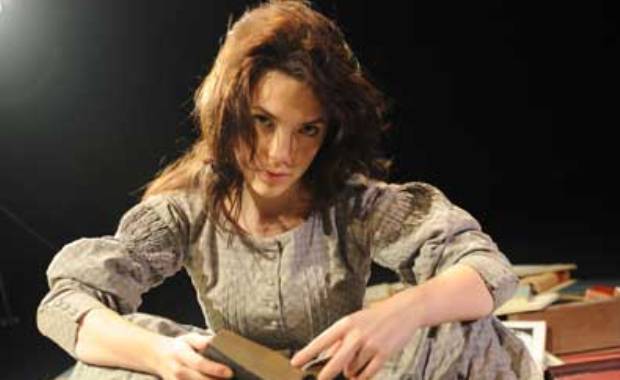
In the title role, Kristin Atherton makes a sparky Mary, conveying her precocious intelligence and appealing confidence while also occasionally peeling back this outward gloss to remind us that she is just a teenage girl, one who trembles at the thought of the love that consumes her and who is prone to fevered fits of jealousy. We are only given true access to her inner emotions, however, through visually inventive dream sequences, which under Polly Teale’s direction become some of the production’s most memorable moments. William Chubb makes a suitably prickly intellectual as Godwin and it is not hard to see why all three sisters fall for Ben Lamb’s Shelley, but it is Flora Nicholson’s poignant, beautifully understated turn as Fanny which becomes the surprising show-stealer, revealing more about this supporting figure than we ever really learn about Mary.

Near the end of the play, as Mary explains the plot of Frankenstein to her father, it becomes clear what purpose the chosen details of her life are serving, beyond simply presenting us with a fictionalised biography. Mary dreams of the possibility of bringing her child back to life; she struggles to come to terms with the rejection of her seemingly indifferent father; she has been raised in the absence of a mother – the connections between life and fiction are perceptibly and none-too-subtly drawn. It is nothing new to suggest that Mary Shelley’s extraordinary creation was inspired by some of the more distressing aspects of her own experience, but to have such words plainly drop from the author’s lips seems to draw a line under the theory.

But, to borrow a phrase from John Lennard, dimly remembered from one of the university set texts at the back of my bookshelf, “art is not autobiography”. One of the most damaging criticisms to have dogged the writing of women over the years is the suggestion that it is drawn purely from personal experience, incapable of the same feats of imagination as, to take a convenient example, the output of the male Romantic poets. It is just such an argument that caused suspicions that Frankenstein was the product of Shelley’s imagination rather than his wife’s and that has led generation upon generation of critics to point back to the writer’s life. A startling act of invention is devalued to little more than a fanciful elevation of abandonment issues.

With my feminist hat firmly on, Edmundson’s approach uncovers a troubling reduction of a great work of literature. I should perhaps admit at this juncture that Frankenstein is among my favourite novels, but my point has less to do with my personal opinion of the book and more to do with the reception of literature written by women in a wider sense. In a piece that otherwise offers interesting and intelligent windows on the position of women in a patriarchal society, in keeping with the focus on great women seen in Shared Experience’s previous work, the emphasised connection between Mary Shelley’s life and work and the foregrounding of the influence of two strong men in the form of Godwin and Shelley glares out disappointingly.

To be fair to Edmundson and Shared Experience, this is a quibble that largely arises from my own approach to literature and I suspect that most audience members would have no such concerns. Art and autobiography have a long love affair that even Roland “Death of the Author” Barthes failed to fully dissolve, and there is undoubtedly a certain enduring curiosity excited by this group of free-thinking radicals. One of the most interesting aspects of this production is in fact how it treats the problematic intersection of these thinkers’ beliefs and lives, unmasking the hypocrisy and inevitable human frailty that lurk behind genius. For all Godwin’s espousing of unconventional relationships, he cannot reconcile himself to the thought of his own daughter running off with a married man, while Shelley’s fervent belief in an open, experimental “community” looks a lot like self-serving indulgence of his own adulterous impulses.

In a nice nod to Shelley’s Defence of Poetry, Godwin refers to himself, the poet, Mary and her mother as “legislators of mankind”. But what Edmundson’s writing cleverly acknowledges is the tension between a belief in the advancement of humankind and a genuine respect for humanity, the latter of which is often lacking among all the talk of “political justice”. To wheel out a hackneyed phrase, Edmundson seems to be suggesting that here the personal is political. After all, a community of any kind cannot exist without a consideration of the relationships within that community. In neglecting people in favour of ideas, the ideas of these individuals lose some of their sway, and Mary’s gradual recognition of this forms one of the more fascinating developments of her character.

Ultimately, however, little new is revealed about this extraordinary woman, whose life contains enough to fill several plays. In this sense, Edmundson is wise to restrict herself to the space of a few years – the years in which Mary’s character was arguably most shaped – yet there remains something faintly unsatisfying about the approach that she and Shared Experience have taken. In the end, perhaps one of the most effective elements of the production is Naomi Dawson’s design, which hems in the scenes between overflowing bookshelves; a helpful reminder that literature is also a leading character in this drama, but one that too often lurks in the background.