God/Head, Ovalhouse

If I approach this review in the same way as Chris Goode has attempted to approach his latest show, from a position of total honesty, writing about God/Head presents intrinsic difficulties. As a piece of theatre it is fluid and slippery; resisting a firm grasp, sliding off in different directions, eschewing the “very Radio 4” journey narrative that Goode says he originally thought he would create. Slippery and elusive too are the thoughts that it provokes, darting off in several directions at once as Goode demands us to “link it up”. It is – in as far from negative a way as possible – messy.

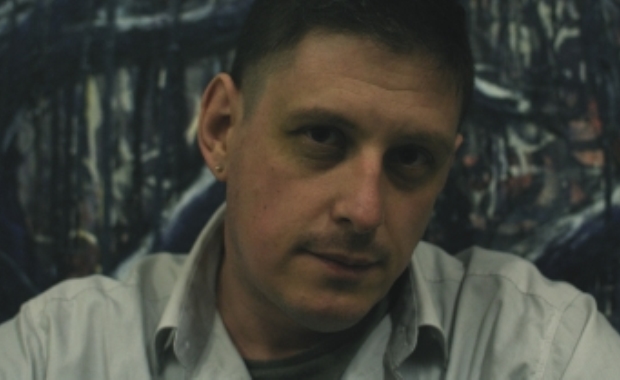
It is this very messiness, however, that fits Goode’s subject matter so well, as he is handling perhaps the messiest thing that any of us ever have to grapple with: belief. The catalyst for this intimate and fascinating piece of theatre was an experience that Goode encountered on an otherwise ordinary day – 21st April 2011, to be exact, as he continually reminds us – while walking home from the supermarket. Suddenly, shopping bags in hand and headphones in his ears, committed atheist Goode became aware of something that he had never felt before. Suddenly, there was God.

Over the following hour and a half, Goode attempts to unpick this troubling experience, inevitably getting ever more tangled in the process. It is an extraordinarily brave attempt, laying its performer bare – it is not for nothing that the idea of nakedness is a recurring motif. As he invites us into his world, Goode exudes warmth, slowly enveloping us in his candid storytelling. This show, it transpires, is about questions rather than answers and about uncertainty rather than certainty. In a world which so often seems to be a contest of who can shout their certainty loudest, such unapologetic doubt is refreshing. Goode also reveals, almost as a side effect, that atheism can be just as inflexible as religion. Whether an advocate of belief or disbelief, how can we all be so sure?

As has already been explained, this is not a journey, and there is no real logic to how Goode’s show progresses. Each night he invites a guest to join him (Greg McLaren on the night I attended), whose own experiences of religion and belief also inform the piece, as well as providing a second presence on stage for Goode to bounce off of and to take on roles in some of the piece’s short scenes. Goode’s technique – although technique itself seems the wrong word – is part storytelling, part dream sequence, part conversation and part sketch, with a good few more elements also thrown into the mix. Appropriately, this piece defies structure and genre.

There are undoubtedly flaws in the evening of theatre that Goode has produced from this probing of his own experience, but that seems almost to be the point. Uncertainty and even distrust in what Goode himself is telling us are actively encouraged at every turn. The sound and lighting deck has been moved into the performance space to, as Goode says with a chuckled Brechtian reference, remind us that what we are watching is a play. The story of his encounter with God is repeated several times over, each time adding details that throw it into doubt: at the time he was listening to a self-help guru who spoke about God, and he had been reading the Bible for a show he was writing.

Artifice and the craft of theatre itself become part of the investigation as the piece goes on. Goode was concerned that by creating a show about his experience he would lose something of it, a possibility that arises through the repeated tellings of his story in this one evening alone. By retelling and retelling the experience, Goode highlights the fallibility of our own experience, something that is compounded by the input of neuroscience and Goode’s own struggles with depression. In another intriguing part of the show, Goode stages a conversation with one of his fictional creations, raising complex and troubling questions about the nature of creating and of power.

Despite this supposedly being a review, I am drawn irresistibly towards the same uncertainty expressed by Goode. It feels almost inappropriate and slightly arrogant to proffer a value judgement on such a subjective experience, both for Goode and his audience members. All theatre is of course different each night, however slightly, but with God/Head there is a true sense that no two performances are the same, not least because of the chopping and changing of guests. Watching this show will also be a different and intensely personal experience for every individual who goes to see it, refracted through their own belief systems and their openness or otherwise to the ideas that Goode is introducing.

But for me at least, the beauty of this strangely captivating and deeply thought-provoking piece is that, in its messiness, it also allows each of us to have our own confrontation with faith and what that might mean for us. As Goode warns his audience, it’s not easy, but as Goode also recognises, it’s usually the difficult ideas that are the ones worth sticking at.

Purge, Arcola Theatre

Estonia’s troubled history is under the spotlight at the Arcola Theatre – and what a harsh, blinding spotlight it is. Flitting between the early years of Soviet occupation in the 1940s and the country’s struggle to cope with the after-shocks of Communism in the nineties, Sofie Oksanen’s violently gripping tale is a vivid portrait both of a besieged country and of two women from very different but similarly afflicted generations. Aliide is from a persecuted ‘kulak’ family and has married a man who repulses her in order to ensure her own survival, while her true passions lie in the direction of the cellar where she hides her deported sister’s hunted husband. Two generations later, Zara is a young Russian girl who has fallen into prostitution and is on the run, a flight that takes her to the now elderly Aliide’s isolated country home.

While the setting is Estonia both during and in the direct aftermath of Soviet occupation, this is a play as much about the abuse suffered by women at the hands of men as it is about a country’s political domination, with both forms of oppression feeding into and informing one another in Oksanen’s script. The harsh irony is that even in supposed peacetime, at the dawn of Estonia’s long-sought independence, women such as trafficking victim Zara remain as helplessly trapped as ever. In the world of the play, women are relentlessly abused, often sexually, and exist as little more than objects to the men who ruthlessly wield the power – just a pair of blue eyes, or a naked body. It is gut-wrenchingly painful yet urgent viewing.

This is difficult, neglected subject matter that is dealt with unflinchingly by Elgiva Field’s brutally intimate staging, creating an atmosphere of terror in which the audience is also prisoner and victim. In the small space of Arcola’s Studio 2, there is nowhere to hide or escape from the horror of the events being exposed. The piece opens with a claustrophobic video projection of one of the secret police’s infamous ‘interrogations’, gripping our nerves in a vice before we even begin and acting as a crucial explanation for Aliide’s actions throughout the play: terrible choices and betrayals that we might otherwise automatically condemn. By showing this horrific experience in flickering film, it becomes a nightmarish, haunting memory, separate from the onstage action yet indelibly imprinted on the walls of Aliide’s home.

From this harrowing opening, however, the pace slackens off and the slow-burner of a first half takes its time to really drag us into its thrall. Although this piece was originally commissioned as a play before being transformed into the better known bestselling novel, Oksanen remains a novelist first and foremost – and it shows. While the play as a whole is far from undramatic, exposition is often clumsy in the absence of the direct psychological illumination available to prose, forcing Oksanen to use the jarring device of having the young Aliide explain her actions to her watching older self. The way in which past and present brush against one another on the stage is a powerful visual reminder of how history lives on in individuals, yet this particular to-ing and fro-ing between Aliide’s present and her memories seems more suited to novel treatment, or possibly to film.

The script’s other key disappointment is its lack of focus on the relationship between Aliide and Zara, a pairing that could have added further nuances to the play’s examination of women but is instead neglected in favour of uncovering the past. One disturbingly violent scene aside, the dynamic between the two women never seems fully realised. But this is not to detract from performances, which deliver a powerful, winding punch. Illona Linthwaite and Elicia Daly are strong as Aliide and Zara respectively, while Kris Gummerus is often heartbreaking in the role of Aliide’s brother-in-law Hans. It is Rebecca Todd as the young Aliide, though, who gives the true knockout performance, achieving a brittle combination of vulnerability and grim resolve and suspending judgement on her character’s violent actions. As terrible as the choices made by the play’s female protagonists may be, Field’s production does its job in making these comprehensible in the context of extraordinary circumstances.

For all that it feels like a novel knocked into dramatic shape, there is one way in which this particular incarnation of Oksanen’s story trumps all others: unlike pages that can be closed, here we are not allowed to look away. Although it may take its time to unfurl, by the time it reaches its compelling final scenes Purge is an emotionally exhausting theatrical experience that is not easily forgotten.

Purge runs at the Arcola Theatre until 24 March.

Sex with a Stranger, Trafalgar Studios

Originally written for Spoonfed.

The bold title of Stefan Golaszewski’s new play, while undoubtedly attention grabbing, is slightly misleading. Although this comedy’s short, punchy scenes dance around many of the moments leading up to, informing and following the carnal act of its title, the narrative’s climax (pun intended) is never quite reached.

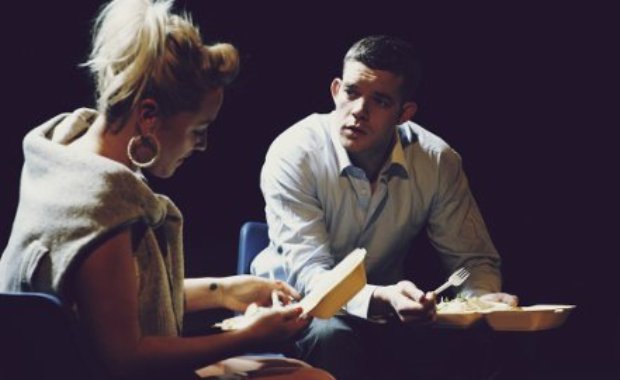
The central one night stand is between Grace, played with pitch-perfect, endearing awkwardness by Jaime Winstone, and Russell Tovey’s equally endearing but romantically clueless Adam. They meet in a nightclub, an encounter followed by all the usual inexpert groping, interminable late night travel and mandatory kebabs that characterise such liaisons. It is the longest, most toe-curlingly awkward display of foreplay imaginable. As a background to this fumbling, fleeting affair, Adam has left at home his long-term girlfriend Ruth, a piercingly poignant bundle of insecurities in the hands of Naomi Sheldon.

With the same shrewd observation deployed in offbeat comedy Him and Her, writer Golaszewski and director Phillip Breen have zeroed in on an unflinching, almost grubby realism. Dialogue revolves around such humdrum topics as Homebase and salad, while the subtlest facial movement from any one of the unfailingly excellent cast conveys a clutch of instantly recognisable thoughts. In the cosy space of Studio 2 such minutiae achieves maximum effect, although the minimalist, close-up focus on the mundane does threaten to dent the play with its own slightness.

The scenes between Adam and his two different partners are chopped up and intersected; fractured moments from flawed relationships that have been roughly thrown about and then separately, delicately held up to the light. Under Emma Chapman’s bright, often stark lighting, these glimpses into the lives of Adam, Grace and Ruth can feel like snapshots, brief bulb-flash illuminations that fade away as quickly as they were captured. The piece resists togetherness and resolution, but its lack of cohesion is symbolically fitting for a play that distils the lack of connection between individuals.

Looked at through the lens of these diced, jagged scenes, Sex with a Stranger reads as a jarring oxymoron: an act of the greatest intimacy juxtaposed with the most fleeting of human connections. But who out of Grace and Ruth is the greater stranger to Adam? While many aspects of these two contrasting relationships differ dramatically, the most striking moments in both are the awkward, strained silences that garner pained laughs of recognition.

Ultimately, what elevates this from the realm of mere observational humour is its unsettling grain of grim truth. Under the veil of comedy, Golaszewski is dishing up for the audience’s guilty consumption our own inability to communicate and connect. Romance may not quite be dead, but the signs of life are hard to find.

Sex with a Stranger runs at Trafalgar Studios until 25 February.

Lovesong, Lyric Hammersmith

The past may be a foreign country, but we sure like travelling there. In the latest production from Frantic Assembly, past and present share the stage in a tender tearjerker about love, time and memory.

The story itself is seductively simple. An old married couple, Billy and Maggie, are nearing the end of their time together as Maggie’s health steadily deteriorates. Meanwhile they are consumed by the shadows of their younger selves that dance – quite literally – through their home. Through these memories, we are introduced to the couple at the beginning of their marriage, following them from honeymoon glow to the appearance of the first cracks in their relationship. We learn that they have emigrated together to the States, where Billy sets up a dentistry practice and they wait for children that stubbornly refuse to come.

By intertwining the lives of this couple at different ages, playwright Abi Morgan (the prolific writer-of-the moment behind The Hour and The Iron Lady among others) is able to give us a fairly comprehensive picture of their marriage. This is no idyllic portrait of perfect love; we see Billy and Maggie bicker and fight, we experience their frustration at their childlessness and witness them both momentarily waver when faced with the temptation of adultery. But we also see how, in old age, they have come to rely on one another in a marriage that has ultimately survived through the years.

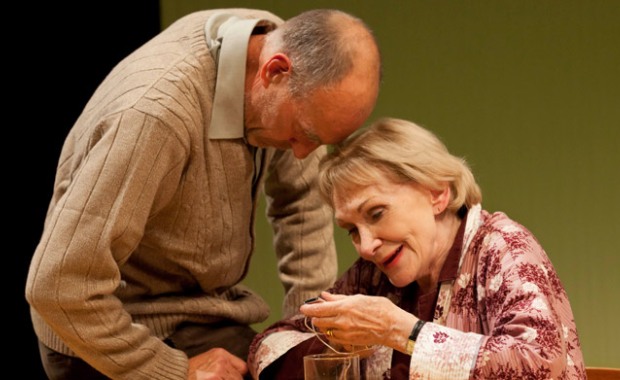
Morgan’s script is brought beautifully and captivatingly to the stage by Frantic Assembly, who unite evocative movement with stunning sound and design. Under the direction of Scott Graham and Steven Hoggett, Billy and Maggie’s past and present selves collide, embrace, dance and separate, all to Carolyn Downing’s moving soundtrack. In one standout moment, the present-day Maggie, heartbreakingly played by Siân Phillips, tries on a treasured pair of shoes from her youth and stumbles through the house. The emotional effect is little short of devastating.

There is no doubt about it, this is meant to make us cry. Frantic Assembly’s production, helped along by an outstanding cast, is unapologetically manipulative, working on our collective tear-ducts with nimble, tender touches until the audience is reduced to a symphony of sniffles. Morgan has cannily tapped into fears that assail us all; we weep not just for Billy and Maggie, but for the inevitability of our own demise and that of our loved ones. Yet, for all that it tugs delicately on the emotions, I can’t help but wish that Lovesong was a little less insistent on leaving its spectators damp-faced.

When not pulling mercilessly at the heartstrings, Lovesong raises some fascinating questions. Far from being merely a eulogy on a love story that is at its imminent end, Morgan’s play prods at some of the deeper concerns that ripple through our existence. How, for instance, do we create our own legacy? As Billy contemplates the end, the optimism of his youth all faded, the only marker of his life seems likely to be his perfectly maintained set of gnashers. The young Maggie’s imagination, meanwhile, is captured by the cave drawings left behind by early humans – drawings that she and Billy later run their hands over together, imprinting these pre-historic images with the story of their own love.

But by far the most intriguing theme to thread through Billy and Maggie’s story is that of time and its linearity or otherwise. The intersection of past and present, while primarily redolent of the potency of memory, asks inherent questions about our conception of time, questions that arise again when Billy introduces different theories of time. Are our lives really lived along a straight line, or is time far more complex than we could imagine? These are ideas that, mirroring Graham and Hoggett’s haunting choreography, are repeatedly caressed and skimmed over, but that this production ultimately loses grasp of.

There is no shame in a piece of theatre about love and death – two of life’s few universal certainties – and especially a piece of theatre that handles these themes as deftly as Lovesong does. Tears, however, have an unfortunate tendency to blur the vision, obscuring the lighter nuances of what Morgan is saying. Exquisitely moving though it may be, in the wake of this strong tide of emotion emerges a yearning for something slightly more clear-sighted.

Lovesong runs at Lyric Hammersmith until 4 February.

Image: Johan Persson