Music gives lives meaning. It gathers communities; marks the rituals of births, marriages and deaths; soundtracks moments of happiness and heartache. A song can be a solace or a spur, a souvenir or a scar.
For the trio of characters in Folk, it’s the music of the title that lends significance to these individuals’ ordinary existences. Tom Wells’s play is, in many ways, a classic story of unlikely friendships. At its centre is Winnie, a gleefully singing, swearing and smoking nun, whose enthusiastic knowledge of the saints is only matched by her love for a good jig. On Friday nights, she’s joined for a sing-song and a pint of Guinness by her quiet best friend Stephen, a man who never quite got the hang of life. Where Winnie is all vivacity, Stephen is all reserve.
Lobbed into their lives like the brick she sends smashing through Winnie’s window, teenager Kayleigh is the improbable third member of their makeshift folk group. Unfolding over a series of their Friday evening jam sessions, the play slowly envelops us in these people’s lives. Bit by bit, Kayleigh opens up about her problems and worries, while Winnie and Stephen strive to conceal theirs. The supposed goal is an Easter Folk Night at the local church, thrust by Winnie upon a reluctant Stephen and Kayleigh, but really it’s the friendships between the three characters that are gradually built up through their playing and singing.
And that’s it. Folk is a slight little thing, its ambitions as modest as those of its characters, yet it’s sort of exquisite in its own tender, unassuming way. It gives the same measured, compassionate attention to unremarkable people and unremarkable lives as Barney Norris’s gentle, muted Eventide or the plays of Robert Holman. Like the writers of folk songs, Wells has an ear for the everyday rhythms of small joys and sadnesses. These things deserve to be sung about too, he seems to be saying.
In terms of plot, it’s easy enough to see where everything is headed, but at heart this is a piece that’s more about character than it is about story. The attention of Tessa Walker’s unshowy production is likewise firmly fixed on the people at its centre. Bob Bailey’s bare frame of a set, filled with the cosy religious paraphernalia of Winnie’s life, is a scaffold for these lives to hang on, while Walker’s direction creates vital breathing space in which the characters can discover one another. Silence and song say as much as words.
As the irrepressible Winnie, Connie Walker vibrates with constant energy. Even when sat down talking, her legs jitter to an inner beat, and when the music starts up she’s instantly transformed, leaping into jigs that are exhausting just to watch. It’s no wonder weary exasperation seems to radiate in waves from Patrick Bridgman’s Stephen. But there’s warmth and care, too, in her uncompromising, non-stop approach to life. Those sentiments are infectious, thawing gruffly protective Stephen’s initially frosty attitude towards Kayleigh and visibly softening the brittle, seemingly self-sufficient exterior of Chloe Harris’s confused teenager. As they play music together, the distance between these three very different people simply slides away.
Folk music is, as Kayleigh puts it, “centuries of troubles and struggles and not-to-worrys”; it’s tunes that lodge in the head like “little ribbons, half-remembered”. In Wells’s play, those songs become tools for living, at the same time as sounding an empathetic ode to lives half-lived and the stories that are so often left untold.
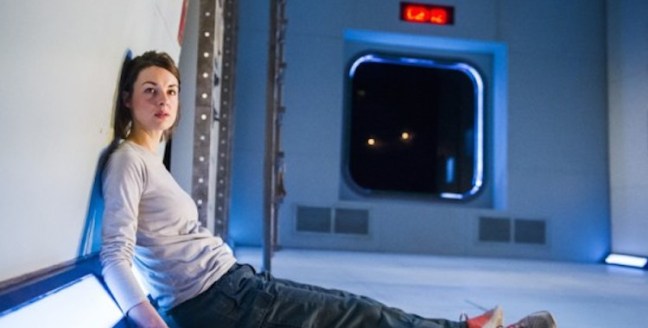
Everything in X is slightly off-kilter. Literally. Merle Hensel’s great grey box of a set is permanently tilted at an angle. The sort of angle that’s just enough to shift your perspective on your surroundings. The sort of angle that’s just enough to start you questioning things.
The same goes for the psychic world inhabited by the characters in Alistair McDowall’s new play. It’s a physical and mental landscape that is out of joint. It’s also out of time. The collection of crew members occupying this bland, functional capsule are billions of miles away from home and the rest of humanity, clinging on at the far reaches of the solar system. The sun is barely a faint flicker this far out; it is, as one character puts it, “one long night”. No days, no markers, nothing to hold onto except technology. And technology can go wrong.
That’s just what has happened as the play opens. Or, at least, something has gone wrong. After an eighteen-month stay, the first scientists to colonise Pluto are due to be picked up and returned to Earth. Except Earth isn’t answering the phone. There’s been no contact for three weeks and the crew at the research base are starting to get restless. “We’re all a bit … fraught,” says second-in-command Gilda (a nervily hair chewing, cereal chomping Jessica Raine), with delicious understatement.
At first, X is essentially a workplace drama – if one with heightened stakes and shrunken surroundings. Imagine being trapped in the same featureless space with your workmates for months on end and you begin to get the picture. The situation is desperate, but also banal. Colleagues bicker over contracts and kill the time with games of Guess Who. There are arguments about who hasn’t done the cleaning. Nerves are frayed.
But then McDowall’s play mutates. Just as it threatens to drag, its pulse – and ours – quickens. Ray (Darrell D’Silva), the captain of the crew and the astronaut who shipped them all out to Pluto, starts seeing things in the empty gloom of the not-quite-planet. Cole (Rhudi Dharmalingam) notices that the clocks have been going back by themselves. There’s a glitch in the system, a ghost in the machine. No one knows how long they’ve been stranded here, and no one is coming to pick them up. Suddenly we’re in the realm of psychological thriller, the confined research base (packed with provisions that will outlast them all) becoming a pressure cooker for the crew’s fears and tensions.
And then things get stranger. And stranger. And stranger. As the display on the digital clock scrambles, so too does time and memory and identity. Ray’s not the only one who’s seeing things. Or is he? There’s a crew member who’s maybe a crew member, or maybe a ghost, or maybe an echo of a memory, or maybe their rescuer. Maybe. False memories multiply and compete. Months or years or decades slip by. Nothing can be trusted. Eventually, even language breaks down, fracturing into single syllables and then just a vomited stream of ‘X’s. All that holds it together at the centre is Gilda, who’s sent spiralling further and further into herself.
It’s baffling and bewildering, but then it’s meant to be. The whole point of X lies in the same ambiguity that characterises its title. X can mean many things. A kiss. An error. The elusive answer to an equation. X marks the spot. In McDowall’s play it is all of these and more. And it’s distinctly, thrillingly theatrical. Sat in our seats at the Royal Court, watching these bodies on stage in front of us, we’re more aware of time passing than we would be behind a screen, where the pause function is always just a tap away. We feel time, which is crucial to this play about time dissolving.
Vicky Featherstone’s production, meanwhile, makes equally canny use of the space of the theatre to tell this fractured narrative. Prolonged blackouts dare us to see our own fears in the enveloping darkness. In between, Lee Curran’s lighting casts a queasy, subtly shifting synthetic glow, under which the characters sweat and squirm. Nick Powell’s sound design, with its nods to sci-fi, gestures towards the cinematic while working with the performances to slowly turn up the tension in a way that only a live art form can. And when things fall apart, Tal Rosner’s video designs transform the dull walls of this enclosed space capsule, twisting the strange world of the stage that bit further out of alignment.
What’s most haunting about X, though, is not the exhilarating theatrical effects or the familiar hint of space horror: the little girl at the window, the spectre of something scary in the deep, deep darkness of outer space. The production is having fun with these elements – and temporarily spooking the hell out of its audience in the process – but what lingers afterwards is the exposed fragility of time and memory. That out-of-joint-ness that doesn’t quite go away after walking out of the theatre and allowing the world to right itself.
Because we might not be on Pluto, but our senses of self are no more robust, really, than Gilda’s. Strip away clocks and relationships and familiar places and things and what are you left with? As McDowall himself has pointed out, in some ways it’s not really all that significant that the play takes place on Pluto; it’s the extreme distance of this place from home and all things known that really matters. And time is both as artificially constructed and as inexorable in its passage for us as it is for this imagined crew. The implicit questions raised – about what we remember, and what we don’t remember, and how we hold onto an idea of who we are – resonate far beyond any sci-fi setting (and the best sci-fi does, after all, have a habit of playing on our deepest fears and preoccupations).
The other thing that haunts is the pervasive atmosphere of loss. X isn’t just a play about being far from home. The home these characters yearn for is one that has already been lost – ravaged for profit and rapidly consuming itself. The snippets of information we gradually glean about this future Earth are horrifically bleak: birds have fallen from the sky, whole continents have been swallowed by the sea, trees have disappeared. It’s ecological crisis writ large. The skill of McDowall’s writing, though, is to imbue these horrors with a chilling normality. This is just the way things are. (And, I sense with a shiver, it is just the way things will be if we continue down our current track of blithe environmental destruction.)
Then again, that’s just one way of seeing it. Tilt your head at another angle and other interpretations reveal themselves. That’s the beauty and the occasional frustration of McDowall’s play, which refuses to narrow possibilities. Like that huge, off-centre grey box, it’s a container for meanings and fears and memories. X, after all, can mean many things.
1968, Burbank, California. Six years after his last number one single, Elvis Presley records an intimate television concert surrounded on all sides by screaming fans.
2016, Shoreditch Town Hall, London. Greg Wohead re-enacts the television broadcast, now known as the 1968 Comeback Special. Well, sort of re-enacts it.
In The Ted Bundy Project, Wohead dissected our morbid fascination with violent figures and his own disturbing attraction to serial killer Ted Bundy’s confession tapes.Comeback Specialonce again unravels the fabric of fascination, though this time it’s the famous rather than the infamous under the microscope. What makes an icon, a King? And what might happen if we try, briefly, to bring him back?
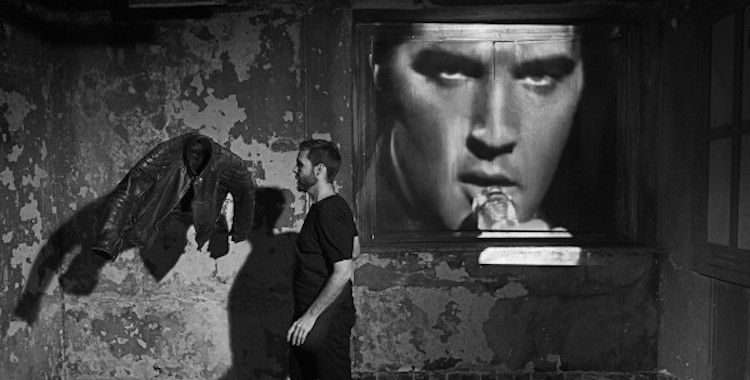
Wohead arranges the audience on four sides of a raised square stage in Shoreditch Town Hall, mirroring the layout of the Burbank studio. Chairs and a microphone stand are placed just so. It’s a perfect reconstruction in some ways, deliberately imperfect in others. Drained of the bright, synthetic colour of 1960s fashion, Wohead’s version is a shadow or skeleton of the original event. Recreated in monochrome, this is a black-and-white negative of the 1968 Comeback Special. An echo. A ghost.
The whole event is, supposedly, about authenticity. “I want you to see who I really am,” says Wohead/Elvis in a seductive drawl. That was the whole point of the television broadcast: to offer fans a glimpse of Elvis the man as well as Elvis the star. The King and his musicians jam together, while Elvis talks to the audience between songs. Yet at the same time, as Wohead tells us, this was all carefully constructed: the television show was pre-recorded and released in multiple different versions. How is it even possible to recreate something that exists under myriad guises?
Wohead builds his re-enactment slowly, in careful layers. At first, the dynamism of the gig is rendered oddly static. Everything is told, not shown: Elvis’s appearance, the layout of the television studio, the position of the cameras, the clothes worn by the fans. Wohead talks us through every last detail of the recording, the meticulous description juxtaposed with a complete refusal to imitate. “You can see that my hair is black, obviously,” says Wohead, looking at us through his mousy mop. Even the lyrics are spoken, deadpan, rather than sung.
And then gradually, bit by bit, Wohead takes on aspects of Elvis’s physicality. A curling lip. A thrusting hip. Then, later, that distinctive voice. That unmistakeable “uh-huh”. Wohead’s is a fragmented impersonation, isolating individual elements of Elvis’s performance. He works like a forensic scientist, as if in search of some elusive essence. Is it in the voice? The recognisable quiff of hair? Those hips?
But meaning resides as much with the audience – the audience then, in the television studio, and the audience now, in Shoreditch Town Hall – as it does with either Elvis or Wohead. Attention is drawn to the ways in which individual spectators cherish moments of eye contact or precious souvenirs: a sweat-soaked handkerchief or a piece of lint plucked from Elvis’s cheek. A good chunk of the show is dedicated to recreating one small moment of interaction between Elvis, the audience and one of his band members, Wohead building the encounter piece by tiny piece with the help of the audience.
The choice of re-enactment also feels crucial. The 1968 Comeback Special is the scene of Elvis’s career resuscitation. But it is also, perhaps, the moment everyone realised for the first time that he was human and fragile and as vulnerable to time and age as the rest of us mere mortals. This is not Elvis as he was in the years before his death – fat, drug-addled, washed-up – but he is no longer quite the untouchable young man he once was. He is, as Wohead puts it, “caught between”.
Scrolling through YouTube the day after watching the show, there’s something hypnotic about the videos of the 1968 Comeback Special. It’s the way the whole event flirts with failure: Elvis interrupts his own songs, jokes about forgetting the lyrics, laughs in a way that is at once exposed and in control. This is not Elvis at the height of his powers. And the footage of the television show itself, when it finally appears in Wohead’s performance, seems flimsy and thin, projected onto translucent cloths hanging behind the four sides of the stage. The King is little more than a flickering image, fleeting and insubstantial.
There’s an aura of dustiness at the opening of Institute. The edges of the stage, shrouded in a crepuscular gloom, are crowded with filing cabinets. Towering, oppressive, rusty brown. This space, designed by Rhys Jarman and Amit Lahav, is somewhere between a workplace, an archive and a Kafkaesque labyrinth of endless documentation. It looks at once humdrum and dystopian.
Gecko’s show, though, is anything but dusty. It might be crammed into this dingy, almost deathly setting, but its movement hums with life. Bodies leap, spin and fall through the space, limbs propelled with joy one moment and despair the next. The storytelling might be puzzling and opaque, but Institute‘s glimpses of the human condition – its ecstasy, its agony – are crystal clear.
It’s hard to say what precisely Institute is “about”. The title, perhaps, is a good place to start. The word “institute” suggests an organisation, a state body or company, somewhere strait-jacketed by rules and leaden with bureaucracy. But “institute” is also a verb: to introduce, to establish, to begin.
At first, we appear to be in a workplace – an unspecified institute of commerce. Its employees are two men: Martin (Lahav) and Daniel (Chris Evans). They make cheery colleagues, dancing around their desks while they carry out meaningless tasks and answer incessant telephone queries from their absent bosses. Yet there’s also a sinister undertow. At odd intervals, bright lights flash and sirens intervene. These men seem to be under surveillance, their office acquiring a tinge of the Orwellian. And those cabinets, which store far more than just files, seem to hold a perpetual, ominous allure for the men who organise them…
The longer the piece goes on, the more I begin to wonder whether we’re in another kind of institute: a hospital, perhaps a bizarre and unconventional psychiatric ward. The two protagonists, who at first simply seem to be grinding through the 9-to-5, are each troubled in their own way. Daniel, a (wannabe? one-time?) architect, is both driven and crippled by ambition. Proud, expectant voices echo from the filing cabinets, while he contorts his resistant body into desk-bound poses of industry. Martin, meanwhile, is driven wild by thwarted love, seemingly doomed to relive the same humiliating restaurant scene over and over and over.
It’s never entirely clear, though, what these haunting scenes represent. Are we seeing dreams, memories, or stunted desires? There are hints of group therapy, as Martin and Daniel link hands with their bosses-turned-carers (Ryen Perkins‐Gangnes and
François Testory) and move in a circle. But the two men who seem to be in charge here – speaking different languages, to amplify the confusion – have traumas of their own. One is increasingly ill and frail, stubbornly pushing away his pills in denial. The other is repeatedly dragged back to a startling nightmare – or perhaps a memory – in which a figure falls away into nothingness.
The sum of these different scenes is fragmented and sometimes bewildering, but never less than compelling. Both design and choreography offer endless surprises. Whole rooms – the desks of the workplace, a restaurant table and chairs for two – spring, fully formed, from the cabinets that line the stage. Jaunty sequences of movement quickly give way to the strange or unsettling. In the most striking of these tonal jolts, Lahav suddenly appears with long contraptions attached to his arms and legs, manipulated by the other performers like a gruesome human puppet. The recurring nightmare in which an unknown man falls suddenly backwards and out of sight, meanwhile, has something of real horror in it.
The invitation explicitly offered by Gecko in its marketing material is to “consider what it means to care”. This suggests one way to join the dots between the company’s disparate but captivating series of images. Sometimes care is physical support – arms to catch and hold up. Sometimes it is a struggle, a case of being cruel to be kind, as Martin and Daniel are forced to confront their demons. Sometimes it is love, which appears in the show under multiple guises. Sometimes it is simply being together, being there.
There’s also a question of what it means to care in a distinctly uncaring corporate environment, where individual human beings are little more than cogs and lives are filed away like inert documents. And then, later in the piece, Gecko raises the spectre of medical care – more relevant than ever in the light of NHS reform and privatisation. Institute is, unquestionably, more visceral than cerebral, but the thoughts and questions it prompts are vital nonetheless.
There’s a moment in Greg Wohead’s show The Ted Bundy Project when the whole audience holds its breath. We’re watching a video – a video that Wohead has already described at (horrifying) length – and we’re wondering if Wohead – lovely, affable, smiling Wohead – is really about to show us this. He wouldn’t, would he? I stare at the screen, feeling slightly sick, yet unable to wrench my gaze away. I can’t stop watching.
“It’s hard to watch,” writes Natasha Tripney of Katie Mitchell’s production of Cleansed. “Yet here we are, watching.” There’s a similar sense of suspended breath in the Dorfman auditorium. I suspect that many of us know, or at least half know, what to expect from Sarah Kane’s play, first staged at the Royal Court in 1998. We have chosen to be here. And we choose to remain in our seats, looking on as horrible things happen to the bodies on stage. What makes us watch? And how, as we watch, do we make sense of what we see?
The first question, perhaps, is what are we seeing? Both Kane’s play and Mitchell’s production make that a difficult question to answer. In both, very specific scenes of torture and tenderness sit within a strange, abstract world. Tom Mothersdale’s Tinker, sadistic and self-loathing, rules over an institution of some kind, where he torments and experiments on a series of subjects: siblings Graham (Graham Butler) and Grace (Michelle Terry), lovers Carl (Peter Hobday) and Rod (George Taylor), and an illiterate boy named Robin (Matthew Tennyson, bringing extraordinary gentleness to this cruel world). What we as an audience experience is more a series of brutal and beautiful impressions than a linear, coherent narrative.
Several reviews of Cleansed (both negative and positive) have listed the violence: litanies of horrors laid out for the reader like a catalogue of cruelty. Quentin Letts even offers the exact timings of each instance of torture. But violence is more than just the blows of a fight or the blast of a gun. It’s more than the blood and gore which have dominated press coverage of this revival (along with the depressingly predictable headlines reporting audience members fainting and walking out – presumably not at the same time) – and which, in any case, I was braced for as I tentatively took my seat.
Yes, it’s often difficult to watch. Yes, certain scenes of torture and mutilation – described in (sometimes problematic) detail elsewhere, so I won’t repeat the fetishisation of that represented violence again here – make me curl my hands into fists or send them flying to my mouth. But there’s also violence in the constant ringing of bells and the smooth wheeling in of gurneys. It’s the casual, precise, institutionalised horror of it all that strikes me as most violent. It’s the plastic sheets and pristine black suits.
Perhaps the cruelest moment of the production is when, having force-fed Robin a box of chocolates, Tinker gleefully peels away a sheet of cardboard to reveal another sickly layer beneath. He picks up each individual chocolate with a long pair of tongs, careful not to get his hands dirty. Rooted to my seat – eyes held open, muscles clenched – I shiver.
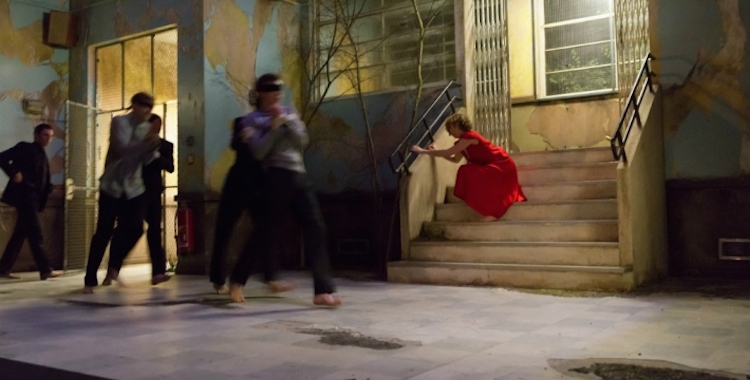
I could write about Cleansed purely in images. Grace trapped in dreamlike incomprehension on the stairs, her red dress a vivid splash of colour against her grubby, washed-out surroundings. Rod and Carl frozen in a kiss as Grace’s arm slowly snakes between them. A slow-motion mockery of a funeral, as faceless figures glide across the stage clutching lilies and umbrellas. The daffodils that sprout, suddenly, through the floor. A series of embraces: tender, fierce, bodies briefly moving as one. Carl’s silent scream as he’s wheeled backwards on a gurney. Grace dancing to Suicide’s “Ghost Rider”, at first a mirror image of Graham, later alone and compulsively, limbs animated with a mixture of horror and joy.
My use of the word “dreamlike” feels apt, as Mitchell’s production is more like a dream than anything else. It’s a nightmare, often, with its shadowy figures and soundless howls. But it also has the vivid strangeness of all dreams, that sense of a world slightly off-kilter. Mitchell (supported by Joseph Alford’s brilliantly controlled movement direction) has slowed everything down to a pace that feels almost outside of time, punctuated with moments of frenetic activity. Nothing quite operates as we expect it to here. Bodies slow and quicken. Plants burst through floor tiles. The seamless combination of Paul Clark’s music and Melanie Wilson’s sound design, meanwhile, generates a constant, queasy anxiety.
Dan Rebellato is one of the few writers to have commented on the theatricality of Cleansed as much as on its naturalism. Many have argued that this version of Cleansed is too realistic, its rendering of violence too convincing. But it’s the hyper-naturalism of Mitchell’s approach to certain moments that creates the production’s uncanniness, its nightmarish blend of (literally) razor-sharp precision and blurry abstraction. As Rebellato puts it, “This production is both fiercely real and achingly theatrical. It’s what it is and it’s humming with metaphor.” It’s haunted by an uneasy doubleness, common to both theatre and dreams. Everything is two things at once. Dreaming and waking. Real and not real. What are we watching?
Mitchell’s production foregrounds the act of watching, of bearing witness. Throughout, we watch Grace watching; she is a constant presence, hovering on the edges of every scene. While the performances are uniformly excellent, it’s Terry as Grace who is utterly unforgettable. Perhaps it’s because we repeatedly see her, rooted to the spot, watching as we watch. In the very first scene she appears frozen to the staircase in the centre of the stage, unable to wrench her feet from where they’re planted, paralysed as if in a nightmare. And it makes you wonder – this constant, almost invisible presence – whether we should indeed read it all as a horrific dream.
There’s more to Grace’s watchful presence, though, than a straightforward framing of the events as a nightmare. By adding an observer, Mitchell throws light on the process of observing. Tinker, too, is often looking on, but his is a different kind of watching. He’s the sinister voyeur – never more so than when watching a peep show, whose performer seems to both attract and repel him. Terry’s Grace, meanwhile, often looks on with tormented compassion, yet able only to helplessly witness. These are our models for watching, making us aware of our own, far from passive involvement as audience members.
“Picture this,” sings a child’s voice in an unsettling rendition of Blondie’s song (just one in a series of inspired musical choices). It’s an invitation to our imaginations, as is Mitchell’s production, even with all its naturalistic touches. There is still, for all the realistic gore, a mental leap. There’s also a choice: a choice to keep watching, like Grace, or to avert our eyes. Why can’t we look away?
At home I have a book full of photographs of abandoned spaces. Barren post-industrial landscapes. Forsaken monuments to forgotten powers. Paint peeling from walls and weeds nudging through cracks. The beauty of their decay is breathtaking. I feel uncomfortably drawn to these ruins, perhaps in the same way I feel drawn to post-apocalyptic fiction. There’s something morbidly fascinating about visions of a world that has left us behind. I also think, as I devour image after crumbling image, how brilliant these would be as stage designs.
Alex Eales’ design for Cleansed could be right out of that book. Kane’s script famously specifies a university – a place of learning become a place of torture – but Mitchell and Eales make this institution much more vague. It could just as easily be a hospital – another ironic reversal that finds its echo in the repeated description of Tinker as a ‘doctor’. There are signs on the walls, but these are the only vestiges of its previous use, relics from another era. Time and nature are gnawing away at this place; the walls are shedding their skin of paint, while bare, spindly trees thrust up through the rotting floor. Dirt and rust and mould are creeping in.
Yet it’s beautiful. And as with those photographs, that’s where the difficulty lies. I’m troubled less by the violence in Cleansed (though it is troubling) than by the extreme beauty I find in it. To what end do we aestheticise acts of cruelty and sites of decay? The question of violence on stage is one that persistently nags at me, and one to which I have no easy answer. Even when cloaked in metaphor, the problem doesn’t disappear. Because those metaphors – Ellen McDougall’s bursting balloons in Henry the Fifth, or the oozing bags of ink in Dan Hutton’s take on The Spanish Tragedy – are beautiful too.
As a challenge, though, Cleansed is vivid and confronting and hauntingly memorable. Kane’s play is known for its series of audacious images – flowers bursting from nowhere, rats carrying off severed body parts – that throw down a gauntlet for any director. It seems to me that Mitchell picks up that gauntlet and then chucks it right at us as an audience. Her images leave us feeling deeply, almost painfully, and they leave us asking the questions that keep punctuating my writing. What are we seeing? What makes us watch? Why can’t we look away? And what is it about what we are seeing that is still, in spite of everything, disturbingly beautiful?








 Catherine Love