Herons, Lyric Hammersmith

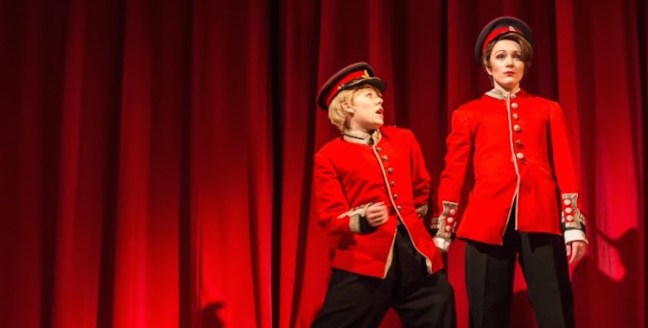
A scene from Herons by Simon Stephens @ Lyric Theatre Hammersmith. Directed by Sean Holmes. (Opening 21-01-16) ©Tristram Kenton 01/16 (3 Raveley Street, LONDON NW5 2HX TEL 0207 267 5550 Mob 07973 617 355)email: tristram@tristramkenton.com

The herons of Simon Stephens’ play are vicious. Vicious and beautiful. They swoop down to catch their prey, still and composed until they go in for the kill.

There’s more than a hint of the animalistic to director Sean Holmes’ and dramaturg Joel Horwood’s new version of Herons. In the soggy Darwinian playground that designer Hyemi Shin has created, everyone gets dragged underwater at one point or another – though categories of predator and prey are never quite as simple as in the natural world that both play and production evoke. The footage of primates that plays constantly on a large screen above the action dares us to watch the unfolding events like a David Attenborough documentary, but it’s far more complicated than that.

If the landscape of the stage is a playground, then teenagers are its main inhabitants. While adults lurk on the sidelines, this is decidedly adolescent territory. As well as the playground, with its garish roundabout and bobbing sit-on horse, Shin’s set suggests all the abandoned, concrete spaces that kids flock to. This one happens to be a canal lock, water gradually trickling through its gates, but it could just as easily be a deserted car-park or grubby underpass. It’s an in-between sort of place, a no-man’s land for those stranded between childhood and adulthood.

One such stranded individual is Billy, the child of a broken marriage and the butt of his classmates’ jokes. A year ago, his dad found a dead girl in the river and reported the boys who killed her. Now Scott – the young brother of one of the murderers – is promising revenge, tormenting Billy with the help of his two guffawing sidekicks. They are cruel in the way that only children are, ruthless and cunning in pursuit of their prey.

The fragmented, out-of-joint aesthetic of the set extends to Holmes’ production, in which scenes jut sharply into one another and the rules of time and space are frequently disrupted. Horwood has cannily chopped and rearranged Stephens’ text, creating the breathless sense that everything is happening at once. What might be calm, quiet exchanges between Billy and his Dad, fishing at the water’s edge, become truncated and immersed into the all-pervasive brutality of schoolyard bullying. Scenes never quite end, the performers remaining on stage to watch what comes next, their presence looming and ominous.

There’s more than a hint of Secret Theatre, its legacy shimmering like the light reflected off the water. It’s unsurprising, perhaps, given that Holmes, Horwood and Shin are all involved. Yet here some of the most interesting aspects of that project – bold design, a resistance to naturalism, a sense of exploration and surprise – are married to another of the Lyric’s core purposes: its commitment to young people. Two Bugsy Malone alumni (Max Gill as Billy and Sophia Decaro as Adele, the young girl who befriends him) return in this production, while impressive performances are delivered by all of the teenage cast (alongside Ed Gaughan and Sophie Stone in compelling turns as Billy’s parents). We see, for a change, young people actually played by young people – and with nuance and complexity to boot.

There are aspects of the play that are inevitably jettisoned by Holmes and Horwood’s short, sharp shock of an approach. The tenderness that tempers the cruelty – in moments between Billy and his alternately tough and gentle dad, or in the delicate connection that Adele finds with Billy – only briefly glimmers through the darkness in this version, while there are few moments in which to pause or reflect. What it does do brilliantly, though, is blur the fine line that separates bully from victim, particularly in its portrayal of tormenting and tormented Scott (a fantastic, production-stealing performance from Billy Matthews).

Unlike in the animal world, here the food chain is forever shifting. Predator becomes prey. The heron swoops. The cycle of fear and violence starts again.

Photo: Tristram Kenton.

Tipping the Velvet, Lyric Hammersmith

TippingHomepage11

Note: an incredibly late response to this production, appearing so long after the show’s run because I submitted it for the Observer Anthony Burgess Competition (which, needless to say, it wasn’t shortlisted for).

“This is not how the show ends!” So goes the protest of the music hall MC in the closing scene of Tipping the Velvet, the Lyric Hammersmith’s knowingly theatrical stage adaptation of Sarah Waters’ novel. David Cardy’s mansplaining cockney narrator is finally having his control challenged by Nancy Astley, the protagonist whose sexual awakening he has nudged and winked his way through for the last three hours. She has some problems with his telling and she’s ready – finally – to answer back. So who owns this story?

Writer Rebecca Solnit, weaver of her own exquisite stories, describes a book as “a heart that only beats in the chest of another”. Without the lifeblood of readers pumping through them, novels are just so many empty ventricles. Since its publication in 1998, Tipping the Velvet has pulsed beneath the ribs of millions of readers. The heart metaphor, indeed, seems especially apt for a novel that means so much to so many. A landmark in lesbian fiction, Waters’ tale of an imagined queer subculture glittering beneath the soot and grime of Victorian London has countless ardent fans.

It’s easy to see why the story of oyster girl turned music hall star Nancy has become so fiercely beloved. Tipping the Velvet is a sumptuous, enveloping read, packed with both period detail and lush imaginative embellishment. At the novel’s opening, Nancy is leading a drab, ordinary life in Whitstable, working in her parents’ oyster parlour and spending evenings with a local beau. Then, one night at the music hall in Canterbury, she sees Kitty Butler, a male impersonator or “masher”. It’s love – and lust – at first sight. In the course of a musical number, Nancy’s life is transformed.

Nancy’s infatuation is as much with the greasepaint and glamour of the music hall as it is with the gender-bending Kitty. And it’s this aspect of the novel that playwright Laura Wade and director Lyndsey Turner have seized on in adapting it for the stage. It makes sense: relocating a narrative to the theatre, why not emphasise its already theatrical elements? So Nancy’s journey of self-discovery becomes a series of music hall acts, ranging from the colourful to the ridiculous, all firmly rooted in the Lyric’s own music hall past.

There’s always been a hint of the fantastical to Tipping the Velvet. Waters herself describes the book as her “attempt to write a Victorian-style novel telling a very lesbian story in a way that was half-authentic but half-anachronistic too”. It’s semi-historical fiction: a sexy twentieth-century riff on lavish Victorian storytelling. Dickens with dildos. Nancy herself, meanwhile, is a chameleonic figure, forever shrugging on a new performance as changing circumstances demand.

It’s wise, then, to approach her tale with some fictional flourish. Gritty realism was never going to serve this narrative well, so it’s for the best that Wade and Turner, along with designer Lizzie Clachan, have embraced a more flamboyant approach, decorating the drama with gaudy painted backdrops and circus acrobatics. But Waters’ novel is no straightforward carnivalesque romp. It’s not with sex or spectacle alone that a novel steals its way into readers’ hearts. Nancy’s story is also passionate and heartbreaking, full of all the giddy vertigo and crushing despair of first love. It is as devastating as it is joyous.

The Lyric’s production, though, has only the one tone. That’s the problem with music hall: it’s designed as a vehicle for broad comedy and thigh-slapping entertainment. But emotional nuance? Not so much. It’s a form – with its insistent gags and relentless visual humour – that demands we laugh. When the object of that laughter is a tender, tentative relationship between two women, though, it’s uncomfortable at best and wildly offensive at worst.

The form also makes it tough to care about its characters. Nancy’s yearning, hot and urgent, should be palpable. In this version, though, Sally Messham – excellent in every other respect – struggles to reach across the gulf opened up by the production’s self-conscious style of choice. Her Nancy, at once bold and tremulous, contains just the right blend of naivety and defiance, but she is forever kept at one remove from the audience. Her romances, first with Laura Rogers’ self-assured and ambitious Kitty and later with socialist force of nature Florence (a no-nonsense yet soft-centred Adelle Leonce), are oddly distant.

There is, admittedly, fun to be had in this adaptation. At times rivalling the Lyric’s much-loved pantomime, the music hall turns deploy their share of ingenuity in moving the narrative forward. Nancy’s breathless journey to London, where she follows rising star Kitty as her dresser and later her fellow performer, is all conveyed through a busy chorus of voices and sound effects; the two women’s hesitant attraction is a tiptoeing dance of suppressed flirtation. For the music itself, Victorian favourites are traded for music hall arrangements of the likes of Prince’s “Kiss” and Miley Cyrus’s infamous “Wrecking Ball”, recalling the a capella numbers that Turner memorably inserted into Wade’s earlier play Posh and wittily filtering the past through the present.

But by forcing Tipping the Velvet into this tight music hall frame, Wade and Turner have smashed it into troublingly small fragments. Each miniature scene whisks past before it can have any real impact, sticking around only as long as it takes to deliver a punchline. Unlike the intense, confessional prose of Waters’ novel, this is a frustratingly interrupted narrative. More worryingly, the curtains have a habit of swishing closed right at the moment the female characters are nearing intimacy. When we do get lesbian sex, it’s studiedly metaphorical: performers twirl and sway in coy aerial acts. The implicit message is that this desire is to be hidden, kept safely behind curtains or cloaked in metaphor.

Most problematic of all is the leering, ever-present master of ceremonies, doling out enforced jollity regardless of the emotional tenor of the drama. Brandishing his gavel – regularly employed to stop and start the action – Cardy’s narrator is two parts East End geezer, one part sleazy uncle. His telling of Nancy’s Sapphic adventures is painfully patronising, enclosing everything on stage within the voracious male gaze. There is a purpose to this, establishing a dominant framework in order to eventually dismantle it. But why can’t this female narrative, told by a female creative team, reject patriarchal frameworks entirely?

Solnit has another startling metaphor for stories. They are “compasses and architecture, we navigate by them, we build our sanctuaries and our prisons out of them, and to be without a story is to be lost in the vastness of a world that spreads in all directions like arctic tundra or sea ice”. By insisting on the music hall framing, Wade and Turner have robbed Nancy of her story. She’s left without direction or shelter, stumbling blindly through act after whimsical act.

The production’s nadir coincides with Nancy’s – though not in the way its creators might have intended. Betrayed by Kitty and utterly bereft, our protagonist trudges aimlessly through the streets of London, suddenly finding herself amid the meat and guts of Smithfield Market. In the novel, this is a moment of complete, all-consuming despair. On stage, by contrast, Nancy is hauled up in a harness, dangling alongside a row of puppet pig carcasses for a musical number that nudges the ridiculous into the realm of the offensive. It’s greeted not with empathy for the character’s suffering, but with muffled snorts of embarrassment.

So, again, whose story is this? You can tell a lot about a narrative from its ending. Waters’ novel closes with “a rising ripple of applause”, as though in the quiet contentment that Nancy finds with Florence she has finally stepped onto the right stage and into the right story. At the Lyric, on the other hand, Nancy wrestles back her story with just enough time to hide it away again, as the heavy velvet curtain falls on her and Flo’s private happiness. Wade and Turner do at least problematise the fashion of their storytelling, but Nancy is granted only enough narrative agency to bring about her own disappearance. And that, ultimately, is the most worrying music hall turn of them all: the vanishing act.

Give Me Your Love, Battersea Arts Centre

DSC_4134

There’s a fantastic image at the centre of Ridiculusmus’s new show. The sort of image that epitomises the entire piece. The sort of image that says more than any volume of words. The sort of image that sticks firmly to the retina, refusing to be shaken off.

A man is inside a cardboard box. To begin with, the box engulfs him whole. Later, more of his body appears: a pair of legs, a finger, the glow of his smartphone beginning to suggest an outline. But he’s never more than a limb here or there, a voice disconnected from its source. He remains hidden – or perhaps hiding.

The man inside the box is Zach, a Welsh war veteran suffering from Post Traumatic Stress Disorder (PTSD). The box – huge and battered – is both a coping mechanism and a visual manifestation of the mental state he carries around with him. He seeks shelter from the outside world, retreating until he’s trapped within the four stifling walls of his own mind.

Trouble is, that simple image is so powerful that the show itself struggles to move beyond it. Visually, the dismal landscape of PTSD is established within moments of the show starting. As Zach, David Woods sits curled up in his box, the room around him grubby, colourless and bare. There’s a gloomy austerity – both material and emotional – to the set design that Jacob Williams has created. The resonances with Zach’s state of mind don’t need pointing out.

Everything that takes place around and within that image, though, runs the risk of obfuscating its potent clarity. What plot there is centres around MDMA-assisted therapy – a genuine treatment under trial for patients with PTSD, and one that Ridiculusmus seeks to dispel the stigma around. Zach hears about the trials via his mate Ieuan, who later comes by with some MDMA that he’s managed to get hold of and attempts to clumsily replicate the therapy process. Let’s say it doesn’t entirely go to plan.

Give Me Your Love is the second in a trilogy of Ridiculusmus shows exploring innovative approaches to mental health, following 2014’s striking The Eradication of Schizophrenia in Western Lapland. Both shows are theatre of images and impressions. The Eradication of Schizophrenia in Western Lapland used its form to suggest the experience of psychosis, layering two halves on top of one another and exposing each section of the separated audience to echoes from the other side of the performance. Give Me Your Love is similarly fragmented and similarly baffling – as fragmented and baffling, presumably, as the mental states it is attempting to evoke.

Here, though, that deliberate confusion is less productive. Give Me Your Love does not feel as fully formed or conceptually satisfying as its predecessor. Instead, it is often strangely disengaging. In a way, this is apt. Zach is a man cut off from the world; disconnection is a running thread through the piece. With the exception of one wordless, physical sequence, we never see anyone’s face. Zach is just a pair of legs in green trainers. Playing both Ieuan and Zach’s wife Carol, Jon Haynes is either an arm reaching through a door or a disembodied voice from offstage.

Laughter, meanwhile, is an intermittent and uncertain presence in the show. In keeping with Ridiculusmus’s brand of “seriously funny” theatre, comedy is frequently used in service of the company’s difficult themes, but the hints of farce throughout Zach and Ieuan’s meandering, drawn-out exchange undercut the stark visuals in a way that is as often clunky as it is poignant. And the loose connections suggested between the noise and confusion of ecstasy-fuelled club culture and the noise and confusion of war, forcefully introduced in an early interlude of thumping music and throbbing lights, are never really developed.

In the latter stages of Give Me Your Love, challenged to get out of his box, Zach retorts: “get out of whatever you’re in”. Ridiculusmus want us to get out of our own boxes and open our minds – both in our approaches to mental health and in our approaches to treatment. Whether their approach really opens up this issue or simply clouds it, though, is a question mark that troublingly lingers.

Richard III, New Diorama Theatre

RIII-030-600x400

There are plenty of shape-shifters in Shakespeare, but few as sinister as Richard of Gloucester. In The Faction’s characteristically stripped-back production, the play’s world of secret plots and political machinations also shifts shape around its scheming protagonist, its performers moulding themselves around the text. As a company, The Faction have always been committed to physicality over props, bodies over stuff. Here, that minimalist aesthetic is pushed to its limit. In the black box space of the New Diorama, the storytelling relies on nothing but the bare stage, the ensemble cast of 21 and the sculpting effects of light and sound.

So limbs contort to form thrones, ghosts, even Richard’s horse as he rides into battle. The most fascinating physical work, though, is done by the aptly named Christopher York as the eponymous rogue. Often, much is made in performance of Richard’s deformity – he is “not shap’d for sportive tricks”, he tells us in his opening speech – but here his physical impairments are as chameleonic as his mood. Confronted by his mother, he retreats into himself, fingers shrivelling up and back hunching over. Elsewhere, his disability is a tool for manipulation, emphasised to plead his case. But then in moments of confidence he suddenly straightens up, tall and broad-shouldered as a soldier.

And soldier he is in this take on the play. When we first see York’s Richard, it is at the close of a dynamic opening sequence of fighting, his vanquished opponent at his feet. But as civil war melts into uncertain peace, he looks less and less comfortable. This Richard itches as much for action as he does for power and the throne. The path he pursues is one of chaos and destruction – eventually for him, too, alongside the mounting bodies of his enemies. While early on he has the air of a confident, calculated politician, summoning and dismissing his pawns with little sweeps of the hand, in the latter stages of the play York suggests the instability and senselessness of Richard’s actions. He has the look of a man driven on by objectless blood-lust, regretting his crimes – such as the killing of one-time ally Buckingham – at the same time as he seems powerless to change his own power-hungry course.

Elsewhere, the success of director Mark Leipacher’s ambitious stage choreography is more patchy. While he’s brought together an exhilaratingly large and hearteningly diverse cast, the quality and tenor of the acting is often inconsistent – in some cases even across the duration of one individual performance. It makes for an odd mixture of styles, as some lines are declaimed as if from the stage of the Royal Shakespeare Theatre, while others are intimately or hurriedly delivered. Even worse, the effect of such dissonant contrasts finds itself amplified: in a production so reliant on its ensemble, small weaknesses can cause large fractures.

And while a muscular approach suits a text with epic scope like this, the use of movement can be as distracting as it is illuminating. There are some absolutely stunning moments: the light touches of multiple couples highlighting Richard’s initial isolation; the chanting fervour of the final moments before the interval; the chilling crawl of corpses towards the king’s sleeping body in the tent where he lies haunted by his deeds. At other times, though, action on the periphery drags our eyes from the supposed focus of a scene, unhelpfully splintering the drama.

2016 marks the fifth year I’ve kicked off by watching The Faction perform in their adopted home at the New Diorama. The company now feel like an established feature of the new year – part of the theatrical furniture of January and February. At their best, they have the ability to crack open classic texts, finding whole hidden worlds to inhabit. But while this latest production may have all of The Faction’s familiar hallmarks – stripped-back aesthetic, inventive physicality, an emphasis on the ensemble – it offers only a limited window onto Shakespeare’s drama.

Photo: Cameron Slater.

Nine Lives, Arcola Theatre

010615DAlexChisholmNineLivesProduction-1-0011-600x400

Originally written for Exeunt.

As so often, at the end of last year Philomena Cunk – the brilliantly terrible (or perhaps terribly brilliant) creation of Charlie Brooker and Diane Morgan – spoke the horrifying truth about the media’s portrayal of the refugee crisis. “Now it looked kind of different,” she reflected on the media’s sudden about-turn, “less swarm-y and threatening and more harrowing and urgent and sad. And the clever thing was, it was the same sort of pictures you’d seen earlier, but now you knew the twist about them being humans it seemed totally different.”

Zodwa Nyoni’s monologue attempts to recover the humanity so often denied in tabloid news reports and bile-filled columns. Nine Lives is the story of just one refugee: Ishmael, fleeing homophobic violence in Zimbabwe. Now in the UK, he waits in a mouldy flat in Leeds – emphatically “not home” – his life on pause while he’s suspended in bureaucratic limbo. Everything hinges on a brown envelope on the doormat, a black and white “yes” or “no” to his asylum request. Stuck on the conveyor belt of the UK immigration system, Ishmael is no longer a person but a number, a statistic on a computer screen or the page of a newspaper.

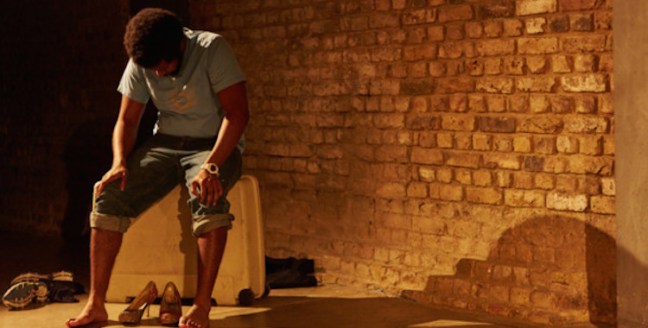
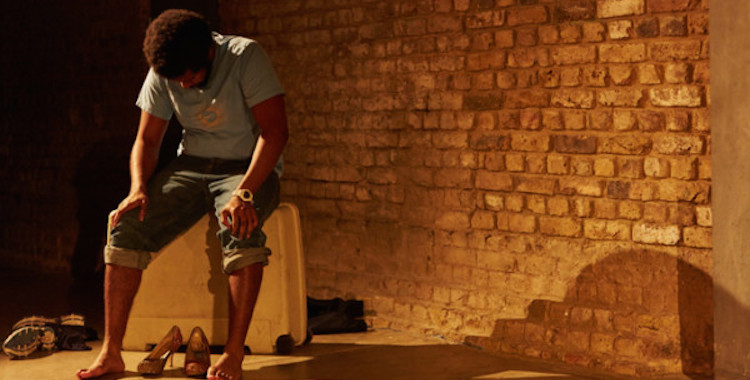
Under a single, stark lightbulb – the bareness of the stage suggesting the bareness of his new life – Lladel Bryant’s restless, lonely Ishmael tells his story. He talks of metamorphosis, of refugees in “concrete cocoons”, and of a hostile, overwhelming city. This jagged day-to-day experience is also punctuated with almost poetic interludes that refer to the wider plight of refugees and asylum seekers. Each beginning “some of us”, they break apart the undifferentiated mass so often shown in the media, reasserting shared yet particular human experiences:

“Some of us were running”.

“Some of us couldn’t recognise ourselves anymore.”

“Some of us were alone.”

“Some of us were begging for a taste of your liberty.”

In keeping with Nyoni’s reclaiming of these stories, the primary focus of Alex Chisholm’s production is the narrative. Aside from the lightbulb, all that joins Bryant on stage is a large, battered suitcase, which has to be both home and past for Ishmael in this temporary new existence. It’s a simple staging that could be even simpler still. Occasional, exaggerated sound effects – the nightmarish ticking of a clock, for instance – hardly seem necessary to communicate what straightforward storytelling does so clearly and compassionately. It’s through being stripped back where headlines are embellished that Nine Lives gains its power.

Implicit throughout, lingering like a bad aftertaste, is the vitriolic media narrative around immigration. Words like “swarm” and “droves” are never used, but they can’t help but haunt Ishmael’s experiences. When he’s targeted in the street, it’s with accusations right out of The Sun or the Daily Mail: he’s seen as a scrounger, an alien, a leech. To his landlady, he’s a source of cash and irritation; to the aggressive teenager who confronts him outside his flat, he’s a convenient figure of blame.

No one talks about the loneliness. Absent from all the news reports is the yawning emptiness of arriving on a foreign shore without family, friends or lovers. While lacking depth and background in some areas, what pierces through both Nyoni’s writing and Bryant’s performance is the terrible enforced solitude and isolation experienced by refugees like Ishmael. Pacing the empty stage and impressively inhabiting the voices of a range of other characters, Bryant can appear at times like a man frantically fighting to fill the void of his loneliness.

At a slender 55 minutes, there are limits to what Nine Lives can achieve. There are few resolutions, either for endlessly waiting Ishmael or for the wider issues that the piece touches on. But as a simple, unadorned plea for common humanity, it’s still depressingly necessary. In one of the play’s tenderest moments, teenage mother Bex – herself discarded and mistreated – reaches out a hand to Ishmael, recognising him for who he is and extending the offer of friendship. It’s an act that, on a much larger scale, Nine Lives implicitly appeals for.