Deborah Pearson

1996

Originally written for the Guardian.

Deborah Pearson wants to talk about white privilege – a desire the writer and performer recognises is a huge privilege in itself. For people of colour, she suggests, there is an expectation to be conscious of race relations, whereas “if you are white then you can not think about it, and not talk about it, and nobody will necessarily call you out on that”.

In her show at the Yard theatre in London, Made Visible, Pearson makes the choice to discuss these issues. The show is influenced by Peggy McIntosh’s 1988 essay White Privilege: Unpacking the Invisible Knapsack, which lists 50 everyday examples of white privilege (No. 21: “I am never asked to speak for all the people of my racial group”; No. 32: “My culture gives me little fear about ignoring the perspectives and powers of people of other races”). Made Visible similarly reveals some of the ways in which invisible systems confer privilege on some at the expense of others.

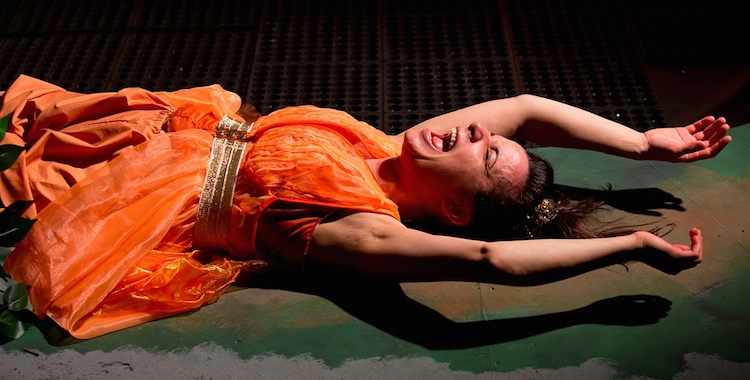
“I don’t know if I really know how to talk about this,” Pearson admits. With the show, she is anxious to join ongoing conversations about racism and privilege in a way that is “productive and useful”, without replicating the same power structures she’s critiquing by taking over the debate. The show stages a conversation between three women – one white, two of Gujarati heritage – sitting on a bench in Victoria Park, east London. The conversation is undercut by interjections that expose the workings of privilege and debate the politics of representation. “The actors swap characters quite a lot and they are constantly complaining about particular forms of appropriation,” Pearson explains. One of the performers, for example, protests against the sari her character is forced to wear, calling out lazy representations of Indian culture. “So it becomes this meta-commentary on the consequences of a white writer approaching this kind of material,” says Pearson.

With its actors frequently disrupting the scene and addressing the audience, the play draws attention to the problematic assumptions we are all too used to seeing on stage, setting up racial and cultural stereotypes in order to undermine and question them. It’s deliberately messy – much like the complex conversations it is responding to. “It needs to be less tidy,” says Pearson, who is still making final tweaks to the script when we speak. “It needs to let the white character off the hook a little bit less.”

The difficult balance for Pearson in the process of writing Made Visible has been between unpacking her own privilege and giving room to other, non-white voices. “There was a draft of the piece where I just gave over the entire ending to different theorists of colour,” she says. “That was really dry and theatrically it didn’t work, but conceptually I know why that’s what I wanted to do, because it’s about using my privilege to amplify other voices.”

While attempts to address racism often focus on political and social institutions, Pearson is clear that “culture is not blameless in this”. If anything, she adds, culture has to answer for the dominant white narratives it reproduces. “I think that as people who work in culture, albeit a very small fringe area of culture, we have to be aware of the fact that we contribute hugely to this discourse,” she says.

These are issues for theatre to confront as a sector. Despite numerous diversity drives, theatre organisations remain overwhelmingly white. Last year the Warwick commission found that black, Asian and minority ethnic (BAME) workers represent only 6.7% of the workforce in music and performing and visual arts, while Arts Council England reported that 13.7% of those working in its national portfolio organisations in 2014-15 were BAME. “The fact that so few of the people who work professionally in theatre aren’t white is not an issue for people of colour to deal with – that’s an issue for all of us,” says Pearson. “As a white person who’s working in theatre, you have to think about it really carefully and just be aware of the choices that you make in terms of what you see, what you curate, which voices you’re paying attention to.”

In response to racially motivated hate crimes and police violence, novelist Marlon James has argued that being non-racist is not enough. “We need to stop being non and start being anti,” he insists. Pearson agrees that in an unjust, unequal society, staying silent is not an option.

“The easy thing for white people to do is to not talk about it,” says Pearson. “If we don’t talk about it we don’t risk being criticised. But at the same time, if you don’t talk about it then you are complicit in enabling that power structure to continue.”

Photo: Ian Willms.

Access all areas

1093

Originally written for the Guardian.

Captioned and signed performances have become common in theatre, with BSL interpreters and LED displays a familiar presence at the side of the stage. But theatres are increasingly making their work accessible for deaf and disabled audiences in a more creative, integrated fashion and are placing issues of access right at the heart of their design.

Graeae theatre company’s touring production of Jack Thorne’s play The Solid Life of Sugar Water, which arrives at the National Theatre in London this week, imaginatively incorporates live captioning at all of its performances. Birmingham Rep, meanwhile, is preparing to open a new version of Nikolai Gogol’s The Government Inspector with an integrated cast of deaf, disabled and able-bodied performers. Rather than being hidden away, the latter show’s audio describer and sign language interpreters will be incorporated as characters within the world of the play and have been involved in the production right from the start.

Roxana Silbert, artistic director of Birmingham Rep, is enthusiastic about the ways in which creative access can open up aspects of Gogol’s play. “Sign language is great for The Government Inspector,” she says, “because there are a lot of secrets and lies in the play and a lot of people who are saying things that other people don’t understand. So having that second language enhances what the play is already trying to do.”

The show’s aesthetic has been affected in more subtle ways by the access needs of its performers. “Once you start looking at it from the actors’ point of view and what they need to make the stage work for them, actually what it does is make the stage a really interesting place,” Silbert says. The set for The Government Inspector suggests the lobby of a hotel, with various levels accessed by ramps and a lift as well as stairways and ladders.

Graeae has championed disabled artists and accessibility since it was founded in 1980. Those decades of work are now informing new initiatives aimed at improving access and widening opportunities for disabled artists across the sector. One of these is Ramps on the Moon, a collaborative network of theatres being funded by Arts Council England and supported by Graeae to create three new pieces of touring theatre that put disabled artists and audiences at their heart. The Government Inspector is the first of these.

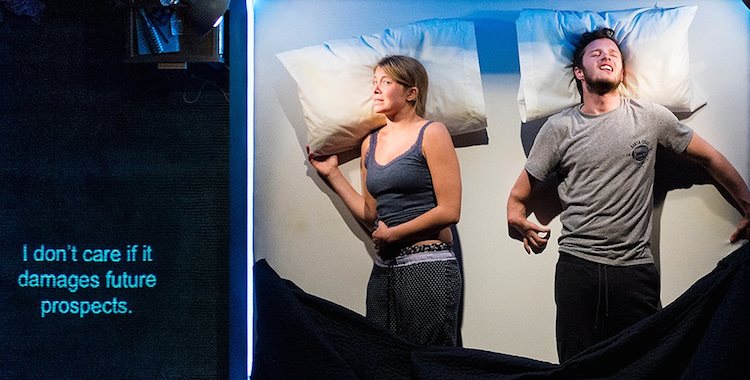
Graeae’s Amit Sharma, the director of The Solid Life of Sugar Water, is also interested in how access can be incorporated in ways that speak to the themes of the piece. Thorne’s play tells the story of a couple attempting to overcome grief and regain intimacy. The whole show is set in the protagonists’ bedroom and takes an incredibly candid approach to relationships, sex and the difficulty of communication.

“Because of the nature of the text and it being very explicit in how it’s describing certain sexual acts, I made the decision very early on of not using British Sign Language,” says Sharma. Instead, captions are projected on to the bed that the two characters share, which the audience see as if from above. “When we were working with the set and the elements of access … we always said there are three characters in the play: there are the actors and there’s the bedroom,” he says, stressing the importance of the design. The prominence of the captioning in this intimate shared space highlights the play’s themes of communication – and lack of it. As Sharma puts it, “to have those words spelt out gives it an extra meaning, an extra layer”.

Within the play, references to the specific disabilities of the performers are incidental rather than integral. “We just went for the actors who felt right for the roles,” says Sharma. After Genevieve Barr and Arthur Hughes had been cast, Thorne made small changes to the script to refer in passing to Barr’s deafness and Hughes’s arm impairment – details that are always secondary within the narrative. “Disability is irrelevant,” Sharma says. “It’s the story that matters.”

The Solid Life of Sugar Water was staged at the Edinburgh festival last summer where it was one of many shows representing a game-changing year for disabled artists at the fringe. It prompted audiences and theatre-makers to think about accessibility in different ways. This kind of work, however, requires support. In addition to the backing of the Arts Council, which has awarded £2.3 million of funding to Ramps on the Moon, Silbert stresses the importance of safeguarding schemes such asAccess to Work. “It is about performers who have specific requirements being able to get the Access to Work support they need,” she says. “That’s where the problem is going to lie, not in theatre funding.”

Photo: Patrick Baldwin

The Light Princess, Tobacco Factory

1800

Originally written for the Guardian.

The Light Princess is having a moment. George MacDonald’s 19th-century story has been something of a footnote in the fairytale canon, but now – just two years on from the ambitious Tori Amos musical at the National Theatre – it’s receiving a second, deliciously silly staging courtesy of Tobacco Factory Theatres and Peepolykus.

Where Amos and co padded out the plot of MacDonald’s tale, this version sticks to the basics. As an act of revenge by her snubbed aunt, the princess of the title (an infectiously joyful Suzanne Ahmet) is cursed with levity of body and mind. She can’t keep her feet or her mind rooted to the earth, and laughs up among the clouds instead. When a gloomy, gravity-bound prince (Richard Holt) arrives searching for a wife, it’s the perfect match.

A weightless heroine presents obvious staging challenges, which John Nicholson’s production meets with knowingly shambolic solutions. Some wobbly shadow puppetry and a heavy dose of make-believe compensate for the lack of aerial stunts, deliberately exposing the mechanics of the show.

This yields some fantastic gags, especially from a scene-stealing Amalia Vitale in various supporting roles, though the company could ease up on the arch nods and winks.

So intent is The Light Princess on being funny that often clarity of plot is sacrificed for levity of tone. Luckily, Verity Standen’s songs – all characteristic wit and gorgeous vocal texture – are there to steer the story back on track. Standenorchestrates the show in more ways than one, her court conductor marshalling the chaotic action with a flick of her baton.

This take on MacDonald’s fairytale might be anarchic and disordered, but its messiness is all part of its joy. Like its floating, lighthearted heroine, it unabashedly celebrates the amusing and the absurd – two aspects of life that we could all do with being reminded of from time to time.

Photo: Farrows Creative.

Sleeping Beauty, Bristol Old Vic

2036

Originally written for the Guardian.

Fairytales have long been fair game for transformation. Even the best loved of our childhood stories have gone through multiple versions, from Brothers Grimm to Disney animation. There’s a precedent, then, for Sally Cookson’s playful, gender-switched reworking of Sleeping Beauty, which tells a familiar story in unfamiliar style.

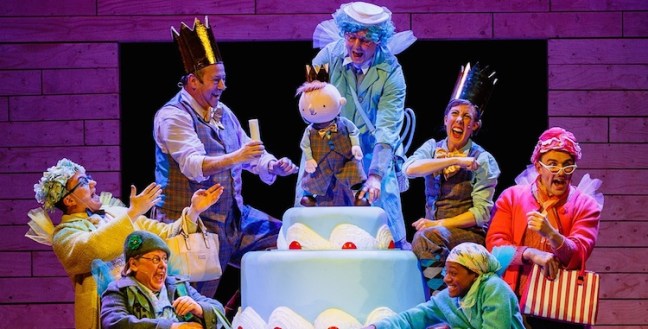
Instead of the princess catching Zs, at the Bristol Old Vic it’s a prince. Prince Percy (David Emmings) – after a childhood wrapped (quite literally) in cotton wool – has been cursed to snooze for a hundred years, awaiting the kiss of his one true love. The hero, meanwhile, has been imported from Welsh folk tale The Leaves That Hung But Never Grew. Deilen (Kezrena James) is a resourceful but lonely adventurer, who stumbles across the unresponsive Percy while on her own quest and sensibly administers mouth-to-mouth.

It might not be Sleeping Beauty as we know it, but Cookson’s version – devised with the multi-role-playing company of eight – is all the more charming for the reinvention. Tongue-in-cheek irreverence is balanced with true fairytale magic, reimagining rather than bulldozing long Christmas show traditions. Nowhere is this more evident than in the supporting cast of fairy godmothers, spells intact but gleefully transformed into a lineup of cake-baking, knitting-needle-wielding WI members.

There’s also more than a hint of panto to Cookson’s joyful production. Cross-dressing aplenty – often with brilliantly ridiculous wigs – meets the demands of the large cast of characters, while Stuart Goodwin’s deliciously evil baddie anticipates the hisses from the audience. Where Sleeping Beauty differs from the glitter and garishness of other festive offerings, though, is in its relative simplicity. Michael Vale’s elegant and versatile wooden design transforms instantly from climbing frame to castle, while the songs are all courtesy of an onstage, ad-libbing trio of musicians.

Though much is gained from mashing up two separate stories – not least a dynamic, complicated female lead who has more to do than lie around – the plot can occasionally feel cluttered as a result, especially in the second half. Unfailingly enthusiastic performances from the whole cast keep the show driving forwards, but like the overgrown trees encircling the palace, it could benefit from a little pruning.

That said, it’s a gorgeous piece of storytelling – and not without a message. As theatres wheel out the same stories year after year, the Bristol Old Vic’s novel approach is a reminder that we always have a choice about how to tell them. If any persuasion were needed, Sleeping Beauty makes the case that stories this old are ripe for retelling.

The Night that Autumn Turned to Winter, Bristol Old Vic

2820

Originally written for the Guardian.

If you go down to the woods today, Little Bulb have a big surprise. Set on the last day of autumn as winter creeps ever closer, the company is bringing the wildlife of the forest to the heart of the city in a series of charming sketches. Following 2013’s Antarctica, they once again take intrepid young explorers on a charming, idiosyncratic tour of the animal world.

With trademark Little Bulb energy, performers Clare Beresford, Dominic Conway and Miriam Gould rapidly transform from excitable woodland wardens into the various animals they conscientiously watch over. Hyperactive squirrels, a sly but suave fox and a hungry, shortsighted owl all make memorable appearances, evoked by homespun, makeshift costumes. That’s without even mentioning the rare, much-anticipated winter unicorn.

They have their audience of under-sevens sussed, getting them noisily involved one moment before holding them quietly rapt the next. The key is in variety and ingenuity, as their motley cast of creatures – from rabbits to badgers to frogs – constantly changes.

And the music – central, as ever, to the company’s work – ensures that this is no ordinary woodland. Brandishing banjos and violins, Little Bulb’s endearingly goofy rock stars turn forest into gig, while kids excitedly clap along. The multitalented trio swap instruments as readily as costumes, deftly matching musical genre to animal.

As with all of Little Bulb’s work, the DIY aesthetic belies the craft and detail of a show that considers parents as much as kids. There are plenty of grinning asides for the grownups, along with some entertainingly wry, mock-David Attenborough commentary. But really the joy lies in the silliness and wonder, both of which Little Bulb offer in bumper Christmas-size portions.

Photo: Jack Offord/Handout.