Why we can’t stop watching violence

a3aa32e2-d7db-4a97-8f8a-b0f24e8ff393-2060x1236

Originally written for the Guardian.

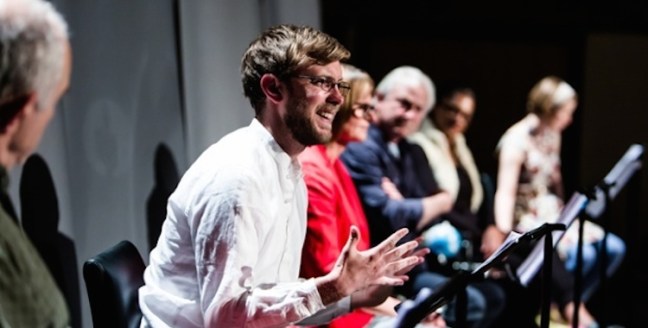
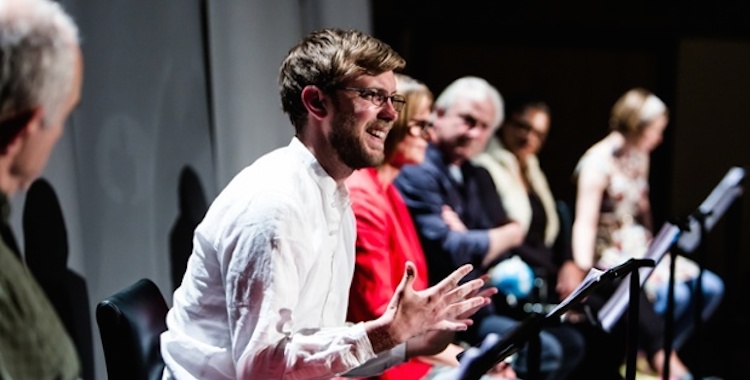
Greg Wohead’s theatre show about the crimes of serial killer Ted Bundy opens innocuously enough. He welcomes his audience, shares some facts and tells a few jokes. Then he gets to the point: “I guess you want to know the juicy stuff.”

The Ted Bundy Project was provoked by Wohead’s experience of stumbling across Bundy’s confession tapes online and finding himself compulsively listening for the “juicy stuff”. “This was the spark of interest,” he says, “feeling at once disgusted and horrified but also really interested and intrigued.”

The same could be said of our own relationship with violence both on and off stage. Today, violence is ubiquitous, beamed worldwide on 24-hour news channels and freely available at the click of a mouse. Society has never been more saturated with images of brutality.

Another new piece of theatre, Image of an Unknown Young Woman, starts with one such instance of violence that goes viral. A woman in a yellow dress is shot by the police and the video footage sparks a popular uprising. Writer Elinor Cook was inspired by events during recent revolutions, but did not specifically set out to address any particular political situation. She explains that she was interested in exploring “how the extinguishing of something bright and beautiful galvanises people”, as well as interrogating “this idea of some violence being, in a sense, titillating”.

Theatre has a complicated relationship with violence. “It goes back to the Greeks, doesn’t it?” suggests Christopher Haydon, who will be directing Image of an Unknown Young Woman at the Gate theatre, London. Greek tragedy kept violent events out of sight, leaving the grisly details to the imagination of the audience. Since then, though, plenty of violence has erupted on stage, from the bloodbath of Titus Andronicus to the shock and gore of the in-yer-face theatre of the 1990s. More recently, Tim Crouch’s in-yer-head show The Author both skewered and questioned the provocative violence of its theatrical forebears at the Royal Court, while directors such as Ellen McDougall have used striking visual metaphors – balloons, water, chalk – to stand in for physical blows.

Nothing, the debut show from the young company Barrel Organ, which is currently on tour, is of the Crouch school. Rather than putting anything shocking on stage, the casual violence that permeates its series of alienated monologues is all described, making the audience complicit in imagining it.

Barrel Organ’s new piece, a work-in-progress entitled Some People Talk About Violence, is upending the concept altogether. “I wanted to write a play about quite insidious, inherent forms of violence that occur within a capitalist system,” says writer Lulu Raczka, who is in the process of collaboratively devising the show with the rest of the company. The violence she refers to is the hidden and often internalised violence of zero-hours contracts and unemployment legislation. “It’s about renaming violence,” says Raczka.

“Theatre permits and enables us to contemplate violence,” argues Lucy Nevitt in her book Theatre & Violence. It’s an arena in which violence can confront us with its reality and provoke us to question the structures that enable it. But its representation also throws up ethical question marks. When does the staging of violence challenge what it shows, and when does it just reiterate it?

“My feeling is that if it’s done in the right way, representation of violence is totally legitimate,” says Haydon. But in his staging of Image of an Unknown Young Woman, torture and abuse will be shown metaphorically rather than literally. This chimes with the non-specificity of Cook’s narrative; rather than “trying to depict a real country in a specific way”, Haydon explains that “it asks you to look at the underlying processes of a revolution” and the ways in which power can “warp reality”.

Wohead, meanwhile, insists that “there’s a blurry line between represented and real”, challenging any clear-cut binary between real and fictional violence. The violence that we see on television, for instance, is “framed in a certain way, it’s filmed by someone”. In researching The Ted Bundy Project, Wohead came across whole online communities built around the sharing of violent images, on the basis that “it’s stuff that is happening in the world and by confronting that we can take steps towards confronting the reality”. But Wohead has his doubts; he’s more interested in prodding at the less savoury motivations behind such voyeurism.

“I think there’s a lot of theatre out there that is pointing a finger at something or someone,” he says. “And sometimes that’s useful, but the way I work … is about pointing the finger back at myself and at all of us. Lots of these structures that we have problems with, we are all complicit in.” Audiences can expect to leave The Ted Bundy Project feeling just as uncomfortable with their own reactions as with the subject matter itself.

For Raczka, the use of violence on stage is complicated. “In order to take it on I think you have to take it on absolutely fully,” she says. “When we’re talking about using violence to shock and to move a plot line along, that’s when I think it becomes very exploitative.” This is the sort of exploitation that Barrel Organ aim to eschew and subvert in Some People Talk About Violence. The company also hopes that the very deliberate use of the word violence in the show’s title will “set up an expectation that can then be dismantled”, allowing a discussion to take place afterwards.

“It’s quite aggressive to actively say that you want someone to leave a theatre and discuss the issues you’ve brought up,” says Raczka, casting the idea of a “violent play” in a new light. “That’s surely what all theatre is about, but this is going at that full pelt.”

Photo: Alex Brenner.

Theatre goes wild in the country

Wolf's Child Ö WildWorks' show for the Norfolk & Norwich festival.

Originally written for the Guardian.

Across the South Downs, on Brighton beach and deep in the woods in Norfolk, theatre-makers are redefining the relationship between art and nature this spring and summer. For a number of outdoor shows and installations that are exposed to the elements and at the mercy of the unpredictable, the environment is far more than just a backdrop. The recent rise of site-specific performance means that the “where” is becoming almost as important as the “what”.

In the promenade performance Nightingale Walk, audiences will venture across the South Downs late at night in search of the elusive song of the nightingale – “the romantic heartbeat of England”, according to the musician and artist Sam Lee. During the performance, Lee and his musicians play songs that both speak to and celebrate the bird. “We’re not trying to disturb or interfere,” he says of the piece, which is about respecting as much as exploring the surroundings. Audiences might return without actually hearing any nightingales, but Lee suggests that “the sense of the unknown is what makes it so exquisite”.

Birds are also the inspiration for And Now’s Brighton beach installation, Fleeting. Using fire and sound, the artist Mandy Dike hopes to create something that is “in feeling with the landscape”, evoking the starlings that flock around the collapsing West Pier. The installation is also concerned with the place of humans within the landscape. “The pier is a standing symbol of impermanence and change,” Dike says. “It’s not a natural feature, it wasn’t there 200 years ago; it’s something that has been built by man and has gone through an evolution and is now dissolving back into the water.”

Both Nightingale Walk and Fleeting are part of the Brighton festival, which starts on 2 May and offers a range of genre-defying work. Guest director Ali Smith is inviting visitors to “imagine the world seen from the eye of a bird. Migrating birds are born naturally equipped with maps that even newborn birds know how to follow. Imagine maps of landscapes with no border, and birds with nothing but the urge to flock together.”

Other performances at the festival delve further into the wild. The forest has frequently been imagined by artists as a place of transformation – consider the woodland escapes of plays such as A Midsummer Night’s Dream. Burn the Curtain’s adaptation of Angela Carter’s The Company of Wolves immerses audiences in “an edgeland where you feel surrounded by danger all the time”. The performance will transform Stanmer Park into a fairytale landscape of beasts and hunters.

The director Joe Hancock explains that the company wanted to create “a very visceral experience of the outdoors”, something they have achieved by getting audiences on their feet in groups of runners and walkers. Hancock hopes to give theatregoers, as physically active participants, a different point of access to the story. “Antonin Artaud talks about creating a theatre that isn’t a theatre of the intellect, but where instinct is as important as intellect,” he says. “Promenade [theatre] does that very well.”

In The Lone Pine Club, Pentabus theatre company’s new children’s show adapted by Alice Birch from the series of books by Malcolm Saville, young protagonists roam across the landscape with a freedom that few British children now enjoy. The show will tour five National Trust properties this summer, starting at Carding Mill Valley in Church Stretton, Shropshire, in July. Director Elizabeth Freestone describes the original books as “proper Bond-style adventure stories in the countryside”, and hopes the show will rekindle children’s relationship “with being feral and being wild”. In her books Wanderlust and A Field Guide to Getting Lost, Rebecca Solnit likens the human mind to a landscape: thought is a kind of wandering, and musing takes place in “meadowlands of the imagination”. Likewise, for Freestone, “there’s a really direct link between being outside and imagining stuff”.

For WildWorks’ new show, Wolf’s Child, which is part of this month’s Norfolk & Norwich festival, the company’s artistic director, Bill Mitchell, started with a question: “Is it possible to get an audience to look through the eyes of an animal?” Drawing on myth, fairytale and folklore, the show takes audiences into the woods around Felbrigg Hall, exploring a natural landscape that we so often ignore or abuse. “We’re losing our connection with the wild,” Mitchell says. Felbrigg Hall is one of those dreamlike places. Sun-dappled clearings narrow into tree-crowded paths; overhead, branches twist and curl in fantastical formations. In one part of the woods, cedar trees rise up like columns, creating a backdrop more evocative than many a stage set. “We’re trying to honour the space,” he continues. “There’s a phrase: ‘What do you get for free?’ Actually, here you get a hell of a lot that is just given to you.”

Reflecting on the impact of outdoor performances and installations on these landscapes, Dike says: “You leave an energy there, but you’re not leaving big structures or marks or scars.” All of these artworks are about working with what is already there. As Mitchell puts it: “There’s a big difference between doing A Midsummer Night’s Dream in Regent’s Park and actually using the landscape, trying to understand the landscape, and letting the landscape shape the story.”

Oxford’s everyday activists inspire audiences

d4c51c91-309f-4a9b-b3d2-11a948935c16-620x372

Originally written for the Guardian.

Oxford’s residents have a history of taking a stand. Over the years the city has been home to the likes of Emily Wilding Davison, Percy Bysshe Shelley, Tony Benn and John Ruskin. During the English civil war, it had associations with the radical Levellers movement, two of whose members were executed near Gloucester Green. The city’s Ruskin College has long been a symbol of workers’ education, as well as hosting the inaugural Women’s Liberation Movement conference in 1970. But as Oxford celebrated its radical history last year, theatre-maker Chris Goode and the Oxford Playhouse were more interested in what it means to be radical today.

Commissioned for the Playhouse’s Radical Thinking season, the show Stand – now on at Battersea Arts Centre in London – celebrates the ordinary and extraordinary ways in which local people are standing up for what they believe in. For some, that means activism in a familiar form: campaigning, demonstrations, occupations. For others, it’s simply about being a parent. In the show, Goode has captured and told six of these stories.

The Oxford Playhouse asked its community a simple question: when was a moment you stood up for something you believe in? “I feel like the callout set the bar quite high,” Goode reflects. “There’s something nicely self-selecting about it, because it means that the people who want to talk really want to talk.” Having chosen his six storytellers, Goode interviewed them all over a couple of weeks, gathering the material that would later be performed by his cast of six actors.

The stories they found were as varied as the people sharing them. There’s a climate campaigner, a woman who works with refugees, a mother, an activist who campaigned to save the alternative community at Oxford’s Jericho boatyard, one of the founders of the Reclaim Shakespeare Company, and a man in his 80s who has spent most of his life protesting against animal testing.

Isn’t there a danger, though, that these eclectic narratives just end up serving a structure imposed by the theatre-makers? Goode’s answer to that question is to be constantly confronting it. “I just think being really aware is half of the task,” he says. “You have to let go of your agenda quite often, because it has to be about the people rather than about the issues that you’re trying to articulate.” All of the interviewees speak, for example, about their childhoods, offering a portrait of their personalities as much as their acts. “I think one of the virtues of Stand is that you see everyone in quite high resolution,” says Goode. “Hopefully you get a real sense of the details of people’s lives, so that they’re not just mouthpieces for certain points of view.”

That said, Goode admits that he and his team always had the aim of inspiring their audiences, with the hope that they in turn will go on to stand up for their own causes. “I felt like there had to be that call to action embedded in the show,” Goode explains, “quite gently, but definitely there.” For that call to action to be heard, though, the show has to connect with audiences who might feel worlds away from the activists sharing their stories – “you have to feel like you’ve been listening to people like you,” as Goode puts it. That’s where the human detail comes in.

“One of the really nice things about the people we found is that they were all really quick to talk about themselves in ways that pointed at moments where they’d failed, moments when things had gone in an unexpected direction – moments of daftness,” says Goode. Activism has its fair share of the ridiculous alongside the serious – “bizarre situations where they’re superglued to something or they’re wearing a costume in a peculiar place”. And what Stand’s storytellers all share, like so many of us, is a guilty feeling that they could be doing more: “Even among really hardcore activists, there’s always someone who’s more hardcore.”

Stand was also an opportunity to present people’s courage in a new light. “People don’t often see themselves in that way,” says Goode, “they don’t see their own bravery.” One example is Jan Thomas, who wanted to celebrate her adopted daughter’s small stand against injustice, but found to her surprise that Goode was more interested in her story as a mother. “I felt I had done nothing special,” she tells me. Since taking part in the project, though, she has been bolder in taking a stand, joining some of her fellow participants in their campaigning activities. “After seeing Stand and meeting the others I resolved to be much more active in standing up for the things I believe in.”

A big part of the project has been about engaging new audiences with the work of the Playhouse, not least through performing the show in a local community centre. “I think there’s a perception around Oxford Playhouse, as there is around a lot of venues and organisations of that scale, that they’re slightly fortressed,” suggests Goode. “It felt really important to them as well as to us that this was a way of opening up some different doors.” Producers Hannah Bevan and Michelle Walker describe Stand as unlike any other show the Playhouse has ever worked on, adding that “to be bombarded with audience responses ever since the show opened about how joyful and inspiring they found it was nothing short of a dream”.

“I’ve never done anything with quite such a strong local focus,” adds Goode, questioning how that might translate to audiences during its London run at BAC. “There’s definitely a strength in that specificity, but I don’t know whether it’s a crucial strength yet.”

Just days after Goode and I spoke, Battersea Arts Centre’s Grand Hall was hit by a devastating fire, followed by an overwhelming show of support for a venue with a radical history of its own. It seems that in Battersea, as in Oxford, there continues to be a tradition of standing up for what matters.

Photo: Richard Davenport.

Chimera: The play about the twin inside

Chimera suli holum

Originally written for The Guardian.

We all have moments when we don’t quite feel ourselves. For some, though, fragmentation of the self is a biological as well as a psychological fact. Chimerism describes the medical state of having two sets of genetic material; it means, in other words, containing your own twin inside you.

This rare medical condition provides the unsettling premise for Deborah Stein and Suli Holum’s collaboration Chimera, which opens at the Gate theatre in west London this week. The show, written by Stein, performed by Holum and co-directed by the two women, tells the story of Jennifer Samuels, a scientist and mother who learns that she possesses two sets of DNA. Shaken by the discovery, Jennifer struggles to hold her splintered self together, while coming to terms with the idea that – genetically at least – her son is actually her nephew.

While Jennifer may be fictional, her crisis of identity stages an experience that is real. “The condition of being a medical chimera literalises something that I think is a pretty universal feeling,” Stein suggests, discussing the multiple versions of ourselves that we try to integrate on a daily basis. She was introduced to the science by Holum, who was intrigued by a true story she heard on the radio about a woman who discovered that her sons did not share her DNA. The pair decided to pursue the idea because, as Holum puts it, “neither of us could figure out immediately how it could be a play, how we could take this phenomenon and theatricalise it”.

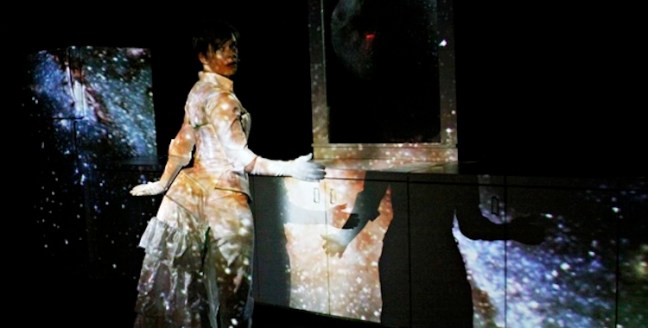
Stein and Holum found their answer in a close weaving of form and content. As the show’s sole performer, Holum inhabits multiple characters, including Jennifer and her 19-year-old son Brian, while projections dance over her body and the smooth surfaces of the kitchen set. “Meaning is created by having these multiple voices in one body,” Stein explains, “because it’s about the condition of being more than one person, and one person, at the same time.” The kitchen, meanwhile, allows for “an exploration of surfaces and what lies beneath,” at the same time as suggesting and disrupting the traditional domestic sphere of the mother. “We do all kinds of surprising things with something that looks very simple and mundane,” says Holum.

The use of technology in Chimera, meanwhile, is an extension of the show’s central idea that “science and technology have got to the point now where they are showing us things that we have no framework for understanding”. Stein goes on to compare the way in which technology disrupts the lives of the play’s characters to how it has forced her and Holum out of their comfort zone as theatre-makers. What she has come to realise, however, is that the contradiction she initially perceived between the live theatrical experience and digital technology does not really exist. “Theatre is about being in the now, in the present moment, and our present moment has so much to do with screens and video and computer technology.”

What Chimera doesn’t do, its creators insist, is offer any answers to the scientific, moral and philosophical questions it throws open: questions about how far science and technology can define our existence, and the extent to which, if our sense of self is torn in two, we can be held accountable for our own actions. “We realised as we were working our way through the questions the play raises that we weren’t making something that answered those questions,” says Holum. “We realised we were working with questions big enough that they couldn’t be satisfactorily answered – and what we were creating was an event that didn’t tell the audience how to feel or think about something, but rather invited them to begin thinking about something and then carry that conversation forward after the event is over.”

“It sits in this really uncomfortable place of asking the audience to actually think and talk about things that we don’t usually get to think and talk about,” Stein adds, describing the play as a “stew” of ideas that we rarely consider alongside one another. “There’s pretty hard science in it, and then there’s also this story about a mother who doesn’t want to be a mother.”

This investigation of motherhood, it turns out, has been more provocative than the science, suggesting that Stein and Holum have hit on a collective raw nerve. In post-show discussions, the pair explain, it is Jennifer’s attempted flight from her responsibilities as a mother which has attracted the most debate. In this way, Chimera has travelled from the chilling but faraway realm of rare scientific phenomena to the more close-at-hand experiences of the theatre-makers and their audiences.

This journey is typical of the pair’s process, Holum tells me. “We start with research material, then we very quickly branch out pretty far afield from the original sources as we dive deeper and deeper into the process to unearth really what it was that drew us to the material.”

The questions they have arrived at are questions about identity, about motherhood, about the philosophy of science. But most of all, Holum suggests, Chimera asks what we believe in and where we find meaning.

“In the end we’re all searching for meaning, we’re all searching for a way of making sense of it all.”

Photo: Stephen Schreiber.

Duncan Macmillan

Duncan-Macmillan-011

Originally written for The Guardian.

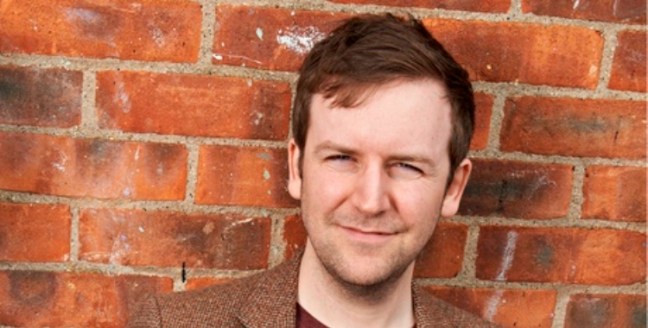
“There’s nothing I can do in my life to compensate for the fact that the world would be better without me in it,” says Duncan Macmillan, smiling over his coffee. It’s a bleak statement, but one that the writer and director explains is grounded in climate science. Each of us in the west, with our hefty carbon footprints, is a drain on the planet’s resources.

When we meet, Macmillan is buried deep in research about the worsening state of the environment. This is all in aid of 2071, a new project for the Royal Court that he is co-writing with climate scientistChris Rapley. For the past six months, the two men have been meeting regularly at University College London, trading their respective expertise in an attempt to bring climate change centre stage.

Directed by Katie Mitchell, 2071 follows her 2012 show Ten Billion, in which scientist Stephen Emmott painted a gloomy picture of our planet’s future. Macmillan tells me that Rapley’s outlook is more complex, challenging our understanding of how we affect the environment. “I thought I was concerned and had read well about it,” he says, “but it’s a whole other thing talking to Chris.”

“I sound like a broken record,” Macmillan laughs a moment later, catching himself using the word complicated yet again to describe Rapley’s insights. Conversation with Macmillan is punctuated with these moments of thoughtful, anxious self-awareness. Intense but amiable, he has a tendency to pause mid-thought, picking apart his own statements as soon as he makes them.

It’s a tendency that Macmillan’s plays share. Monster, the play that scooped two awards in the inaugural Bruntwood prize for playwriting, prodded uncomfortably at ideas of responsibility. In Lungs, a conversation about starting a family is folded into concerns about the state of the planet, interlacing the personal and the global. And when approaching George Orwell’s Nineteen Eighty-Four, Macmillan and co-adapter Robert Icke set out to “represent the challenge” of the novel’s ambiguities rather than attempting to solve them.

“I can’t speak for what theatre can or should do, but I know from my perspective I’m interested in complexity,” says Macmillan. “Chris [Rapley] keeps saying, ‘It’s a little bit more complicated than that.’ And I’ve always thought that would be a really good subtitle for any good play.”

The same complexity applies to Macmillan’s career. Increasingly, he has been working in a number of different roles, from co-directing Headlong’s 1984 with Icke to collaborating with Mitchell on her multi-media productions in mainland Europe. One frustration, however, is the pigeonholing impulse of the British theatre industry. “I think there’s a perception that the playwright is someone who writes the spoken text and that everything else is the domain of the director,” says Macmillan, adding that this is not the case with many of his projects.

Not that spoken text doesn’t interest Macmillan any more. He admits that Lungs, for instance, “is essentially just talking”. That play, which is currently on the road with touring company Paines Plough, spans one long conversation over several years. Its agonised back and forth between a couple deciding whether or not to have children was Macmillan’s attempt to wrestle with some of his own anxieties.

“I found myself worrying about these things and I didn’t know the solution,” he says, discussing the “anxiety debt” that his generation has inherited. “Putting characters on stage who talk about those anxieties makes them quite absurd. And they are. It is absurd that you can have a conversation now about whether or not you want to start a family and at the same time you can be talking about the industrial revolution.”

At the same time as travelling the UK, Lungs is also part of the repertoire at the Schaubühne in Berlin, in a German production directed by Mitchell. While the form that Macmillan initially imagined for the play – no sound, no lights, no props – was an attempt to “break out of a certain kind of formal cul-de-sac”, Mitchell’s production finds a new visual metaphor to communicate the narrative. In her version, the two actors are poised throughout on static bikes, powering the stage lights as they pedal.

“What I enjoy most as a theatre-maker and as an audience member is getting my brain to do more than one thing at once,” says Macmillan, pointing to Mitchell’s production of Lungs as one example. Another isEvery Brilliant Thing, which tours alongside Lungs this autumn. In this interactive monologue, misery and ecstasy are two sides of the same coin. The subject might be suicidal depression, but the show itself manages to be joyously life-affirming.

“It’s the least cool piece of theatre ever, in some ways,” says Macmillan. Staged in the round in Paines Plough’s portable Roundabout auditorium, the formal gesture of the show is deliberately democratic, while its message for those struggling with depression is unashamedly heartfelt. “You’re not alone, you’re not weird, you will get through it, and you’ve just got to hold on. That’s a very uncool, unfashionable thing for someone to say, but I really mean it.”

Like so much of Macmillan’s work, Every Brilliant Thing came out of a desire to say something that wasn’t being said. “I didn’t see anyone discussing suicidal depression in a useful or interesting or accurate way,” he says. Similarly, at the time of writing Lungs, he felt that he “wasn’t seeing enough about what it’s like to be alive now”. He positions both of these plays as interventions of a kind, adding with an apologetic smile, “that sounds really grand”.

Theatre at its best is, he says, “incredibly direct and incredibly interventionist”. He talks about Wallace Shawn’s monologue The Fever, which the actor and playwright took into people’s homes to shock them into a crisis of conscience. “I find that really inspiring.”

So is 2071 an intervention? The questions it poses – “What is happening to our planet, and what is our role in that?” – would suggest so. Still, Macmillan insists, it is not quite as simple as issuing a manifesto for saving the planet. As Rapley might say, it’s a bit more complicated than that.

Photo: Geraint Lewis.