Sketches of Love

wot-no-fish-ab-and-celie--013

Originally written for The Guardian.

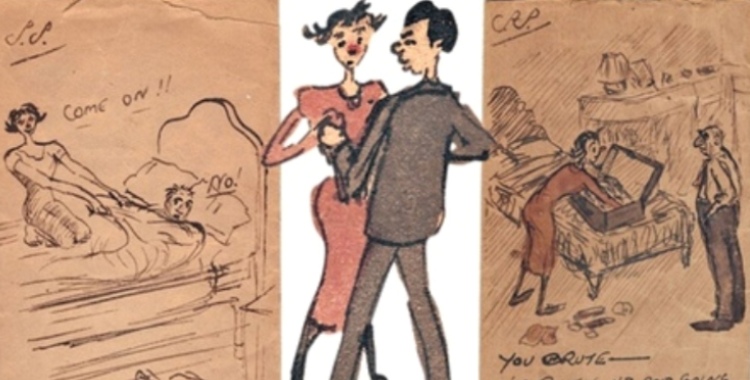
It’s hard to imagine a more complete depiction of a relationship than the one that Danny Braverman unearthed in a dusty shoebox five years ago. Laid down over almost 60 years, the 2,500 or so images were the work of Braverman’s great uncle Ab Solomons, a shoemaker who started scribbling pictures for his wife, Celie, on the back of his weekly wage packets in 1926.

Beginning in London’s East End, where Ab worked and lived, the drawings trace the evolution of a marriage, as flirtation gives way to bickering and domestic contentment is ruptured by painful events. There are bedroom scenes where Ab jokes about his snoring; and others where the quarreling couple are locked in stalemate. One is annotated with the telling words, “I can be as obstinate as you can.” We see the growth of Ab and Celie’s two sons, and the growing spectre of illness. Celie is a constant presence, pictured forever as she was when the pair married.

There is an extraordinary honesty in Ab’s refusal to skip over the agonising episodes in his life with Celie. “These aren’t cartoons; this isn’t being funny,” Braverman says. “As an artist, he had a compulsion to tell the truth.”

“I challenge anyone to find a more comprehensive picture of one person by another person,” agrees Nick Philippou, the director who helped Braverman bring Ab and Celie’s story to the stage. “It’s so vast and so relentless.”

Flickering away in the background is the social history of the 20th century, from blitz to boom to bust. Not surprisingly, anxiety pervades the drawings made during the war years. “It’s so monumental, it becomes like a Greek tragedy,” Philippou says. “And, like a Greek tragedy, it talks of all the things we can’t avoid: birth, life, death.”

Braverman, a writer and performer, shares his great uncle’s story in Wot? No Fish!!, which is about to begin a run at Battersea Arts Centre. Somewhere between a lecture and a performance, the show is delivered by Braverman himself, sifting through his surprising inheritance. Of the many questions the piece asks, Braverman highlights the way it prods at notions of high and low art. “What is the value of art in our lives?”

Philippou breaks in: “And who’s allowed to make it?” Both men describe the wage packets as an example of outsider art, but they are adamant that Ab is an artist by any standards. “Whenever anyone uses the word doodle I say no,” Philippou insists. “It is art, and it’s fantastic art.”

The outsider emerges as a recurrent theme of Ab’s art and of the show. As the son of Jewish immigrants, Ab was something of a marginal figure himself, with antisemitism casting a shadow over several of his drawings. In a Britain where immigration is once more the subject of fierce public debate, this is where the show’s subtle but insistent politics is located.

There is also, I suggest, a modern resonance to Ab’s compulsive sharing. What he depicted in art, we now publish on social media. In the same way that Ab’s drawings give equal space to death and trivia, as many Twitter posts are devoted to the serious as to the silly.

“It’s very different,” counters Philippou. “What you do in a tweet is you spend 10 seconds doing it; what you do with a work of art is you make it. You don’t make a tweet.” What has been lost, Philippou and Braverman suggest, is craft and care. “It does make you wonder about that mode of communicating – where is it now?” asks Braverman.

The answer, perhaps, is in the theatre. Wot? No Fish!! is not one but two stories, Braverman says. “There’s the story, and then there’s the story of the story. There’s the story Ab draws, but also the story of my discovery and my connectedness to it. It is about history in the present.”

“Somebody said the show is an act of love,” Philippou recalls. “I think that’s probably true, but it’s only true because Ab’s work was an act of love. The best way to love somebody is by not looking away. It’s continuing to look.”
The Roof: Free-running Meets Gaming

image

Originally written for The Guardian.

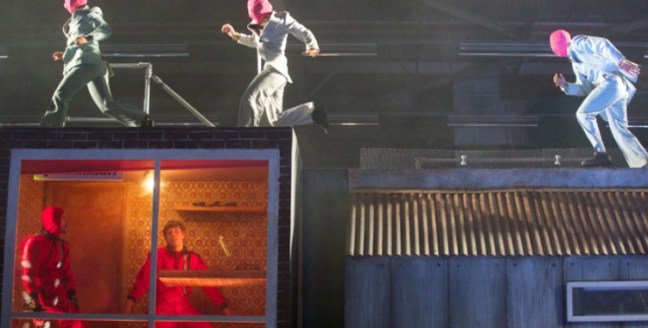
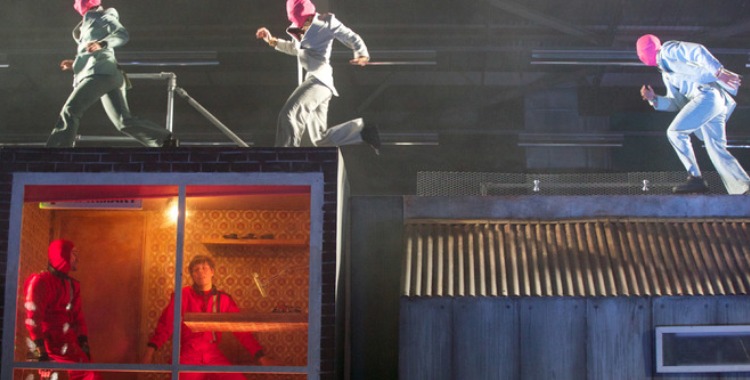
In an age of screens, avatars and online anonymity, David Rosenberg and Frauke Requardt’s latest collaboration performs an intriguing reversal. The Roof, which is part of the London international festival of theatre, explodes the video game out of the screen and into the open air. In a car park opposite the National Theatre, audiences are invited to look on as a three-dimensional hero runs, jumps and fights his way through level after level. Virtual meets real.

Surprisingly, neither Rosenberg nor Requardt are big gamers. The concept of gaming as a structural and visual reference point emerged from the idea of an audience inhabiting a single character at the same time as being able to observe that character’s actions from an external perspective – the relationship between gamer and avatar, essentially. The resulting show is, according to Rosenberg, “a bit of an out-of-body experience”, in which audiences invest in an avatar whose movements they have no control over.

This unsettling dual experience is created through the use of headphones and binaural technology, harnessing immersive sound to transport audiences to the heart of the action. But while each audience member is offered an individualised, isolated experience through the soundtrack being pumped into their ears, Rosenberg and Requardt insist that it is vital to observe the piece as a group. “We want to create an environment where the audience feel that they’re part of a mob and there is something gladiatorial about the perspective that they have on the action,” says Rosenberg. As a group, spectators can watch, but not intervene.

“We never set out to create an interactive experience where an audience can determine an outcome,” Rosenberg explains. He compares the helpless experience of both inhabiting and watching a character to how we live our lives “through a collection of mainly random events and attempt to attach our own agency onto those events”. As Rosenberg and Requardt discuss, the clear parallels between gaming and life – progression, growth, levels – invite an audience to draw such connections.

“We were interested in taking the structure from gaming because the structure holds the audience through the show,” Requardt adds, suggesting that the “predictability” of this structure helps to give shape to a piece which relies more on movement than on words. Layered over this simple logic, Requardt’s choreography has been able to access a more abstract language, exploring “existential things about what it’s like to be alive”.

Despite this abstraction, Rosenberg and Requardt are also interested in some of the concerns particular to gaming – violence chief among them. The Roof may not explicitly address this issue, but Requardt believes that “there’s a question about violence which is raised, just because it’s a live performance and it’s not a game”.

The implications of this might have as much to say about the culture from which those games arise as the games themselves. After all, as Rosenberg reflects, “there aren’t many video games where you get rewarded for altruism or empathy”.

Photo: Paul Hampartsoumian.

Ben Miles

Ben-Miles-Thomas-Cromwell-002

Originally written for The Guardian.

When Hilary Mantel first introduces us to Thomas Cromwell, the wily social climber at the centre of her award-winning historical novels, he’s face down in a pool of his own blood. It’s possible to view the entire narrative that follows in Wolf Hall and Bring up the Bodies as Cromwell’s defiant rise, as he scrapes himself off the floor and ascends to the zenith of 16th-century politics.

“These plays are about how this man gets up on his feet having been on his knees and how far he goes,” says Ben Miles – the actor shrugging on Cromwell’s robes – of the Royal Shakespeare Company’s pair of stage adaptations, now transferred to London’s West End. Cromwell – “the original working-class hero, the original self-made man” according to Miles – is the scheming heart of the two stories, determinedly throwing off his humble origins and charming himself all the way to Henry VIII’s side. He’s a compelling figure, but one with a hard, ruthless streak.

“Morally, it’s very ambiguous,” says Miles, identifying this ambiguity as one of the attractions for him as an actor. “People are intrigued, they’re drawn in by this charismatic figure who drags himself up, but the means by which he does that are often dubious. There are lots of themes in these stories, but one of them is this idea of vengeance or retribution – how far do you carry that? When you’re finally in a position of power, what do you do with that power? Do you use it to settle old scores, or do you use it for the common good? Or do you do both? I think that’s what Cromwell finds himself doing. It’s an endlessly fascinating study of human character.”


Also fascinating is the wider Tudor context, and the fierce debates that still surround figures such as Cromwell, Henry VIII and Anne Boleyn. “I think these plays and these books have really held a light up to that period,” says Miles, who confesses to having been a huge fan of Mantel’s novels even before the RSC project arose. “Hilary’s rewritten the book as far as opinion about Thomas Cromwell is concerned,” he adds, describing the experience of bringing this reimagined character to life as “a great thrill”.

While Mike Poulton’s stage versions of Wolf Hall and Bring Up the Bodiesare necessarily “streamlined”, stripping out a number of peripheral characters and subplots, Miles insists they remain faithful to the vivid character portraits in the books. “What the plays keep, I think, are the main arteries of the story,” he says. And, like Mantel’s novels, the plays succeed in marrying historical narratives with a very modern set of concerns and sensibilities.

“Politics, nationhood, religious fervour, extremism, European political machinations, the threat of war, how to get on in the world, the trials and tribulations of the self-made man – all these things, they’re things that concern us now and will always concern us,” he says. “It’s these things that make the plays contemporary, as well as period.”
Photo: Tristram Kenton.

Keep it moving: Jeremy Herrin

Wolf-Hall-14-2013-541x361

Originally written for The Guardian.

“It’s about using the power of the words,” says the director Jeremy Herrin. He is reflecting on the Royal Shakespeare Company’s stage adaptations of Wolf Hall and Bring Up the Bodies, the meaty Hilary Mantel novels that have achieved the double feat of topping bestseller lists and winning literary prizes. At more than 1,000 pages combined, the books pose a formidable challenge to adapters.

“You’re very conscious that there’s an enormous amount of material and a limited amount of stage time,” says Herrin, summing up the dilemma. Working closely with the playwright Mike Poulton (“it’s got to be collaborative”), Herrin resolved to create a driving momentum at the centre of the drama, moving the action along swiftly enough to keep audiences engrossed throughout the two three-hour productions: “I don’t like to keep an audience waiting.”

Discussing the adaptations, Herrin repeatedly mentions the importance of “moving forwards”, stressing the dynamism of his approach. Mantel’s novels, which trace the turbulent politics of Henry VIII’s reign through the behind-the-scenes figure of Thomas Cromwell, are dense with court politics. The stage versions navigate this by hopping rapidly from location to location with minimal fuss. In telling this fictionalised historical narrative, Herrin was keen to avoid some of the more familiar tropes that have congealed around representations of Tudor England, devising, instead, a stage language that “could hint subtly at modernity”.

“You can find out a lot about who we are now by looking through the prism of history,” Herrin suggests, arguing that it is this “sense of where our nation was defined” that continues to inspire our fascination with the Tudor era. “It’s one of those stories that every generation can look at again and find different meaning in,” he says. “There’s also a sort of horror about the tyranny underneath those facades that we’re really keen to revisit and to analyse.”

Central to the stage productions is the characterisation of Cromwell, with which Herrin is particularly pleased. “Ben Miles was always the right man for the job,” he says. “It’s a gargantuan feat, in terms of pure stamina and precision. He does six hours of the most sublime, subtle, very clear, very specific acting.”

After a successful initial run, the move from Stratford-upon-Avon to London’s West End, where the double bill opens next month, presents another challenge for Herrin. Of the change of stage, he says: “We’ll have to find the right performance language to fit in that room.” It’s “a chance to have another go at it and tell the same story under different circumstances”.

At the same time as preparing for the London transfer, Herrin has been settling into his new job as artistic director of touring theatre company Headlong. For the man once dubbed “Britain’s busiest director”, the added workload should not be a problem, but filling predecessor Rupert Goold‘s shoes is no mean feat. Herrin shrugs off the pressure, simply saying, “I’m really grateful to Rupert for doing his job so brilliantly”.

Herrin is now in the midst of his first season in charge, with an updated version of Frank Wedekind’s Spring Awakening out on tour and a new co-production with the Royal Court coming up this summer. For Herrin, the priority is to “keep doing what we do really well” and – as with all his work – to continue making the theatre that inspires him.

“I’m interested in theatre that’s exciting and exhilarating, and that goes into territory that will create debate and will be firmly about what’s going on in the world.”

Photo: Keith Pattison.

Matilda the Musical

MAT-13.5-14

Originally written for the Guardian as part of their Musicals we love series.

In a recent episode of Outnumbered, a headmistress in the mould of Roald Dahl‘s deliciously vile adults announces her desire to ban the beloved author. “He’s probably ruined more children’s lives than polio,” she sneers. “Ruined them with the ludicrous belief that all adults are stupid and can routinely be outwitted by small children and the occasional fox.”

This is perhaps Dahl’s greatest achievement. Adults are fallible, flawed, fickle creatures, and we could all do with an occasional reminder of that. None of Dahl’s resourceful young characters do this quite as well as the heroine at the heart of the Royal Shakespeare Company’s musical adaptation, who outsmarts her adult oppressors with the triple threat of brains, guts and telekinesis.

The irresistible charm of this musical is not so much its music, its book, its design or its performances, but the appealing streak of naughtiness that runs through them all. Listening to Matilda sing “Even if you’re little, you can do a lot, you/ Mustn’t let a little thing like little stop you”, I was suddenly eight years old again, cracking open the pages of Dahl’s book and feeling an instant connection with his bright, brave and bookish protagonist.

Dennis Kelly and Tim Minchin’s version is that rare thing: a stage adaptation that manages to both honour the spirit of the original and confidently stake out its own identity. The insertion of songs is vindicated at every turn as they allow mischief and emotion to explode out of the narrative, from the gleeful rebellion of Naughty to the bittersweet optimism of When I Grow Up. Minchin is an inspired choice as composer and lyricist, marrying his own brand of irreverence with that of Dahl’s and throwing some wickedly clever rhymes into the bargain (see the dazzling pairing of “miracle” and “umbilical” in the opening number).

And there is plenty of substance beneath Minchin’s witty tunes. Dahl’s narrative of a young girl overcoming cruelty and neglect with a little help from the books she voraciously reads carries a number of implicit but never patronising messages – about the importance of standing up for oneself, the value of intelligence and the power of the imagination. Then there are the characters: the smart, plucky protagonist, her fantastically grotesque parents, and the frankly terrifying Miss Trunchbull, who had not a little of the Iron Lady about her in Bertie Carvel‘s interpretation.

The show’s real sucker punch is saved for after the interval, as When I Grow Up hits the stage with a sudden, unexpected wallop of sentimentality. Just like Dahl’s prose, the musical boasts a direct line back to childhood, leaving younger audience members grinning with recognition and their adult counterparts misty-eyed with nostalgia.

What Matilda is strongest on, though, is an aspect that musicals often neglect in favour of razzle and dazzle: storytelling. It says a lot that Kelly, a seasoned playwright, was brought on board before Minchin; the RSC wanted to get the story right. It was a canny choice. Matilda is, at heart, a story about stories. Accordingly, the musical is drenched in narrative and bursting with words, right down to the brightly coloured letter blocks of Rob Howell’s gorgeous set – a Scrabble lover’s paradise.

Despite now being a hit on the West End and Broadway, with a clutch of awards to its name, Matilda’s fate was by no means secured. As Kelly has stressed, no commercial producer would take the risk that the RSC did in commissioning the show and putting it in the hands of two writers with little to no previous musical theatre experience. If ever there was an argument for arts subsidy, this joyous, playful, rebellious musical has to be it.