Home is Where the Art Is

Caroline-Sabins-Lifedeath-011

Originally written for the Guardian Culture Professionals Network.

What value do you attach to a community art exhibition? How do you assess a conversation on a funding application? Is it possible to put a price tag on a space that allows young people to feel that the art inside belongs to them?

Responding to Arts Council England’s recent report on arts funding,Towards Plan A, some commentators suggested that arts organisations might be better off formulating a funding plan B. It’s clear that pleading the economic case for the arts is failing to have the desired impact with the government, while equally failing to take into account the many other, less tangible ways in which the arts produce value.

The alternative proposed by a recent article on the Guardian is to transform cultural organisations into vital, cherished hubs of their local community, making their disappearance unthinkable. This is not a new idea; many organisations are already buzzing hives of community activity – think of the local classes and workshops at Battersea Arts Centre, or the Albany’s commitment to open its doors to the people of south east London.

But it’s beyond London, where the funding climate is harsher, that such initiatives might have the greatest impact. This is certainly the hope of Annabel Turpin, chief executive of the ARC in Stockton, who insists that “arts centres have a much bigger part to play in the lives of local people”.

It’s her aim to open up the organisation as much as possible to its community: “giving people permission to come in and use the building.” Alongside its artistic programme, the ARC hosts activities that cover all demographics, from children’s dance classes to an extensive programme for older people. “It’s a very broad spectrum, and that allows us to attract people from right across the community,” Turpin explains.

The same discovery has been made by mac Birmingham, which can boast high levels of engagement with its local community. “What’s important is the range of what we do because we are a multi-artform centre,” stresses artistic director and chief executive Dorothy Wilson. The centre aims to take visitors on a journey, offering various points of entry and leading them to unexpected destinations, be that a contemporary theatre show or a craft workshop. Its mantra is that the community are all artists. As Wilson puts it: “We encourage people to feel that this is a place for them.”

One of the greatest assets held by arts centres is their space. This is something that has been recognised by Chapter Arts Centre in Cardiff and Farnham Maltings in Surrey, the latter of which has offered much of its space over to its local community. “For us to thrive – to be truly popular – we needed to become relevant to more people and improve our usefulness,” says director Gavin Stride.

The difficulty, however, can be getting people over the threshold. “I don’t think we make enough of the fact that it’s free to come into an arts centre,” suggests Turpin. As public space shrinks, arts centres remain some of the only places that can be enjoyed without necessarily having to buy anything, a fact of which local people are not always aware. It is for this reason that mac Birmingham, for example, invests heavily in “free at the point of access opportunities” for those who might just stumble across the venue.

As well as throwing their doors open, some venues have gone further in their attempts to hand ownership over to local people. Matt Fenton is a passionate advocate for involving audiences in programming, an idea that he first tried out at the Nuffield Theatre in Lancaster and has now taken to Contact, Manchester, where a group of young people from the area have a key role in how the venue is run. He argues that audiences today expect more of a “two way conversation” and that the best way to target new, more diverse audiences is to represent their voice from within an organisation’s decision making structures.

“If arts organisations are genuine about a desire not just to reach more people but more broadly across the spectrum of their communities, then they’re going to need to think about how open they are, how engaged they are, as organisations,” Fenton insists.

The anecdotal support for these approaches is backed up by some compelling statistics. Contact’s commitment to young people has resulted in audiences that are 70% under 35, while mac Birmingham achieves 30-65% crossover audiences across its arts programme. Chapter boasted 800,000 visits in 2013, two-thirds of whom attended non-core activities and, as all of these organisations are keen to emphasise, none of this is at the expense of making great art.

Convincing as this model may be, however, the organisations that have committed to it all stress that such changes cannot be made purely in the service of self-preservation during difficult times. As Fenton puts it: “Arts organisations, especially publicly funded ones, should be doing this anyway.”

Photo: Chapter Arts Centre.

Mark Heap: Mr Zany Buttons Up

Mark-Heap-011

Originally written for The Guardian.

Mark Heap is wryly recalling an online comment describing his bizarre turn in Channel 4’s Green Wing. It ran: “Mark Heap doing his usual mad thing, but slightly fatter.” “Which I thought was brilliant,” he says, “but it’s kind of true.”

Heap has become television’s go-to oddball, best known for the roles of otherworldly conceptual artist Brian in Spaced and Green Wing’s outlandish and obsessive Dr Alan Statham. More recently, he’s been stealing scenes in Friday Night Dinner as an over-friendly neighbour. Now he is returning to the stage after a 20-year hiatus. Next week he takes over from Matthew Macfadyen as PG Wodehouse‘s famously unflappable butler in the Jeeves and Wooster comedy Perfect Nonsense, alongside Peep Show star Robert Webb (replacing Stephen Mangan) as his foolhardy employer.

When we speak at the Duke of York’s theatre in the West End, at the end of a long day of rehearsals, Heap confesses that throughout his years of TV work, he was rarely tempted by theatre roles. Jeeves, however, was a part he could not turn down. “It came along and I found it difficult, nigh-on impossible, to say no to.”

It was the appeal of PG Wodehouse’s fiction that clinched it. “It’s just a joy to read,” Heap says simply. “They make such a mountain out of nothing – there’s high farce over a teapot or an ashtray.” Heap also revels in Wodehouse’s distinctive, elaborate use of language. “On the one hand you’re saying a thousand words with two words, like ‘indeed sir’, or you’re saying one word using 30 – it’s brilliant. There’s so much implied.”

Heap was particularly impressed by the way Robert and David Goodale’s stage adaptation manages to retain the memorable prose of Bertie Wooster’s narration. The action is framed within a play put on by the protagonist – with only his aunt’s servant Seppings, and Jeeves, to assist him. Cue chaos, confusion and quick changes. “There are two levels,” says Heap. “The Wodehouse meat and the froth of watching people struggling to double up and play with all the theatrical conventions.”

Does Wodehouse’s distant world of buttoned-up butlers and fearsome aunts have anything to say to us today? Heap suggests that it is precisely because Wodehouse’s characters are so of their time that they continue to tickle audiences, tapping into a very British brand of nostalgia. Unlike Shakespeare, whose works have been relocated to every era and setting imaginable, Wodehouse’s stories demand to remain firmly in the early 20th century; any attempt to update them, Heap argues, “would be hopeless”.

In person, Heap is unexpectedly straightforward – unassuming, almost – revealing only the occasional glimmer of the strangeness that animates his TV performances. Although he insists his succession of quirky roles was a “total accident”, he admits that “arsing about and being silly” have always appealed to him as a performer. The Green Wing cast had two months together before getting in front of a camera – “you develop little tics”. As for Brian: “he was meant to be quite flamboyant and I found myself, just because I was in the mood that day, thinking: what if he was really uncertain and a bit tortured. It built from there.”

The business can narrow you down, Heap says. “You start off going, ‘I can play anything’, and slowly you get whittled down.” But he shrugs at the happy coincidence of his career: “I’ve always just fuddled along. I do my job and it’s all I’m any good at to be honest.”

A year into university, he ran away from his studies – not with the circus, but with Fools Theatre, a touring company producing Pinter plays and “avant-garde, mime dance-movement things”. From there, he joined his brother Carl’s Medieval Players company, performing all around the world until he and fellow actor Mark Saban splintered off to form a street theatre duo, The Two Marks, which eventually led to television work.

Is it intimidating to return to theatre in a role with as rich a history as Jeeves? Heap concedes that the prospect is “bloody daunting”, but adds: “like any character, you have to bring your own thing to it”. He is still discovering his idiosyncratic take on the character, explaining that his approach tends to be “instinctive” rather than psychological. In a show that takes a sledgehammer to the fourth wall, some elements will remain uncertain until put in front of an audience – the “missing ingredient”.

“I’m hoping, if I live to the first performance and don’t die of exhaustion, that I’ll suddenly realise the joy of theatre – that immediate response and feedback,” Heap says. The show, with its breakneck visual gags and more costume changes than a Lady Gaga gig, is an unforgiving reintroduction to the stage. At the very least, Heap jokes, the punishing pace will keep him fit. “They will say Mark is doing his usual mad thing, but looking a lot thinner.”

Photo: Graham Turner.

Steffan Rhodri’s theatrical road trip with piglets as passengers

Steffan-Rhodri-in-Id-Rath-013

Originally written for The Guardian.

On the tiny stage of Notting Hill’s Gate theatre, Steffan Rhodri is joined by a pair of unlikely co-stars. Director Jude Christian’s production of the awkwardly titled I’d Rather Goya Robbed Me of My Sleep Than Some Other Arsehole has added two small, headstrong piglets to Rodrigo García’s surreal monologue.

“I was bemused by this decision at first,” the actor says, “but I’ve sort of learned to love it.” He adds that the pigs, who stand in for the protagonist’s two sons, are “unpredictable”, but the chaos and absurdity of their presence is oddly fitting for the piece. The animals and their unscripted behaviour send out a strong signal to audiences: “It immediately sets that surreal tone, that absurd tone of we are not in naturalistic reality here, this is up to you to interpret what this man is on about.”

García’s play follows a man in the grip of a midlife crisis; he is “railing against the materialism of life, but also searching for some meaning”. As the man questions his own existence, he tells the story of a hedonistic road trip with his sons, which culminates with breaking into the Prado museum, in Madrid, to look at Goya’s Black Paintings. The line between fantasy and reality, however, is constantly blurred.

This character’s experience mirrors, to an extent, Rhodri’s reasons for taking on the role. The actor is best known as Dave Coaches from the television comedy Gavin and Stacey, which quickly became a runaway hit for the BBC. Rhodri says of the show that he was “lucky to be involved, but not defined by it”. He has since taken on a string of roles at the Royal Shakespeare Company and in the West End, as well as making a brief appearance in the penultimate Harry Potter film. This production is an opportunity to break out of that mainstream trajectory and do something “completely off the wall”. It is Rhodri’s window-smashing moment.

He is also firm in his belief that this sort of risk-taking, form-pushing work should be the purpose of fringe theatre, pointing out that a play such as this one would never be produced in the West End. “Quite often these days fringe theatre can be used in a very safe way as a vehicle for smaller, cheaper versions of mainstream theatre,” he says. “I think this is very different.”

As well as contending with the whims of the piglets, Rhodri has the formidable task of carrying García’s anarchic narrative alone each night. Although this is Rhodri’s first solo show, he describes himself as “a sucker for a challenge” and is excited about standing the piece up in front of an audience. “I never imagined myself doing a one-man show,” he confesses. “If I’m going to do one, I’d rather do one that breaks all the rules.”

Rhodri is also relishing the challenge of the “particular openness” that this slippery, ambiguous play allows. He compares it to Beckett and the absurdist tradition, as well as identifying “a sort of dreamlike quality that is reminiscent of Pinter”.

What most excites Rhodri – and, he hopes, the audiences who will come to see it – are the ideas that García is grappling with. “It is about the big questions of life, in a very short, punchy piece. How should life be lived? How should life be experienced? Do we need to make plans and be safe, or do we just need to do things?”

Photo: Tristram Kenton.

Victoria Melody

Victoria-Melody-Major-Tom-008

Originally written for The Guardian.

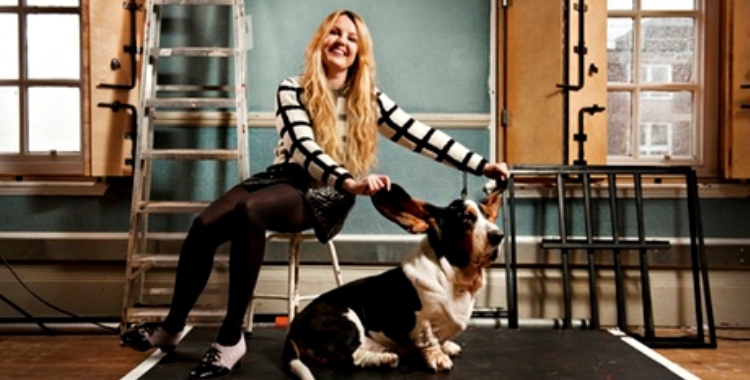
Major Tom, the long-eared, irresistibly endearing basset hound lying in the corner of the room, lets out a low disapproving howl. Awwww, is someone not happy? Is someone not getting enough attention? Oh well, I did come here to talk to Major’s owner, the performance artist Victoria Melody. But Major is clearly keen to get in on the action. He is, after all, a born performer. He even has a show named after him.

Using live performance and film footage, Major Tom follows the attempts of both dog and owner to prove their beauty: Major in championship dog shows, Melody in national beauty pageants. The piece is an attempt to show “the beauty world from a woman’s eyes and a dog’s eyes”. And its conclusion is that the two are “not that dissimilar”. Major was told by judges that his ribcage was too big, while Melody was advised to lose weight.

It might seem like an odd premise for a theatre piece, but Melody’s performance work has always been rooted in real – and often idiosyncratic – people and situations, her primary interest being “the funny things we do as humans”. Trained as a fine artist, she crossed over into theatre with Northern Soul, a one-woman show recounting her adventures in pigeon fancying and northern soul dancing. What is it that makes her embed herself among such clusters of idiosyncrasy, throwing herself headlong into their worlds and then shining a light on them? “Curiosity,” she says. “Which is quite a nice word for being nosy.”

Major Tom, which opens in London next month, is a bit of a departure for Melody, though, thanks to the element of competition. Whereas in the past she was a participant, with everyone on the same side, both the dog shows and the beauty pageants pitted her (and Major) against the individuals whose world she was exploring. The show was initially going to be just about all the dog contests Major was entered in – including the one where he wins biggest ears in a show in south-east England – until Melody started to feel a growing sense of guilt. If she was going to force him to compete, and subject him to a judging panel, shouldn’t she put herself through a similar experience? So, somewhat reluctantly, she entered Mrs UK and found that her discomfort didn’t last long. She won Mrs Brighton with relative ease in 2012, before moving on to the bigger challenge of Mrs UK. “Soon I just wanted to win everything,” she says.

And so did everyone else. Melody often found the dog shows surprisingly hostile: following a string of losses, one judge told her she’d be better off investing in a new dog. By contrast, she was pleasantly surprised by the warmth shown by her fellow beauty contestants, contradicting stereotypes. “There was no bitchiness, no backstabbing, no dresses going missing – none of that.”

Major Tom performs alongside her in the show and, apparently, isn’t very good at doing what he’s supposed to do. This means he often steals the limelight from Victoria at precisely the wrong moment. “His comic timing is genius,” she says. “He always ruins my stories.”

Melody likes to embed herself as fully as possible in the worlds she investigates, developing real and meaningful relationships along the way. Humour is a vital tool. “I’m able to make the work that I do because I’m quite funny and down to earth,” she says. “I think I endear myself to people. I put them at their ease: they believe I won’t exploit them.”

Although Melody and Major were there to be judged, she is determined not to pass judgment herself. She describes Major Tom as being about “the beauty myth and the oppressive function of that”. But she is quick to qualify this, saying: “My shows are only about direct experience. I’m talking about these worlds from the inner sanctum, seen through my eyes.” In the show, although she is frequently – and hilariously – critical of herself, she does not directly criticise those around her. “I don’t tell people what to think. I leave it to the audience to form their own opinions, because audiences are clever and can decide for themselves. They don’t need to be fed something on a plate.”

Melody’s shows often leave the audience wondering about the extent to which they are authentic. Although she insists that the stories she tells in Major Tom are all “absolutely true”, she does also seem to welcome the ambiguity that surrounds the show, the blurring of art and reality.

The process is demanding and frequently takes over her life. But when it does so, Melody sees it as a good sign: it suggests that she’s on the path to something promising. “When it gets to the stage of me not knowing if I’m doing this for my research or for my life, that’s when I know a project’s progressing. One of the interesting things, for me, is that intersection between art and real life.”

She reaches for a comparison and plumps for Fountain, the famous conceptual work by Marcel Duchamp that challenged how we define art. “I see Major Tom as my urinal,” she says.

Photo: Linda Nylind.

Lack of female role models? Make one up

CB_KitchenSmile

Originally written for The Guardian.

At the last count, there are currently more than 40,000 Disney Princessproducts on the market. It has been estimated that pre-teens now spend seven hours a day staring at a smartphone, computer or TV, and witness many thousands of violent acts online each year.

These are just a few of the startling facts performance artist Bryony Kimmings uncovered during research for her latest project. Part social experiment, part educational project, part theatre show, Credible Likeable Superstar Role Model – now showing at the Edinburgh fringe – is a response to Kimmings’ mounting anger at the commodification of childhood and the pop industry’s objectification of women and young girls. In her attempt to push back, she has recruited an unlikely ally: her niece, Taylor, now 10.

“I was a bit shocked at what was available to her,” Kimmings explains during a break from rehearsals. As the two talked, it became clear that the female role models on offer in the media were worryingly limited, and that they all seemed to offer the same bland version of success. Kimmings names flesh-baring pop stars such as Rihanna and Katy Perry, who perpetuate a similar idea of femininity. As she points out, young people can get “a really limited view of what women are”. So the pair decided to take matters into their own hands – and invent an alternative.

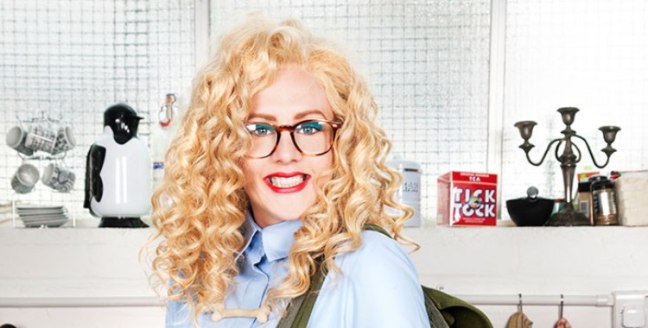
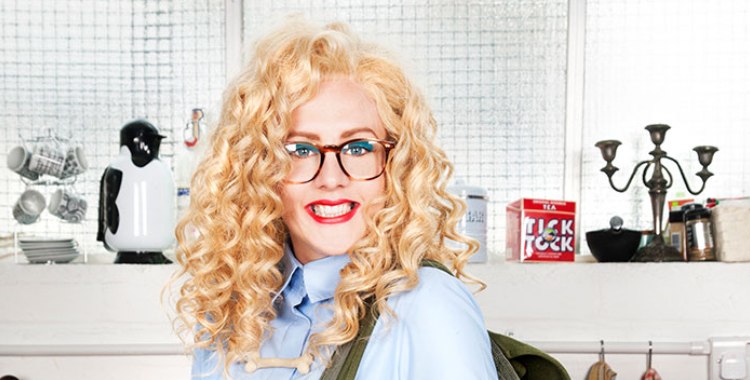
Dreamed up by Taylor and brought to life by her aunt, Kimmings’ new alter ego is a pop star created with a child, for children. Catherine Bennett – CB to her fans – is a dinosaur-loving, bike-riding, tuna pasta-eating hero who squeezes in a pop career around working in a museum as a palaeontologist. As Taylor explains, it was important to make CB “very different” to the female celebrities children usually see. Where most stars straighten their hair, CB wears hers defiantly curly. While other singers opt to bare their flesh, CB’s skirts are kept firmly below the knee.

But, like all pop stars, Catherine Bennett wants to be famous. Kimmings repeatedly refers to the project as “the fame experiment”, approaching it with all the hope and mischief of a kid with a chemistry set. To help Bennett hit the big time, Kimmings has assembled a true pop-star entourage: real-life makeup artists who have worked with Girls Aloud, i-D magazine stylists and a PR company. The team have offered their expertise to turn Catherine Bennett into a viable superstar, giving her the best possible shot at fame. “I just copied what they did with real pop stars,” Kimmings says, noting the enthusiasm and generosity she has met from those in the industry – many of whom feel just as disillusioned about how the system works.

Catherine Bennett’s successes so far include recording two music videos, closing the Children’s Media Conference in Sheffield in July and appearing as part of Yoko Ono’s Meltdown festival at the Southbank Centre in London. For her to be considered truly famous, however, Taylor has decided she needs to achieve a series of “fame aims”, including reaching a million hits on YouTube and making three celebrity friends. But the ultimate target, Kimmings adds, is to spawn a copycat.

While it might be said that the project’s fixation on fame runs the risk of reinforcing dominant definitions of success, it is important to Kimmings and Taylor that their creation makes her mark. If CB’s influence can be seen elsewhere, says Kimmings, the duo will know that they have “changed a bigger thing”.

The theatre show, which debuted as a work-in-progress at the Almeida festival in London ahead of its run in Edinburgh, is rejecting the “show and tell” format of Kimmings’ previous fringe successes, Sex Idiot and 7 Day Drunk, which dwelt, respectively, on Kimmings’ acquisition of an STI and her problematic relationship with booze. Instead, Kimmings is adopting a more “abstract” and “fantasy-based” approach, taking inspiration from the aesthetic of shows such as Game of Thrones to tell a coming-of-age narrative with a twist. “There’s quite a lot of symbolism,” Kimmings says, “but hopefully not in a cheesy way, hopefully in a cool way.” In the show, she and her niece appear together on stage to explore the darker side of growing up, from inappropriate dance routines to internet violence. The version I see is still being developed, but you can expect fake armour and a healthy amount of leaping around.

After Edinburgh, the show will tour until the end of 2014, while the mission to meet the fame aims continues. By the time Kimmings says goodbye to Bennett, she would like “just the tiniest of shifts in the brains of loads of children, or just a couple more cool representations of feminist women in the media”.

Kimmings is realistic about what she and Taylor are up against, but she remains resolutely optimistic. “I’ve got this blind hope that it’s going to happen,” she smiles, making it clear that this latest show is not about to let audiences off the hook. As Taylor adds cheerfully: “It’s a bit like being kicked in the stomach.”