Building Innovation

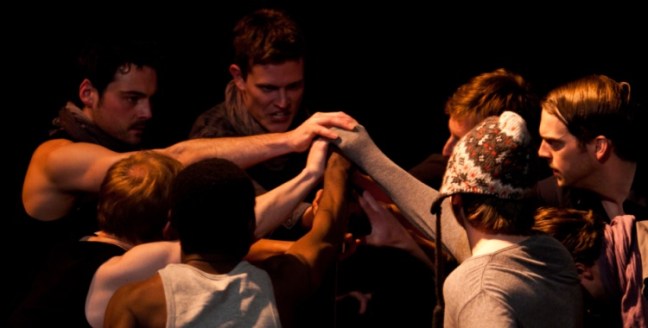
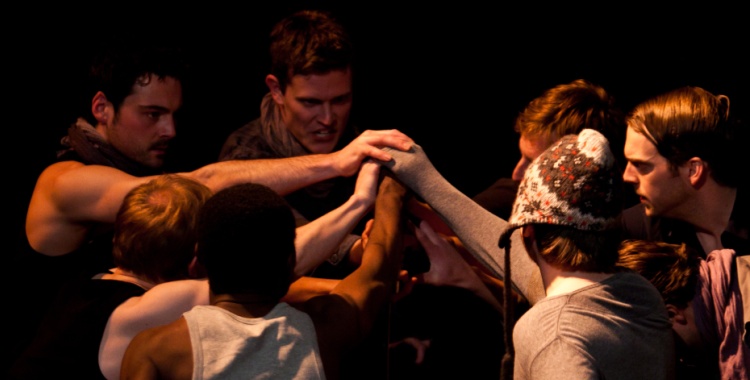
NORTH14 group photo credit Topher McGrillis

Originally written for The Stage.

Theatregoers and theatre-makers alike can breathe a sigh of relief as The Shed, the National Theatre’s temporary riverside venue, is granted a longer life. The 225-seat space could now be open for up to another three years, extending its programme of new and experimental work. Under the National Theatre’s associate director Ben Power, this little red powerhouse has stretched the remit of the theatre’s programming since opening last April, bringing in exciting new artists and different ways of working.

But The Shed is not alone. Across the country, a range of subsidised venues are investing in innovative, experimental programming, developing the next generation of artists from within their walls. From festivals to scratch nights, artist residencies to audience development initiatives, these regional producing houses are dedicated to developing the theatre ecology around them, even in lean times.

For Lorne Campbell, artistic director of Northern Stage in Newcastle, new ways of working with artists are not an accessory to the theatre’s core work – they are essential. “The old systems simply aren’t of use,” he says simply, referring to how funding cuts have altered the landscape. In their place, the venue is looking at strands of work that feed the ecosystem of young artists – such as its NORTH scheme for performing arts graduates – and offer the space for new companies to test their work in front of audiences.

This latter need is filled by the theatre’s Stage Three space, which Campbell is developing into a fringe venue for the city. The work on this stage will not be produced by Northern Stage, but instead the venue will be thrown open to Newcastle’s young artists. “Unless there’s a space for those artists to get their work on and make their mistakes in public, they aren’t going to evolve,” Campbell explains the intention. “Unless those young artists can grow an audience at the same time as they’re beginning to grow themselves as artists, nothing is ever going to change.”

For Emma Bettridge, curator of Bristol Old Vic’s artist development department Ferment, it is equally important to offer artists the opportunity to evolve within the theatre’s programme. She describes Ferment’s work as “an ongoing conversation with artists”, emphasising its flexibility in response to artists’ needs. “It’s become about working with artists that we’re really excited about and facilitating them in whatever way is suitable for them,” she explains.

One development in which Bettridge has been instrumental since joining the Old Vic is the backing of more work to full production. It is essential, she stresses, to get the work seen and give it a longer life, as well as connecting it to larger audiences. This is partly achieved through the two Ferment fortnights of work-in-progress showings each year, but Ferment also now supports between six and eight productions a year.

Elsewhere, festivals have become an important outlet for experimental and often unfinished work. Two such examples are Transform in Leeds, produced by the West Yorkshire Playhouse, and the New Wolsey Theatre’s Pulse Festival in Ipswich. Both festivals feature a mixture of finished productions and works-in-progress, placing the work of young artists alongside more established companies.

Rob Salmon, associate director at the New Wolsey, explains that the theatre has honed the Pulse Festival over the years in order to be able to simultaneously support bold programming and retain an audience. The festival now supports a mixture of high profile work and embryonic scratches, combining these different levels of experimentation in a way that manages the risk for theatregoers. Similarly, this year’s Transform Festival includes full-scale commissions, visiting shows from mid-career artists and showings of work in development.

What both Salmon and West Yorkshire Playhouse’s associate producer Amy Letman are adamant about, however, is the need to extend this kind of work beyond the isolated pocket of a short festival. Salmon has recently started up Pulse Presents, a strand of work that keeps the festival’s spirit alive throughout the year. The aim behind it, he says, was to “keep that work ongoing rather than it being something that crashed into the programme at one point in the year and then disappeared”.

Letman agrees: “I think the key thing is people know that there’s an ongoing commitment and desire for this work, and that it’s not something that flashes up and that we do once, but that it’s an ongoing part of our programme. The fact that the work is coming back helps to develop the audience.”

For all of these theatres, they understand this commitment to pushing their programming and supporting new artists as absolutely key to their artistic purpose. Asked how this work fits into his vision for Northern Stage, Campbell responds, “it is the vision”. Meanwhile Peter Rowe, artistic director of the New Wolsey, describes it as the theatre’s “particular mission” to help companies make the leap from small-scale to mid-scale work.

These sentiments are echoed by James Brining, artistic director of the West Yorkshire Playhouse, who tentatively suggests that theatres like his have a leadership role in their regions. “The problem with leadership roles in the past with big organisations is that they set an agenda which is about how you should do it, and that isn’t what I mean by leadership role. What I mean by leadership role in a city, in an area like this, is that our leadership role is about facilitation, it’s about collaboration.”

In times of stretched funding, that notion of collaboration could become increasingly crucial. Importantly, in all of these examples it is the theatres’ status as larger, regularly funded organisations that allows them to take the necessary risks in showing and developing new work. About the necessity of subsidy, Bettridge is unequivocal: “We fill a gap for risk-taking. We always need to have a subsidised pot of money that can we can invest in the ideas stage.”

Photo: Topher McGrillis.

School Links Are Proving an Education

DSC_0298 (2)

Originally written for The Stage.

In straitened times, collaboration is a word that seems to be constantly on the lips of those working in theatre. While this is no reason to drop the fight for arts funding, financial challenges have had the silver lining of producing a number of surprising but fruitful partnerships, be they between fellow artists, artists and venues, or across organisations.

Among these collaborations, some of the most creative and supportive are those that have developed between theatre makers and higher education institutions. This is not a new link, as universities and drama schools have long nurtured the next generation’s theatre makers, but now several organisations are looking at how to strengthen, build and innovate these connections, offering benefits that go both ways.

In many cases, such partnerships are born out of financial necessity. Clean Break, for example, have a 14-year, “multi-faceted” relationship with Royal Central School of Speech and Drama which was originally part of a funded education initiative, but their more recent partnerships with institutions including the University of the Arts and Rose Bruford had “an economic imperative” alongside the broader goal of widening participation. Director and writer Vicky Jones, meanwhile, admits that a real advantage of DryWrite’s partnership with Oxford School of Drama is that they do not have to raise funds for the projects they collaborate on.

Although higher education institutions are also facing cuts, universities and drama schools usually still have more resources at their disposal than independent artists – resources which are increasingly being shared. James Stenhouse, one half of performance duo Action Hero, explains that a great benefit of their relationship with the University of Chichester is the opportunity this affords them to make work in a well resourced environment, an opportunity they might not otherwise have.

Often the starting point for more extended partnerships is a simple teaching relationship which then develops into something deeper. Practitioners from Clean Break regularly deliver lectures for Central, while the foundation of DryWrite’s relationship with Oxford School of Drama is the company’s collaboration on the students’ third year show, which forms a cornerstone of their course. DryWrite now work to deliver a “unique and bespoke” final piece with third year students, bringing in playwrights such as Patrick Marber, Penelope Skinner and James Graham.

However, as Stenhouse is keen to point out, independent theatre makers do not necessarily have to take on regular teaching posts in order to make a living. Despite Action Hero’s long relationship with the University of Chichester, neither Stenhouse nor fellow artist Gemma Paintin are on the staff, and Stenhouse stresses the danger of getting “caught in a loop where we’re training the next generation of artists to teach the next generation of artists”.

In an attempt to break this loop, several of the organisations nurturing such relationships point to their vital role in bridging the gap between higher education and the reality of the theatre industry. At the most basic level, theatre companies working in partnership with higher education organisations can offer work experience for students, but often relationships extend much further than this.

Paul Hunter of Told by an Idiot, whose relationship with RADA was the product of “completely artistic reasons”, explains that the school’s principal Edward Kemp was “very interested in the notion of actors making more of their own work”. As a result, Told by an Idiot have begun developing work with students right from its earliest stages, a practice that they hope to build on. Similarly, one of the crucial aims of the University of Chichester’s relationship with Action Hero – and, more recently, with artists’ collective Forest Fringe – is to offer their students a real sense of what it means to be a working artist.

While most of these relationships have developed through a combination of necessity, accident and artistic curiosity, the longstanding partnership between Accidental Collective and the University of Kent has roots that go back as far as the company’s inception. When co-artistic directors Daisy Orton and Pablo Pakula decided that they wanted to make work together after graduating, the university offered them the opportunity to become their first supported graduate company, acting as “guinea pigs” for a new initiative to retain theatre makers in the region.

The company have since taught at the university, collaborated with academics on a number of research projects, events and publications, and established Pot Luck, a performance platform supporting contemporary theatre makers in Kent. “It’s set us on a very particular path,” says Pakula, recognising how rooted they now are in the local area. “Our practice has been strongly shaped by the region, and by our position between the university and the region. We have, in some ways, acted as a bridge.”

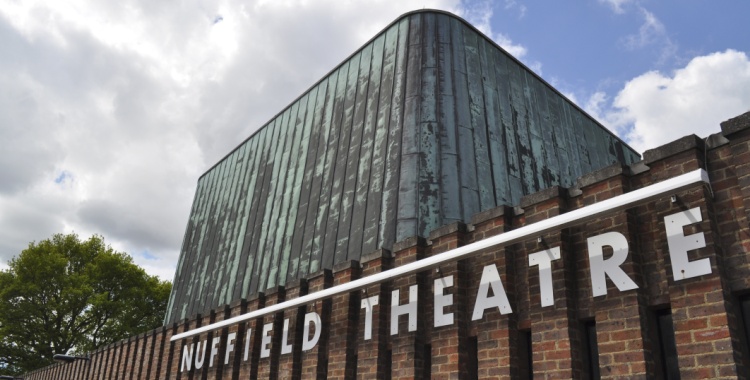
For Sam Hodges, the new artistic director of the Nuffield Theatre, it is important that the theatre’s relationship with the University of Southampton – on whose campus it sits – stretches further than just its arts departments. Since taking the reins he has been working simultaneously on a number of new initiatives, many of which link the activities of the theatre with the university’s leading science and engineering departments, with the aim of creating a “pooled vision and strategy”.

“It makes sense that in a bid to perfectly reflect and embody the qualities of its environment, the theatre should create work that is provocative and intellectually stimulating, provide opportunities of training and professional development, and develop a profile and reputation which reaches well beyond Southampton into the national and international field,” Hodges explains.

Perhaps the most exciting element of these emerging partnerships is their potential to create unique and unexpected outcomes, often through the collision of different artistic approaches. Hodges’ attempt to bring together art and science is one such instance, while the pairing of Told by an Idiot’s highly visual aesthetic with the more traditional actor training of RADA is another prime example. These unanticipated benefits can even have international reach, as with the cultural exchange that the University of Chichester have helped to establish between Action Hero, Forest Fringe and a group of artists in San Francisco.

The real opportunity of these new collaborations, as Hunter recognises, is to open up both artists and students to new possibilities. “Sometimes I think you can learn and be provoked more by going to a place that feels different, rather than aligning yourself always with people who feel familiar.”

The Rep Tide Turns

-C2-A9RWD10-20Faction_The-20Robbers_-36

Originally written for The Stage.

Repertory theatre might just be staging a comeback. While the Lyric Hammersmith undergoes major building work, the Secret Theatre company is occupying the untouched auditorium with a year-long programme of work driven by the ensemble. Elsewhere, Vicky Featherstone began her Royal Court tenure this summer with a festival featuring an ambitious weekly rep programme, while English Touring Theatre is exploring a repertory structure with Tonight at 8.30, its upcoming production of one-act Noël Coward plays.

The freshly vaunted advantages of the rep model will come as no surprise to The Faction. The company, which recently celebrated its fifth birthday, has been working towards this model from the moment of its conception, guided by artistic director Mark Leipacher’s passion for ensemble theatre and muscular versions of classical texts. The company’s ambition is bold but simple: a permanent ensemble, a home venue and a rolling repertoire.

While many have mourned the decline of the great British repertory theatre, which acted as a fertile training ground for the likes of Judi Dench, Ian McKellen and Derek Jacobi, The Faction looks to the continent rather than to the past for its chief inspiration. The company’s model is drawn from that of German theatres like the Schaubühne in Berlin, where a large repertoire of plays is presented by a resident ensemble.

“The idea for The Faction was always an ensemble theatre company following the model of a German theatre,” Leipacher explains. “Because it doesn’t really exist over here; even when rep was alive and well, that’s not the format that our rep model had in the UK.”

What The Faction’s ensemble approach does share with the old British rep model, however, is its focus on the actor. At a recent conference, playwright Simon Stephens – who is currently working as a dramaturg for the Secret Theatre ensemble – suggested that the UK’s freelance culture “can stifle bravery in acting performance”. This is just what The Faction hopes to reverse.

“Any director will tell you it’s a requirement to try and make the rehearsal room a safe place,” says Leipacher, “so that an actor can arrive without the need for ego, without inhibitions, and have the confidence in order to experiment and to play. I think with an ensemble that’s inbuilt.”

Although The Faction is still some way from its ultimate aim of a permanent ensemble performing a repertoire of plays all year round, this will be the third consecutive year that the company has presented an eight-week rep season at the New Diorama Theatre. Leipacher tells me that these rep seasons are “essentially a small model of how we want to work full time”, with the plan being to slowly extend these towards a year-long programme. He admits that it’s a “gradual process”, but the final aim is unwavering.

This year’s programme represents a blend of old and new for the company. It is remounting its Peter Brook Award-winning production of Friedrich Schiller’s The Robbers, which Leipacher describes as a “quintessential Faction show”, as well as returning to Shakespeare to tackle Hamlet for the first time. Completing the season is Thebes, an audacious attempt to weave together Sophocles’ and Aeschylus’ accounts of the Oedipus dynasty. Unlike the more defined thematic threads of previous rep seasons, Leipacher says that “the only condition this year was that they had to be plays that really excited us as directors, as a company – meaty, big, epic material that played to our strengths, that pushed us into new areas.”

Epic is the key word there. This sense of scope – both in terms of narrative and emotion – is what keeps The Faction returning again and again to classical plays. Leipacher insists that “there is no better material”, citing the plays’ timelessness and “universal themes” in contrast to new writing’s preoccupation with the zeitgeist. “It’s much more about human experience, about jealousy, about love, about responsibility,” he continues, “something that’s applicable to everybody and to any time. The purpose of doing the productions now is to do them for this time.”

As much as Leipacher enthuses about what excites The Faction as artists, the company is equally focused on its audience. Leipacher is adamant that repertory theatre offers a richer experience for theatregoers, with whom the company is able to “extend a dialogue” over a longer period. Audiences also have the opportunity to see the ensemble in a range of different roles, which Leipacher argues allows them to “enjoy the craft of the production and the ethos of the company as part of their theatregoing experience”.

Geoff Colman, Head of Acting at Royal Central School of Speech and Drama, is in agreement with The Faction about the advantages of the rep model for both theatre makers and audiences, describing it as “a place of experience, experiment, continuing development and trust”. He is also optimistic about the potential for bringing back rep under a new guise, adding, “I am convinced that other theatre makers will be looking at this reinvention of rep very closely”.

Discussing the experiments in ensemble theatre that are cropping up across British theatre, Leipacher says that “any movement towards that European model here in the UK is exciting”, but stresses the importance of longevity. It remains to be seen whether projects like Secret Theatre will go on to create longer term change, but Leipacher hopes that the Lyric and others will make the same commitment to ensemble theatre that is central to The Faction’s ethos. “Hopefully it’s the beginning of a tidal shift.”

Rosie Wyatt

BLINK_3_Rosie Wyatt as Sophie_Photo Sheila Burnet (2)

Originally written for The Stage.

Rosie Wyatt loves to look audience members right in the eye. In Bunny, a solo show about a teenage girl increasingly out of her depth, she offered an intense portrait of adolescent swagger and anxiety, breathlessly delivering Jack Thorne’s narrative directly to the audience. In the absence of connection and intimacy available to her character in Blink, she instead gazed outwards, finding points of contact with spectators; even delivering a script-in-hand reading, her stare can penetrate right through a play.

“It’s just about being really honest and genuinely telling a story,” Wyatt explains when we speak, quickly adding, “not acting talking to the audience, but actually talking to the audience. That sounds like something really simple but it is very different.” With care, she discusses the unique demands of direct audience address, in which “the audience are your other character”.

“If you act a traditional scene with dialogue, you’re always looking at how you’re affecting that other person and what you want to do to that other person in the scene. When you’re talking right out to the audience it’s the same thing: it’s what do I want to do to the audience, what am I trying to tell the audience?”

This way of relating to an audience was initially developed while performing in Bunny, Wyatt’s first job out of drama school. Thorne’s blistering monlogue went to the Edinburgh Fringe in 2010 – where it won a Fringe First – travelled down to London for a run at Soho Theatre, and eventually ended up in New York as part of the Brits Off Broadway season. “It couldn’t have been a better start for me really,” says Wyatt, describing herself as “incredibly lucky”. “You can’t ask for more from a first job: for it to be able to give you your debut, your London debut and then your New York debut.”

But it must have been intimidating to take on a one-woman show straight out of drama school? “Yes, petrifying,” Wyatt says with a laugh. “It was an amazing experience because I got this showcase that was just me, but it was also incredibly exposing and scary.”

This showcase certainly opened doors; “it got me in front of people and got me to meet a lot of people,” Wyatt says. The play’s success quickly led to her second job in the Paines Plough tour of Love, Love, Love, and she says that even her casting in this year’s national and international tour of One Man, Two Guvnors can be traced back to that first job. Other gigs to follow the acclaim of Bunny have included roles in Mogadishu, Blink and most recently Virgin – all new plays.

Despite this impressive track record with new writing, Wyatt reveals that her passion for acting has much more traditional roots. “I sort of fell in love with the theatre because of Shakespeare,” she tells me, recalling the regular trips she used to make to RSC productions while she was a sixth form student in Stratford-Upon-Avon. “I hadn’t really known about the world of new writing until I stepped into it doing Bunny,” Wyatt admits. Now, however, she describes working on new plays and originating roles as “the biggest joy” of what she does, adding, “I feel very happily placed in the world of new writing”.

The other notable feature of Wyatt’s career to date is the amount of touring work she has taken on. As well as the tour of One Man, Two Guvnors, which visited destinations such as Australia, New Zealand and Hong Kong, Wyatt has taken to the road with Bunny, Love, Love, Love and Mogadishu. “I don’t think it gets any easier,” she says of the touring lifestyle, “but I think what you do is learn your way of doing it that keeps you sane.”

What she relishes, however, is the opportunity to constantly perform in front of new audiences. “Every play I’ve done, you find that you get different responses in each city,” Wyatt says. “That’s so interesting and that’s something that I feel like I’ve been really lucky to get to do.” While these regional and cultural differences can sometimes be challenging – particularly when elements of the humour in One Man, Two Guvnors got lost in translation – Wyatt explains that “you just learn to always bring to it the same energy and always give that best version of the performance that you would want to give”.

Wyatt will soon have the opportunity to travel again as she returns to Blink, which is going out to India before opening for a second time at the Soho Theatre in December. Phil Porter’s off-kilter romance, which Wyatt first performed in at the Edinburgh Fringe last year, tells the story of an unusual relationship between two shy outsiders – not the most obvious export. Wyatt confesses that she’s got “no idea how they’re going to engage with our little love story”, but she is excited to return to the play.

“I think actually the experience of re-rehearsing something having had some distance and some time away from it is really quite valuable,” she reflects. “Returning to a script you already know but with fresh eyes is really useful and makes for an interesting production. In a script as good as the one Phil has written, there’s always more to be found and more to get to know about these two characters.”

Photo: Sheila Burnet

Open dialogue

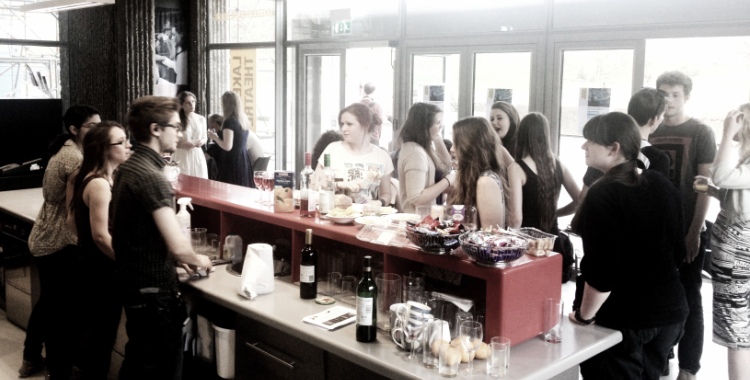
Colchester 24.4.13 Theatre Arts Society and Frequency Theatre ViTW Reception 2 (2)

Originally written for The Stage.

The post-show discussion does not have the best of reputations. What should be an opportunity to share thoughts and gain artistic insights often becomes a stilted Q&A, a one-sided stream of anecdotes, or an unspoken contest to see who can ask the most intelligent question. But what about a post-show discussion for people who hate post-show discussions?

One of those people – by her own admission – is Lily Einhorn, project manager of the Young Vic’s Two Boroughs community engagement scheme. The project offers free tickets to residents of the boroughs of Lambeth and Southwark, many of whom Einhorn noticed were attending the theatre on their own. Recognising the lack of opportunity these theatregoers might have to discuss the work they were seeing, and acknowledging that the usual post-show format might alienate or intimidate them, Einhorn set about creating an alternative.

The Two Boroughs Theatre Club is modelled on the book club format: rather than being plunged straight into discussion immediately following a show, recipients of Two Boroughs free tickets are invited back after they have all had a chance to watch and reflect on a production. And just as a book club would never dream of inviting the author, Einhorn is firm that no members of the artistic team should be present for the discussion facilitated by the Theatre Club.

“I thought it would be really nice to have a group where the creative team are strictly not allowed,” Einhorn explains, “because I wanted it to be a comfortable atmosphere where people felt like they could say anything they wanted without fear of offending anyone, but also without fear of feeling like they’re stupid.” She continues, “it’s about unlocking something in them and saying: ‘your opinions are as valid as anyone else’s opinions’”.

Einhorn’s brainchild has been run in partnership with Guardian writer and Dialogue co-creator Maddy Costa, who has similar reservations about the traditional post-show format. “We all kind of hate the post-show discussion where everyone’s trying to ask the most interesting question,” she says. “So Lily and I both agreed that we don’t even go to those things; what we wanted to create was something different.” Their Theatre Club is designed to be as welcoming as possible, doing away with the hierarchies that usually characterise post-show events and creating a space that allows for relaxed, open discussion. The response has been enthusiastic, prompting Costa to try it out at other theatres, both through Dialogue and in association with theatre producers Fuel.

Einhorn and Costa are not the only ones seeking alternative models to the post-show Q&A. Camden People’s Theatre, for instance, has created a format it calls Talk Show Club, in which discussion is led by another theatre-maker who has not been involved with the show in question. China Plate, meanwhile, has adapted the post-show events surrounding its latest tour of Mess to suit the specific needs of both production and audience. Caroline Horton’s show is based on her own experiences of anorexia, opening up numerous issues around eating disorders. In recognition of this, China Plate are currently touring the show in association with the charity BEAT, taking it into schools and colleges as well as theatres and running a tailored series of discussions and workshops designed with psychiatrists from Kings College Hospital.

While numerous practitioners are currently experimenting with different formats, the idea of a model that eschews the post-show set-up of questions and answers is not entirely new. The National Theatre’s Platforms programme, which has been running almost as long as the theatre itself, is decidedly not post-show. Instead, the building runs regular events in the slot before its evening shows, ranging from straightforward discussions about the productions in the current repertoire to conversations that address the programme more obliquely. In the past, for example, Platforms have hosted numerous comedians and politicians, as well as a memorable encounter between atheist writer Philip Pullman and the Archbishop of Canterbury.

“It isn’t about being immediately reactive, audience wise, to what you’ve just seen,” says Platforms programmer Angus MacKechnie. “It’s either about making a choice to learn more about what you have seen on a previous occasion or coming to prepare yourself in advance of seeing it, usually on that night.” As a result, MacKechnie suggests that “it’s a different kind of commitment from audiences and we get a different kind of relationship with the audiences”. Because of the absence of an educational focus, MacKechnie explains that these events also offer audience members the opportunity to ask questions that they might not normally voice.

The desire to make critical conversations around theatre more inclusive and accessible is a feature that many of these initiatives share. The Theatre Club discussions might be guided by Costa, but the principle is that everyone in the room is equal and free to share their thoughts. “I am not the person with all the answers,” Costa makes clear, “I go in with as many questions as anyone else.” In line with this approach, Fuel’s co-directors Kate McGrath and Louise Blackwell make it clear that the Theatre Club events represent “one of the key ways that we are building new audiences and making our work more accessible”. Lorna Rees, one of Fuel’s local engagement specialists and a regular organiser of post-show events, puts her attitude simply: “for me there are no ‘silly questions’”.

Crucially, all of these events are about contact and conversation. MacKechnie insists that at the National Theatre “we don’t just drop the curtain and that’s it, you haven’t got any more contact with us”, while for Einhorn the Two Boroughs Theatre Club is about “prolonging and enriching” the theatregoing experiences of its participants. The conversation itself, meanwhile, is one in which exclusive, specialist vocabulary is exchanged for straightforward, honest expression. For Costa, it all comes down to a simple but vital distinction: “Theatre Club is a place where we don’t ‘speak’ theatre, we talk about theatre, and those are two very, very different things”.

Conversation Starters

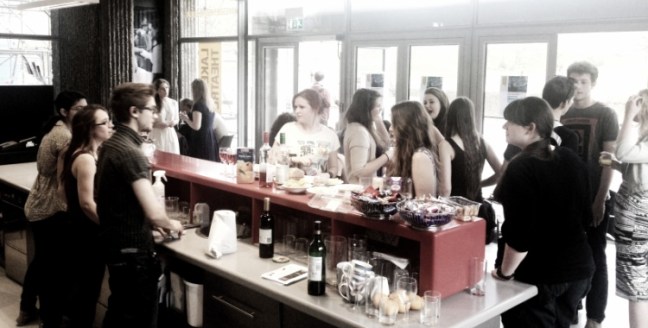
  • Maddy Costa and Fuel have found that offering refreshments instantly shifts the mood of a post-show event, transforming it into a welcoming social context. As Kate McGrath and Louise Blackwell put it, “you don’t have to spend a lot on hospitality, but you do have to be hospitable”.
  • It can also help to move the discussion out of the theatre space. While the National Theatre’s Platforms have successfully used the stage, Lorna Rees suggests that sometimes the auditorium “can be quite intimidating and not conducive to discussion”.
  • Involving the audience does not have to be difficult or complicated. Costa explains, “I always start by just getting a quick show of hands, did you like it, did you not like it, something very simple like that”.
  • Angus MacKechnie recommends experimenting with the format and fitting it to the context of discussion. “In terms of format, form should follow function,” he says.
  • Fuel point out that it must be clear where and how the event is taking place, so they recommend sending out invitations, putting up flyers and making sure box office staff are fully briefed.

Photo: The Lakeside Theatre, Colchester.