Glasshouse, Battersea Arts Centre

web_GLASSHOUSE_176_view

Ever been to one of those dinner parties where it feels like people just keep saying the same thing? At The Honest Crowd’s surreal culinary experience, they actually do. Here, the dinner guests are bludgeoned with small talk and the anecdotes are set to repeat. It’s like being stuck inside a DVD, relentlessly rewinding, fast-forwarding, pausing and skipping.

Glasshouse starts ordinarily enough. After being led into one of BAC’s many small side rooms, we seat overselves at a series of tables arranged in a square, facing one another across the gap in the centre. Our places are laid with plates, serviettes, glasses of wine. Five performers are seated in our midst, while a waitress lingers at the edge of the room. And then the conversation starts, following a plausibly familiar path as the guests discuss wine, films, quirky stories on the news. In fact, everything is pointedly normal; even the acting style is understated, while the audience’s gradual sips of wine lull us into the rhythm of a recognisable social situation. We know what’s going on here – we can do this.

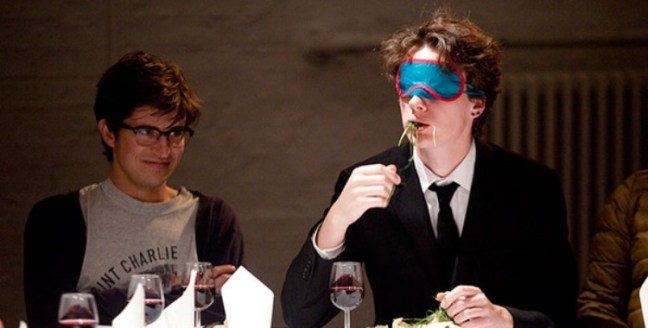
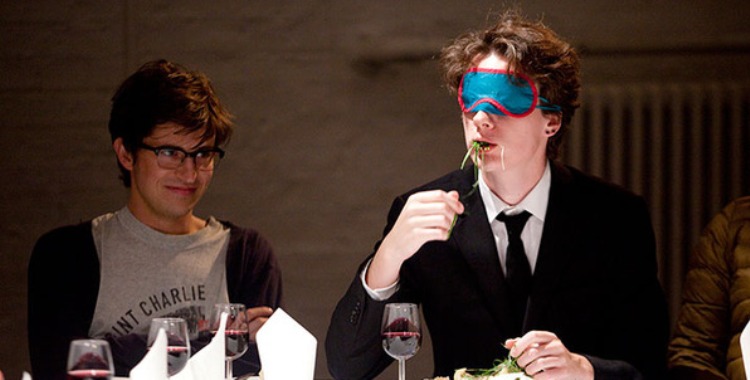
Of course, as most of us probably anticipate even as we enjoy our wine, there’s a lot more to Glasshouse than social ritual. Suddenly, the conversation is rudely truncated and reset. We hear the same questions, the same answers, the same laughs at exactly the same moments. From this moment onwards, the same snippet of prosaic conversation is played out again and again in seemingly endless, grating variations, as the circling waitress pours wine into overflowing glasses and adds more and more ridiculous items to the guests’ plates – lemons, grass, chili peppers, sponges. The dialogue jumps and intercuts, skittering like a broken record, while the performers’ table manners become more and more repulsive. Grass is flung across the table and saliva oozes down chins.

Throughout this surreal spectacle, every last giggle, gasp and grimace of our fellow audience members is deliberately visible across the room. Although the level of audience involvement could be more carefully thought through (our role in this space and in the bizarre universe of the characters is not entirely clear, while I could feel irritation radiating from the actor next to me when I dared to ask him to pass the butter), our arrangement within the space is cannily calculated for maximum impact. Just as the increasingly animalistic habits of the actors reveal something uglier beneath the gloss of small talk, perhaps our reactions reveal something about us as they catch us off guard.

The piece’s implicit nods to absurdism and its borrowed elements of live art – putting the performers through genuine physical ordeals before our eyes – might be more obvious reference points, but what I find myself reminded of is Cheek by Jowl’s recent production of Ubu Roi. Framing the crude extremes of Alfred Jarry’s text within a teenage boy’s frustrated fantasy, the company used this disruptive narrative as a sort of theatrical grenade thrown into the centre of a pristine dinner party, which carried on blithely amid the accumulating mess of the production. The Honest Crowd show the same stubborn, illogical attachment to social norms while everything else unravels around them, simultaneously upturning the very conventions they cling to.

At the same time as it decimates its social setting, however, Glasshouse is in danger of pulverising its point – if, indeed, it seeks to make one. Perhaps the point, if there is any, is the sheer, ridiculous futility of these social routines, exposing the emptiness of the words we eat up as hungrily as the gourmet cuisine. Like Ubu’s oblivious guests, we sip wine and trade anecdotes while the world crashes down around us. This implicit comment on vacuous middle class dinner party culture might not be new, but the mess and vigour of its delivery makes it difficult to forget in a hurry.

Photo: Ludo Des Cognets.

Thinking Outside of the Building

WYP-600x400

Originally written for The Stage.

At Vicky Featherstone’s first Royal Court press briefing, there was an intriguing statement of intent about the theatre’s direction. As well as reaffirming the theatre’s commitment to writers, handing over the keys of the building for a summer season led by the playwrights, Featherstone made a comment with potentially far-reaching implications for the future role of the Royal Court. She said, with a playful grin, “no space should be safe from theatre”.

As the new artistic director went on to explain, she’s interested in utilising different spaces within the building, in taking shows outside the Royal Court’s home in Sloane Square, and in bringing new audiences through its doors. It’s perhaps not surprising that Featherstone, who has led the nomadic National Theatre of Scotland for the last eight years, should want to look beyond the restrictive and arguably exclusive boundaries of the Royal Court’s four walls. What’s more striking is that she’s not alone.

While “audience development” has long been a key part of theatres’ PR arsenal, this can often be just so much empty rhetoric. Now, however, there seems to be a genuine commitment to opening up theatre spaces, venturing beyond bricks and mortar and establishing theatres as a vital part of their surrounding communities. It’s a development that’s sorely needed and one that might, if successful, ensure a future life for theatres within an arts funding landscape that is looking increasingly precarious.

At last year’s Theatres Trust conference on delivering sustainable theatres, Griff Rhys Jones championed the theatre as a place of public assembly in modern day communities, taking on the civic role once occupied by the town hall or community centre. While a vision of the theatre as the beating heart of the community is perhaps a little utopian, there are ways that buildings can connect with local residents through more than just their artistic programme. Just look at Battersea Arts Centre, where experimental performance jostles alongside yoga classes and tea dances. Artistic director David Jubb is keen to retain this diverse make-up of functions, hoping to achieve an overlap between the venue’s two distinct strands of activity, while ongoing improvement works will make the building structurally more open.

Beyond London, this gesture of opening out is even more essential, particularly as other public spaces are threatened. Rhys Jones has pointed to the example of Derry Playhouse, which is open to local people throughout the day, functioning almost like a community centre. There are other similar if not quite so far-reaching examples. Chapter Arts Centre in Cardiff has worked hard to create a welcoming environment that encourages people to drop in, while one of the key pledges made by West Yorkshire Playhouse’s new artistic director James Brining is to open up the building and explore the way the theatre relates to its communities. One of the few things theatres do have is space, much of which lies dormant when not being used for performance. Why not fill it?

As well as inviting audiences in, establishing theatres as buzzing hubs of the community, venues might look outwards. As buildings hold less prestige than they once did, there is the opportunity for theatres to redefine their identity beyond their own walls. West Yorkshire Playhouse has effectively demonstrated this approach with the city-facing programming of this year’s Transform Festival, including a piece of performance made with local residents and performed outside the theatre. The challenge, of course, is to expand this beyond the fleeting festival context.

But does all this shift the focus away from the art itself? There are clearly potential pitfalls for such an approach – particularly if treated as a careless add-on to tick funding boxes – but the community benefits need not be at the expense of the theatre. At their best, each can positively impact upon the other. Fresh influences enter the building, disrupting and invigorating a process of theatremaking that might otherwise become stultified, while new potential audience members are given the opportunity to encounter the work and be surprised.

None of this is to say that theatres should abandon their core activities; rather, as ever, they need to adapt. Buildings have always been one step behind the performances and audiences they host, running to keep up. Think of the exponential growth in site-specific work over recent years, to the point where the National Theatre is now selling tickets for Shunt and Punchdrunk shows taking place miles away from the South Bank. The need from local communities and potential audiences is there, the only question is whether theatres will step in to fill the gap.

In her recent keynote speech addressing the thorny issue of arts funding, culture minister Maria Miller firmly stated that the arts need to make the case for their ongoing importance in economic rather than artistic terms. It’s a statement that has prompted an understandable backlash, pinpointing many of the dangers and inadequacies of measuring the arts’ value in purely monetary terms. But perhaps theatres’ greatest argument for their survival is the role they might play within their local areas – artistically, economically, and as a central component of the community.

Photo: Richard Davenport

Mess, Battersea Arts Centre

DSC_9159_view

Mess, despite its title, isn’t really that messy. And yet, at the same time, it’s extremely messy indeed. I should explain. The delicate subject matter that Caroline Horton’s show bravely and urgently tackles, that of eating disorders and more specifically anorexia nervosa (an illness that Horton has personal experience of), is about as messy as it gets. It’s a topic that’s still something of a taboo and that, even if we know we should be talking about it, has the tendency to make everyone in the room feel distinctly uncomfortable. To overcome this, Horton has created a form that speaks directly to the experience of suffering with anorexia, which is much more about control than it is about food. She has, in the meticulous style of the perfectionist, tidied it up.

This framing is both inspired and problematic. Before explaining why, I might as well admit right now that I came into Mess with a fair amount of critical baggage, which has doubtless influenced my perception of the show. I didn’t see it in Edinburgh, which I greatly regretted at the time, but I was a curious witness to the lively debate that surrounded the piece and its treatment of its subject matter. Several people raised concerns about the whimsy employed by Horton and the company in handling this issue, while Lyn Gardner suggested that responses to the show were sharply divided along gender lines, with men loving it and women expressing reservations. Picking up on this discussion, Matt Trueman brilliantly compared Mess with Cristian Ceresoli and Silvia Gallerano’s The Shit/La Merda – the most stunning show of the whole festival in my book, if in a so-searingly-intense-it-almost-scrapes-your-skin-off kind of way. No whimsy there.

Unlike the literal and figurative nakedness of The Shit, Mess bares only so much, covering the rest with flowers and fairy lights. Horton assumes the persona of Josephine, who together with her friend Boris (Hannah Boyde) and keyboard player Sistahl (Seiriol Davies) is creating a show about anorexia which, by its own admission, aims to “tackle issues and conquer stigma”. This isn’t the “proper” show though, Josephine is keen to emphasise – that will have a bigger stage and a revolve and a full orchestra. Instead, for now, we have to use our imaginations. Therefore a mound covered in thick pile bathmat becomes an “installation” representing anorexia; a light switched on downstage substitutes for a fridge, in which Josephine stores the single apple she struggles to eat for breakfast.

The story that Josephine and Boris tell us, with madcap sound effects and interruptions from Sistahl, is that of Josephine’s struggle with anorexia, her attempts to recover, and the anxious, awkward, but faithful support of Boris. Through gentle, endearing and often very funny touches, common concerns and misconceptions about anorexia are lightly addressed. As Josephine sternly tells us, “it is certainly not about silly girls being vain”. Instead, this is a disease that is inextricably linked with anxiety and control. Faced with the nerve-rattling challenges of life, brittle perfectionist Josephine’s coping mechanism involves colour-coding and spreadsheets, a regimented approach to life that gradually bleeds into her diet. She just wants to keep everything under her control. She just wants to win.

This irresistible desire for control is wittily reflected in the staging, over which Josephine repeatedly asserts her stubborn will. Sistahl is chided for his mischievous interventions, while we are unequivocally told – to Boris’s visible dismay – that this play will have no real beginning and no real end. The overflowing structure is poignantly fitting; it’s hard to determine when an eating disorder starts, and it never quite releases its grip on one’s life. Meanwhile, the precisely arranged prettiness of the production, which has faced criticism from some for its candyfloss lightness, is just another trait of the perfectionist. It’s like the grimace of a smile Horton pastes over Josephine’s fragile, wide-eyed face; a desperate assertion of “I’m OK”.

But for all its elegance and intelligence, Mess‘s perfect marriage of form and content begs a few questions. While the show gradually peels away the layers of Josephine’s illness, revealing the vulnerability beneath, one layer remains; there’s always a light coating of sugar. This reluctance to bare all is understandable, as is Horton’s decision to address a very personal subject through a fictional device, and given the anorexic’s need for control it feels apt that a remnant of the mask remains. Yet still there is the concern that this final shred of theatrical clothing obscures something, drawing attention instead to its own cleverness.

Similarly, the pleasing contrivance of the meta-theatrical structure might gorgeously echo Josephine’s compulsion for organisation – “it would have looked like an accident, but actually it would all be beautifully planned,” she smiles – but it also makes me wonder whether it’s perhaps a little too contrived. While apologising for the makeshift costumes and the lack of a revolve, Josephine assures us that “the real version will be even more real”, archly skewering the hierarchy of reality that is paradoxically imposed on a genre steeped in artifice. Does pointing to this contrivance dilute the truths that the show so vitally exposes within its fictional frame? Or is it in fact just an honest reproach to our self-deceiving fetish for “authenticity”? I can’t quite decide.

Whatever my reservations, though, fears that Horton’s sugary-sweet approach might trivialise its subject matter turn out to be unfounded. Instead, she gently opens it up for discussion. Acutely aware of the difficulties that attend conversations about anorexia, the piece is at pains to set audience members at ease, jokingly acknowledging the discomfort it might provoke. By taking on all the awkwardness, mainly through Boris’s blinking unease in attempting to cope with the situation in which he finds himself, it removes any pressure on those watching. With this possible tension diffused, we can just watch.

At the same time, this tactic does not prevent the show from broaching the darker aspects of its subject. The delicately handled sequence in which Josephine toys with paper-thin slices of apple, unable to put even one in her mouth, is heartbreaking, as is the extended monologue in which she observes another anorexic girl, hating her for the skeletal angularity of her starved body. In the most fearless of the play’s scenes, Josephine even admits that anorexia “feels amazing at times”, rhapsodising about the illness with a distorted logic that is both terrifying and captivating.

The most effective and lasting image of anorexia that emerges from Mess, however, is of its imposition of distance. Josephine describes suffering from the illness as being like snorkelling, or looking down from the top of a tall building; the world is muffled, far away. Anorexia serves, like the white duvet Josephine protectively clings to, as a buffer against the challenges of life. Perhaps it’s only appropriate, then, that the show itself always keeps us just that little bit distanced.

Orpheus, Battersea Arts Centre

DSCF3847-600x497

Little Bulb’s latest show, opening a season that will go on to celebrate the theatre’s prized Scratch format, is Battersea Arts Centre through and through. A product of Scratch itself, Orpheus was conceived following an approach from the theatre asking the company to create a piece in response to the building; a beautiful, sprawling, shabbily grand space, with as much rickety charm as Little Bulb themselves. Sharply propelling themselves from the small, delicately observed pieces they’ve crafted in the past, the company have chosen for inspiration not just the imposing Grand Hall, but also its vast organ, partially restored in time for this production. Rather than treating the room as a challenge, an obstacle to navigate, it embraces it.

Alongside the stunning space in which it is staged, the other key inspiration at the heart of this madly ambitious gypsy jazz opera is the music. The fusing of the Orpheus myth with the music of Django Reinhardt, while working extraordinarily well, gives the impression of resulting from the company’s giddy love of these songs rather than from any natural link between the two. Music has always been at the heart of Little Bulb’s work, and here they stage a passionate love song to the art form. The concept at the centre of this musical celebration is a story within a story: the tale of Orpheus’ descent into the underworld to reclaim his lover Eurydice mounted as a lavish entertainment in a 1930s Parisian music hall, with Reinhardt in the title role of the tragic poet.

Little Bulb’s multi-talented – and in many cases multi-instrument playing – performers find plenty to play with in this set-up. For all the epic, operatic glamour, the company still hold tight to elements of their homemade aesthetic, at their best when cheekily undermining their own creations and poking fun at the genres they simultaneously invoke. In a style that seems somehow spontaneous and precise all at once, the company use the meticulously observed conventions of the silent movie to wordlessly convey the narrative, engaging with and occasionally subverting the gestural and musical basics of how we share stories. There are sequences that threaten to become over-long and self-indulgent, but these are always rescued by a timely interjection of sheer charm – an archly clowning expression, a piece of dazzling invention, a gorgeously silly item of costume.

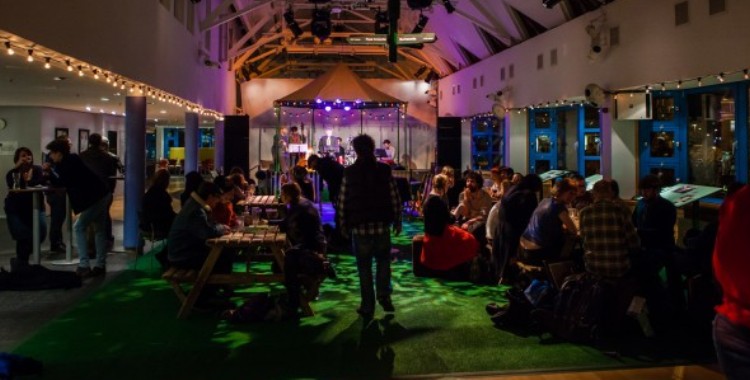
Extending this playful care and precision, the beautiful space of the Grand Hall and its adjoining bar space are used just as thoughtfully as the content. Cabaret tables cluster around the stage and spill over into the room next door, wrapping audience members in another era as Eugenie Pastor’s glorious, wine-swigging hostess weaves between chairs. The whole evening is crafted as an end-to-end experience, a joyous tumble head-first into the world of the jazz club and the music hall. I for one would happily install wine and cheese as a regular feature of the interval, even if there is something a tad cynical about bringing the bar right into the performance space (well, if Shunt can do it …)

The downside of thinking so big, however, is that it has stripped away some of the miniaturist ingenuity of the company’s smaller work. The ramshackle charm of shows like Operation Greenfield has been sacrificed in favour of something slicker but at times less compelling. The emotion, too, suffers slightly on this larger scale. If Operation Greenfield unabashedly wore its heart on its sleeve, Orpheus wears its bright red, centre stage and decked in fairy lights. This is a story about love, and God forbid we should forget it.

But as ever with Little Bulb, objections begin to feel churlish and after a time resistance is futile. Amidst the epic ambition, there are still some gorgeous little gems: in one hilarious scene the performers don cardboard noses and hooves, instantly transforming into a mad menagerie of gambolling animals; in another, a merry-go-round of appearances and disappearances conjures a vivid picture-book of Paris, sending up its clichés as it goes. And the music, honed through night after night performing together as a jazz band, holds the piece and its audience together, all singing to the same infectious tune. Once Little Bulb’s playing has you in its toe-tapping grasp, it’s increasingly hard to break free.

Red, Like Our Room Used to Feel, Battersea Arts Centre

web_Red-Like-Our-Room-Used-To-Feel_jpg_442x294_crop_upscale_q85

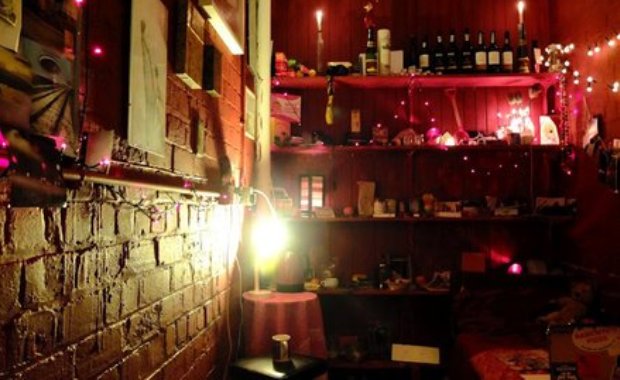
The intimate space of Ryan Van Winkle’s poetry performance, tucked away in a quiet corner of Battersea Arts Centre, is suffused with the warm glow of nostalgia. Photographs and souvenirs stud the walls and jostle on every surface, while a battered leather suitcase lies open on the floor, spilling keepsakes, and an old cassette player sits nestled at the back of a shelf. The taste of the past lies thick in the air, mingled with the faint aroma of woodsmoke from the fireplace. Memories breathe in the walls.

This is poetry given physical edges, an environment that seems to both birth and be born from the words. Van Winkle’s gentle, evocative piece is essentially a simple one-on-one poetry reading, yet to restrict it to that label feels inaccurate and dismissive. It begins unassumingly, as Ryan (it feels odd, given the intimacy, to keep referring to him by his last name) comes to greet me down in the BAC lobby, where I’m already settling into a state of mild bliss in my candy-striped armchair, grinning stupidly at the warmth and the hum of excited voices and the gorgeous neon sign left over from Tim Etchells’ last show. Ryan, a tad jittery with nervous energy, is attentively anxious to get my name right before he reels off a detailed description of how the show is going to work.

To condense and paraphrase Ryan’s charmingly precise account of the experience he has crafted, the sole audience member is led into the space (a cosy red bedroom draped in fairy lights and crammed with knick knacks), offered a cup of tea or a drop of port, and asked to pick one of four envelopes while Ryan switches on a CD soundtrack. In each of the envelopes is a selection of poems; Ryan then pulls a chair close and reads the poems from the chosen envelope, before quietly leaving to allow his guest to listen to the remainder of the CD and explore the room. The whole thing lasts a devastatingly brief, fleeting twenty minutes.

Oddly, given the state of heady captivation in which the performance held me, little of the content of Ryan’s poems stayed with me after leaving the room. Only torn-off scraps remain: geography, books, waves and sandcastles, love and loss. This is poetry made fluttering and ephemeral, rapidly dissipating into the warm air and attaching itself to objects and thoughts. Much of this is achieved by the gentle presence of Ryan himself, whose voice lulls and cradles, sending the mind on journeys.

Emerging from the gorgeous cocoon of the performance, I immediately wished that I had found the time during the feverish rush of Edinburgh to take a reviving step into Ryan’s room at Summerhall. In a ever faster spinning world, this space exhilaratingly offers us what we so frequently deny ourselves: the opportunity to stop, sit, absorb and dream. I was also struck by how the piece somehow manages to be both intensely personal and overwhelmingly generous. It as though, by indulging in this space of imagination and memory, Ryan offers us the room – in more than one way – to traverse our own imaginings and reminiscences.

When left alone, one object of the vast number collected around the room snatched particularly at my gaze: a postcard, emblazoned with the words “Nothing is not giving messages”. It is a statement that immediately invites multiple readings; it could mean that everything involuntarily emits messages, or that the definition of nothingness is the absence of messages, or even perhaps both. For me, it sits like a subtitle beneath the work, in which poetry and meaning live in more than just words, and which in its cluttered, soothing warmth seems firmly pitched against a void that is stripped of meaning, memories and messages.

One-on-one performances of Red, Like Our Room Used to Feel  are running at BAC between 18th-22nd December.