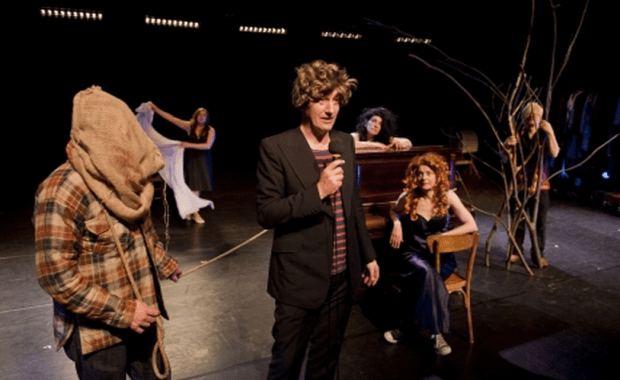
Before I begin (and, incidentally, I hope you’re sitting comfortably) I feel compelled to admit that Friday evening wasn’t the first time I’d seen Forced Entertainment’s latest show The Coming Storm. I first experienced this clowning dissection of the art of narrative some months ago as part of LIFT, and have since read a number of other responses to the show and discussed it with a number of different people. In critical terms, if we’re going to play along with the fallacy of “pureness” and “objectivity”, my reception of this performance was tainted. Yet it feels oddly appropriate, for a piece that plays with the stories we project onto others as much as the ones we hear and tell, that I already brought my own narrative around the show into the room.
The observant among you will also notice that this piece of writing, according to its title, is not just responding to The Coming Storm. I saw it at Battersea Arts Centre alongside Tim Etchells’ new show Sight is the Sense that Dying People Tend to Lose First, a virtuosic symphony of free-association performed by Jim Fletcher. I could have written about these two pieces separately, which might in many ways have made sense, as they do not initially appear to have a great deal in common other than Etchells. But the way in which the pieces were placed in relation to one another, and my experience of them in quick succession, creates a certain response that it feels worth acknowledging. I am, to look at it one way, framing the story.
So, to the beginning. As Terry O’Connor tells us, deadpan into the microphone with the other performers assembled in a line alongside her, “a good story needs a good beginning”. Forced Entertainment’s point of departure is a list, continuing almost to oblivion, of all the elements that make up a successful story: narrative drive, cliffhangers, a love triangle, a death. Immediately, fragments of narrative begin to attach themselves to the performers, who through minuscule gestures take on the role of signifiers. Performers might be implicitly cast as lovers or as enemies. It’s calculated, but pointedly not pointed; the movements of the performers, though suggestive, place the act of projection firmly with the audience. We are the ones who ultimately make the connections.
And this is much how the show continues. Just as it seems Terry’s toneless litany of narrative building blocks might dry up, the microphone is snatched from her, initiating a chain of preposterous, failed or interrupted stories from the rest of the performers. Tales rarely finish – some barely begin. While attempted narratives are breathed into the microphone, the other performers concentrate their energies into chaotic distractions, donning dodgy wigs and masks and underscoring the stories with drumbeats and piano music. Dissonant elements clash and collide. But throughout the pandemonium, the same floating signifiers emerge and dissipate, inviting spectators to make connections that are not there.
Just as each of the individual narratives subverts or fails to fulfil Terry’s initial requirements for a good story, the overall structure of the piece breaks its own lengthily established rules. It meanders, stumbles, defies narrative logic. The cleverness lies in the fact that the show’s very failure (or staging of its own failure, though it doesn’t feel quite that neat) is an affirmation of the need it identifies. If our attention wanders or becomes frustrated, it’s because we’re seeking that narrative to latch onto, a narrative that Forced Entertainment smash apart at the same time as they erase their own creation. The repeated cycle of creation and destruction goes on until the whole collapses in on itself, dropping to its knees, wheezing and exhausted, with a closing note of “melancholy optimism”.
In the midst of this destructive anarchy, the stories themselves can seem irrelevant, random. Their substance is perhaps less important than their form and their (failed) techniques. They borrow from and break convention upon convention, from Hollywood movie (Cathy Naden periodically intervenes in stories to demand which actor would play a particular character) to cabaret confessional, each with an inherent criticism of the flawed ways in which we choose to communicate and share.
Yet their content is not entirely superfluous, at least not to my stubbornly association-drawing mind. There’s something that threads through – or does it? – about aging, about death, about grief and loss. There are also subtle hints at the company’s own history and at the ever-so-lightly hinted idea that (whisper it) they might be getting too old for this. At the evening’s wearied close, the performers seem fed up with what they have created and dissembled, deeply fatigued by their own frenzied effort.
This fatigue extends to the music, which interjects, builds, reaches a crescendo and finally collapses. Introduced as just another distraction, much like the wigs and masks and costumes that are lined up on rails in a nod to the childhood game of dressing up, the music eventually emerges as an integral element that both mirrors and resists the piece’s overall shape. Rhythms are repeated and frustrated; the steady mounting of sound is truncated by a crashing halt. Storms build with the beat of a snare drum and dissolve into monotonous lulls. Even as the chaotic performance limps to a close, Cathy and Claire stand with their backs to the audience tapping out a series of final notes on the piano, notes that are sad yet optimistic.
The “melancholy optimism” with which The Coming Storm concludes seems to bleed into Sight is the Sense – though of course, as already acknowledged, this connection is heavily influenced by seeing the two shows one after the other. Sight is the Sense also feels haunted by the ghost of Gatsby, with whom Jim Fletcher is inevitably associated after the eight-hour theatrical phenomenon of Gatz, and who carries a kind of melancholic weight into the room. The piece itself, however, initially appears to be oddly light and insubstantial. Fletcher stands, scruffy and unassuming, in the bare Council Chamber, reciting a list of statements about the world. And that, in essence, is it.
These statements range from the technical to the banal, the hackneyed to the strangely profound. We’re told that “space is dark emptiness”, “love is a kind of hypnosis”, “laughter is contagious”, “capitalism will probably not last forever”. The associations tumble one after the other, occasionally snagging on their way down. It is time capsule made into text, a collection of proverb, cliche and quotation that feels saturated with the accumulated stuff of modern culture. And just like a time capsule, into which carefully selected objects are dropped, it is necessarily limited. There’s only so much room.
This is deliberately, teasingly slippery theatre. The gathering statements, though simple, are also surprisingly elusive, while neither Fletcher’s oddly mesmerising performance nor the stripped down staging give an audience much to grasp onto. In a sly, knowing move, Fletcher proceeds to tell us that “theatre is mainly pretending” and that “the job of an actor is to simulate thoughts and feelings they do not really have”, remaining all the while blandly expressionless.
This very lack of expression allows Fletcher to become a blank canvas, a generator of words onto whom we project. Meaning is continually displaced, as the lightest wry, world-weary note in Fletcher’s voice is contradicted by the naivety or optimism of his words, which might the next moment become charged with implicit cynicism or sorrow. If this is to be read as a world view, it is a contradictory, undecided one. Which, it might be argued, is the only world view that one can reasonably have in the world as it is.
This confusion and complexity is heightened by the need throughout for objects and concepts to be measured against one another in the attempt to grasp definitions. “Wickedness is the name that people once gave to evil”, or “a mirror is a defective window”. Much like in the frenzied, competitive description of the board game Articulate, lines are hastily drawn between similar or differing ideas, reinforcing Saussure’s assertion that everything in language is based on relations. We are caught in a web of constant references.
But the real beauty of the free-association form that Etchells has appropriated – a sort of distilled stream of consciousness – is that it frees our minds to float between their own associations. My initial use of the word “light” is accurate in a sense, in that the piece brings a certain intoxicating weightlessness to the room. It is in this enabling and unveiling of our own connection-making tendencies that Sight is the Sense finds its affinity with The Coming Storm, freeing our minds to roam while at the same time activating our awareness of these mental processes.
Both pieces also produce a sort of breathlessness – the first weary, the second spellbound. As a pairing, they are unexpectedly complementary in their juxtaposed tone; the crazed energy of The Coming Storm assaults the senses, while Sight is the Sense offers a reviving, hypnotic air of calm. Picking up on my own imprecise, carelessly deployed critical vocabulary, for once the frequently used word “piece” seems entirely apt. Each is a fragment composed of many smaller fragments. Like a story, itself made up of narrative jigsaw pieces, that slots into a wider cultural frame.



 Catherine Love