Born to Run, Traverse Theatre

Originally written for Exeunt.

Fresh out of the patriotism-drenched self-congratulation of the Olympics, it’s not as if we are in need of further excuses to hear Vangelis’ iconic, now numbingly ubiquitous theme to Chariots of Fire. Gary McNair’s play, however, casts a new and markedly less heroic gloss on the activity of running. Born from the idea that even the most exercise-shy of us are running either away from or towards something, this piece projects running as both symptom and cure, a way to escape and a way to get to where you want to be.

For McNair’s protagonist Jane, running is her salvation. Diagnosed with epilepsy and struggling to cope, she discovers that going for a jog can stall her seizures, leading her to plant trainers around her house, in the office, tucked away in her handbag – at any moment, she can run away. Framed within the context of a mammoth 110 mile ultra-marathon across the North American desert, the piece opens a window into Jane’s mind as she steadily eats up the miles while desperately reaching for a decision that eludes her.

In an impressive display of stamina, Shauna Macdonald performs the entire show on a treadmill, pounding the act of running further into her identity with every step. Running is not just something Jane enjoys, it is a part of who she is – “it’s what I do” – replacing her crippling condition as a vital fragment of her identity.

What McNair has created is essentially a psychological study of his protagonist, drawing both on the scientifically and anecdotally proven power of running to clear the mind and on ideas of mental refuge and escape. As Jane repeats, “it’s amazing what you can do if you don’t put your mind to it”, a throwaway assessment of human thought processes which could be given further examination.

Giving rein to Jane’s thoughts and memories, McNair’s staging is fittingly simple, leaving the space around Macdonald empty save the treadmill she is running on. The only intrusions into this space are slickly executed projections which fire out questions and scroll through internet pages, visualising the ultra-connected anxiety that plagues the modern consciousness in a world in which every illness can purportedly be diagnosed through Google. Alone with her thoughts, Jane’s sole interaction is with her running app, a poisonously smug electronic voice that counts down the miles.

While Macdonald is an engaging and fiery performer, the piece as a whole is oddly unsatisfying, limping off with aching muscles and minimal lasting impact. As a personal story it is absorbing while it lasts, but in a way that is not far removed from the inspirational profiles that make convenient news programme fillers; impressive and often poignant, but easily switched off at their close. Its main power is derived from its near-universal resonance, the ability it allows for every spectator to identify with Jane’s struggle. After all, “everyone runs, don’t they?”

Monkey Bars, a Not Quite Review

“That is my world,” one of the performers in Chris Goode and Company’s new show gently tells us, candid but shy. She is talking about singing, her favourite hobby. One day, she continues, she just opened her mouth and discovered that this was something she was good at; “I had a voice”.

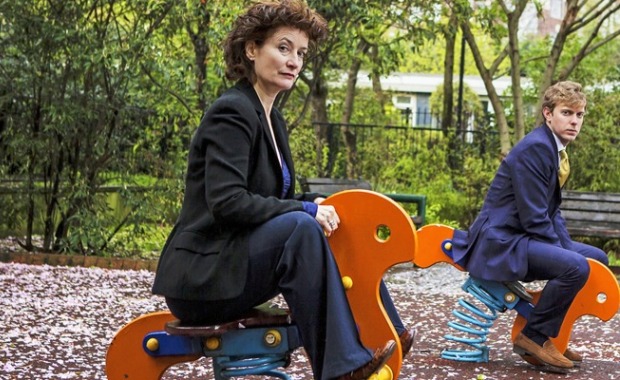
It is a poignant and strangely loaded moment in this gorgeously thoughtful slice of theatre, a gentle hour and fifteen minutes that begs us to look again at children and their view of the world. The performer in question is a middle-aged woman, dressed professionally in a crisp black suit, but her words are those of one of the 72 eight to ten year olds interviewed by Goode’s collaborator Karl James to create this delicate verbatim performance. Her one tentative admission is a reminder, like the show as a whole, that children are too often robbed of a voice, denied the opportunity to speak up.

The playing of child characters by adults is, of course, nothing new. Perhaps taking very seriously the warning never to work with children or animals, many productions feature adults who double up as kids, all too often indulging in snotty caricatures. The adults in Monkey Bars, however, are not playing children. They may be speaking the words of primary school kids, but they are demonstrably, emphatically adults. They dress as adults, they speak as adults and Goode’s production places them in conspicuously adult situations, sipping wine or getting ready for work.

Yet, for all this emphasis on adult activity, there are distinct traces of childhood about Naomi Dawson’s design. The set, with its grass-like floor, is mainly composed of large white plastic blocks that are illuminated from within, a cross between building blocks and night lights. While we usually see the performers in deliberately adult set-ups, they also occasionally sit protectively round-shouldered as they eat from lunch boxes, suddenly collapsing back into kids in the playground. The onstage props include, contrastingly, wine glasses and a bubble machine.

This mingling of the mature and the childish hints at the dizzying cocktail of these qualities in all of us, no matter how “grown-up” we may appear. It often seems as though growing up is really a process of gradually realising that we are all making it up as we go along, perpetually waiting for the moment when it all slots into place. Figured in this way, James’ young interviewees are not all that different to their adult performers or audiences.

But one significant point of difference is their lack of power to make themselves heard. As in the scenario I opened with, the frustration of not being listened to is a recurring theme and a major concern of the piece. One of the most heart-tugging monologues comes courtesy of a girl who feels “all alone in the world” when others don’t listen to her, while another child’s broken arm goes unnoticed by adults who ignore his insistence that he is in pain. The desire for superpowers becomes a motif that intermittently resurfaces, implying a fierce longing to change things without knowing how to make an impact.

Forced to listen as we are by the show that Goode has pieced together from these interviews, it is startling just how much these children have to say. While there are, unsurprisingly, some hilarious moments which verge on Children Say the Funniest Things territory, on the whole the piece reveals just how perceptive these young individuals are. Asked about their ambitions, one child wonders whether he will be a tramp or a banker, satirically remarking that they are essentially the same thing. Another two boys berate their generation in the manner of grumpy old men, tutting at girls who try to grow up too fast. Perhaps most affecting are the repeated protestations against war: “I think people should stop now – game over, you know?”

But this is more than just a vehicle for the opinions of children. As a piece of theatre, Monkey Bars is appealingly self-aware. Neatly side-stepping the issues faced by much verbatim theatre and avoiding the need for lengthy programme notes, Chris Goode and Company simply confront their process head-on. One of the first recordings we hear is that of James explaining the concept of the show to the children he is interviewing, an explanation that also conveniently clarifies the process for the audience. The actor representing James at this point adds, with a playful grin, “we’ll see if the audience finds that interesting”.

There is no doubt about whether the end result is interesting – it’s nothing short of fascinating – but as to the purposes of this piece of theatre and its success on those terms, I’m a little more tentative with my praise. Had the show zeroed in on one aspect of childhood and interrogated that individual angle using this intriguing process, it might come across as more of a complete piece, if not perhaps as meaty. Instead, by speaking to these children about such a wide range of subjects, from families to politics, Chris Goode and Company have created a view of the world that is potentially infinite and open-ended. Not that this is necessarily a bad thing – I like theatre with question marks – but it makes the piece’s process of selection and editing somewhat problematic.

This touches upon one of my issues with verbatim theatre as a form, which is something I’ve been mulling over for a while and assessing more thoroughly since seeing London Road earlier this month. It is, as a method of theatremaking, overtly “truthful”. By which I mean, because the words are purely those of the subjects, it is their truth – verbal stumbles and all – as unmediated as possible without placing them on the stage before us. It might not be a profound, universal truth, but it is truthful to the experience of those interviewees.

At the same time, however, it screams its artificiality. By being so conspicuously “real”, so hammered home with “erm”s and stammers, it simultaneously advertises the fact that these genuine, un-airbrushed words have been uprooted from their source and dumped on a stage, a transplant which implicates its process. In Monkey Bars, this process attracts even more attention to itself through the additional layer of meaning and representation created by the use of adults to speak the words of children.

So, as a result of this odd, dislocating blend of truth and artificiality, I always feel very aware of the hand of the editor. (That might also be something to do with being a writer) In this particular case, therefore, the tiny part of my brain not enraptured by the show was nagging away at me, asking what the guiding intention was behind these particular choices.

Has the material been selected in such a way as to expose how children swallow and regurgitate the opinions and values of their adult counterparts? Has the guttingly profound been favoured over the silly or mundane? Of course, this is a conversation I would need to have with Chris Goode (and one that I’d be more than happy to engage in if broached), but I couldn’t help wondering: why these stories?

Not that such doubts and questions are substantially damaging to the experience of watching the beautiful, surprisingly urgent piece of theatre that Chris Goode and Company have created. Where Monkey Bars functions perhaps most effectively is as a warning, a reminder and a bleak unveiling of the lies we have come to blindly accept with age. We can smile at childish fears and anxieties, but essentially these are smiles of complacent denial. The world is a scary place; we have simply taught ourselves not to notice.

The (not quite) End

– this is where the review proper (if it can even be considered “proper”) concludes, but there are also a few other, messier, more experimental thoughts that I felt compelled to put into words …

One of the moments in the show that most tickled me was the recording in which a girl who writes stories is asked about her writing, rendered in a scene arranged much like a television interview. It made me quietly giggle because it reminded me so much of myself as a child, always dreaming up other worlds and fiercely scribbling away, deadly serious about whatever tale I was currently spinning. Inspired by this, I found myself thinking about the child I once was, with the below result.

A letter to my younger self:

Hi there. Just me. So … this feels a bit weird. Why am I writing to you? Well, it’s a critical experiment. That probably doesn’t make much sense to you now, but it will one day. Which, I know, is one of the annoying things that adults say when they don’t feel like explaining something, but this time it’s true. Maybe I’ll explain it some time, but right now I have a couple of other things that I want to say.

I want to say that I remember that it’s hard, even though sometimes I forget and think that it used to be easy. People will tell you that it only gets harder, and that might be true, but it’s also pretty hard right now. It’s especially hard right now because people don’t always listen, but that will get better, if only by a little bit.

I also want to say that it’s good that you’ve learnt to pretend. Pretending is important. Not just because watching people pretending will one day be among your favourite things to do, but because the pretending never ends, not really. That’s the big secret. We all still feel like kids playing at being grown-up, hoping that no one will catch us out in the act of make believe.

And one day a man called Chris Goode and some of his friends will, through some pretending that isn’t quite pretending, make you realise that it’s not just you who feels that way. And it will be comforting but also a little bit heartbreaking, though you won’t be quite sure why. You’ll try writing about it anyway though, because that’s what you do.

Well … that’s all I wanted to say, really. I know that writing letters is boring and not as much fun as writing stories, but perhaps occasionally you can write back to me and remind me what it’s like to be a kid? I’d like to be reminded of that. Now you probably want to ask me what it feels like to be an adult, which seems like a fair exchange. But the answer is, I just don’t know.

Oddly, to depart on a complete tangent, writing the above reminded me vividly of Gob Squad’s Before Your Very Eyes, a piece of theatre that I think I short-changed slightly on first assessment and that has insistently stayed with me over the intervening weeks. In that show, the child performers address recordings of their younger selves, sadly, ashamedly and sometimes wistfully regarding the people that they used to be.

One of the most heartbreaking moments is one boy’s protestation that “this is not me”. In thinking back to the person I used to be, prompted by Monkey Bars to remember what it was to be a child, I was struck by how I both am and am not that wildly imaginative young person, so much like the little girl in the show who speaks earnestly about her stories. This is not a particularly original thought, but perhaps we are all a long series of different people, simultaneously embodying a number of past versions of ourselves and the person we are in the present moment. The child in us never quite goes away; it just takes an experience like Monkey Bars to be reminded of that.

The reviewed performance was at the Traverse Theatre in Edinburgh. Monkey Bars will continue to tour around the country throughout the autumn – full tour dates here.

Dirty Great Love Story, Pleasance Dome

Originally written for Exeunt.

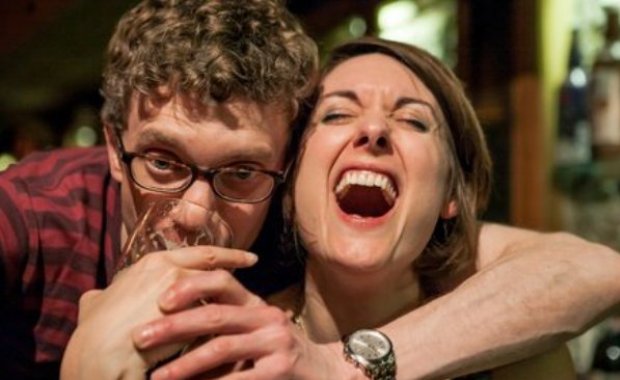
You know the one about boy meets girl, right? A drunken romantic encounter, ensuing awkwardness, years of near misses and friendship and dancing obliviously around one another. Dirty Great Love Story, the sharp new two-hander from writing and performing duo Richard Marsh and Katie Bonna, ticks all of these boxes, but with enough charm, wit and everyday poetry to transcend its predictable romcom trappings.

As the pixellated heart emblazoned on a banner at the back of the stage suggests, this is a distinctly modern vision of love. If it was a Facebook relationship status it would read “it’s complicated”. Richard is short-sighted, socially inept and afflicted with a clumsy sense of humour; Katie is just out of a messy break-up, with a “stabbed up heart” and a short dress. Their pairing on a boozy night out, shoved together by their tipsily crowing mates, is as inevitable as it is cringe-inducing.

The comedy that this seemingly clichéd set-up generates, however, has the intelligence to surprise and delight. Cruder than your average Richard Curtis film, Marsh and Bonna incorporate all the groaningly familiar embarrassments of contemporary single life, from cloakroom fumbles to untimely vomiting, all related through unlikely poetry. A sparkling fusion of drama and spoken word, the pair’s ingenious rhymes – owls and bowels, anyone? – span the ridiculous and the romantic, remaining deliciously sweet while refusing to sugar-coat the often bewildering, humiliation-ridden world of 21st-century dating.

For all that it resembles the much maligned romcom, Marsh and Bonna’s show also unveils the many lies implicit in the genre that it owes its creation to. Romance is skewered by realism; as Richard eventually tells Katie, “I love you realistically – I wouldn’t die for you”. There is a playful, teasing commentary on the familiar story arc, with one periphery character knowingly remarking that the turn of events is “just like a movie”. Wisely, Marsh and Bonna never taken themselves or the show they have created too seriously.

But the piece’s greatest charm lies in its unfashionable note of hope. Despite all the binge-drinking, apathy and casual sex that are usually held up as indictments of modern twenty- and thirty-something life, Marsh and Bonna find optimism rather than gloomy inevitability in the position of their generation. As they put it, “fucked up is just fine” and slightly ugly romance can be every bit as intoxicating as the airbrushed kind. Just as poetry can sometimes be clumsy, unconventional and a little bit dirty, so can love.

I ❤ Peterborough, Pleasance Courtyard

Originally written for Exeunt.

Love is a feeling that you can’t describe in a word, not really. That is the real reason, Joel Horwood’s quirkily beautiful new piece argues, why we draw anatomically inaccurate symbols on Valentine’s Day cards and tacky tourist T-shirts. We struggle to say it in words, so we make it into a picture.

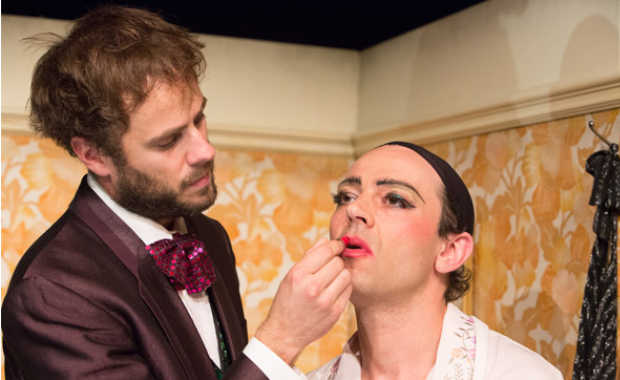
The love that Horwood’s play paints is romantic love, parental love and the strange, unconditional love mingled with hate that we often feel for the place we come from. In the unlikely surroundings of Peterborough’s cul-de-sac ridden suburbs, Michael – or, as he’d prefer us to call him, Lulu – applies his lippie and slips on his ruby red heels. He is in pursuit of love and happy endings, but that love arrives in a somewhat unexpected package when his teenage son Hew arrives at his doorstep.

As the ruby slippers hint at, for Lulu and Hew there’s no place like home. Their small, chintz-decked abode is a refuge from the jeers and stares of the town, of the eyes that would “take bites” out of them. Within this gaudy sanctuary, father and son work on a double act, escaping the world’s cruelties through the retreat of music. Jumping off from this platform, Horwood, who also directs, is able to flirt playfully with form, clashing drama with cabaret and throwing occasional meta-theatrical winks to the audience.

A keyboard sits at the back of the performance space, at which Jay Taylor’s awkwardly gentle Hew plays musical accompaniments and lends his voice to Lulu’s stories. It is these stories which form the real heart of the piece, with Milo Twomey’s warm, overtly theatrical presence as Lulu spreading across the stage. Yet beneath the brash persona there is a strain of brittle vulnerability and viciously protective violence, a violence that is reflected in Horwood’s words.

Love is often meshed with pain, with fists and bites, while recurring interruptions remind us of the people blowing each other up around the globe at the same moment the onstage events are occurring. It is a shade of darkness pasted with glitter that colours the entire piece but is not fully interrogated. Tenderness, it is perhaps suggesting, can never come without scars.

Horwood’s writing offers up phrases like candies, sweetly rolling on the tongue. He is a creative master of the simile; love feels like “driving over humpback bridges too fast”, while a girl’s face “trembles like a pond”. Grit-flecked poetry is crafted from the soulless concrete, proof that anything can be beautiful if it means enough. In this way, Peterborough slowly becomes a mirror for these two damaged inhabitants. They might be odd and occasionally ugly and difficult to love, but the possibility for love still remains.

Photo: Mike Kwasniak

New Voices in Edinburgh

As part of the giddy, hectic and slightly insane experience that was my first fringe, I was lucky enough (thanks to IdeasTap) to catch all five plays that made up the Old Vic New Voices Edinburgh season at Underbelly. This is just one example of what seems to be a growing trend towards curation within the uncurated, amorphous bubble of the festival; other models along these lines include those adopted by Escalator East to Edinburgh and Northern Stage at St Stephen’s. While the hit and miss nature of the fringe is part of its quirky charm, there is something quite comforting about having these reliable miniature programmes to retreat to through the haze of clumsy adaptations and misplaced whimsy.

The emphasis of the Old Vic New Voices programme is, unsurprisingly, very much on “new writing”. The pieces are small, with a bias towards monologues and two-handers, but the writing and productions all proved themselves to be solid and often exciting. The whole season was, as Edinburgh goes, a pretty safe bet, though without the safeness of subject matter that implies. The advantage of a curated programme was also in seeing how these different pieces refracted through one another, experiencing them both as standalone plays and as part of a wider context.

If they have a future life, which I suspect they will, it would be fascinating to see these plays reformulated into double bills. Chapel Street and One Hour Only would be my top pick for a pairing, but Bitch Boxer and Strong Arm could also make a fascinating juxtaposition. While Edinburgh can easily become a distorted blur of production after production, seeing pieces whose placement alongside one another actively informs their reception is a refreshing and intriguing exercise. Here are a few more of my thoughts on the programme …

Glory Dazed

While his friends come home in coffins and wheelchairs, Ray knows that war can make you lose something other than life or limb. Returning to Doncaster with frustrated aggression and tortured memories, the only thing that Ray is any good at these days is fighting. But there’s no memorial service or prosthetic aid for being messed up in the head. Read more …

Bitch Boxer

Every fighter has a reason.

That’s the thinking behind this new show written and performed by Charlotte Josephine, taking a particularly timely dive into the world of female boxing. Read more …

One Hour Only

AJ’s mates have bought him a banging present for his 21st birthday – quite literally.

Out of place in a classy London brothel, the gift he ends up with is Marly, a cash-strapped student in her first night on the job, with whom he has more in common than he expected. Read more …

Strong Arm

Sporting ambition and athletic excellence are high on the national consciousness as the country continues to ride the wave of Olympic success. When competitiveness goes up a weight class into pure obsession, however, that same determination to succeed becomes altogether more disturbing. Read more …

Chapel Street

On Chapel Street, “every week it’s shit”.

Same people, same bars, same drinks. Or so we’re told by Joe and Kirsty, both out on a Friday night and each with their own reasons to seek oblivion. Through these two characters, Luke Barnes’ viciously funny and quietly devastating two-hander sketches out a searing, booze-stained portrait of the Pro-Plus generation, grabbing at their next energy kick while putting off tomorrow. Read more …