Strong Arm, Underbelly

strong-arm-review_540_306_Crop

Originally written for IdeasTap.

Sporting ambition and athletic excellence are high on the national consciousness as the country continues to ride the wave of Olympic success. When competitiveness goes up a weight class into pure obsession, however, that same determination to succeed becomes altogether more disturbing.

Roland Poland has a lot to prove. Cursed with rolls of fat and a ridiculous name, he finds unexpected strength after visiting Plates, a run-down gym above a butcher’s shop where pumping iron becomes a substitute for emotional fulfilment. Eyes transfixed on the goal of becoming Mr Britain and discovering what Arnold Schwarzenegger calls “The Pump”, Roland guzzles protein shakes and doses up on science, trying every tactic possible to get stronger.

Although entitled Strong Arm, Finlay Robertson’s protein- and testosterone-fuelled play is more concerned with another appendage. Roland, played with humour and granite-eyed determination by Robertson, fantasises about having veins so popped that he resembles a giant penis. He spunks while working out and reels off the names of “hardcore” supplements that have a hint of the pornographic. In a deeply sexualised world, strength seems to be synonymous with virility, offering a deeply critical vision of what it means to prove one’s masculinity.

Much like Roland, Robertson’s writing has more to it than it initially appears. While seeming to promise to be a vaguely amusing one-man show, it teases at our expectations, even offering up the dramatically disappointing possibility of sentimental catharsis before snatching it away again. Although grounded in a recognisable world, there is just enough strangeness to the writing – the unlikely, Dahl-esque names, the vividly grotesque descriptions – to lace the piece with a sense of the surreal and sinister.

The same might be said of Kate Budgen’s direction and James Turner’s design, which each reveal themselves as increasingly clever. The performance space is backed with a set of four mirrors, as rusting and distorted as Roland’s perception of himself, through which coloured strip lights flicker like the neon of strip clubs or of the signs on which Roland dreams of seeing his name.

Because ultimately this is all about self-identity. In a society in thrall to the media, in which outcasts can become superheroes and a bodybuilder is a Hollywood hero, to demonstrate superhuman strength is to gain fame, validation and, most importantly, acceptance.

Photo: Jassy Earl

Glory Dazed, Underbelly

glory-dazed-review_540_306_Crop

Originally written for IdeasTap.

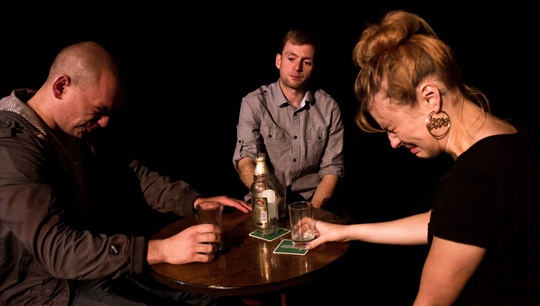
While his friends come home in coffins and wheelchairs, Ray knows that war can make you lose something other than life or limb. Returning to Doncaster with frustrated aggression and tortured memories, the only thing that Ray is any good at these days is fighting. But there’s no memorial service or prosthetic aid for being messed up in the head.

As Ray returns to the local boozer in a misguided attempt to win back ex-wife Carla, the bar becomes a vodka-doused pressure cooker in this new piece from Second Shot Productions, stitched together by writer Cat Jones with help from ex-servicemen at HMP & YOI Doncaster prison. Knocking back shots with Carla, old mate and pub landlord Simon and ditzy barmaid Leanne, the invisible wounds begin to split open and weep.

The production is knotted together by an explosive performance from Samuel Edward-Cook as “wounded lion” Ray. Dripping with sweat and radiating aggression, he is as pathetic as he is dangerous, yet still with a spark in his eyes that hints at former charm. Like Carla, we are unable to fully detach our sympathies, no matter how broken and violent he becomes.

This is not the first piece of theatre, or even the only piece of theatre in Edinburgh this year, to tackle the bitter legacy of the conflicts in Iraq and Afghanistan. Where it demonstrates nuance, however, is in its dissection of the relationship between the world of war and the domestic battlefield. As terrifying and as impossible to understand as warfare may be, Jones does not play down the struggle and drudge of everyday life, a drudge that might just be enough to make someone prefer the danger that war entails.

We are also left staring down the barrel of the bleak fact that no one really cares. The struggle goes on in the warzones and the suburban streets and all we do is sit and watch The X Factor on a Saturday night. In more than one sense, this loaded production departs with the perception that the world is indeed, in Simon’s words, a “fucking scary place”.

Photo: Jassy Earl

Dr Quimpugh’s Compendium of Peculiar Afflictions, Summerhall

26993_article

Originally written for Fest Magazine.

Treading the line somewhere between opera and musical theatre, this strange little piece by Martin Ward and Phil Porter concerns legacy and what it means to make the most of a life. Nearing the end of his days, the eponymous Dr Quimpugh worries about what he is leaving behind, prompting his two nurses to remind him of his life’s work and trigger a musical skip down memory lane.

The doctor’s speciality, it emerges, is odd and unusual ailments. As hallucinatory memories form before him in his study, the piece takes us back through a category of increasingly bizarre complaints, from one woman whose hand has a mind of its own to another determined to eat every object she can lay her hands on. Embarrassing Bodies has nothing on Dr Quimpugh’s clientele.

A musical freak show of sorts, this succession of strangeness muddles on with little purpose. Peculiar it certainly is, but even peculiarity can become dull. While Ward’s score is skilfully sung by the cast, accompanied by a trio of onstage musicians, the eccentric charm that the piece reaches for remains just out of its grasp.

Despite this, there is something intriguing and potentially moving about the piece’s central question; as Quimpugh despairingly sings, “what will they write on my grave?” the doctor doubts the worth of a career essentially fed by the misfortune of others, questioning the value of the knowledge he has accrued. It is just a shame that such questions are not more engagingly interrogated.

The Prize, Underbelly

26936_article

Originally written for Fest Magazine.

It’s not the winning, it’s the taking part that counts, right? Maybe not for the hundreds of determined Olympic hopefuls we have anxiously watched compete during London 2012. It is this passion and intense desire to succeed that is explored in this delicately constructed verbatim piece from Murmur and Live Theatre, drawing on interviews with British athletes past, present and future. For them, failing is simply not an option.

Performed by a cast of five on an almost bare stage, the power and the poignancy rightly lies with the voices of those interviewed, their experiences communicated through the actors. Murmur has spoken to a huge range of athletes, from a female diver who competed in the 1950s, when the honour really was the taking part, to athletes with ambitions for this year’s Olympics and Paralympics.

The carefully selected and assembled snatches of the resulting interviews reveal the athletes’ drive, dedication and struggles without ever tipping into the trite sentimentalism that the media around the Games has often fallen prey to. The principal emotional manipulation comes courtesy of projected text revealing whether or not those speaking qualified for the Games, a device that could be intrusive and heavy handed but is here executed with heartbreaking simplicity.

Propelled by the energy of the Games’ success and looking towards the Paralympics, The Prize resonates perfectly with current national feeling. But by being so of the moment, it is difficult to envisage much of a future life for the piece. Beautifully formed though it is, it feels—much like the sporting triumph it revolves around—fleetingly ephemeral.

Uninvited, Bedlam Theatre

26944_article

Originally written for Fest Magazine.

In the festering heart of suburbia, behind the neatly trimmed privet hedge, an intruder lurks. Or does he? This new piece by Fat Git Theatre, adapted from Peter Mortimer’s novella of the same name, prods at human neuroses with the blackest of humour, as one man finds his secure haven gradually transfigured into an anarchic nightmare.

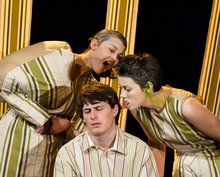
Fat Git’s surreal and grotesque performance aesthetic finds its perfect partner in the swirling, dreamlike paranoia of Mortimer’s protagonist. Managing his single household with obsessively meticulous care, his control-crazed movements are watched with boredom and amusement by the wallpaper, until a distraction is found in the sudden appearance of a whistling stranger. As the lone bachelor struggles to maintain the order he clings to, things progressively fall apart.

The care taken in the crafting of this piece is evident, from the precisely judged looks with which the three wallpaper figures curiously regard the audience to the sinisterly dissonant sound effect of a finger skimming the edge of a wine glass. Menace infects the piece, generated by both the oddly ominous nonsense of the text and the choreographed strangeness of the performances.

As suffocatingly strange as Fat Git’s bizarre creation can be, this peculiarity traps the audience within the same unsettling nightmare world as the unravelling man at its centre. It also makes us think. Despite the dreamlike unreality of this world, it taps into something psychologically, uncannily true about loneliness and anxiety, remaining wedged in the mind long after it departs.