The Rep Tide Turns

-C2-A9RWD10-20Faction_The-20Robbers_-36

Originally written for The Stage.

Repertory theatre might just be staging a comeback. While the Lyric Hammersmith undergoes major building work, the Secret Theatre company is occupying the untouched auditorium with a year-long programme of work driven by the ensemble. Elsewhere, Vicky Featherstone began her Royal Court tenure this summer with a festival featuring an ambitious weekly rep programme, while English Touring Theatre is exploring a repertory structure with Tonight at 8.30, its upcoming production of one-act Noël Coward plays.

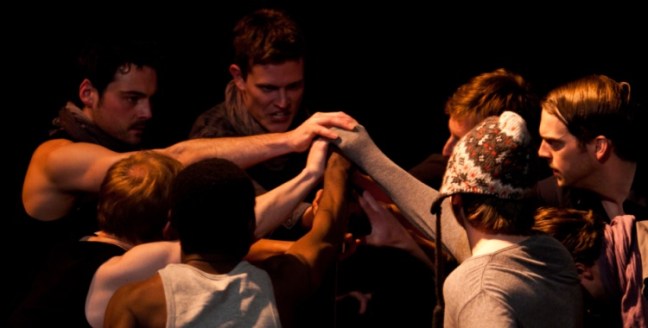
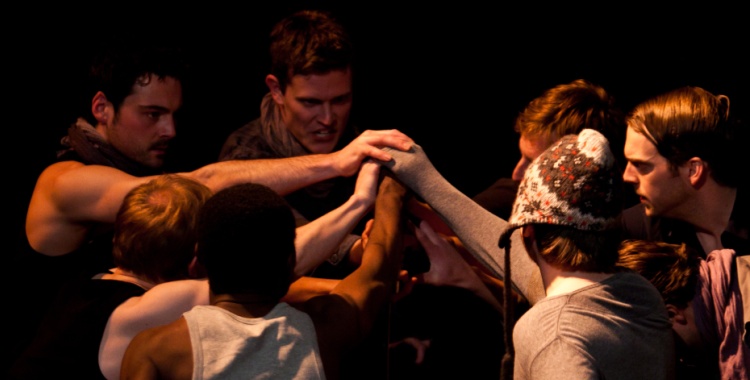
The freshly vaunted advantages of the rep model will come as no surprise to The Faction. The company, which recently celebrated its fifth birthday, has been working towards this model from the moment of its conception, guided by artistic director Mark Leipacher’s passion for ensemble theatre and muscular versions of classical texts. The company’s ambition is bold but simple: a permanent ensemble, a home venue and a rolling repertoire.

While many have mourned the decline of the great British repertory theatre, which acted as a fertile training ground for the likes of Judi Dench, Ian McKellen and Derek Jacobi, The Faction looks to the continent rather than to the past for its chief inspiration. The company’s model is drawn from that of German theatres like the Schaubühne in Berlin, where a large repertoire of plays is presented by a resident ensemble.

“The idea for The Faction was always an ensemble theatre company following the model of a German theatre,” Leipacher explains. “Because it doesn’t really exist over here; even when rep was alive and well, that’s not the format that our rep model had in the UK.”

What The Faction’s ensemble approach does share with the old British rep model, however, is its focus on the actor. At a recent conference, playwright Simon Stephens – who is currently working as a dramaturg for the Secret Theatre ensemble – suggested that the UK’s freelance culture “can stifle bravery in acting performance”. This is just what The Faction hopes to reverse.

“Any director will tell you it’s a requirement to try and make the rehearsal room a safe place,” says Leipacher, “so that an actor can arrive without the need for ego, without inhibitions, and have the confidence in order to experiment and to play. I think with an ensemble that’s inbuilt.”

Although The Faction is still some way from its ultimate aim of a permanent ensemble performing a repertoire of plays all year round, this will be the third consecutive year that the company has presented an eight-week rep season at the New Diorama Theatre. Leipacher tells me that these rep seasons are “essentially a small model of how we want to work full time”, with the plan being to slowly extend these towards a year-long programme. He admits that it’s a “gradual process”, but the final aim is unwavering.

This year’s programme represents a blend of old and new for the company. It is remounting its Peter Brook Award-winning production of Friedrich Schiller’s The Robbers, which Leipacher describes as a “quintessential Faction show”, as well as returning to Shakespeare to tackle Hamlet for the first time. Completing the season is Thebes, an audacious attempt to weave together Sophocles’ and Aeschylus’ accounts of the Oedipus dynasty. Unlike the more defined thematic threads of previous rep seasons, Leipacher says that “the only condition this year was that they had to be plays that really excited us as directors, as a company – meaty, big, epic material that played to our strengths, that pushed us into new areas.”

Epic is the key word there. This sense of scope – both in terms of narrative and emotion – is what keeps The Faction returning again and again to classical plays. Leipacher insists that “there is no better material”, citing the plays’ timelessness and “universal themes” in contrast to new writing’s preoccupation with the zeitgeist. “It’s much more about human experience, about jealousy, about love, about responsibility,” he continues, “something that’s applicable to everybody and to any time. The purpose of doing the productions now is to do them for this time.”

As much as Leipacher enthuses about what excites The Faction as artists, the company is equally focused on its audience. Leipacher is adamant that repertory theatre offers a richer experience for theatregoers, with whom the company is able to “extend a dialogue” over a longer period. Audiences also have the opportunity to see the ensemble in a range of different roles, which Leipacher argues allows them to “enjoy the craft of the production and the ethos of the company as part of their theatregoing experience”.

Geoff Colman, Head of Acting at Royal Central School of Speech and Drama, is in agreement with The Faction about the advantages of the rep model for both theatre makers and audiences, describing it as “a place of experience, experiment, continuing development and trust”. He is also optimistic about the potential for bringing back rep under a new guise, adding, “I am convinced that other theatre makers will be looking at this reinvention of rep very closely”.

Discussing the experiments in ensemble theatre that are cropping up across British theatre, Leipacher says that “any movement towards that European model here in the UK is exciting”, but stresses the importance of longevity. It remains to be seen whether projects like Secret Theatre will go on to create longer term change, but Leipacher hopes that the Lyric and others will make the same commitment to ensemble theatre that is central to The Faction’s ethos. “Hopefully it’s the beginning of a tidal shift.”

Beginnings and Endings

Show_3-600x399

Originally written for Exeunt.

Let’s start with a beginning.

Sitting in the stalls of the newly plastic-swathed Lyric Hammersmith this September, I’m not sure I’ve ever felt such palpable anticipation in the moments before a show. As suggested by the words “Secret Theatre”, most of us in the audience did not know quite what to expect. The curtain was eventually raised to reveal the performers in a line at the back of the stage, dressed in plain white shorts and vests. Accompanied by a sinister, clinical voiceover, these figures rushed forward to drink from bowls of water, scrambling over one another in a desperate, animalistic struggle. What followed might not have been the best show of the year, but it is hard to think of a more memorable opening.

As I attempt to craft some sort of assessment of the year in theatre, the Lyric Hammersmith’s Secret Theatre project feels like an apt emblem for the change that is slowly pressing in on multiple sides. This time last year, writing another of these deeply subjective round-ups, I reflected that 2012 felt like a year of “small tectonic shifts”. While those shifts might not have precipitated a violent eruption of change across the landscape of British theatre, the last 12 months have nonetheless seen ripples of movement – just more gradually than perhaps anticipated.

Unlike the noisy, thrilling arrival of Three Kingdoms last year, the changes of 2013 have been subtle and structural, hinting more at future promise than present fulfilment. Chief among these changes is the exciting wave of new artistic directors who have either taken up post or been announced: Vicky Featherstone at the Royal Court, Rupert Goold at the Almeida, Rufus Norris at the National Theatre, Lorne Campbell at Northern Stage, Sam Hodges at the Nuffield. Whether these appointments will really offer the shake-up they hint at is still to be seen – though the early signs of Featherstone’s tenure are encouraging – but the collective urge for new ways of working is clear.

The impetus towards change is also characteristic of one vein of work that has particularly stayed with me this year. The phrase “political theatre” always feels like a misnomer – isn’t all theatre political in some way? – but a clutch of angry, thoughtful and passionate productions in 2013 have dealt specifically with ideas of political change and protest. How to Occupy an Oil Rig playfully explored the demonstration (in every sense), while Hannah Nicklin’s A Conversation with my Father offered a decidedly personal perspective on protest – almost reducing me to tears in the process. And another kind of activism is at the heart of Bryony Kimmings’ bold and brilliant Credible Likeable Superstar Rolemodel project, which twice bowled me over with both its raw emotion and the galvanising ambition of its aims.

Elsewhere, the potential for future change was more lightly hinted at. At this year’s Edinburgh Fringe, Dan Hutton and I noted the theme of hope that threaded its way through several of the productions we saw, complicatedly paired with both critique and irony. Contrived as this narrative perhaps is, it is one that has retrospectively haunted many of this year’s shows, inflecting my way of watching and thinking about theatre. From its very explicit presence in what happens to the hope at the end of the evening to its troublesome ghost in The Events, the question of hope has been a key feature of much of the most interesting work I’ve seen over the past 12 months.

Chris Goode's The Forest and The Field ©Richard Davenport

Closely linked to hope is the idea of community, which is often vaunted as being at the heart of theatre as an art form. We share the same space in the theatre, after all, so we must be a community of sorts, right? This was tested in various ways by much of the best theatre of 2013, be it the stunning yet gentle intellectual interrogation of Chris Goode and Company’sThe Forest and the Field or the joyously communal celebration of The Strange Undoing of Prudencia Hart – which arguably nailed the whole thing by staging itself in a pub and throwing in some song and dance for good measure.

Similarly to Prudencia Hart, music was a key ingredient of the fleeting community forged night after night in Edinburgh by The Bloody Great Border Ballad Project; food took the same role in Only Wolves and Lions, reminding me of the simple community we build when we cook and eat together. It’s not insignificant that that last example was part of Forest Fringe, a gorgeous instance of transitory artistic community in the midst of this summer’s Edinburgh Fringe. This community also offered up countless other small scale theatrical highlights of the year, among them Ira Brand’s delicate contemplation on ageing, a consideration of our addiction to virtual communities in I Wish I Was Lonely, and Deborah Pearson’s haunting The Future Show.

One show that managed to be both small and epic was Grounded, the absolute standout production of the Fringe for me. The remarkable Lucy Ellinson once again looms large over my theatregoing memories of the year after her compelling delivery of George Brant’s tightly written, blistering monologue, all the while imprisoned within the striking grey cube of Oliver Townsend’s design (as an aside, cubes seemed to be big this year – see Chimerica). Ellinson also dazzled, though very differently, in #TORYCORE, a deafening, devastating scream of rage against the destructive policies of the coalition government.

And it was not only the politicians of today who found themselves criticised in theatres this year. Following the death of Margaret Thatcher, a number of pieces have already directly or obliquely approached her legacy. Theatre503’s quickfire offering of short plays produced a decidedly mixed bag, although Margaret Thatcher Queen of Soho’s glorious drag queen rendering of the Iron Lady has deservedly lingered in my memory. The difficulty of discussing Thatcher’s legacy was addressed in all its complexity by Mars.tarrab’s brilliantly titled The Lady’s Not for Walking Like an Egyptian, while perhaps the most striking visual representation of Thatcher came courtesy of Squally Showers, a show that touched on her and her politics only indirectly. Yet somehow, in the image of a performer in a Thatcher mask holding aloft an inflatable globe while surrounded by the detritus of a wild party, Little Bulb wordlessly directed a powerful judgement at the world left to Thatcher’s children.

Little Bulb's Squally Showers

Squally Showers also provided plentiful helpings of sheer joy, a theatrical quality not to be underestimated. Alongside the charming eccentricity of Little Bulb’s latest show, the Edinburgh Fringe also offered the utterly bonkers but irresistibly endearing Beating McEnroe,which will forever leave me with the glorious memory of Jamie Wood pretending to be a tennis ball. An equally joyous moment to imprint itself on my mind this year emerged from Peter McMaster’s Wuthering Heights, in which I screamed with laughter at the four male performers’ move by move recreation of the dance in the Kate Bush music video, while the final scene of rain-drenched anarchy in the RSC’s As You Like It topped off a production that was a delight from start to finish. And no assessment of theatrical joy in 2013 would be complete without pausing to remember Zawe Ashton’s frankly inspired rendition of ‘Where Are We Now?’ in Narrative, a show that achieved the rare feat of being both absolutely hilarious and intellectually meaty.

While it may not fit neatly within the thematic threads I’m attempting to loosely weave through my overview of the year, any consideration of 2013 has to include a mention for Headlong. The company has had a ridiculously successful 12 months, encompassing the slick, stylish storytelling of Chimerica, a bold and theatrically astute new interpretation of The Seagull and – best of all in my opinion – the complete headfuck of Duncan Macmillan and Robert Icke’s stunningly intelligent adaptation of 1984. I’ve missed out on American Psycho,but from the outside it appears to offer a striking end to a fairly extraordinary year for Headlong.

As averse as I am to naming any one production “best”, when looking back over the year I find my mind dragged time and time again back to Mission Drift. For many this hardly counts as a “new” production, having first been seen at the Edinburgh Fringe in 2011, but this summer’s run at the National Theatre’s temporary Shed space was my first opportunity to see The TEAM’s dizzying trip through 400 years of American capitalism. Fast-paced, sexy and beautiful to look at, Mission Drift can also justifiably be described as epic, an adjective that I rarely find myself applying to theatre. Its scope, energy and excitement has become my personal benchmark against which to measure the year’s theatre, and very little in the subsequent months has equalled it.

As I opened this narrative with a beginning, I might as well close with an ending. Looking ahead to 2014, February will see the dismantling of The Shed, whose garish red silhouette on the South Bank has come to stand for vitality and experimentation at the heart of an institution often associated with tradition – as the narrative it spun to celebrate its 50th anniversary did little to challenge. One can only hope that The Shed’s spirit of innovation, together with that of Secret Theatre and Vicky Featherston’s Open Court festival this summer, finds a way to continue into the next 12 months.

I also contributed to a collective look back at 2013’s theatre with the rest of Exeunt’s writers.

Keeping the Secret

9802714633_caebd5356a_z

Originally written for Exeunt.

There has always been a certain tension at the heart of the Lyric Hammersmith’s new project. One manifestation of this tension emerged in the opening lines of Sean Holmes’launch speech, which was paradoxically required to contain both arrogance and humility – “Arrogance because there is definitely something provocative and cocky in the gesture we are making, and humility because we are aware of that arrogance and hope that it reflects a desire in our audience”. Secret Theatre is a project that strives to both explode and build, to create something new while drawing inspiration from past endeavours, to maintain secrecy at the same time as being inclusive, to challenge the supremacy of the text while not entirely departing from its spirit. It’s no easy task.

There is also something a little disingenuous about assessing this task now, after the first two shows have opened. Secret Theatre is taking place over a year, establishing a permanent company of ten actors and ten creatives to work on a series of shows in repertory, through a process that is continually adapting to the space, the people in it and the audiences coming through the doors. It is a structural shift over many months, and its real value lies in its impact as a whole endeavour rather than in the individual shows that are emerging from it. So the current view is necessarily a limited one – just the first glimpse of a much wider picture. This response, therefore, must also be a glimpse, an early set of impressions rather than a comprehensive critical overview.

The element of the project to receive most attention at this stage is embedded in its very name – the “secret” part of Secret Theatre. One of many risks the Lyric is taking with this season is the decision not to release the names of the shows, instead referring to them as Show 1, Show 2, etc. The stated aim of this decision is to “counter a prevailing culture saturated with information”, allowing theatregoers to experience work without the burden of expectation. Since its launch, however, the secrecy of the project has come to acquire lots of other connotations, many of them highlighting that central tension. It functions as a sexy marketing tool, but it is also in danger of implying exclusivity. It erodes at the notion of theatre as commodity, yet it is problematic in the risk it asks audiences to take in shelling out money on an unknown.

It remains uncertain just what effect this secrecy will have in the longer term, although it’s unfortunate – not to mention a little ironic – that this has so far overshadowed the shows themselves. To approach the work in the spirit of its creation, however, I’ll be keeping the secrecy intact as far as possible. Whatever the other implications of the “secret” tag, it feels churlish to deprive anyone of the heady thrill of sitting in an auditorium buzzing with the kind of anticipation that only comes from going in blind. Anything might happen.

And this spirit – this breathless sense of the unexpected – runs right through the metabolism of both productions, even once they reveal their titles. Show 2 does not remain a mystery for long, with an early line clearly determining the familiar classic text, but the revelation takes nothing from the vitality of this interpretation. It might not be quite the theatrical hand grenade that Holmes promised to lob in his interview with Matt Trueman, but it somehow manages to strip itself of the kind of baggage that its iconic female protagonist drags on in a towering collection of suitcases.

In common with the troublingly clinical, synthetic eroticism of Three KingdomsShow 2manages to be at once achingly sexy and stylishly cold. The plot is centred on two sisters (Nadia Albina and Adelle Leonce), both of whom find themselves far from their privileged rural upbringing in the cramped claustrophobia of the city, and both of whose lives are shaken by the impulsive violence of the younger woman’s husband (Sergo Vares). In this version, sexuality is repeatedly foregrounded, as performers undress at the front of the stage and Leonce suggestively licks ice-cream from a spoon. But any sensuality is underscored with a hard edge of menace. No one exemplifies this better than Vares, whose muscular presence hints at the animalistic traits attributed to his character, but who maintains a deeply unsettling aura of control even in the fiercest of his rages.

Alongside themes of sex, gender and violence, this production also draws out a thread of fragile hope and imagination. Hyemi Shin’s clean, pleasingly minimalist set is something of a blank canvas, onto which Albina’s delicate, damaged escapist can project her desires. Brightly coloured balloons are symbolic as well as celebratory: hopeful and captivating, but easily punctured and deflated. The aural landscape of the production, meanwhile, is filled with a series of intoxicating Motown tunes, each truncated as abruptly as the protagonist’s dreams. It all makes perfect sense, but as metaphor rather than literal representation. As Albina declares “I don’t want realism, I want magic”, it’s hard not to nod emphatically.

Show 1, while grappling with an equally revered play, has the benefit of reimagining a text that is already fragmented and incomplete. This is where the non-literal, symbolic approach of the Secret Theatre team really pays off, exposing an ugly, oozing wound right in the middle of a play whose implicit social critique is suddenly painfully explicit. Here, the central character (Billy Seymour) is stuck on a punishing treadmill, trapped in a life of unremitting poverty and toil. To eliminate any doubt about the impossibility of his situation, Seymour is tethered to the middle of the stage, able only to go round and round on a pre-determined path, always running but never getting anywhere. The only way to sever this tie is through violence, an answer that is really no answer at all.

The dark, desperate world presented on stage is one in which individuals like the protagonist have been mercilessly dehumanised by the system they exist within. This is clear right from the captivating animalistic struggle of the first scene – as startling an opening as you’re likely to witness – and is insistently compounded by the images that follow. In one of the rawest, messiest moments of the show, the cast pull on animal onesies and dance furiously under flickering strobe lights, flinging water across the stage. It’s a thrilling yet devastating stage image, capturing both the giddy intensity and the furious despair of this hedonistic release.

The real punch to the guts, however, is reserved for the conclusion. In the aftermath of the play’s climactic scene of violence, Albina – who has spent most of the show hovering above the action like a mocking angel – steps up to a microphone. In the most haunting of the show’s many striking music choices, she launches into a bitter rendition of a song that suddenly shifts the nature of what we have been watching for the past 75 minutes; something previously abstract is made uncomfortably specific. Through the insertion of these bile-coated lyrics into the text, a brilliant and disturbing new reading is revealed.

One of the great joys of both shows is to see unexpected ingredients of the text wrenched out and realised anew. In place of literalism, a rich symbolic language illuminates new facets of the plays. In Show 2, a repeated line about metaphorical “coloured lights” is visually translated into gorgeous, colour-shifting neon bulbs; the grim, relentless cycle that is implicit in the narrative of Show 1 finds expression through Seymour’s compulsion to walk in endless circles. Rarely does theatrical metaphor combine such careful thought with real visual excitement.

My initial thought, on emerging from Show 2, was that this is theatre that turns the text inside out. Theatre that grabs something from deep inside the guts of a play and holds it up for an audience to see; theatre that excavates from within rather than imposing from outside. But on reflection, perhaps even to distinguish between internal and external is a misguided project which continues to implicitly judge a production based on its relationship with the text. It might be more accurate to say that this is theatre in which the text is in dialogue with the rest of the stage vocabulary, neither raising its voice nor dwindling to a whimper.

And here is where the much discussed secrecy that surrounds the project suddenly seems vital. The first two shows are productions of famous, frequently revived texts, each carrying not just baggage but voluminous trunks of the stuff. Some have expressed surprise that Holmes has opted for two such behemoths of classic drama, but in the light of Secret Theatre’s aims, nothing could be more logical. How better to challenge the structures of literalism and “serving the text” than to reimagine a pair of plays with a long lineage in this tradition?

The names of these plays, however, inevitably conjure a whole range of associations and expectations, influencing their reception and perhaps even putting some people off entirely. In the case of such well-known plays, the decision to keep their titles under wraps is more than a mere gimmick; it allows for a viewing experience that does not immediately hold the production to the example of the text. Instead of measuring the show up to an imagined ideal, we are freed to watch what is actually happening on stage, in this moment, now. Whether we enjoy watching that or not, central to the gesture is a refreshing liberation from pinning the entire production down to one supposedly fixed element. All of a sudden, everything is up for grabs.

Of course, none of the work that has come out of Secret Theatre so far is perfect. Much of the emerging aesthetic remains in the swaggering shadow of Three Kingdoms, from the drenching of water to the abundance of suitcases, while the promised explosiveness could still do with a bit more of a bang. The secrecy is perhaps mishandled and the right vocabulary to discuss it is still being shaped. But this is theatre that is not afraid to be messy, theatre that refuses to be quiet and well behaved. It’s theatre that demands to be watched – really watched – and that respects its audience’s ability to think and interpret. It’s rough, it’s sexy, it’s interrogative, it’s thrilling. It’s theatre to make the heart beat a little faster. And that, surely, is something to get excited about.

Photo: Alexandra Davenport.

Secrets and Surprises

Originally written for Exeunt.

As our huddled group of partygoers shudder upwards in an industrial lift, headed towards the Lyric Hammersmith’s secrecy-veiled launch, a woman behind me compares the experience to seeing a show by Shunt or Punchdrunk. There’s that same sense of an event, of the unexpected. Walking across Lyric Square, we’ve been directed around the side of the building, to its concealed, warehouse-like innards. While waiting in this space, we have an opportunity to see the building – and our relationship with it – from a different angle. The very walls seem to shift.

Artistic director Sean Holmes’ plans for the Lyric over the next few months, announced on Monday night, are about transforming the theatre from within as much as from without. At the same time as the building itself is completely renovated in a huge capital project, a group of theatremakers are occupying its heart. The auditorium, which will remain untouched for the duration of the building work, is to become the flexible home of Secret Theatre, which is exactly what its name suggests. In a bold and teasing move, the Lyric is not releasing any details of the plays it will be producing over the next year; instead, audiences will come to be surprised.

But this is not simply about returning a sense of the unexpected to the theatrical event in a society saturated with information. Mirroring the work that is taking place around them, the Secret Theatre company are engaged in challenging and changing structures. Resisting the rapid turnaround of an industry used to dishing up end products and swiftly moving on, the company of ten actors and ten creatives will be working together in the space throughout the year, collaboratively making and performing and sharing. As Holmes put it in his speech, “the company we have assembled is an attempt to create a new structure that might lead to a new type of work”.

There are a number of ways in which Secret Theatre is shifting the structures of how the Lyric – and many other institutions like it – make theatre. The ensemble of actors is evenly split between men and women and includes black and disabled performers. This immediately erodes the structure of literalism, which has become something of a straitjacket for much British theatre. The set-up is also designed to create a different conversation in the rehearsal room, allowing those involved more time to create work in true collaboration and for a specific space. One niggle is that everyone involved is still assigned a rigidly defined title – writer, director, actor – but one suspects that in rehearsal these roles will be much more fluid.

Surrounded by the vivid red of the Secret Theatre launch party, I’m reminded of the similar injection of colour that has just been administered to the Royal Court by new artistic director Vicky Featherstone. Even the bar is bursting with yellows, reds, blues and greens. The Court is another established building whose existing structures are being challenged, in this case thanks to a sharp burst of fresh air that Featherstone is blasting through the theatre over the summer. Open Court, while guided by different principles and very much organised around playwrights, cultivates a similar atmosphere of experimentation and surprise. The sense is that anything could happen.

As Andrew Haydon notes, it’s clear that, even without the kind of construction work taking place at the Lyric, Featherstone has given careful thought to the building she’s inherited. As well as the changes to the bar, which now feels like a place you might actually want to hang out in without worrying you aren’t wearing the right shoes, the season itself kicked off with a telling reflection on the theatre building. In the first “Surprise Theatre” offering, Cakes and Finance, Mark Ravenhill read from the transcripts of a series of playwrights talking about their ideal theatre, musing on everything from the idea of 24-hour theatre to the suggestion that cats should be incorporated into more performances (surely one of Chris Goode’s contributions).

Alongside the obvious similarities between Open Court’s surprise shows and the secrecy around the Lyric’s new season, there are other shared experiments. Like Secret Theatre, the main house plays during Open Court are operating using a rep system (which is as much a return to the past as a new innovation), with an ensemble of actors rehearsing next week’s show by day while performing this week’s show at night. In some ways this offers the complete opposite of the Lyric’s project, driving at energy and a quick turnover of plays rather than extended rehearsal periods, but it equally fosters that sense of the collective at the same time as bringing a vital roughness back to the stage. Also, while the gesture of Open Court honours the mythology of the Royal Court’s status as “the writers’ theatre” – a mythology that Featherstone’s launch announcement was drenched in – this has been done in such a way that it explodes in the same movement in which it preserves. Clever.

And it’s not just these two venues. While exciting developments have been pushing at the outside for years, it feels increasingly as though some change is beginning to seed itself on the inside. I think of the scarlet structure of the National Theatre Shed, shouting its presence on the South Bank – again, a dash of colour – and of the ongoing developments at Battersea Arts Centre, as it too undergoes building work that will open it and its brilliant work out even further to the surrounding community. It’s not everything, and there’s a definite danger of getting carried away and falling back into complacency, but it is a start. Perhaps most importantly, there’s a rare and much-needed whiff of optimism in the air.

To encapsulate some of that optimism, it feels right to conclude with Holmes’ galvanising words from Monday night. Speaking about the vision for Secret Theatre, he expressed his hope “that even if you hate it, you can’t ignore it. That even if you love it, it scares you. That you will believe it’s an honest attempt to change. To delight. To question.”

Metamorphosis, Lyric Hammersmith

Metamorphosis

Originally written for Exeunt.

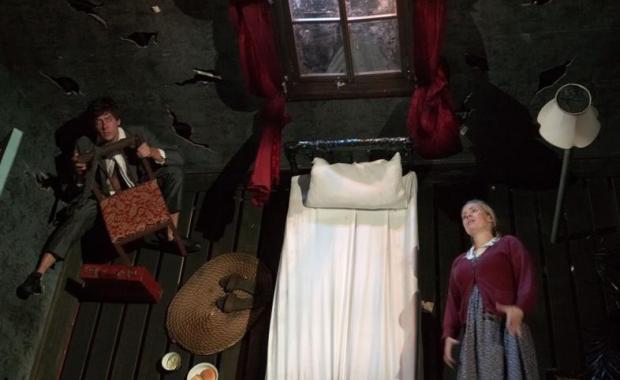
A performer dangles upside down, supported only by the strength of his own body; visual perspectives shift and skew across the split level set, distorting reality; a family home cracks open, metaphorically and literally, at its very centre. There is no question that this production, now six years old and making its fourth visit to the Lyric Hammersmith, remains thrilling in every sense of the word. What is so heart-stopping about the Lyric and Vesturport’s visually virtuosic rendering of Kafka’s nightmarish tale, however, is not the dazzling disbelief that such images be thought to provoke. Instead, the most chilling horror at its core is all too plausible.

Just as the true awe that is inspired by loose-limbed performer Gísli Örn Garðarsson derives from the sheer ease with which he flings himself about the set rather than the gravity-defying spectacle of his acrobatics, the real sting of the piece lies in its incisive diagnosis of the human capacity for evil. In the shell-shocked aftermath of Gregor Samsa’s titular, unexplained metamorphosis, his bewildered family grope around their shattered domestic haven in search of coping mechanisms, slowly surrendering to the most brutal of self-preservation tactics. It is a grim metaphor for society’s fear of the other and its destructive impulse to exterminate perceived threats from within.

Extending this metaphor, Vesturport’s telling of Kafka’s disturbing novella is as much a retrospective dialogue with the tale as it is an interpretation. Armed with the knowledge of twentieth-century European history, parallels with the dehumanising rhetoric of totalitarian regimes readily present themselves; a line such as “work will set us free” uttered today immediately summons the echo of Auschwitz. Most strikingly, David Farr and Garðarsson’s production presents us with a distinctly human Gregor, eschewing any attempt at physical deformity. We know that this character has transformed into a monstrous creature, but all we see before us is a man, making the monstrosity all of our own creation; the audience find themselves complicit in the same horrifying division between human and inhuman that the Samsas finally pursue.

Alongside the production’s thinly veiled allusions to Nazi Germany, money emerges as an equally sinister force. It is less Gregor’s physical state that provokes his family’s disgust than the loss of his income, while the tantalising promise of a wealthy lodger sends the Samsas physically giddy. A human being who is no longer economically useful, this version darkly hints, is no longer considered human. Every creative force at the production’s disposal unites in this act of considered excavation, from Börkur Jónsson’s mind-bending set, physically setting Gregor and his family at opposing, disjointed angles, to the steadily darkening clothing, to Nick Cave and Warren Ellis’ painfully haunting music.

But for all the intellectual and visual inventiveness at play, the piece’s greatest triumphs are also what threaten to soften the devastating punch it seeks. Precise rather than visceral, each movement is so delicately, meticulously calculated – from the contained physical effort of outward domestic perfection to the seductive power that emanates from a wad of bank notes as they are slowly handed over one by one – that the raw intensity of the horror gives way slightly to an unsettling but clinical choreography. As the final, stunning image imprints itself on the stage, however, such objections seem churlish. Mingling beauty with terror, it is in these closing moments that the rotten heart of Kafka’s tale finally bursts from the production’s finely polished chest.