Desire Under the Elms, Lyric Hammersmith

Originally written for Exeunt.

Property is a flimsy, fleeting, yet enduringly seductive object of desire. There is a bitter irony contained in an object over which lives are lost but which, as attested to by proverb, you can’t take with you. This empty basis on which possessions possess is laid startlingly bare by the Lyric Hammersmith’s new revival of Eugene O’Neill’s lust-laden study of ownership and desire, claustrophobically bound within the confines of a farm both built on and fought over with sweat.

The farm in question is under the disputed ownership of Ephraim, an aging but tough espouser of hard work whose joyless mantra is that “God’s hard, not easy”. As elucidated by O’Neill’s script in a laboured collection of expository scenes, this farm has become the subject of squabbling between his three sons, the youngest of whom, Eben, eventually buys out the stake of his two brothers. It is only when Ephraim returns, with pretty but fiercely acquisitive new wife Abbie in tow, that the friction between conflicting desires – material and physical – begins to emit sparks.

While O’Neill’s text is laden with words, lilting to a lazy rhythm that seems born from the slowly emanating heat of the earth, it is the visual landscape of the Lyric’s stage that seduces our attention. Ian MacNeil’s gorgeous design has realised the house at the centre of the characters’ alternately violent and petty disputes as a tellingly insubstantial structure, a plywood skeleton that dismantles into a series of self-contained domestic spaces. Its deliberately flimsy cladding and the abandonment of any pretence to cover its inner workings speak of both fragility and artificiality; the prize at which Ephraim, Eben and Abbie are all grasping is as creakingly hollow as it is ephemeral.

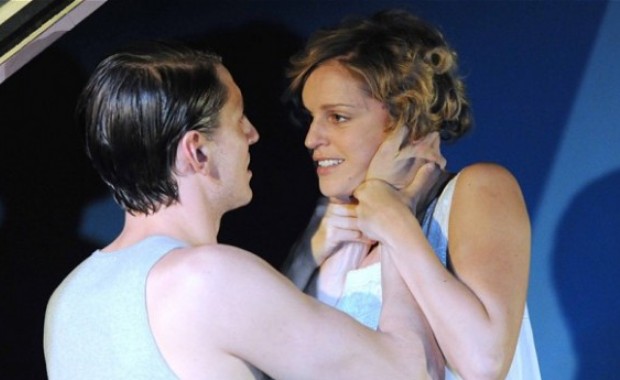
There also seems to be a recognition within Sean Holmes’ intelligent staging of the labour on which this coveted property has been founded, a labour that its “purdy” exterior would seek to elide. The wooden shells that house the various scenes are wheeled around the stage by figures in overalls, pointing to an act of labour by which the inhabitants’ comfort – or discomfort – is secured, an exposure of economic relations which in turn highlights the uneasy exchange that Denis Gough’s increasingly desperate Abbie is engaging in. As she initiates an inevitable affair with Eben, the acquisition at stake might shift from property to love, but payment must still be made.

Recurrent threads around these themes are insistently sewn by O’Neill and plucked at by Holmes’ production: the creeping threats of cold and poison, a “lonesome” chill that creeps through the house, the greedy, lingering promise of “gold in the sky”. The air of O’Neill’s world is as heavy with imagery as it is laced with desire – too heavy, it often seems, for his narrative to support. The melodramatic tint of the unfolding drama allows Gough to tear herself apart in a blistering, ferocious performance, but something in this strange, overburdened play seems to be torn along with her.

Morning, Lyric Hammersmith

The auditorium is flooded with mangled, discordant screams. Pale fluorescent light creeps across the stage, illuminating a snapshot of horror with the clinical blandness of the hospital ward. And all around me, audience members stifle laughs.

This is the moment from Morning that is etched most vividly on my memory. Being seated in the middle of a group of teenagers, the demographic with which Simon Stephens’ latest, horribly compelling play concerns itself, offers a fascinating perspective on this piece – certainly not one likely to be found on press night (just one reason why it can be helpful to occasionally step out of the herd of ferociously scribbling critics, but that’s a subject for another time). Ripples of discomfort swell through the theatregoers around me as they drink in a cocktail of strangeness and recognition to which the only response is a nervous titter. As one boy put it on his way out, with a hint of awkward admiration, “that was bare weird”.

The “bare weird” show that Stephens and director Sean Holmes have created with the Lyric Young Company centres on Stephanie, a fiercely intelligent but disturbed teenage girl played with terrifying precision by Scarlet Billham. Sick with sadness yet unable to stop smiling, she dispenses viciousness without a flicker of concern. Stranded in an antiseptic suburbia where all the meticulously kept gardens look exactly the same, ennui is a permanent state for Stephanie and her friends – one of whom, Cat, is about to escape for university. Before she leaves, however, Stephanie has recruited unwitting boyfriend Stephen in a scheme for a savage send-off, an escalatingly brutal scene around which the play nauseatingly pivots.

I expect that numerous comparisons will have been made with Punk Rock, another unsettling Stephens play that takes modern youth as its subject. Not wanting to disappoint, I admit that such thoughts did strike me while watching Morning; in many ways these are quite different pieces, but a direct line can be drawn between William Carlisle and Stephanie. In each case, Stephens’ protagonist is startlingly intelligent, an intelligence that acts as an uncanny counterpoint to their respective brutality and apparent emotional detachment. Eschewing the hoodie-clad image that haunts portrayals of contemporary teenagers, Stephens’ portraits of this generation are all the more blackly horrifying.

What strikes me as being particularly important, perhaps for this play even more so than Punk Rock, is the teenage perspective. This is perhaps because my ears are still ringing with the words of Ontroerend Goed’s Alexander Devrient, who said something along the lines of teenagers being at a stage of life in which they can see what is wrong with the world but are not yet able to formulate any remedial ideologies (I’d recommend listening to his full, thoughtful, softly spoken interview for Theatre Voice, in which he speaks eloquently and at length about his work with young people). But what if they only see diagnosis without cure because that is the unacknowledged truth of the world?

Perhaps what we can take from Morning is the incisive awareness of a world in which, in Stephanie’s words, “everything is fucking shit”, an awareness not yet blunted by ideology or philosophy or religion – teenage nihilism three times distilled. But there is a taut, oddly appealing ironic tension between this apparent nihilism and the quotation from Marx that Stephanie prints in bold felt tip: “the philosophers have only interpreted the world; the point, however, is to change it”. The knowledge that this piece has been made specifically for and with the age bracket represented then adds another fascinating layer; how have the astonishingly talented members of the Lyric Young Company influenced this final, unblinkingly bleak vision of the world?

Which brings me neatly, if not uncomplicatedly, onto my next point. As discussions of Stephens’ work tend to veer towards considerations of collaboration, especially in the wake of the extensive critical discussion around Three Kingdoms, and as I’m ever more conscious of the disingenuousness of critically portioning a production into writing, direction, design and so on, it seems apt to reflect on the ways in which the various elements of this piece feed into one another.

In considering the aesthetic of the whole, the words that rise most stubbornly to the surface of my mind are “antiseptic” and “clinical” (neither in a negative sense, I should add, but one that feels crucial to the piece). From stark fluorescent lighting to unsettlingly alienated performances, there is a sterile coating that settles over the production like the shimmering sheets of plastic that shroud Hyemi Shin’s set. The design itself is what first snatches at the attention: the large, half-filled glass tank of water, the industrial fridge containing a single bag of blood, the forensic tent, the assorted lights, the plastic – there’s lots of plastic. This seeps into the plasticity of the performances, a sort of blank, detached distortion of naturalism that could just be taken for stiff acting in the opening moments but that soon emerges as a very particular style, one that is married to the coldly artificial quality of the design and the dislocated realism of Stephens’ text (a misleading and loaded word, as I’ve discussed elsewhere, but one that will do in the absence of a more precise vocabulary).

In place of the domestic settings to which Stephens’ dialogue refers, the production is littered with forensic paraphernalia, an implicit nod to the current ubiquity of the detective narrative, but this is a crime scene in which nothing is solved (a nice example of how a non-literal interpretation can be a more perceptive comment on the text than one which sticks rigidly to its real-world inferences). It also hints at a certain clue-hunting critical approach to theatre, a quest for meaning that Stephens – and indeed the whole production – actively eschews.

Without listing every aspect of this intriguing staging, the other element of the production that merits particular mention is Michael Czepiel’s nightmarishly distorted soundscape, which is produced live on stage with both Czepiel and the sound desk in full view. As well as peeling away the illusions of theatricality, this choice pulls on strands of voyeurism and plants another of the production’s subjects as a permanent presence, the (mostly) silent youth glued to the computer screen.

Returning to nihilism, this multi-layered whole produces an anarchic, punk-inflected void of meaning, a great black gaping hole where we might expect to see hope or redemption or some kind of “message”. Perhaps deflecting some of the criticisms that have been levelled at his work in recent years, the concluding words of Stephens’ script (yes, sorry, I’m attaching elements to single individuals once again, but let’s just assume for sake of ease that these words are purely Stephens’) are a gutting “fuck you” to any demand for an optimistic chink of light. But just to contradict that – and to once again overturn my simplifying attributing of authority to Stephens – the production itself goes on to complicate this appropriately teenaged gesture of rebellion.

Morning is the sort of uncompromising piece that inevitably cleaves opinion, if not perhaps to the same impassioned extremes as Three Kingdoms (which I will, eventually, stop going on about – probably). Potent reactions spill tangibly through the audience throughout the painfully gripping hour of the play’s length and pour out into the packed foyer after the final bow. The one response that is markedly absent from the teenagers around me, however, is shock. Like Stephanie, they emerge smiling. After all, if you know already know that there is nothing but terror, what else is there to do but laugh?

Revisiting Three Kingdoms

Here we go again …

On Saturday, the final night of the run, I went back for a second viewing of Three Kingdoms. Drowning in superb but brain-frazzling criticism and starting to feel, much like Maddy Costa expresses in her wonderfully honest blog, uncertain which thoughts were my own and which I had accidentally borrowed from others, I needed to see it for myself again. I needed another hit of that visceral punch that can only be gained from the production itself (though Megan Vaughan evokes it pretty forcefully for anyone who wasn’t there).

And it was an ecstatic rollercoaster of an experience, even second time round – perhaps even more so second time round. I surrendered myself to the dream and awoke three hours later, dizzied and wondering where all that time had gone. I also realised how utterly stupid my first impressions of the production were and how much I had missed. There is simply so much going on, and a second viewing only compounded the feeling that it would be futile to attempt to write about the production as a whole. This conceded, I’m not going to make such an attempt, but there are a few points that I feel the need to return to.

Critical response – By now it’s fairly clear that, whether or not you believe Three Kingdoms will change the face of British theatre, it has had an extraordinary response. For me the past couple of weeks have been a brain-melting whirlwind, and I’m still not sure I’ve read everything out there on the internet about this show. I personally have never seen such an overwhelmingly vocal response or such a volume of responses to one show – and this is all despite a fairly dismissive attitude from (the majority of) the mainstream press. I can only echo Maddy in hoping that someone will find the time to collate everything that has been written in one space.

As a result, I feel that much of my own response to the show has been bounced off of what other people have said about it. Which isn’t necessarily a bad thing, as I find it valuable to test my own thoughts against those of others and continue to weigh up my reaction to a show for some time after, but it did make me begin to lose sight of what moved me to engage so much with this production in the first place. For that reason I feel as though a repeat viewing is vital, although even now the intervening hours since that second experience of the show have widened the gap once again between the thoughts that are purely my own and the thoughts that are responding to the opinions of others.

But I’m beginning to think that maybe this is what theatre is all about. I firmly believe that objectivity is a fallacy, because the way in which any of us view a piece of theatre is inevitably coloured by our own identity, experiences and opinions no matter how hard we try to discard these, and perhaps the truly individual response is much the same. Unless we are to view and critique a production in complete isolation, without access to any form of marketing material or even so much as the body language of the audience member sitting next to us, we are going to be influenced, however minutely, by those around us. I’m hardly the first to quote Tassos Stevens on this, but it seems appropriate and helpful to recruit his point here:

“The experience of an event begins for its audience when they first hear about it and only finishes when they stop thinking and talking about it.”

Within this extended experience, as Stevens sees it (and I happen to think he’s hit the nail on the head), there are lots of other voices involved. The marketing material that alerts you to the production, the feature or interview you might read in the paper before going to see it, the programme notes, the background buzz of the theatre bar, the conversation with your friend in the interval. No critic can be completely impervious to this trickle of outside influence.

As long as we do not find our own opinions indistinguishably mingled with those around us, which I have felt is a real danger for me with Three Kingdoms, I’m not sure there’s anything particularly wrong with taking on board the opinions of others. Engaging in dialogue afterwards is fast becoming one of my favourite parts of the theatrical experience and I frequently find myself refreshingly challenged by hearing or reading the responses of others. While I sadly don’t have the time or, quite frankly, the mental capacity to respond to everything else that has been written about Three Kingdoms, I can only jump for joy that so much has been written and that so many people are having these conversations. This is, of course, where online criticism comes into its own.

Text and production – Coming back to the production itself after veering off on that slight tangent, I’m still intrigued by this question of how Three Kingdoms has been pieced together. If you can get your hands on a copy of the playtext (which might be difficult as I nabbed the Lyric’s last one on Saturday night – sorry!) then I would strongly recommend taking a look at it. I’ve yet to read it cover to cover, but a cursory skim is enough to establish that this is a world away from the final production. As well as making it clearer which elements have emerged from the collaborative process with Nübling and the rest of the creative team, it has also made me think a lot about the relationship between text and production and playwright and director.

There are many, many differences between the original text and the final production it has morphed into, but two jump out. Firstly, reading the playtext reveals that Ignatius was originally conceived as a bilingual character, a fact that was only changed to adapt to a casting alteration during rehearsals. I was surprised by this, because Ignatius’ deep sense of linguistic disconnection and cultural disorientation felt absolutely vital to the final production; as an audience, we too are enveloped in the surreal sense of dislocation that he experiences. It would not be the same play without it. Which raises questions about the value we put on deliberate design versus happy accident or fruitful experimentation. Is a play ever really finished until it reaches the stage? (Going further, we might ask if it is ever finished even then.)

Secondly, another integral element of the production does not appear in the written script at all. Here I’m talking about the character listed as ‘The Trickster’, the strange, ethereal, white-clothed figure who lopes on and off stage with his microphone and leaps athletically through windows. Stephens writes in the introduction to the playtext that this character, created by Nübling, was inspired by a figure from European myth who “takes many guises and is able to release the subconscious of those he meets and the underbelly of his world”, a description that fits perfectly with his elusive role in the production. While he may seem incidental to the plot itself, he is central to the way in which we understand it and provides a striking demonstration of how script and production are melted together.

But perhaps it is a false division to keep talking about script and production as though they were two divorced entities. Yes, there exists a playtext version of Three Kingdoms that Stephens sat down and wrote and that we can now read, but it was never intended to be performed in this incarnation. It is misleading to talk about Nübling’s treatment in the same way in which we might describe a radical reinterpretation of a classic text by a maverick director, because Stephens wrote this play for Nübling. As Dan Rebellato so effectively hammers home, this was not the director poaching the text of the writer and running amok; Stephens deliberately left room for the direction and actively collaborated in the rehearsal room process. So really, there is nothing but the production.

Structure – One thing that leapt out and slapped me on the face second time round – apart from the production’s extraordinary visuals – was the overarching structure of the piece. It made me wonder how I could have missed so much of it initially (I’m inclined to blame all the deer heads, strap-ons and full-frontal nudity, which have the tendency to be a little distracting). It also made me doubly frustrated at all the mainstream reviews that point to the piece’s meandering self-indulgence, as beneath all the deer heads, strap-ons and naked actors there is a carefully planned play full of eerie symmetries and striking symbolism, from which all of those supposedly self-indulgent elements essentially spring.

I could go into all of this in detail, but Matt Trueman has beaten me to it, comprehensively and analytically picking apart the structure and the symbolic use of deer, wolves and grass. It is (duh!) the food chain, the cycle of life. The idea that “shit doesn’t go away”, graphically illustrated by the faeces smeared on the set, also slots into this natural, cyclical structure and resonates powerfully with the issues that Three Kingdoms is grappling with. We go through every stage of the cycle and cannot escape it, thus being, as I spoke about before, somehow complicit in the sex-trafficking trade being shown on stage. We are all a part of the system in which this trade operates. It is about demand and supply, with sex becoming a commodity that has a demand as stable and constant as that for food and water. As one of the Estonian gang puts it, “the real advantage in our market is that demand is always, has always been and will always be stable”.

One severely neglected area in my previous write-up was the play’s massive inherent criticism of capitalism and market economics, which I touched upon only in relation to the discussion of the market that takes place during the first scene in Estonia. This was mainly because my mind was taken up by other thoughts at that point, but I feel it should at least be mentioned if not fully unpacked. Because this is what is really at the rotting heart of this tale. The industries of pornography and sex-trafficking that are depicted here are symptomatic of a larger problem, facilitated by a world that is dictated by market forces; again, demand and supply.

By watching one of the pornographic films in which the murdered Vera appeared, the two detectives become not only complicit in the abuse of women (more on this below) but also in the commercial circuit that has allowed this industry to thrive in the first place, a cycle reflected by the cyclical nature of the food chain. And then of course the play is also cyclical, with the interrogation of Ignatius by the Estonian police at the end mirroring the opening interrogation of Tommy – this was clear first time around, but the symmetries are even more resonant than I had initially realised. Three Kingdoms is nothing as tidy as a circle, but it does loop back around in a shape that, going back to mirrors, seems to perfectly reflect the content.

Women – This is the biggie. First of all, I’m using the word women and not misogyny because, despite this being raised by a number of separate individuals in relation to Three Kingdoms, misogyny is not a word I ever used myself and I tend to lean towards Andrew Haydon in thinking that this word has a nasty way of closing down discussion, or at least making it difficult to respond. Also, despite the concerns I raised in my initial write-up, I would certainly not want to make the accusation that anyone involved in this production comes from a misogynistic standpoint, because in fact I believe that the opposite is the case.

Even so, this has been one of the most emotive and pressing issues to crop up around the production. Perhaps the most upsetting blog I’ve read on the matter was Sarah Punshon’s, which articulates a very personal reaction to the violence against women that is depicted throughout Three Kingdoms and subsequently made me question my own experience of the play. Yes, I was troubled and felt the need to raise such concerns when writing about the production, but this was more retrospective than anything. Only on reflection did the majority of my worries rise to the surface, and this was in any case influenced by the conversation that I had already read on Twitter between Chris Goode and Stella Duffy. While watching the play itself, a few grating moments aside, I was mostly swept along in the thrill of the production. Where this places me as a woman and a feminist I’m not sure.

So where to begin when addressing the question of how women are portrayed in Three Kingdoms? Firstly, I think we have to accept that some level of violence against women is inevitable when tackling subject matter such as that presented here. To attempt to deal with sex-trafficking without exposing the abuse at its core would be just as much of a betrayal, if not more than, portraying the victims on stage. Diagnosis, after all, is the first step towards cure. Whether or not it has to be portrayed quite in the way it is here is another question, although the violence is nowhere near as gratuitous as it might have been. This production wisely chooses to leave the majority of the brutality to our imaginations, and it is easy to forget amongst all the concern being expressed that we see far worse on our television screens nightly.

I was initially disappointed that we see so little from the perspective of the women upon whom the sex-trafficking trade being depicted most impacts, but now I am less sure how this would fit into the production that Stephens, Nübling et al have crafted. Although it precludes the possibility of a more even gender balance in the cast (that is if we accept that casting must be done along gender lines, which is a whole other question in itself and one that is particularly interesting in relation to a play in which a male actor at one point takes on the role of a female prostitute), it feels vital to the production that this is a male dominated environment. If one or both of the detectives investigating the case had been female it would be a very different play and perhaps a less powerful one; grubby complicity takes on a big role here.

In dealing with this question, on whatever very basic level on which I am able to do that, I’m aware that I owe a response to Chris Goode, who commented on my original write-up as well as on Andrew Haydon’s blog. If I’m honest, I’m still grappling with his distinction between showing and making in theatre. Do we see theatre as simply depicting a situation or do we take that a step further and accept that theatre is also making that situation? This also goes another step further to what we think theatre is essentially for; is it there to hold up the mirror to life, as Hamlet would have it – to show us the state of things as they are – or to offer an alternative? Theatre can be powerful as a tool for exposing disgusting and unjust situations and making us feel that injustice, but if we’re already aware of those situations then what is the function of a further depiction? I’m asking a lot of questions, because I really don’t know.

Separately but related, Chris also suggested the need for a moratorium on the use of the word “exploring”, in response to marketing material that described Three Kingdoms as “exploring human-trafficking”. It all comes back to the idea I touched on previously about the precision of language, something that I sense Stephens is particularly attuned to in his writing. Exploring can mean a lot and suggests something fairly extensive, while it is questionable to what extent any work can fully “explore” the subject matter presented here. Words such as this are dangerous and I wonder if this is tangled up with the problem (if, that is, we perceive it as a problem) of the representation of women. Seen as an all-encompassing “exploration” of sex-trafficking, Three Kingdoms clearly falls short by denying the women involved a voice. If we view it more precisely as pulling apart the driving market forces and male complicity behind this disgusting trade, it seems a lot more successful.

In this argument I’m neglecting the many aspects of Nübling’s direction that confuse gender and representation further. Men frequently play women (although, as others have asked, why not vice versa?); a male corpse provides the backdrop for the scene in which Vera’s decapitation is graphically described; red herrings are dropped left, right and centre. I’ve also failed to mention that, though they might be outnumbered by men, there were of course women involved in the creation of this production. To simplify it all to the extent to which I am in part guilty of seems to be missing the point somewhat. Nothing in Three Kingdoms is simple, as my aching, slowly unravelling brain can attest to.

Despite the time I’ve given to the above, which is something I feel I should address as it’s become such a big issue and my earlier write-up was pointed to by others in relation to this issue, I worry that it is a reductive argument. This is undeniably an important element of the production and one that deserves our consideration, but not above and beyond everything else that’s going on in Three Kingdoms. It seems deeply unfair to everyone involved that this is what has grabbed arguably the most attention when, as I’ve said before, there is so much going on here. I only wish I had time to address it all in the detail it deserves, although I suspect that would require a book (or several).

[note: since writing the above, Exeunt have produced a much more thorough and intelligent discussion about the gender politics at play in Three Kingdoms, which I’d recommend anyone interested in this issue to have a read of]

~

I realise that this has mostly been a lengthy, meandering failure to articulate and work through thoughts that have been troubling me for the past few days, and that I have no solid answers. All I can say is that certainty is overrated. But I hope it’s clear that Three Kingdoms has got me thinking, thinking harder than I have in a long time, and it’s got plenty of others thinking too. If there is one thing to be certain about, it’s that this is not the end. If this production leaves no other legacy, which is hopefully not the case, it will at least have set a lot of minds into motion. And that alone seems worth celebrating.

 

Three Kingdoms: New Ways of Seeing, Experiencing, Expressing

If it is possible for one piece of theatre to be an argument against the traditional model of theatre criticism, then Three Kingdoms makes that point rather comprehensively over its messy, anarchic, thrilling three hours. Despite wrenching the obligatory, paltry 400 words out of my still slightly dazed brain, a part of me wants to go back smash them apart again. Simon Stephens’ latest play actively resists being weighed up and judged with a neat star rating within a tidy word limit; it sticks two fingers up, as it were, to the well made review.

To be completely honest, I left the Lyric Hammersmith on Tuesday evening in a state of confusion, disorientation and uncertainty. It was as though I had been submerged for three hours in a strange and baffling yet oddly captivating dream, one that frustrated at some turns and delighted at others. If someone had asked me, in the immediate moments after I vacated my seat in the auditorium, whether I liked Three Kingdoms, I would have struggled to answer them. “Like” strikes me as a word from a completely different vocabulary to the one in which this piece of theatre operates. In fact this whole production, directed by Sebastian Nübling in an extraordinary British, German and Estonian collaboration as part of World Stages London, seems to speak a different language to the one we are accustomed to in British theatre.

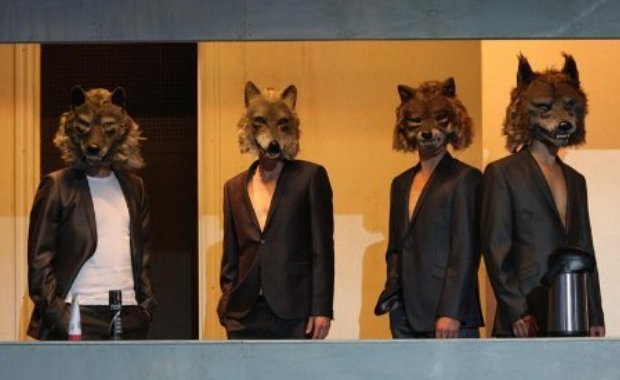
The strange irony of describing Three Kingdoms as dreamlike – which is the closest I can get to evoking its loopily surreal quality – is that I did in fact dream about the production in anticipation of seeing it. Yes, I was that excited. But my subconscious was incapable of creating anything as bizarre, visually imaginative and downright bonkers as what appeared on the stage of the Lyric Hammersmith. As in the image above, women don deer heads and are pursued by wolf-masked men; a gang of boxers violently pummel the soiled set; a strangely haunting, white-clad figure sings chilling pop song accompaniments; there is more lurid sexual content than you can shake a strap-on at.

I should perhaps point out that within the hallucinatory kaleidoscope of images there is a plot of sorts, and a detective plot no less, but this is far from your average whodunnit thriller. We begin in the middle of a police interrogation, as detective duo Ignatius and Charlie question a young man who has inadvertently thrown a severed human head into the River Thames. The forensic evidence points back to Europe, where the decapitated sex-worker has been trafficked from. With odd suddenness, the two detectives follow the trail back to the pimps and pornographers of Berlin and later – with Charlie inexplicably disappearing from the scene – to an Estonian sex-trafficking gang.

Without knowing much about European theatre – a lack of knowledge that I’m keen to remedy off the back of this – I would ignorantly speculate that the style and tone of the production shifts appropriately with the geographical location. Never is the writing more central than in the early London-based interrogations, reflecting the new writing culture of British theatre, with more than an echo of Pinter in the detectives’ swift back and forth of dialogue. As the action moves to Germany and later to Estonia, we are offered increasingly audacious visual imagery and an escalating physicality, as performers tumble through windows and spring startlingly from suitcases. It certainly feels many miles from British theatre, and bracingly so.

In this way, Nübling manages to create a disorientating visualisation of the dislocation of foreign travel, immersing us in cultures that are strikingly different to our own through the conduit of Ignatius, a man severely lost in translation and persuasively, energetically portrayed by Nicolas Tennant. In this sense, the perplexing surreality of the production is a resonant metaphor for the clash of cultures in an increasingly globalised world, where Europe is both sister and other.

Through the piece, Stephens and Nübling make us aware of our own strangely separate and insular status as an island nation, a culture that is supposedly part of Europe and yet distinctly divided from it. Our perceptions of this continent, and particularly of the still largely alien society of Eastern Europe, are both channelled and challenged. While the practice of sex-trafficking may be this play’s overt subject, the relationship between East and West demands an equally prominent place on the stage.

Related to this, language is another key concern, perhaps surprisingly in a production so anchored by the sensory. The very experience of having to read surtitles for much of the evening already puts a different slant on how this play is received, with the audience having to do the mental leg-work of reading and connecting both spoken and physical language. Translation also throws up its own issues, particularly as Ignatius is forced to rely solely on what German-speaking Charlie chooses to tell him, a potent illustration of the power of words and the fluidity of their meaning. Even when we are dealing only with English, words are important. Ignatius and Charlie verbally play with synonyms before finding the right fit, while a sentence such as “they sawed it not sliced it” (in relation to the woman’s decapitation) is an excruciating demonstration of how a slightly different word can have a vastly different effect.

While Nübling has clearly transformed Stephens’ script into a theatrical creation that is as much his own as it is the playwright’s (the word collaboration here feels fully justified), the words still dazzle on their own. There is a sharp precision to Stephens’ writing, conjuring an incisively perceptive vision of the world that emerges most powerfully through the short monologues that various characters speak. One character’s description of the market economics of sex trafficking is brutally wounding in its calculated logic; the analogy of a toilet to convey the message that “shit doesn’t go away” is a painfully apt one.

Dealing with Stephens’ script also brings me onto the relationship between writer and director, which is here figured strikingly differently to how we are used to it in this country. The respective places of the writer and the director in British theatre demand a whole other blog post, but it is worth briefly pointing out the extraordinary free rein that Stephens has given to Nübling, placing huge levels of trust in the director’s hands. Anyone interested in this area should read Alex Chisholm’s excellent essay for Exeunt, in which she questions the imposed division between “new writing” and “new work”. It is certainly worth considering whether the model posed by Stephens and Nübling could provide a way to bridge this gap in British theatre.

Moving on, in the multi-lingual environment that Stephens has created, pop music emerges as a common language. This clearly reflects Stephens’ own interests, but it also seems an appropriate demonstration of the wide-reaching penetration of some elements of culture and not others. There is a sinister irony to the way in which music is used, with romantic lyrics often clashing with the global commodification of sex and sexual violence that is being portrayed. One particularly haunting rendition of the Beatles’ Golden Slumbers still has yet to release its grip on me.

As heart-pumpingly exhilarating as this production may be, however, I cannot quite offer Three Kingdoms my wholly unfettered praise. My main problem with the piece is the way in which it treats its female victims (a word I use with caution). Is silence the way to give these women a voice? Before criticising, I can wholly appreciate and understand the perspective of this production, which is itself a primarily male product. (To briefly digress, the word “product” here feels significant. As in the sentence I have just written, products are actively created by men – the product is the object, the men the collective subject – while women in this play are referred to by the Estonian sex traffickers as the passive “product” that they trade.)

On one level, it makes perfect sense. Three Kingdoms is shocking in its treatment of women, thereby shocking us as a result. The women in the piece are largely silent because the women they represent are living in enforced silence; it seems appropriate, authentic (another word that is tainted through its particular, unsavoury use by Stephens – see my earlier point about the importance of language?).

But doesn’t this just compound the problem? Here I’d like to refer you to an exchange on Twitter between Chris Goode (@beescope) and Stella Duffy (@stellduffy) that caught my attention before I had even seen the show myself and that sums up pretty comprehensively what I’m trying to get at:

@beescope: Three Kingdoms is hugely impressive, a near-perfect match (collision?) of writer, director and intrepid actors. Still frustrating though that nobody wanting to work in those modes wholly within the British system would ever get past the gatekeepers. Also wish it didn’t revel quite so much in the misogyny it’s describing.
@stellduffy: @beescope the difficulty of representing that which we’re trying to counteract/deal with.
@beescope: @stellduffy Yeah, for sure. But it’s extra troubling when the work so completely reproduces the malaise that there’s no critical leverage. If you make the victims essentially voiceless you can come awfully close to appearing not to have noticed there’s a problem.
@stellduffy: @beescope women are abused in life. re-creating a problem is not the same as creating an alternative. sigh.

(Apologies for the awful formatting of the above, I couldn’t get a decent screenshot)

There is something to be said for exposing an issue in all its brutal ugliness, but it is disturbing and worrying that it is so rarely exposed from the perspective of those upon whom it most impacts. Women are rendered speechless throughout, either by language barriers or by fear. In one of Nübling’s many powerful images, a half-clothed female figure silently irons in the background while men watch porn on a phone screen; another woman is unable to even communicate with the men who viciously insult her.

The production also seems to revel somewhat in the sexual violence it portrays, which is upsetting and troubling on the one hand but intriguing on the other. Such is the level of dazzling visual spectacle that we are invited to become complicit spectators; Stephens and Nübling recruit the audience as a living example of the dark forces within human nature that drive the acts they are depicting. Thought of in such a way, Michael Coveney’s protestation that anyone to enjoy this experience must be “debauched beyond redemption” takes on a slightly defensive air.

Also complicit are the two detectives, whose common gender – while it may exclude greater involvement from female characters – becomes darkly significant. At the same time as doggedly pursuing their case, they are implicit participants in the industries responsible for this murder. In a chilling scene in which they watch a recording of the young woman’s beheading, they become tainted spectators, and their attitude towards the women they encounter on their investigation hints at deeper problems. The concluding twist, which I am still wrapping my head around, seems to enhance Ignatius’ guilty complicity in what he is attempting to destroy; there are no heroes here.

Another potential criticism is the plot’s gradual descent into incomprehensibility, as we are assaulted with unfathomable image upon unfathomable image in a hedonistic Estonian finale that becomes increasingly hard to follow and digest. This frustrates the very British aim of getting to the bottom of what a play is “saying”, but perhaps it is the critical approach that is at fault rather than the production. We can be determinedly blinkered as a theatrical culture and have nurtured a sort of suspicion towards theatre that asks its audiences to feel and experience as much as it asks them to think.

The very lack of meaning here seems to create a new kind of meaning. Stephens has said that Nübling never asked him what he was trying to say in his script, and perhaps we should not ask either (I am aware of the hypocritical irony of making this statement several hundred words into a piece of writing that it is, on some level, doing just that). This is theatre that demands a new way of watching and I found myself feeling hampered by the nagging knowledge that I would have to write a formal review, pestered by the panic-inducing question of how I was going to critique it. I almost wish that I could have experienced this production without the critical handcuffs binding me.

Value judgements are usually, at least by the standards of the conventional review and the purpose it serves, what make a piece of critical writing. Readers want to know whether the reviewer thinks it is “good” or “bad” theatre (note the inverted commas); they want to know whether or not they should buy a ticket, which is a valid expectation to have from a review. In this case, although I obviously did give one in the form of a star rating, I felt to an extent incapable of offering my value judgement, my thumbs up or down. But as for whether others should go to see the show, I can only offer a resounding YES. This is theatre that needs to be consumed on an individual basis, and I suspect that it may be divisive, but it should be experienced. It is made to be experienced.

As if to prove my opening point about Three Kingdoms‘ inherent challenge to mainstream theatre criticism, the majority of the mainstream press have struggled with it and, in some cases, condemned it. This style of theatre is clearly not to everyone’s taste, but it saddens and frustrates me that many of the reviews do not even attempt to engage with it on the most basic level. Instead, there has been a startling dichotomy between the verdicts of what we might call the traditional critics and the response that the production is receiving through Twitter and online critical outlets. Perhaps this heralds the realisation that we need new ways of seeing, of experiencing, of expressing. And perhaps that isn’t such a bad thing.

For some other interesting approaches to Three Kingdoms, try taking a look at reviews by Andrew Haydon and Daniel B. Yates. And for anyone wanting a more visual impression of the production (as only seems appropriate), see the Lyric’s trailer below:

Lovesong, Lyric Hammersmith

The past may be a foreign country, but we sure like travelling there. In the latest production from Frantic Assembly, past and present share the stage in a tender tearjerker about love, time and memory.

The story itself is seductively simple. An old married couple, Billy and Maggie, are nearing the end of their time together as Maggie’s health steadily deteriorates. Meanwhile they are consumed by the shadows of their younger selves that dance – quite literally – through their home. Through these memories, we are introduced to the couple at the beginning of their marriage, following them from honeymoon glow to the appearance of the first cracks in their relationship. We learn that they have emigrated together to the States, where Billy sets up a dentistry practice and they wait for children that stubbornly refuse to come.

By intertwining the lives of this couple at different ages, playwright Abi Morgan (the prolific writer-of-the moment behind The Hour and The Iron Lady among others) is able to give us a fairly comprehensive picture of their marriage. This is no idyllic portrait of perfect love; we see Billy and Maggie bicker and fight, we experience their frustration at their childlessness and witness them both momentarily waver when faced with the temptation of adultery. But we also see how, in old age, they have come to rely on one another in a marriage that has ultimately survived through the years.

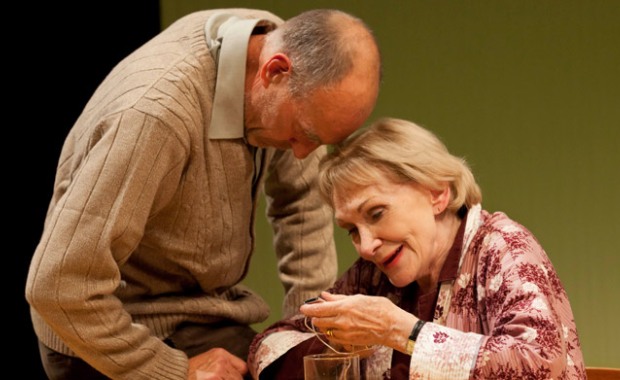
Morgan’s script is brought beautifully and captivatingly to the stage by Frantic Assembly, who unite evocative movement with stunning sound and design. Under the direction of Scott Graham and Steven Hoggett, Billy and Maggie’s past and present selves collide, embrace, dance and separate, all to Carolyn Downing’s moving soundtrack. In one standout moment, the present-day Maggie, heartbreakingly played by Siân Phillips, tries on a treasured pair of shoes from her youth and stumbles through the house. The emotional effect is little short of devastating.

There is no doubt about it, this is meant to make us cry. Frantic Assembly’s production, helped along by an outstanding cast, is unapologetically manipulative, working on our collective tear-ducts with nimble, tender touches until the audience is reduced to a symphony of sniffles. Morgan has cannily tapped into fears that assail us all; we weep not just for Billy and Maggie, but for the inevitability of our own demise and that of our loved ones. Yet, for all that it tugs delicately on the emotions, I can’t help but wish that Lovesong was a little less insistent on leaving its spectators damp-faced.

When not pulling mercilessly at the heartstrings, Lovesong raises some fascinating questions. Far from being merely a eulogy on a love story that is at its imminent end, Morgan’s play prods at some of the deeper concerns that ripple through our existence. How, for instance, do we create our own legacy? As Billy contemplates the end, the optimism of his youth all faded, the only marker of his life seems likely to be his perfectly maintained set of gnashers. The young Maggie’s imagination, meanwhile, is captured by the cave drawings left behind by early humans – drawings that she and Billy later run their hands over together, imprinting these pre-historic images with the story of their own love.

But by far the most intriguing theme to thread through Billy and Maggie’s story is that of time and its linearity or otherwise. The intersection of past and present, while primarily redolent of the potency of memory, asks inherent questions about our conception of time, questions that arise again when Billy introduces different theories of time. Are our lives really lived along a straight line, or is time far more complex than we could imagine? These are ideas that, mirroring Graham and Hoggett’s haunting choreography, are repeatedly caressed and skimmed over, but that this production ultimately loses grasp of.

There is no shame in a piece of theatre about love and death – two of life’s few universal certainties – and especially a piece of theatre that handles these themes as deftly as Lovesong does. Tears, however, have an unfortunate tendency to blur the vision, obscuring the lighter nuances of what Morgan is saying. Exquisitely moving though it may be, in the wake of this strong tide of emotion emerges a yearning for something slightly more clear-sighted.

Lovesong runs at Lyric Hammersmith until 4 February.

Image: Johan Persson