Blurred Lines, National Theatre

blurred-lines-600x374

Originally written for Exeunt.

Back in November of last year, myself and others were questioning the underrepresentation of female playwrights in the National Theatre’s 50th anniversary gala – and in its programming more broadly. Now, only a couple of months later, the fierce final scene of a new show with an all-female cast and a majority female creative team boldly critiques the venue’s gender inequalities from within its very walls. It’s nowhere near a solution, and one self-reflexive show in the theatre’s smallest, most risk-friendly space is no reason to get complacent, but it feels like a start.

The context for Carrie Cracknell and Nick Payne’s new show is right there in the title. Robin Thicke’s misogynistic song and accompanying video were just the most visible tip of the iceberg in a year that outdid itself in terms of casual sexism and media objectification of women. But 2013 was also a year in which feminism was very much part of the public discourse, a discourse that Blurred Lines continues. It is less a play than a theatrical conversation; an ongoing discussion about insidious, background sexism in its many mutating forms.

The show, devised by the company with Cracknell and Payne, promises to interrogate all areas of gender politics, from the media to the workplace to the home. It’s a big ask. To tackle these myriad forms of sexism, the piece deploys what are perhaps best described as a series of sketches. We see, for instance, a conversation between a married couple about the husband’s visits to prostitutes; the repeated shooting of a television scene in which a woman is assaulted; an office confrontation in which it is made clear that success for a few individuals does not translate into equality for the many. Given the force with which that latter point was made in Top Girls in 1982, it’s telling that it still needs to be reiterated.

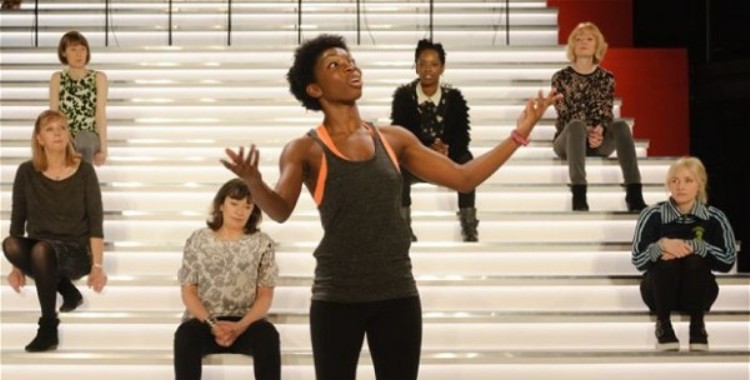
These swift, punchy scenes, punctuated with performances of songs that cheekily and sometimes explosively critique the depiction of women in popular music, are all played out on the huge white staircase of Bunny Christie’s design. This installation, complete with colour-changing lights, boldly thrusts out into the Shed’s modest performance space, itself acting as a sort of intervention. It frames the female performers in ways that at times reflect the objectifying aesthetics of music videos and advertisements, but at others set up an uncomfortably close confrontation with the audience, while the steps themselves are suggestive of the distance that we still have to climb.

But what Blurred Lines is perhaps most successful at exposing is the sexism that remains rife within theatre itself. The piece opens with a series of statements spoken in turn by the performers: “girl next door”, “single mum”, “Northern blonde, bubbly”. It soon becomes clear that these are roles, referring at once to casting types, dominant cultural perceptions and the desperately restrictive boxes that women are expected to fit into in everyday life. This critique of what roles women are allowed to play remains implicit throughout, coming to a head in the final scene. While this powerful conclusion risks being something of a theatrical in-joke, alienating those who might not catch its shrewd self-referential nods, it is an important move towards theatre owning up to its own failings when it comes to gender (in)equality.

Representation is also at stake in other ways. Throwing together a cacophony of female voices, the piece is careful never to directly speak for or represent any one woman. When an individual’s story is told, as in the narrative of a teenage girl who is sexually assaulted by her partner, it is transmitted through multiple voices and in a fragmented structure. Straightforward portrayal of anyone who might be construed as a victim – perhaps most prominent among the roles available to women – is deliberately avoided. This also points, though obliquely, at the persistent tendency to take one woman as a representative for her entire sex, a tendency that the company stubbornly refuse.

On another, simpler level, the very fact of an all-female cast does interesting things to the staging of sexism. Every male character in the piece is, necessarily, played by a woman. This inversion makes an intriguing contrast with, say, Three Kingdoms, which despite sharply skewering misogyny, still placed it – potentially problematically – in the mouths of men. In this production, the exchange of misogynistic expressions between an all-female cast furiously underlines them, while managing to subtly subvert these views at the same time as reproducing them.

Yet women are still, with unsettling frequency, seen as victims here. That ranges from victims of violence to victims of workplace prejudice, but time and again they are rendered voiceless and frustrated. The intention is understandable; like the Everyday Sexism project, the piece attempts to unmask the latent sexism that pervades our society, often going unnoticed and unremarked upon. The bitter familiarity of many of these scenes provokes both recognition and discomfort, but it leaves us mired in our current situation rather than looking towards any solutions.

Of course, the very existence of this production and its team of talented women is a form of action in itself, and perhaps it is apt that we are left to continue the conversation and fight ongoing injustices. To downplay the scale of inequality and let the audience off the hook would be irresponsible. Nonetheless, there is something a little disheartening about a piece of theatre with such fire in its belly that insists on simply presenting and representing all too familiar portraits of sexism and victimhood.

Scene Changes: Theatre Criticism

As part of the National Theatre’s 50th anniversary celebrations, I spoke on one of the Scene Changes platforms on the subject of theatre criticism. I was part of a panel alongside Michael Billington, Andrew Clarke and Mark Shenton and the discussion was chaired by Dan Rebellato.

Open dialogue

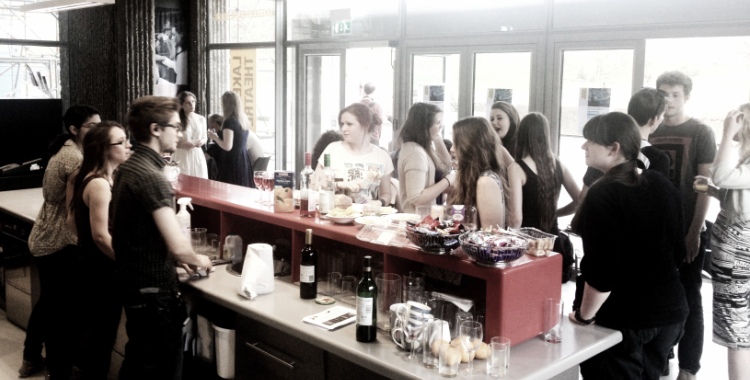
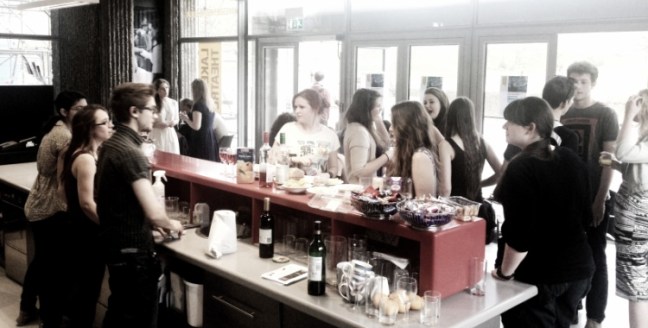
Colchester 24.4.13 Theatre Arts Society and Frequency Theatre ViTW Reception 2 (2)

Originally written for The Stage.

The post-show discussion does not have the best of reputations. What should be an opportunity to share thoughts and gain artistic insights often becomes a stilted Q&A, a one-sided stream of anecdotes, or an unspoken contest to see who can ask the most intelligent question. But what about a post-show discussion for people who hate post-show discussions?

One of those people – by her own admission – is Lily Einhorn, project manager of the Young Vic’s Two Boroughs community engagement scheme. The project offers free tickets to residents of the boroughs of Lambeth and Southwark, many of whom Einhorn noticed were attending the theatre on their own. Recognising the lack of opportunity these theatregoers might have to discuss the work they were seeing, and acknowledging that the usual post-show format might alienate or intimidate them, Einhorn set about creating an alternative.

The Two Boroughs Theatre Club is modelled on the book club format: rather than being plunged straight into discussion immediately following a show, recipients of Two Boroughs free tickets are invited back after they have all had a chance to watch and reflect on a production. And just as a book club would never dream of inviting the author, Einhorn is firm that no members of the artistic team should be present for the discussion facilitated by the Theatre Club.

“I thought it would be really nice to have a group where the creative team are strictly not allowed,” Einhorn explains, “because I wanted it to be a comfortable atmosphere where people felt like they could say anything they wanted without fear of offending anyone, but also without fear of feeling like they’re stupid.” She continues, “it’s about unlocking something in them and saying: ‘your opinions are as valid as anyone else’s opinions’”.

Einhorn’s brainchild has been run in partnership with Guardian writer and Dialogue co-creator Maddy Costa, who has similar reservations about the traditional post-show format. “We all kind of hate the post-show discussion where everyone’s trying to ask the most interesting question,” she says. “So Lily and I both agreed that we don’t even go to those things; what we wanted to create was something different.” Their Theatre Club is designed to be as welcoming as possible, doing away with the hierarchies that usually characterise post-show events and creating a space that allows for relaxed, open discussion. The response has been enthusiastic, prompting Costa to try it out at other theatres, both through Dialogue and in association with theatre producers Fuel.

Einhorn and Costa are not the only ones seeking alternative models to the post-show Q&A. Camden People’s Theatre, for instance, has created a format it calls Talk Show Club, in which discussion is led by another theatre-maker who has not been involved with the show in question. China Plate, meanwhile, has adapted the post-show events surrounding its latest tour of Mess to suit the specific needs of both production and audience. Caroline Horton’s show is based on her own experiences of anorexia, opening up numerous issues around eating disorders. In recognition of this, China Plate are currently touring the show in association with the charity BEAT, taking it into schools and colleges as well as theatres and running a tailored series of discussions and workshops designed with psychiatrists from Kings College Hospital.

While numerous practitioners are currently experimenting with different formats, the idea of a model that eschews the post-show set-up of questions and answers is not entirely new. The National Theatre’s Platforms programme, which has been running almost as long as the theatre itself, is decidedly not post-show. Instead, the building runs regular events in the slot before its evening shows, ranging from straightforward discussions about the productions in the current repertoire to conversations that address the programme more obliquely. In the past, for example, Platforms have hosted numerous comedians and politicians, as well as a memorable encounter between atheist writer Philip Pullman and the Archbishop of Canterbury.

“It isn’t about being immediately reactive, audience wise, to what you’ve just seen,” says Platforms programmer Angus MacKechnie. “It’s either about making a choice to learn more about what you have seen on a previous occasion or coming to prepare yourself in advance of seeing it, usually on that night.” As a result, MacKechnie suggests that “it’s a different kind of commitment from audiences and we get a different kind of relationship with the audiences”. Because of the absence of an educational focus, MacKechnie explains that these events also offer audience members the opportunity to ask questions that they might not normally voice.

The desire to make critical conversations around theatre more inclusive and accessible is a feature that many of these initiatives share. The Theatre Club discussions might be guided by Costa, but the principle is that everyone in the room is equal and free to share their thoughts. “I am not the person with all the answers,” Costa makes clear, “I go in with as many questions as anyone else.” In line with this approach, Fuel’s co-directors Kate McGrath and Louise Blackwell make it clear that the Theatre Club events represent “one of the key ways that we are building new audiences and making our work more accessible”. Lorna Rees, one of Fuel’s local engagement specialists and a regular organiser of post-show events, puts her attitude simply: “for me there are no ‘silly questions’”.

Crucially, all of these events are about contact and conversation. MacKechnie insists that at the National Theatre “we don’t just drop the curtain and that’s it, you haven’t got any more contact with us”, while for Einhorn the Two Boroughs Theatre Club is about “prolonging and enriching” the theatregoing experiences of its participants. The conversation itself, meanwhile, is one in which exclusive, specialist vocabulary is exchanged for straightforward, honest expression. For Costa, it all comes down to a simple but vital distinction: “Theatre Club is a place where we don’t ‘speak’ theatre, we talk about theatre, and those are two very, very different things”.

Conversation Starters

  • Maddy Costa and Fuel have found that offering refreshments instantly shifts the mood of a post-show event, transforming it into a welcoming social context. As Kate McGrath and Louise Blackwell put it, “you don’t have to spend a lot on hospitality, but you do have to be hospitable”.
  • It can also help to move the discussion out of the theatre space. While the National Theatre’s Platforms have successfully used the stage, Lorna Rees suggests that sometimes the auditorium “can be quite intimidating and not conducive to discussion”.
  • Involving the audience does not have to be difficult or complicated. Costa explains, “I always start by just getting a quick show of hands, did you like it, did you not like it, something very simple like that”.
  • Angus MacKechnie recommends experimenting with the format and fitting it to the context of discussion. “In terms of format, form should follow function,” he says.
  • Fuel point out that it must be clear where and how the event is taking place, so they recommend sending out invitations, putting up flyers and making sure box office staff are fully briefed.

Photo: The Lakeside Theatre, Colchester.

The Light Princess, National Theatre

LightPrincessNT3©-Binkhoff-Mögenburg_2-600x399

Originally written for Exeunt.

There can be little doubt by now that fairytales are a fertile source of artistic inspiration. And, as Angela Carter brilliantly proved with The Bloody Chamber,they are certainly not just for children. The long-awaited musical by Tori Amos and Samuel Adamson attempts to follow in this line of interpretation, adding considerable narrative and thematic padding to the 1867 tale by George MacDonald. Unfortunately, the result is less innovative than it is wedded to convention and archetype – not so much reinventing fairytale tropes as giving them a light prod.

The premise itself is intriguing. Althea, played by Rosalie Craig in a dazzling central performance, has no gravity. The princess hovers perpetually above the earth – not flying, but floating – unable to keep her feet or her thoughts rooted to the ground. Following the death of her mother, Althea’s head is in the clouds in more ways than one; she is buoyant in spirit as well as body, living in a fantasy of her own construction and incapable of taking anything seriously. Her opposite number is another motherless royal, Prince Digby, who reacts to grief not with escapism but with unrelenting sorrow. Thanks to the warring of their two nations, Lagobel and Sealand, the two are quickly set on a collision course – one that any fairytale fan can see will end in romance.

From the initial lengthy exposition onwards, the musical teeters uncertainly between straightforward fantasy and impish irreverence. In its most enjoyable moments, it is knowingly playful, referencing and occasionally sending up its fairytale heritage. Matthew Robbins’ animations, which lend a hand with the early storytelling, have an appealing picture-book quality, while the “once upon a time” framing of the narrative by Amy Booth-Steel and Kane Oliver Parry offers glimpses of arch wit. Elsewhere, however, the show slides all too smoothly into established patterns. There is nothing essentially wrong with conforming to fairytale conventions – they haven’t endured for hundreds of years for nothing – but The Light Princess never seems quite sure what it is doing with these inherited devices.

Equally, Amos and Adamson’s flimsy plot makes a cursory and often clumsy attempt at feminist revisionism. Mentions of Angela Carter in the programme notes – known, of course, for her own feminist appropriation of fantastical narratives – raise hopes that the piece itself all but dashes. Yes, Althea’s characterisation is a bit more complex than your average Disney princess, and yes the final tying up of loose ends raises a couple of cheers for strong women, but on the whole the storyline is hardly subversive. Even in the supremely capable hands of Craig, Althea is not a patch on one of Carter’s heroines.

Despite these flaws, however, there is a fair amount of enchantment in Marianne Elliott’s inventively staged production. Rae Smith’s design occasionally veers towards the indulgently saccharine, but at its best it conjures the spirit of heightened, wide-eyed wonderment that is at the heart of all good fairytales. There’s also some charming puppetry and a series of giddying acrobatics to create the illusion of Althea’s weightlessness – so giddying, in fact, that the sheer awe they inspire can be distracting. Craig, meanwhile, is stunning in the central role, achieving Althea’s floating physicality with an apparent effortlessness that must in fact be extremely effortful, while lending her belting voice to Amos’ surprisingly unmemorable score.

But just as the production seems about to sweep us off our feet – as during the aerial stunts of the unapologetically romantic first encounter between Althea and Digby, or in an altogether darker scene that finds its heroine suddenly earthbound – it struggles to maintain the flight that is so natural to Althea. Caught between playful subversion and faithfully rendered magic, The Light Princess fails to deliver on either.

Photo: Binkhoff Mögenburg

Table, National Theatre Shed

table11-600x399

Originally written for Exeunt.

It seems appropriate that the first show in the National Theatre’s new, temporary performance space on the South Bank should announce itself just as plainly and unassumingly as its venue. Table, the world premiere christening The Shed, is about just that, using a tough wooden dining table as the focal point for a domestic tale that straddles the generations. Tanya Ronder’s play, tracing 115 years of one family’s tumultuous history, zooms in on the stains that can’t be scrubbed away, the grit that remains lodged in the grooves of the wood and the messages carved indelibly on its surface. Her eponymous piece of furniture is living history, speaking just as loudly as its human owners.

Katrina Lindsay’s design furnishes the intimate interior of The Shed with not one but two tables, the raised wooden space of the stage mirroring the sturdy domestic linchpin that sits upon it. Hewn with love and breathless hopes for the future, this stubbornly resilient item of furniture begins life as the creation of carpenter David Best, made to sit in the home he makes with his wife in late nineteenth-century Lichfield. From here, it is passed down from generation to generation, journeying first to a convent in Africa and then back to England and a hippy commune in Herefordshire, before finally ending up as the battered, beloved centrepiece of a family home in South London. Along the way it witnesses sex and betrayal, deaths and births, the grime and the mess and the joy of human life.

Ronder packs a lot into the play’s two hours and 20 minutes, at times resorting to the crowbar. From troubled nuclear families to a convent of missionary nuns, from a commune dedicated to alternative living to a gay couple with a half-Asian daughter born through a surrogate, there is a determination to portray as many different living arrangements as possible over the span of six generations. While this tactic provides colour and continual interest, the limits of plausibility are occasionally stretched, and some scenes – such as the painfully stereotypical commune, complete with goat’s milk and bed-swapping – seem inserted purely for laughs. The first half of the show is tight and cannily plotted, engaging the emotions with impressive rapidity, but as the narrative goes on the grip progressively slackens.

Although Ronder’s plot may run away from her, Norris’ sensitive, precise direction offers up some heart-catchingly beautiful moments: the presciently precarious, delicate image of David’s short-lived bride ascending a row of chairs in her wedding gown; the use of the table as a womb giving birth to the next generation, from which a protectively curled performer tumbles, Bambi-like, all helplessly flailing limbs; the gorgeous sequences of song that cradle the piece, smoothly linking scenes while nodding to ritual and familiarity. The production also benefits from a set of uniformly committed performances from its cast, who wring extraordinarily vivid characterisations from Ronder’s series of fleeting snapshots.

For all that this journey through the generations might be contrived – and, make no mistake, it is – the slightness of its meandering plot is balanced by a charm that begs forgiveness for its flaws. But when the smile fades, this production still leaves us wondering what it might be saying about the family, a unit of living that receives just as much of a bashing over the years as the table that unwaveringly anchors it. Are we damned by what we inherit, both in terms of the traits passed down to us and the upbringing we receive? Ronder’s generation game would seem to suggest so, as each successive member of the Best family kicks against what has come before but inevitably makes similar mistakes; generation upon generation of children knowingly or unknowingly wronged by their parents. And by the end, even our old friend the table is endangered, at threat of being replaced by a sleekly functional sliver of glass from Ikea. History might be deeply ingrained, but we are all too good at forgetting.