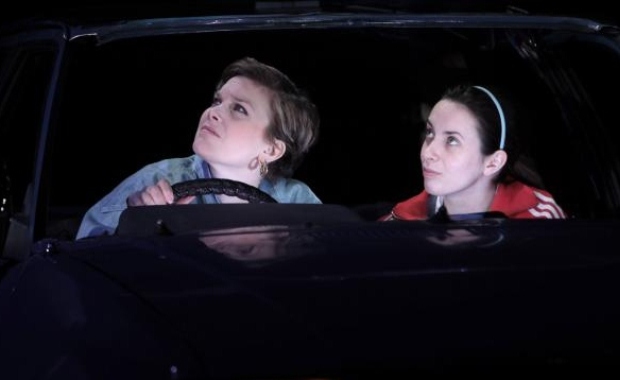
Port, National Theatre

port1

Originally written for Exeunt.

There’s a striking moment, towards the end of this nostalgic, grit-flecked portrait of Stockport, when the concrete-clad surroundings perceptibly shift. Protagonist Rachael, back in her home town after several months away, remembers once gazing up at the clocktower as a soaring skyscraper, a local landmark of immense proportions that in adulthood has dwindled to a mere speck on a vast world. It’s a simple moment, but one that speaks to the shifting space in which we play out our lives, the contours that seem to move and blur as we grow older, the once huge monuments that now feel inconceivably small.

Geography – or more accurately psychogeography – is central to this story of growing up in Stockport, which announces its preoccupation with place in its very title. Rachael, who over the course of the play transforms from a gobbily precocious eleven-year-old to a bruised but optimistic woman of 24, fighting fiercely all the while to get out of the place that has spawned her, is trapped in a town populated with ghosts. First Rachael’s mother and then her grandfather make swift exits from her life, leaving behind traces in the frayed urban fabric. Past exists alongside present in a way that is reflected in the circumstances of this production, a revival of the play’s 2002 premiere at the Royal Exchange Theatre headed by the same creative pairing of Simon Stephens and Marianne Elliott, equally haunted by their own memories of the shared home town that shaped them.

While the naturalistically rendered environment of this nostalgia trip vividly conjures the bus stops, battered cars and hospital waiting rooms of Rachael’s world, the space of the Lyttelton stage is engaged in more than a simple one-way exchange with the piece. Between the play’s collection of snapshot scenes, Lizzie Clachan’s beautifully constructed designs conspicuously dismantle around the perceptive central character as she very deliberately looks on, participating in her own transformation at the same time as the space transforms with her. This is habitat as clothing, old haunts shrugged off like school jumpers; the landscape seismically shifting within the perspective of the protagonist whose eyes we see it through as she struggles with family crises and collapsing relationships. Light, from anaemic fluorescent tubes to a heart-catchingly hopeful sunrise, is more than just illumination – it is frustration and desire.

This eloquent dialogue with the content stretches from the way the production looks into the way it sounds. Just as the concrete pulses with the pop music of a decade that played to the soundtrack of The Stone Roses and Oasis, so the structure of the play as a whole jitters and jumps to an almost musical score. The pace, beginning at a frustratingly slow patter, speeds and slows across the eight distinct scenes, with occasional furious rises in pitch that rip through the rhythm of the drama; repeated themes – home, childhood, fear of death – loop back around in refrains, or perhaps more like tracks that keep returning on shuffle. The whole is sometimes frustrating, sometimes catchy, but with a chorus that climbs insistently into the ear.

Amid all this movement and sound, it’s hardly surprising that Rachael repeatedly refers to the world as “mental”, with the double implication of inconceivable, unjust madness and a psychological dimension to the version of Stockport that we are presented with through her experience. Rachael is a challenge and a gift of a role, a complex, wounded but resolutely optimistic figure, who in the hands of Kate O’Flynn is unceasingly engaging. So captivating is this central presence that the characters around her often feel lightly sketched, faded and drab alongside her vivid outline, barely less ghost-like than the gaping absences in Rachael’s life.

While the grim realities that Port portrays have not evaporated, the nostalgic tint of the production is a reminder that today’s world, more than a decade after Rachael’s closing look at her home town, is in many ways a very different place. There is a heavy sense of this particularly in the play’s build-up to the turn of the millennium, at which Rachael ponders whether this break represents a beginning or an end. Thirteen years later, as this production is inevitably refracted through subsequent events, it’s a question we still seem to be asking. Just as the play’s cyclical structure rewinds the track back to the beginning, we often end up in the same place we started in.

A Change of Scene

Originally written for Exeunt.

Sitting folded origami-like in my seat in the balcony of the Royal Court, I can’t fight a certain nagging irritation at the peripheries of my perception. Captivating as its disconnected scenes are, there’s something distracting about Love and Information, Caryl Churchill’s new piece about the knowledge onslaught of the digital age. Or, more accurately, it’s the lack of distraction that becomes distracting in itself. Staged in Miriam Buether’s open-sided white cube of a set, each of Churchill’s 57 miniature plays is punctuated by a blackout, during which cast members and props are swiftly, invisibly switched. Each scene is surgically removed with such precision that not even a scar remains.

It’s a dizzying feat of stage management, but in its very invisibility it attracts attention. Doing away with the creaking, carefully ignored dragging on and off of props by stage hands and cast members, the production instead leaves a gaping black hole into which our latent anxieties about the craft of the stage are helplessly sucked. It might be seen as an inversion of the effect of Mike Leigh’s Grief at the National Theatre last year, in which tiny tweaks to the meticulously naturalistic set were made with unapologetic conspicuousness. Only when pronounced in either its presence or absence, it would seem, does the inherently awkward scene change impinge on the audience’s consciousness.

The scene change, as a convention, is a culturally conditioned blind spot in the illusion of representational theatre, an unseemly blip that we as an audience collectively ignore. We can handle a table being spirited in by black-clad figures in semi-darkness, or characters suddenly, inexplicably transporting chairs off with them upon their exit; this is all part of a game whose rules we are smug in the knowledge of. We know how this works. It’s the disruption of those rules and thus the unveiling of the game that causes discomfort, a discomfort that might fall under theatre academic Nicholas Ridout’s diagnosis of the “ontological queasiness” that theatre is capable of producing.

Much like Ridout’s description of the unsettling experience of a face-to-face encounter during a performance, a break in the conventions of the scene change can cause an uncertain lurch, a disconnect between the accepted illusion and the reality behind it. We’re aware not only that this isn’t real, which we knew all along even if we’d suppressed that knowledge, but that we have been willing participants in the illusion. What we’d ignored is suddenly impossible to ignore, either in its overt interference or its glaring absence. To take the resulting discomfort a step further, it might be suggested, to stick with Ridout, that our blushing reaction is caused by an acknowledgement of the economic relations at play: we’ve paid for people to shift the set around and agreed an unspoken contract to pretend that they’re not there.

So we could just see these odd dislocations as inadvertent slip-ups, of over-efficiency in the case of Love and Information and of sheer clumsiness in Grief, slip-ups that throw open the true nature of the economic exchange upon which theatre is based. But the more I think about these two examples, the more I wonder if there might be more to the simple scene change than a necessary movement of props that can choose to either conceal or expose its seams.

While at the time of watching Grief the constant to-ing and fro-ing of stage hands was a frustrating distraction and the small changes it was all in aid of seemed to be a hint that Leigh had become more accustomed to the cutting room than the stage, in retrospect it acquires more significance. Why construct such a perfectly observed sphere of naturalism, down to the last precisely placed photo frame, just to smash that illusion apart with the intrusion of backstage mechanisms?

Assuming, as I think good criticism should, that creative choices have been made for a reason, it is perhaps more productive to think of these intrusions as a deliberate jolting of the hermetically sealed suburbia in which Leigh’s protagonists exist. The changing of a vase of flowers or the tidying of a pile of newspapers, alterations so small they are laughable, could in this context be read as a comment on the essentially unchanging atmosphere of this household, a decaying stasis that is at the heart of the piece. These tiny adjustments mock the fatal lack of any real transformation. Scene change, if interpreted thus, is thematically enmeshed with scene; stagecraft reflects the content of the stage.

Likewise, the dazzling smoothness of Love and Information’s transitions would seem, when investigated in conjunction with the piece as a whole, to have a guiding rationale. Buether’s minimal container of a stage, with its clinical white glow, recalls the screen of a computer or smartphone; as actors and props appear and disappear with a magically seamless lack of fuss, the experience of viewing is strikingly similar to the experience of clicking through videos or apps. What we are witnessing is a series of downloads in an age of unlimited digital information.

These are striking but certainly not solitary examples. It would be naive and potentially insulting to suggest that no more creative thought is invested in the transition between scenes beyond which piece of furniture needs to be shifted where. But perhaps from a critical perspective, when we encounter the humble scene change, we ought to start considering this seemingly unremarkable feature of the stage as something that might alter more than just the props or signified location – as something that has the power to truly change and shape the situation being presented.

This House, National Theatre

Originally written for Exeunt.

The opposing benches in the House of Commons are placed at a calculated distance of exactly two swords’ lengths apart; it is an arena which was, from the very first, built with confrontation in mind. It is also an arena which, conveniently for the purposes of theatre, is no stranger to performance. The focus of James Graham’s new play, however, peels back the overtly theatrical space of ministerial speechifying to take a peek backstage, at the applying of the warpaint and the cracking of the whip.

His subject is a chapter of parliamentary history in which that largely invisible behind-the-scenes discipline was pivotal. The phrase “you couldn’t make it up” – avoided by Graham’s script but ever implicitly present in the farcical political wranglings presented on stage – is arguably more applicable to the parliament of 1974-9 than to any other period in recent political history. With little to no majority, Labour’s precarious position of governing rested on a “tug of war”, determined by who could exert the strongest pull on the “odds and sods” and the wavering backbenchers.

Placed in the heart of this parliamentary battlefield, Jeremy Herrin’s production constructs a compromised version of immersiveness, in which the audience are decidedly located within the sphere of the Commons but at a remove from its machinations. We are privileged observers, but never actors – a lack of agency that forms a fitting reflection of the average citizen’s place at the sidelines of politics. Rae Smith’s design has transformed the Cottesloe into parliament in miniature; the stage is flanked by those familiar, aggressively arranged benches, while the performance space itself is sharply divided into the government and opposition whips’ offices, the scene of scheming, dealing and ruthless backstage manoeuvring. No consensus politics here.

While the padded green benches on which we sit and the near-constant presence of the bewigged Speaker provide the perpetual visual backdrop of the Commons, the power games and posturing at play here might just as easily be taking place in the office or the schoolyard. This latter reference is brought to mind by the blackboard that haunts the government whips’ office, its chalked up political allegiances like marks against Labour’s governing. The schoolboy atmosphere of insecurities and one-upmanship extends into the spiritedly boisterous performances of the largely male cast, dominated by rival deputy whips Philip Glenister and Charles Edwards, who clog the air of both offices with frustrated testosterone.

As fascinating as this bizarre slice of politics is, the production seems also to be engaged with wider concerns. Primarily through the rivalry between Glenister’s and Edwards’ characters, Graham suggests that human nature is both the downfall and the triumph of politics, what gets in its way and what propels it forwards. It is an intriguing idea, but one that is not quite given room to be fully unpacked amid everything else at play. What This House does achieve with smiling clarity is a precise portrait of the foibles of the British political system, a system encumbered with idiosyncratic traditions and described as “creaking” and “diseased”, but a system that is at the same time implicitly compared with the giant clock in whose shadow the seat of power lies; both old, but still ticking away.

While Graham has delicately patched together an intricate and frequently compelling account of this curious caesura in twentieth-century politics, the complexities of these slippery deals and the very nature of the parliamentary stalemate that is its subject form something of a barrier. In the words of one frustrated MP, “this isn’t parliament, it’s a fucking purgatory”. Though at the end of the impasse, as Margaret Thatcher’s disembodied promise of “hope” echoes around the Cottesloe, this production makes it hard not to feel that this state of limbo might have been better than what was to follow.

DNA, Unicorn Theatre

A group of teenagers are in trouble. Big trouble. What began as a playful bit of bullying – ‘a laugh’ – has spun wildly out of control and one of their classmates now lies dead in the woods. The only solution, as it appears to this shocked group of youngsters, is to cover it up. It seems like they might just get away with murder, but the lie that they have fabricated soon becomes bigger than they could have anticipated in Dennis Kelly’s unsettling thriller, originally written for the National Theatre’s Connections programme and now revived by the Hull Truck Theatre.

Unlike some other dramatists targeting troubled youth as their subject matter, Kelly does not patronise his adolescent protagonists, nor does he dwell gratuitously on their violence. The terrible act that binds the group together takes place off stage, as does a subsequent instance of violence, thus refusing to make these shocking events the visual centrepiece of the play. Instead, this incident becomes a springboard to explore this group of teenagers and their relationship to the world and one another, relationships that are heightened by the predicament they find themselves in. The central moral dilemma faced by the teenagers – is it better to come clean or to cover up what they have done for the greater good of the group? – is the hinge of the piece, but is far from the only issue that Kelly is prodding at.

Much of these issues are communicated through the character of Leah, who barely pauses for breath throughout most of the play. In a constant stream of chatter that betrays her brittle insecurity and desperate need to be liked, this waffling yet oddly insightful teenager touches on profound questions of time, meaning and the nature of humanity in a delicately poignant performance from Leah Brotherhead. While the unrelenting talk occasionally verges on the irritating, Kelly has wrapped up in Leah that very teenage contradiction of developing self-awareness and crippling anxiety, and through her seemingly light conversation begins to get close to the truth of what it is to be trapped in the confusion of adolescence.

Leah’s verbal diarrhoea is contrasted with the brooding, indifferent silence of her companion Phil, who seems more intent on his food than on anything she spouts. Crisps, sweets, a waffle meticulously drizzled with jam – rarely has food occupied such a demanding place in centre stage. Despite barely uttering a word, James Alexandrou pulls off the most genuinely disturbing performance of the piece as this determinedly mute yet commanding figure, and when he does open his mouth he formulates a plan to get the group out of trouble with the calm, calculated precision of a psychopath. The most impressive achievement of Kelly’s writing, however, is his lack of condemnation; while we appreciate that what this group of teenagers have done is deeply wrong, we continue to be compelled to care about them and even to an extent to understand the situation that they have backed themselves into. This, we can imagine, is just what a group of panicking teenagers might do when offered what seems to be a way out.

While the young characters themselves are for the most part rendered plausibly – if perhaps a little less foul-mouthed than might be expected under the circumstances – the world that Kelly has created has a nightmarish, surreal quality, with echoes of Lord of the Flies inevitably raising their voices. Before the squirming teenagers know it, they are blocked in behind the bars of their own lie, forced down the increasingly twisting paths of a complex labyrinth of deceit. They have fallen down the rabbit hole and there is no way out. The sense of heightened reality is intensified by the pulsing lights and dazzling projections of this production’s simple but striking design, although the mat of grass that is regularly dragged out for Phil and Leah’s scenes together seems an unnecessary item of clutter in an otherwise effectively minimal set.

For such a darkly atmospheric piece, however, there is a sense in which this feels oddly, paradoxically safe. The description of Adam’s death, while building escalating tension, lacks a chill of horror; we never experience the visceral shiver of shock that ought to accompany the darkening action. This may partly be due to a certain elusive ingredient missing from Anthony Banks’ otherwise impressive production, but I suspect that it might have more to do with the text’s uptake by the GCSE curriculum. I certainly have nothing against introducing schoolchildren to such compelling and challenging work – this is just the sort of thing that we should be encouraging young people to see – but I fear that this revival, which has clearly been created with students in mind, has taken the edge off Kelly’s script. Ironically, it is that very edge that might have really captured the attention of its young audience.

DNA runs at the Unicorn Theatre until 28 April and is then touring until 25 May.

Image: Simon Annand