Naturalism, Optimism and Donuts

WEB-superior-donuts-rehearsals-019-21

Originally written for Exeunt.

Ned Bennett is telling me a story about the back wall of the Royal Court, a fixture held in reverential affection by a good chunk of the theatre community. During preparations for The Ritual Slaughter of Gorge Mastromas, the ordinarily black wall – which was visible for portions of the show – had to be made to look like exposed brickwork. Instead of stripping the paint back to the bricks beneath it, Bennett explains, the black surface was painted over with brick-effect artwork. Bricks painted to look like bricks.

This small absurdity is oddly apt for both the postmodern commentary of Gorge Mastromas, in which surface is everything, and for the self-mythologizing urges of the Royal Court. Few theatres are quite so invested in their own history. Bennett emerges fresh from this environment, having just finished a year as trainee director with the theatre, in twelve months that spanned the departure of Dominic Cooke, the arrival of Vicky Featherstone, and the whirlwind festival of Open Court. It was nothing if not a baptism of fire.

“It was certainly demystified in no small way,” Bennett admits, agreeing that there is a potentially intimidating aspect to the building’s status within modern British theatre. “It’s funny, though,” he goes on, “you go in being aware of all the history … and it feels like it’s very important to acknowledge the history, then kind of leave it at the door, as it were, and see what’s happening next.”

Despite the demystification, Bennett clearly still holds a fierce affection for the theatre and the projects he worked on during his time there, which ranged from directing a production that toured around schools to being right in the thick of Open Court. “I’d always admired, respected, loved the theatre,” he says, “but what never ceases to amaze me about the building – and this is proper gushy – is how uncynical it is, how uncynical a place to work it is. It is all about trying to create the most interesting, most urgent, most exciting plays, and they’re a very cohesive bunch who all are pulling in the same direction.”

Open Court, the summer festival during which Featherstone handed the keys to the theatre’s writers and the building hosted a staggering range of different events, was clearly a highlight for Bennett. “It was amazing to be going from rehearsing one weekly rep and putting that into tech, and then starting that day on the next weekly rep, and working with a really versatile, exciting rep company of actors. It felt like with Open Court we discovered a lot about what direction the theatre was going to go in from then onwards.”

It was during Open Court that Bennett and I first met, while he was assisting on Anthony Neilson’s Collaboration project. Neilson too was an important feature of Bennett’s time at the Court; as well as being involved with Collaboration, he assisted earlier in the year on Narrative. Neilson’s process, which involves working closely with actors while developing a new play, is one that fascinates both of us. We discuss the openness of his rehearsal room, in which Bennett says “play and curiosity become part of the lifeblood of the room”, and the trust he places in both the actors and the collaborative process.

“What I got from Anthony that I thought was amazing was his perseverance in exploration, rather than immediately wanting to get results then and there,” Bennett tells me. “So if it wasn’t ready, it wasn’t ready; we’d just keep exploring, keep going and keep trying out different things.” This closely tallies with my own experience of Neilson’s rehearsal room, where ideas were gently pushed in new directions and input was welcomed from all directions. “Simply, he creates a non-hierarchical room, and then you get such surprising results.”

Bennett’s year at the Royal Court followed hot on the heels of his explosive revival of Philip Ridley’s Mercury Fur at the Old Red Lion, a show that was 2012’s unexpected hit of the fringe. When I mention that the production with which Bennett made his breakthrough was almost two years ago, he shakes his head in smiling disbelief. He is still a little disbelieving, too, about the show’s success; “we were really, really surprised,” he says of the overnight impact it made. Fuelled by astonishing word of mouth, Mercury Fur quickly sold out at the Old Red Lion, earning itself a transfer to Trafalgar Studios that same summer.

Ridley’s play is set in a dystopian near future, where London is a lawless wasteland and addictive hallucinogenic butterflies are eroding the memories of those still scratching out a living. Bennett’s startling, visceral production for Greenhouse Theatre Company created an electric charge in the tightly packed space of the Old Red Lion, drawing out both the play’s infamous power to shock and the surprising humanity of its characters and their love for one another.

“I was just so struck by the relationship between the two brothers, Elliot and Darren, and this big question of what would you do for those that you love,” Bennett says, getting right to the heart of his interpretation. He describes Mercury Fur as a “modern masterpiece”, explaining that when he was given the script to read by Greenhouse’s Henry Lewis and Joel Samuels it immediately became his favourite play. Even with this faith in the material, however, he was blown away by the response it received. Bennett attributes some of this to the production’s appearance in the wake of the 2011 riots, which lent Ridley’s play a haunting prescience, but he is clear that his version did not set out to make this connection. For Bennett, it was all about the characters.

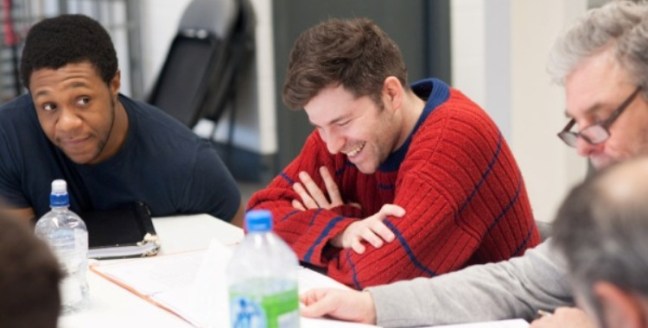
It is character once again that has attracted Bennett to Tracy Letts’ Superior Donuts, the UK premiere of which he is currently directing at the Southwark Playhouse. It is being presented by the same company behind Mercury Fur, who have newly reinvented themselves as The Trick. Bennett is a “huge fan” of Letts and is excited to get his hands on this script. “I always found that his writing – as with Ridley – has such a visceral complexity to it,” he explains the fascination.

Superior Donuts is set in a donut shop in Chicago, telling the story of the man who runs it and the people who pass through every day. “You’ve got these nine fantastic characters, aged 21 to 72, all endowed with such depth and humanity,” says Bennett. “I found it profoundly moving and hugely optimistic. It just felt like the right play to do, and it couldn’t be more different from Mercury Fur.”

While Bennett describes the play as a “naturalistic piece”, he is interested in ways of pushing that naturalism in his production. “We didn’t just want to build a donut shop,” he explains. “The brilliant Fly Davies has come up with an incredible design that allows us to represent the off-stage world in a non-literal way in the space.” He quickly adds that they are “not doing some big expressionistic production of it”, but it is clear that his production hopes to test what can be done within an ostensibly naturalistic framework.

When I ask how Bennett feels about naturalism as a director, he wrestles a little with the question. Referring to projects such as Narrative, which clearly departed from naturalism, he suggests that his own position is somewhat ambivalent, before adding, “I don’t think there is an either/or”. We end up discussing Secret Theatre, which offers an intriguing marriage of a more naturalistic, character-based British tradition with continental influences that are less interested in realistic representation.

“One of my biggest interests is definitely character,” Bennett says, “but I think – as things like Secret Theatre’s Streetcar showed – you can still create, represent, express amazing characters, but not necessarily be pinned down to some kind of naturalistic context. I sort of feel like I’m just exploring what that means.” For now, he is happy to remain on the fence and keep exploring.

Photo: Ben Broomfield.

The Pass, Royal Court

pass-600x398

Originally written for Exeunt.

Following Thomas Hitzlsperger’s decision to publicly come out, renewed focus has fallen on the prejudice still faced by gay footballers, bestowing something of a mixed blessing on the Royal Court’s latest offering. On the surface of it, John Donnelly’s play is “about” a premiership footballer struggling with his sexuality, which he stubbornly refuses to define or discuss. But it also touches on lots of other things – fame, money, friendship, competition –which get slightly elided in the wake of its sudden topicality.

The play, following a familiar trajectory, traces the journey of footballer Jason (the ever-excellent Russell Tovey) from early promise through to the giddy zenith of fame, plotted out via three pivotal moments in three different hotel rooms. Its first scene, while slow to develop, offers plenty to relish. Jason and best mate Ade (Gary Carr) are killing time on the night before the biggest match of their lives – two tensely coiled springs in close proximity. Their relationship and its silent undercurrent of mutual attraction are believably and wittily sketched, as laddish banter gradually gives way to compelling tenderness.

Cut to seven years later, when Jason has gained fame and fortune but lost the puppylike glimmer of mischief that so animated him on his first appearance. This is where the piece begins to slacken its initially confident grip, taking a long time to get anywhere. The scene’s encounter between Jason and table dancer Lyndsey (Lisa McGrillis), though enjoyable, feels convoluted and contrived for the sake of a plot point that could be achieved with much less meandering. The swagger returns after the interval, as Jason and Ade are reunited for a hedonistic night that crackles with danger and desire, but it’s hard to shake the suspicion that this is a script in need of some tightening.

Alongside the main thrust of the plot, there are also some more ambitious shots which – though on target – rarely hit the back of the net. Buried within the classic tale of fame’s empty promises is an implicit critique of the parameters of success in modern society, most of which rest on money. Competition, in life as in sport, also receives a bit of a battering; the sense is that this, more than anything else, is what drives a wedge between Jason and Ade, while Jason’s desire to win leaves him cripplingly lonely. But these avenues are left frustratingly underexplored.

Despite its weaknesses, however, Tovey holds the piece together in a remarkable central performance. From his first youthful grimaces of self-congratulation, furiously skipping to the imagined roars of the crowd, to the hunched husk of a form that he becomes in the final scene as he bends determinedly over his exercise bike, Tovey’s every last muscle is employed in fleshing out the character of Jason. Astonishingly, he seems to age physically as well as emotionally, subtly transfiguring himself before our eyes as he progresses from enthusiastic newcomer to hardened veteran. One imagines that he behaves on the football pitch as he does in life – dodging, sprinting, pulling off slick manoeuvres without breaking a sweat, yet all underscored with a faint attitude of desperation.

This is reflected in John Tiffany’s production, which marries polish with uncertainty, machismo with vulnerability. There are also brilliant outbursts of playfulness, Jason and Ade’s gleeful trashing of the hotel room in the final scene being one of the most entertaining, though these do not always sit comfortably with the rest of the action. More could perhaps be made of Laura Hopkins’ clean, slick design, capturing both the attraction and the cold impersonality of the hotel room setting. It’s a canny choice of location, at once encapsulating glamour, escape and loneliness. I’m particularly struck by Lyndsey’s loaded observation that “tomorrow someone will come in and clean this all away”; a simple factual statement that resonates deeply with Jason’s transitory, unfulfilled existence.

As the piece closes, however, it leaves the nagging sense of something lacking. Ultimately, the main disappointment of The Pass is that it fails to add anything significantly new to the discussion it engages with, leaving my opinions on its subject matter little altered or challenged at the end of two and a bit hours, in spite of many intriguing turns along the way. But this is, perhaps, less a failure on its own terms than on the terms of the media discourse surrounding it. Timeliness, it seems, is something of a double-edged sword.

Hard Work? Not I

The following owes a huge debt to Stewart Pringle, who got me turning a lot of this around in my head after a fascinating conversation in the Royal Court bar. It’s also influenced by some of my dim memories of the thinking in Nick Ridout’s fantastic book Stage Fright, Animals and Other Theatrical Problems and the tiny bit I’ve so far read of Passionate Amateurs, which will no doubt add more thoughts to the mix …

Not-I1-600x390

If there’s one thing we all know about Beckett, it’s that it’s hard. Hard for its would-be scholars (as I quickly learned at university), hard for actors, hard for directors held to the strictures of the dead playwright and his famously inflexible estate. We as audience members are encouraged to look upon Beckett’s work as difficult, serious art, while for performers it is a daunting but defining challenge. Apparently, for all involved, it’s hard work.

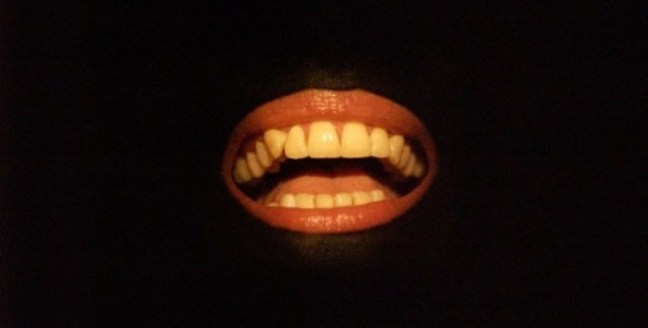
This is certainly the impression that has been generated by the marketing and media coverage heralding the Royal Court’s latest Beckett offering, a trilogy of short plays headlined by breakneck monologue Not I. In a piece for the Guardian, performer Lisa Dwan insists “There is not a single aspect of Not I that isn’t difficult”; a short behind-the-scenes feature on BBC News (see below) is almost exclusively focused on the physically strenuous nature of the performance; headlines have all zoomed in on Dwan’s record time (an admittedly remarkable sub-nine minute verbal sprint); and even the show’s poster frames the performance as an ordeal, with Dwan’s eyes seeming to appeal to us from above the black make-up surrounding that all-important mouth.

And yes, the experience of becoming Mouth – the body part that must appear suspended in darkness above the stage for the short length of Not I – sounds fairly horrific. As Dwan describes for both the Guardian and the BBC, the performance requires her to be strapped into a contraption mounted on a high platform, with her eyes and ears covered for the duration. Then there’s the text itself, which loops, jumps and scratches like a record, its frenzied repetitions and rapid stream-of-consciousness construction offering no footholds for the memory. Pair that with the demanded speed and Beckett’s strict instructions for its delivery, and Not I reads like a nigh on impossible feat; it’s not surprising to learn that Billie Whitelaw originally described it as “unplayable”. The role of Mouth might sometimes be described as “the female Hamlet”, but no one is listening to “to be or not to be” with a stopwatch in hand.

All of this emphasis on the “how” of Not I is both striking and slightly paradoxical. Theatre tends to be notable for the erasure of its own work; we are invited to partake in illusions, to forget the labour that has produced what we witness on stage. There are, of course, exceptions to this, but more often than not we view theatre as a place of leisure rather than one of work. It’s strange, then, that the work of producing Not I is what has dominated the discourse around it. And not just the strain of the labour involved, but the mechanics of the illusion – pulling back the magician’s veil to reveal how it’s all done.

In some ways, arguably, this unveiling is appropriate. In his review of Not I, Stewart Pringle suggests that “Dwan’s achievement in delivering such a diamond-dense performance is to shave away a little more of the actor, of the polluting falsity of the theatre”. Beckett’s classic note was “don’t act”, demonstrating his desire to get at something beyond the art (or artifice) of performance. At the same time, however, it seems to me that what Beckett was digging towards in his rejection of the usual flourishes of theatre was a visceral rawness that nonetheless depends upon a very theatrical device. The precision with which the disembodied mouth is imagined underlines its importance as a stage image – one that is bold, uncanny and oddly hypnotic. But it’s slightly less hypnotic when you’re thinking about the make-up Dwan is wearing or imagining the straps holding her hidden body in place.

This is noted by Matt Trueman in his brilliant interrogation of why he failed to “get” Not I. He remembers being distracted throughout the performance by just the kind of mechanics discussed above, noticing occasional flashes of exposed cheek that destroyed the illusion of the disembodied mouth. I didn’t experience that same distraction myself (I might as well admit at this point, at the risk of echoing the rhapsodies of others, that the whole thing exerted an almost hallucinatory power over me), but there was, on some level of my brain that wasn’t preoccupied with the relentless shower of words and the unsettling sense that the tiny, glimmering mouth was swaying in the dark, a dim, unhelpful awareness of the sheer technical achievement of the piece. I would consider this awareness of the show’s construction as an intended effect of Walter Asmus’ production, but every other meticulously calculated element of its staging – in particular the deep, inky blackness that envelopes the audience, focusing our attention exclusively on the hovering mouth – seems intent on immersing spectators in the experience, not setting them at one remove.

I wonder, then, what the obsession with “hard work” in relation to this production might say about popular perceptions of theatre as an art form, about the idea of work in our society, and specifically about the attitude to labour within theatre. Without even getting into the economic intricacies of paying artists, which are currently the subject of much vital discussion, I would suggest that there is a tension around theatre and work that is not easily dissolvable. Going to the theatre is an activity typically associated with leisure time – something to do after work, or at the weekend. As such, audiences don’t tend to like being reminded that this is a workplace too, and the majority of the time theatre obligingly covers up the work that goes into making it. Alongside this, however, is a popular suspicion that making theatre is simply too much fun to count as proper work, met with artists’ ever more desperate protests that they do work hard – honest.

It was a small revelation to read Alex Swift‘s words, in response to the whole artists and money debate, that “work is not a moral good”. He is, of course, right, but we all (myself most definitely included) act as though it is. On the other hand, I don’t believe that the notion of hard work, when uncoupled from monetary value and profit-driven ideas of productivity, is actually a bad thing in itself, but that’s another discussion. The reason I wanted to bring Swift’s comments in here was to highlight something simple but often ignored about how our society is built on a generally unquestioned assumption that hard work equals good work. This assumption is applied to theatre too, but with a tricky double bind: you have to work hard (not too much fun allowed), but you can’t possibly let us know that you’re working hard, because that would just be embarrassing for everyone.

So how does this loop back around to Beckett and the popular take on Not I? This is just an idea – and a rather uninterrogated one at that – but I wonder if it comes back to that distinction between art and entertainment that Andrew Haydon recently discussed. He argued that in this country at the moment we’re “pretty much taught to hate, fear and mistrust art”, while funded theatre is required to succeed as entertainment in order to vindicate the public money that has gone into making it. Looked at from this angle, Not I (and much of Beckett’s work in general) falls into an odd place. It’s not really entertainment, certainly not in the way that War Horse or One Man, Two Guvnors are entertainment, but it’s revered rather than hated as art – though it might well still be feared.

As well as and connected to Beckett’s position in the canon, I want to tentatively suggest that it is precisely the “hard work” of Not I that makes it acceptable as a piece of art. There is, to echo Swift, a sense of “moral good” in the effort that this piece is supposed to require from audiences, who attend in an attitude of self-improvement (one that is, as an aside, problematically tied up with class; Beckett productions are, as Trueman points out, something of a “bourgeois experience”). The punishing labour demanded of the performer, meanwhile, is also something to be admired, something that cannot be mistaken – God forbid – for having fun. Not I soars above the fraught battleground between art and entertainment because it can be seen as a serious, hardworking endeavour for all involved.

For me, though, the experience of watching Not I was far from hard work. Hard, in a sense, maybe, but not in a way that I connect with the slog of work (though of course that depends on the kind of work we’re talking about). Blinking up at the miniscule mouth – you somehow expect it to be bigger, despite knowing that would be impossible – the rest of the world seems to melt away into the darkness. And time dances, sometimes faster, sometimes slower, but never the steady tick, tick, tick of the working day. If anything, the astonishing speed is one of the least interesting things about the production, or at least it is its effects that matter, rather than the record-breaking time it achieves (here I’m reminded of Gatz, which was also framed as “hard work”, and in which the much-discussed length was again less interesting than everything else it was doing).

There are plenty more fascinating and important things to be said about theatre and work, and theatre as a place to contemplate work (see Nick Ridout’s books), but I don’t think that viewing certain productions as something audiences need to work at* is particularly helpful or illuminating – on the contrary, it can be both elitist and alienating, not to mention damaging the case for art by restricting it to work that ticks a certain box marked “difficult”. If we really want to rescue art, I’m not sure an appeal to hard work is the answer.

*Just a note: when I mention shows that audiences need to “work at”, I don’t think I’m talking about the same thing as theatre that makes audiences think – that kind of theatre is often very enjoyable to watch at the same time as it is intellectually stimulating, and feels nothing like hard work. In any case, it’s more a distinction between the ways in which work is discussed than a comment on the work itself.

Beginnings and Endings

Show_3-600x399

Originally written for Exeunt.

Let’s start with a beginning.

Sitting in the stalls of the newly plastic-swathed Lyric Hammersmith this September, I’m not sure I’ve ever felt such palpable anticipation in the moments before a show. As suggested by the words “Secret Theatre”, most of us in the audience did not know quite what to expect. The curtain was eventually raised to reveal the performers in a line at the back of the stage, dressed in plain white shorts and vests. Accompanied by a sinister, clinical voiceover, these figures rushed forward to drink from bowls of water, scrambling over one another in a desperate, animalistic struggle. What followed might not have been the best show of the year, but it is hard to think of a more memorable opening.

As I attempt to craft some sort of assessment of the year in theatre, the Lyric Hammersmith’s Secret Theatre project feels like an apt emblem for the change that is slowly pressing in on multiple sides. This time last year, writing another of these deeply subjective round-ups, I reflected that 2012 felt like a year of “small tectonic shifts”. While those shifts might not have precipitated a violent eruption of change across the landscape of British theatre, the last 12 months have nonetheless seen ripples of movement – just more gradually than perhaps anticipated.

Unlike the noisy, thrilling arrival of Three Kingdoms last year, the changes of 2013 have been subtle and structural, hinting more at future promise than present fulfilment. Chief among these changes is the exciting wave of new artistic directors who have either taken up post or been announced: Vicky Featherstone at the Royal Court, Rupert Goold at the Almeida, Rufus Norris at the National Theatre, Lorne Campbell at Northern Stage, Sam Hodges at the Nuffield. Whether these appointments will really offer the shake-up they hint at is still to be seen – though the early signs of Featherstone’s tenure are encouraging – but the collective urge for new ways of working is clear.

The impetus towards change is also characteristic of one vein of work that has particularly stayed with me this year. The phrase “political theatre” always feels like a misnomer – isn’t all theatre political in some way? – but a clutch of angry, thoughtful and passionate productions in 2013 have dealt specifically with ideas of political change and protest. How to Occupy an Oil Rig playfully explored the demonstration (in every sense), while Hannah Nicklin’s A Conversation with my Father offered a decidedly personal perspective on protest – almost reducing me to tears in the process. And another kind of activism is at the heart of Bryony Kimmings’ bold and brilliant Credible Likeable Superstar Rolemodel project, which twice bowled me over with both its raw emotion and the galvanising ambition of its aims.

Elsewhere, the potential for future change was more lightly hinted at. At this year’s Edinburgh Fringe, Dan Hutton and I noted the theme of hope that threaded its way through several of the productions we saw, complicatedly paired with both critique and irony. Contrived as this narrative perhaps is, it is one that has retrospectively haunted many of this year’s shows, inflecting my way of watching and thinking about theatre. From its very explicit presence in what happens to the hope at the end of the evening to its troublesome ghost in The Events, the question of hope has been a key feature of much of the most interesting work I’ve seen over the past 12 months.

Chris Goode's The Forest and The Field ©Richard Davenport

Closely linked to hope is the idea of community, which is often vaunted as being at the heart of theatre as an art form. We share the same space in the theatre, after all, so we must be a community of sorts, right? This was tested in various ways by much of the best theatre of 2013, be it the stunning yet gentle intellectual interrogation of Chris Goode and Company’sThe Forest and the Field or the joyously communal celebration of The Strange Undoing of Prudencia Hart – which arguably nailed the whole thing by staging itself in a pub and throwing in some song and dance for good measure.

Similarly to Prudencia Hart, music was a key ingredient of the fleeting community forged night after night in Edinburgh by The Bloody Great Border Ballad Project; food took the same role in Only Wolves and Lions, reminding me of the simple community we build when we cook and eat together. It’s not insignificant that that last example was part of Forest Fringe, a gorgeous instance of transitory artistic community in the midst of this summer’s Edinburgh Fringe. This community also offered up countless other small scale theatrical highlights of the year, among them Ira Brand’s delicate contemplation on ageing, a consideration of our addiction to virtual communities in I Wish I Was Lonely, and Deborah Pearson’s haunting The Future Show.

One show that managed to be both small and epic was Grounded, the absolute standout production of the Fringe for me. The remarkable Lucy Ellinson once again looms large over my theatregoing memories of the year after her compelling delivery of George Brant’s tightly written, blistering monologue, all the while imprisoned within the striking grey cube of Oliver Townsend’s design (as an aside, cubes seemed to be big this year – see Chimerica). Ellinson also dazzled, though very differently, in #TORYCORE, a deafening, devastating scream of rage against the destructive policies of the coalition government.

And it was not only the politicians of today who found themselves criticised in theatres this year. Following the death of Margaret Thatcher, a number of pieces have already directly or obliquely approached her legacy. Theatre503’s quickfire offering of short plays produced a decidedly mixed bag, although Margaret Thatcher Queen of Soho’s glorious drag queen rendering of the Iron Lady has deservedly lingered in my memory. The difficulty of discussing Thatcher’s legacy was addressed in all its complexity by Mars.tarrab’s brilliantly titled The Lady’s Not for Walking Like an Egyptian, while perhaps the most striking visual representation of Thatcher came courtesy of Squally Showers, a show that touched on her and her politics only indirectly. Yet somehow, in the image of a performer in a Thatcher mask holding aloft an inflatable globe while surrounded by the detritus of a wild party, Little Bulb wordlessly directed a powerful judgement at the world left to Thatcher’s children.

Little Bulb's Squally Showers

Squally Showers also provided plentiful helpings of sheer joy, a theatrical quality not to be underestimated. Alongside the charming eccentricity of Little Bulb’s latest show, the Edinburgh Fringe also offered the utterly bonkers but irresistibly endearing Beating McEnroe,which will forever leave me with the glorious memory of Jamie Wood pretending to be a tennis ball. An equally joyous moment to imprint itself on my mind this year emerged from Peter McMaster’s Wuthering Heights, in which I screamed with laughter at the four male performers’ move by move recreation of the dance in the Kate Bush music video, while the final scene of rain-drenched anarchy in the RSC’s As You Like It topped off a production that was a delight from start to finish. And no assessment of theatrical joy in 2013 would be complete without pausing to remember Zawe Ashton’s frankly inspired rendition of ‘Where Are We Now?’ in Narrative, a show that achieved the rare feat of being both absolutely hilarious and intellectually meaty.

While it may not fit neatly within the thematic threads I’m attempting to loosely weave through my overview of the year, any consideration of 2013 has to include a mention for Headlong. The company has had a ridiculously successful 12 months, encompassing the slick, stylish storytelling of Chimerica, a bold and theatrically astute new interpretation of The Seagull and – best of all in my opinion – the complete headfuck of Duncan Macmillan and Robert Icke’s stunningly intelligent adaptation of 1984. I’ve missed out on American Psycho,but from the outside it appears to offer a striking end to a fairly extraordinary year for Headlong.

As averse as I am to naming any one production “best”, when looking back over the year I find my mind dragged time and time again back to Mission Drift. For many this hardly counts as a “new” production, having first been seen at the Edinburgh Fringe in 2011, but this summer’s run at the National Theatre’s temporary Shed space was my first opportunity to see The TEAM’s dizzying trip through 400 years of American capitalism. Fast-paced, sexy and beautiful to look at, Mission Drift can also justifiably be described as epic, an adjective that I rarely find myself applying to theatre. Its scope, energy and excitement has become my personal benchmark against which to measure the year’s theatre, and very little in the subsequent months has equalled it.

As I opened this narrative with a beginning, I might as well close with an ending. Looking ahead to 2014, February will see the dismantling of The Shed, whose garish red silhouette on the South Bank has come to stand for vitality and experimentation at the heart of an institution often associated with tradition – as the narrative it spun to celebrate its 50th anniversary did little to challenge. One can only hope that The Shed’s spirit of innovation, together with that of Secret Theatre and Vicky Featherston’s Open Court festival this summer, finds a way to continue into the next 12 months.

I also contributed to a collective look back at 2013’s theatre with the rest of Exeunt’s writers.

Gastronauts, Royal Court

700x650.fit

Originally written for Exeunt.

Anything that addresses its audience as “intrepid eaters” asks to be approached with a touch of apprehension. Gastronauts, dreamed up by April de Angelis, Nessa Muthy and Wils Wilson, is teasingly tight-lipped in its marketing material, explaining only that the show will offer a range of tastings for its “brave dinners”, along with the details necessary for them to make informed choices about what they eat. Probably not for fussy eaters or the squeamish, then.

Led into a dimly lit holding chamber in the upstairs theatre and instructed to drink from glasses of lurid Alice in Wonderland-style potion, the automatically tentative stance seems justified as we prepare to throw ourselves headlong down the rabbit hole. But for all the uneasy mystery and foreboding hints, the Royal Court’s surreal theatrical dining experience lacks the bite it so tantalisingly promises.

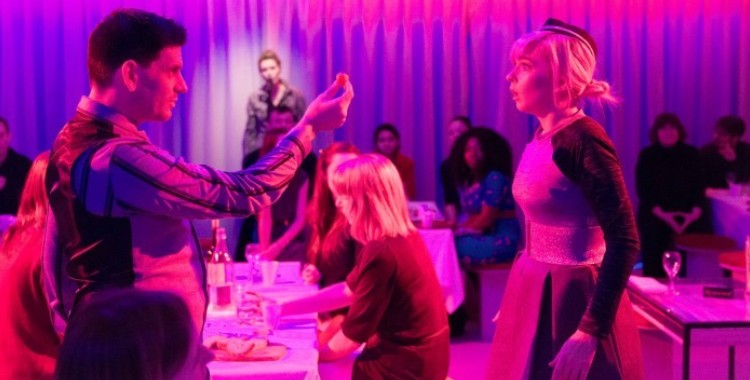
The basic concept of the show is contained within its title: we are travellers, embarking on a flight towards the flavours of the future. Once seated at our tables on board Lizzie Clachan’s futuristically reconfigured performance space, the cast of four gamely point out the nearest exits, while Alasdair Macrae as our pilot and maître d’ is a deliciously oddball host, at once strange, charismatic and lightly threatening. He reassures us, with a twinkle in the eye, that “nothing here will harm you – in the normal sense of the word”. His introduction, as it turns out, is a fitting primer for the show itself: quirky, kooky and charming, laced with just a dash of menace.

In keeping with the modest courses brought out one by one to delight our taste buds, the show itself is divided into small, bite-sized portions. The performers slide in and out of their roles as waiters to present short sketches on everything from derivatives trading to family dinnertimes, punctuated with Macrae’s brilliantly wacky songs. The audience watch all of this from our tables, eating and drinking throughout. There are, as one expects, a few surprises served up on our plates, but none that are particularly unpleasant or challenge our consciences too taxingly. Even one seemingly unappealing dish ends up being surprisingly innocuous, the tense frisson prompted by its arrival quickly settling into grinning relief.

And herein lies the problem. As a novelty dining experience, Gastronauts ticks most of the boxes: idiosyncratic waiting staff, eccentric host, a range of dishes that assault and confound the senses. As a meditation on our species’ messy relationship with food, however, the Royal Court’s creation is disappointingly uneven, movingly clumsily from madcap comedy to cutting critique while trying too hard to cover all bases. One impetus for the show was the recent horsemeat scandal, which brought the question of where our food comes from right to the fore of the public consciousness, offering more than enough material to chew on. Rather than focusing attention here, however, the show distractedly casts its gaze in all directions, also offering nods to eating disorders, food banks and the communal ritual of eating together.

Taken – like the menu – as a set of tasters, there is plenty to relish. Visions of food crisis offer a bitterly entertaining satirical portrait of the unappetising future we are potentially heading towards, while there is a mad, hallucinatory joy to watching the cast don cow masks and sing about how we’re all fucked. But for all its playfully provocative statements, the appetite for probing critique is left unsatisfied, even if our hunger is appeased. Instead of making us think twice about what we blithely gobble down, Gastronauts hands us a spoon and urges us to dig in.

Photo: Johan Persson