Secrets and Surprises

Originally written for Exeunt.

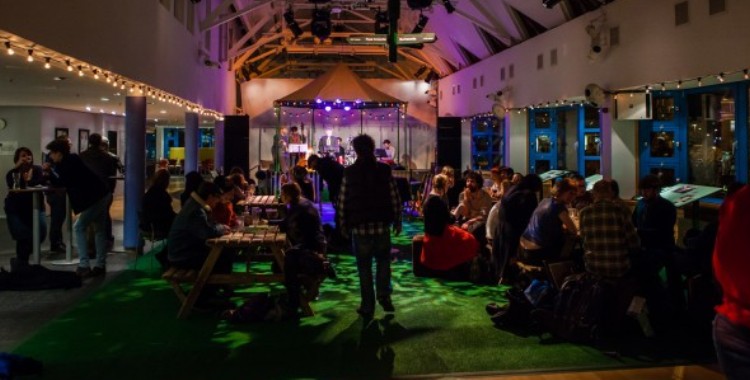
As our huddled group of partygoers shudder upwards in an industrial lift, headed towards the Lyric Hammersmith’s secrecy-veiled launch, a woman behind me compares the experience to seeing a show by Shunt or Punchdrunk. There’s that same sense of an event, of the unexpected. Walking across Lyric Square, we’ve been directed around the side of the building, to its concealed, warehouse-like innards. While waiting in this space, we have an opportunity to see the building – and our relationship with it – from a different angle. The very walls seem to shift.

Artistic director Sean Holmes’ plans for the Lyric over the next few months, announced on Monday night, are about transforming the theatre from within as much as from without. At the same time as the building itself is completely renovated in a huge capital project, a group of theatremakers are occupying its heart. The auditorium, which will remain untouched for the duration of the building work, is to become the flexible home of Secret Theatre, which is exactly what its name suggests. In a bold and teasing move, the Lyric is not releasing any details of the plays it will be producing over the next year; instead, audiences will come to be surprised.

But this is not simply about returning a sense of the unexpected to the theatrical event in a society saturated with information. Mirroring the work that is taking place around them, the Secret Theatre company are engaged in challenging and changing structures. Resisting the rapid turnaround of an industry used to dishing up end products and swiftly moving on, the company of ten actors and ten creatives will be working together in the space throughout the year, collaboratively making and performing and sharing. As Holmes put it in his speech, “the company we have assembled is an attempt to create a new structure that might lead to a new type of work”.

There are a number of ways in which Secret Theatre is shifting the structures of how the Lyric – and many other institutions like it – make theatre. The ensemble of actors is evenly split between men and women and includes black and disabled performers. This immediately erodes the structure of literalism, which has become something of a straitjacket for much British theatre. The set-up is also designed to create a different conversation in the rehearsal room, allowing those involved more time to create work in true collaboration and for a specific space. One niggle is that everyone involved is still assigned a rigidly defined title – writer, director, actor – but one suspects that in rehearsal these roles will be much more fluid.

Surrounded by the vivid red of the Secret Theatre launch party, I’m reminded of the similar injection of colour that has just been administered to the Royal Court by new artistic director Vicky Featherstone. Even the bar is bursting with yellows, reds, blues and greens. The Court is another established building whose existing structures are being challenged, in this case thanks to a sharp burst of fresh air that Featherstone is blasting through the theatre over the summer. Open Court, while guided by different principles and very much organised around playwrights, cultivates a similar atmosphere of experimentation and surprise. The sense is that anything could happen.

As Andrew Haydon notes, it’s clear that, even without the kind of construction work taking place at the Lyric, Featherstone has given careful thought to the building she’s inherited. As well as the changes to the bar, which now feels like a place you might actually want to hang out in without worrying you aren’t wearing the right shoes, the season itself kicked off with a telling reflection on the theatre building. In the first “Surprise Theatre” offering, Cakes and Finance, Mark Ravenhill read from the transcripts of a series of playwrights talking about their ideal theatre, musing on everything from the idea of 24-hour theatre to the suggestion that cats should be incorporated into more performances (surely one of Chris Goode’s contributions).

Alongside the obvious similarities between Open Court’s surprise shows and the secrecy around the Lyric’s new season, there are other shared experiments. Like Secret Theatre, the main house plays during Open Court are operating using a rep system (which is as much a return to the past as a new innovation), with an ensemble of actors rehearsing next week’s show by day while performing this week’s show at night. In some ways this offers the complete opposite of the Lyric’s project, driving at energy and a quick turnover of plays rather than extended rehearsal periods, but it equally fosters that sense of the collective at the same time as bringing a vital roughness back to the stage. Also, while the gesture of Open Court honours the mythology of the Royal Court’s status as “the writers’ theatre” – a mythology that Featherstone’s launch announcement was drenched in – this has been done in such a way that it explodes in the same movement in which it preserves. Clever.

And it’s not just these two venues. While exciting developments have been pushing at the outside for years, it feels increasingly as though some change is beginning to seed itself on the inside. I think of the scarlet structure of the National Theatre Shed, shouting its presence on the South Bank – again, a dash of colour – and of the ongoing developments at Battersea Arts Centre, as it too undergoes building work that will open it and its brilliant work out even further to the surrounding community. It’s not everything, and there’s a definite danger of getting carried away and falling back into complacency, but it is a start. Perhaps most importantly, there’s a rare and much-needed whiff of optimism in the air.

To encapsulate some of that optimism, it feels right to conclude with Holmes’ galvanising words from Monday night. Speaking about the vision for Secret Theatre, he expressed his hope “that even if you hate it, you can’t ignore it. That even if you love it, it scares you. That you will believe it’s an honest attempt to change. To delight. To question.”

Thinking Outside of the Building

WYP-600x400

Originally written for The Stage.

At Vicky Featherstone’s first Royal Court press briefing, there was an intriguing statement of intent about the theatre’s direction. As well as reaffirming the theatre’s commitment to writers, handing over the keys of the building for a summer season led by the playwrights, Featherstone made a comment with potentially far-reaching implications for the future role of the Royal Court. She said, with a playful grin, “no space should be safe from theatre”.

As the new artistic director went on to explain, she’s interested in utilising different spaces within the building, in taking shows outside the Royal Court’s home in Sloane Square, and in bringing new audiences through its doors. It’s perhaps not surprising that Featherstone, who has led the nomadic National Theatre of Scotland for the last eight years, should want to look beyond the restrictive and arguably exclusive boundaries of the Royal Court’s four walls. What’s more striking is that she’s not alone.

While “audience development” has long been a key part of theatres’ PR arsenal, this can often be just so much empty rhetoric. Now, however, there seems to be a genuine commitment to opening up theatre spaces, venturing beyond bricks and mortar and establishing theatres as a vital part of their surrounding communities. It’s a development that’s sorely needed and one that might, if successful, ensure a future life for theatres within an arts funding landscape that is looking increasingly precarious.

At last year’s Theatres Trust conference on delivering sustainable theatres, Griff Rhys Jones championed the theatre as a place of public assembly in modern day communities, taking on the civic role once occupied by the town hall or community centre. While a vision of the theatre as the beating heart of the community is perhaps a little utopian, there are ways that buildings can connect with local residents through more than just their artistic programme. Just look at Battersea Arts Centre, where experimental performance jostles alongside yoga classes and tea dances. Artistic director David Jubb is keen to retain this diverse make-up of functions, hoping to achieve an overlap between the venue’s two distinct strands of activity, while ongoing improvement works will make the building structurally more open.

Beyond London, this gesture of opening out is even more essential, particularly as other public spaces are threatened. Rhys Jones has pointed to the example of Derry Playhouse, which is open to local people throughout the day, functioning almost like a community centre. There are other similar if not quite so far-reaching examples. Chapter Arts Centre in Cardiff has worked hard to create a welcoming environment that encourages people to drop in, while one of the key pledges made by West Yorkshire Playhouse’s new artistic director James Brining is to open up the building and explore the way the theatre relates to its communities. One of the few things theatres do have is space, much of which lies dormant when not being used for performance. Why not fill it?

As well as inviting audiences in, establishing theatres as buzzing hubs of the community, venues might look outwards. As buildings hold less prestige than they once did, there is the opportunity for theatres to redefine their identity beyond their own walls. West Yorkshire Playhouse has effectively demonstrated this approach with the city-facing programming of this year’s Transform Festival, including a piece of performance made with local residents and performed outside the theatre. The challenge, of course, is to expand this beyond the fleeting festival context.

But does all this shift the focus away from the art itself? There are clearly potential pitfalls for such an approach – particularly if treated as a careless add-on to tick funding boxes – but the community benefits need not be at the expense of the theatre. At their best, each can positively impact upon the other. Fresh influences enter the building, disrupting and invigorating a process of theatremaking that might otherwise become stultified, while new potential audience members are given the opportunity to encounter the work and be surprised.

None of this is to say that theatres should abandon their core activities; rather, as ever, they need to adapt. Buildings have always been one step behind the performances and audiences they host, running to keep up. Think of the exponential growth in site-specific work over recent years, to the point where the National Theatre is now selling tickets for Shunt and Punchdrunk shows taking place miles away from the South Bank. The need from local communities and potential audiences is there, the only question is whether theatres will step in to fill the gap.

In her recent keynote speech addressing the thorny issue of arts funding, culture minister Maria Miller firmly stated that the arts need to make the case for their ongoing importance in economic rather than artistic terms. It’s a statement that has prompted an understandable backlash, pinpointing many of the dangers and inadequacies of measuring the arts’ value in purely monetary terms. But perhaps theatres’ greatest argument for their survival is the role they might play within their local areas – artistically, economically, and as a central component of the community.

Photo: Richard Davenport

Narrative, Royal Court

?????????????????????????????????????????????????????????????????????????????????????????????????????????????????????????????????????????????????????????????????????????????????????????????????????????????????????????????????????????????????????????????????????????????????????????????????????????????????????????????????

Let’s start at the beginning. Anthony Nielson’s latest work is, the Royal Court website tells us with succinct authority, “a new play about stories”. There’s also an image: a line with a break and the provocative words “form is dead”. And that’s it. The reason for the scant details is partly down to Nielson’s method – the play was written during rehearsals, building on a process of daily workshopping and improvisation with the cast – but it’s also sort of fitting. All the best stories know not to give too much away.

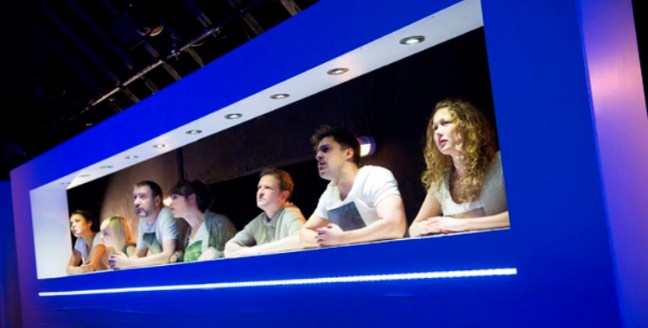
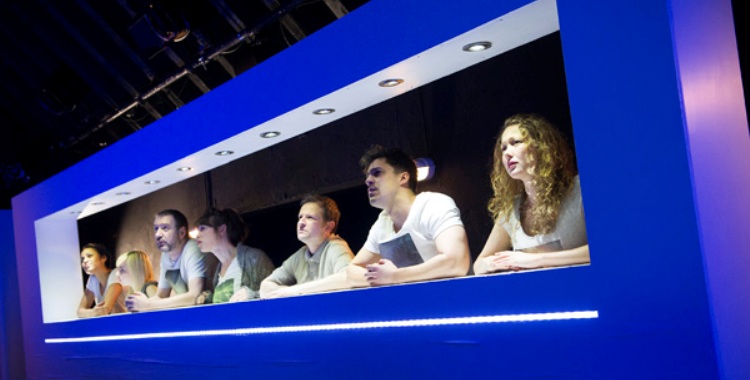
Another beginning. To one side of a sleek white design jewelled with blinking blue LEDs – Apple’s smooth, clean lines extended across an entire theatre set – a screen hosts a projected cave painting. If we’re to believe the authoritatively intoned description of the voiceover, this is the earliest example of human narrative: just a man, a bison and a spear. The implication is of a struggle, though whether man or bison or neither is killed is unclear. The presence or absence of death is important, the voiceover tells us. Without death, there’s no consequence. Without consequence, there’s no narrative; only suspended struggle.

Narrative plays out in that zone of suspended struggle. It’s a story – or, more accurately, a web of interconnecting, overlapping stories – that must continue at all costs, but the consequence it’s reaching towards is always just out of grasp. The spliced-up narratives themselves range from the banal to the bizarre, often in an almost soap opera vein. A paranoid actor keeps being slipped mysterious photos of arseholes; a grieving mother drags around a petition, pathetically begging passersby to sign; a young woman aggressively seeks out her soulmate, while another casually kills her best friend. Just as the opening voiceover is helplessly drawn to creating a story from a few marks on the wall of a cave, we as an audience are left to do what we do best: connect the dots.

As well as making connections, the audience is required to engage in a process of choice, picking out some elements and discarding others. While certain scenes are tightly focused, isolating a monologue or a video (of which there are many, bursting onto the screen throughout the piece), at other times the production relies on a technique of bombardment. The first “scene” proper, for example, works on a collage principle, pasting on layer after layer as one conversation overlaps with another, more and more performers entering the space until all we can make out is a fuzzy cacophony of noise, punctuated by the odd audible word or sentence. At which point, in a puff of dry ice, Zawe Ashton bursts into a sudden, off-key rendition of David Bowie’s ‘Where Are We Now?’ This pretty much sets the tone.

The crowded confusion sounds bewildering, but the ease with which we navigate this flood of theatrical stimuli is just as striking as its over-abundance. Essentially it’s just a staged manifestation of digital noise, noise that we’re now adept at filtering. If the formal experimentation of Caryl Churchill’s Love and Information riffed on one facet of modern experience – the quickfire onslaught of information in the digital age – then Narrative is its exploded, densely networked extension. At times it feels as though it’s occupying the internet; interruptions pop into view, scenes flip from window to window, ad-speak is constantly intruding – there’s even a cheeky nod to the ubiquity of the cat video. It’s theatre for the multi-tab generation.

And yet this is more than just a meditation on the ways that digital technology has rewired our thought and behaviour. As signalled by the opening lecture on cave art and the recurring motif of the bison throughout, these stories we tell are an integral part of our existence, stretching right back to our earliest origins. Narrative is wired into our cultural DNA. Looking not quite so far back, the play is also engaged in a tense dialogue with the particular way in which we tell stories on stage, demonstrating a deep understanding and cutting critique of the often shallow techniques of drama. The small, broken-off splinters of plot that we are given concern themselves with the sort of domestic scenes we are used to seeing represented on stage, particularly at the Royal Court, occasionally marked by the violent caesura of a “dramatic” incident. Often these vignettes are haunted by a kind of narrative dissatisfaction, or they simply don’t work, requiring another surreal interruption to rupture their bland surface. Our old stories are broken.

It’s worth pausing briefly here to also consider Nielson’s process. While he remains very much a writer, his writing happens alongside rehearsals; a new draft gets frantically written each night and brought in the next day to rehearse and improvise around with the actors, prompting yet more re-writes based on the outcome. As I understand it, any improvisation that takes place during this process is very much within the piece that Nielson is already writing, rather than a more free-form method of devising from scratch. It’s a process of generating, gathering and discarding that is particularly apt here, mirroring the way that we refine and retell our own stories, yet always within the narrative limits that our culture has schooled us in and always with reference to the narrative tropes that precede us – storytelling from the inside. In our postmodern, post-structuralist world, truly original narratives are no longer thinkable, but the linear stories we are accustomed to telling are no longer adequate. The answer, as Nielson proposes, is a structure that deconstructs from within, disruptively playing with the cultural material and narrative constructs that we can never quite get outside of.

Just say it and it will be true.

Much like Martin Crimp’s cutting attack on the cult of the personality in In the Republic of Happiness, the modern focus on the individual keeps rearing its head. Mirrors are everywhere, both in the text and dotted around Garance Marneur’s design, most strikingly as a scattering of reflective fragments in a shallow pool of water; in place of costume, the actors wear T-shirts adorned with photos of their younger selves, a statement of identity and personal narrative sitting against their skin. Just as Crimp’s characters stubbornly insist upon their narrative autonomy – “I write the script of my own life” – here the ability to tell one’s own story is depicted as central to contemporary experience. While the situations are often distorted into mad extremes, the very human impulses that drive them are wincingly familiar. We’re always spinning stories, always telling lies to others and ourselves, always making up shit.

The other purpose of telling stories, as Nielson reminds us, is to insulate ourselves from our own mortality. In a ridiculous attempt to divert a break-up – one of many amusing moments in what is often a viciously funny play – one character petitions her indifferent lover with the uncompromisingly bleak observation that “we’re going to die”. Spoken out loud, particularly in Ashton’s gloriously melodramatic tones, it sounds almost laughable, that truth that we all fight against. We will all die. But it also prompts the unsettling realisation that we’re all constantly pretending we won’t. That’s what all this noise really is: distraction.

Another distraction, another mirror, another classic narrative device, is romance. Neilson’s characters are unremittingly obsessed with love. Or, rather, an idea of love; “the big love thing that they fill our heads with”. They’re all looking for “The One”. They’re looking for “it”. They’re looking for their soulmate, the person they’re meant to be with – and when they know, they’ll know.

Whether we’re listening in on a lovers’ row – and they all sound the same – or a conversation between gossiping best friends, the dialogue trills to the echo of a hundred pulped Valentine’s Day cards, channelling the ghost of every second-rate romcom and soap opera romance. This is a world where idealised love is a consumer item, where our romantic relationships are snatched out of our grasp and sold back to us at a price. Stories are stolen and priced-up in the same way, co-opted into advertising (an industry to which the play makes repeated references). Much as Ashton’s soulmate-hunting young woman is resolute in her belief that there is an ideal love waiting for her, we are fed a feeling of entitlement to perfect happiness, but always at a cost.

It’s also no mistake that each of the individuals we encounter is, in their own way, in the business of selling us falsehoods. Whether perpetuating the Hollywood dream of overnight fame, battering us with empty advertising slogans, or telling a lie that they themselves believe in, the characters depend upon peddling untruths – just as the success of the performers beneath, the layers of real and fictional identity messily overlapping, is predicated on creating a fiction.

The last, dissolving vestiges of narrative are desperately clung to, much as the members of Forced Entertainment propel The Coming Storm stubbornly forward with story after story after story. Particularly with the 24-hour epic of Quizoola still seared on the collective memory, Forced Entertainment and their stretching and implosion of the narrative form feels like an apt reference point. There’s the same frenzied impulse to keep going no matter what, the conviction that the show – and the stories – must go on. This work also shares a certain sense of inbuilt failure. Alongside the stories that fall flat on their face or get rudely truncated, the theatrical event itself is deliberately balanced on the point of falling to pieces; as actors refer to one another by their actual names and occasionally read directly from hand-held scripts, the illusion of theatre is always brittle, if not completely smashed.

In negotiating these blurred lines and weaving between the many different fragments of narrative and identity, the cast work brilliantly with the material they’ve been given and had a hand in crafting. There’s a lot of fun to be had with the text that Nielson has produced and the atmosphere is consistently playful, stretching and pushing at its theatrical confines. Ashton, already mentioned, turns in a dazzling comic performance, at once awkward, manipulative and somehow endearing, while the increasingly zany bewilderment of Imogen Doel’s clumsy murderer and Barnaby Power’s despair-drenched audition provide some of the production’s most bleakly hilarious moments.

This bit coming up is the future.

Rather than finishing at the end, I want to conclude by looking both forwards and backwards. I wonder – and here I’m connecting the dots – whether Narrative might join Love and Information and In the Republic of Happiness in a sort of loose trilogy on modern life. As well as sharing many thematic preoccupations, all three attempt to answer the demand, repeatedly echoed by Nielson, for a new dramatic structure, a dramaturgy that responds to a rapidly changing world and digitally wired ways of thinking. As Nielson put it in a recent interview with Matt Trueman: “Plays don’t feel like they’re modern […] That idea of dramatic unity is becoming less relevant. People are sophisticated enough to make quite large leaps of cognition from small amounts of information.”

Interestingly, Dan Hutton suggests that Nielson’s attempt to write work that responds to this experience of modern life “throws into light questions of what we class as ‘written’ text”, occupying a space somewhere between writers’ theatre (the traditional preserve of the Royal Court) and directors’ theatre. Based on the production itself and Nielson’s distinctive workshop method of playwriting, it’s a perfectly reasonable suggestion, and one with exciting implications, hinting at the imminent breakdown of that pesky, persistent barrier between “text-based” and “non-text-based” theatre. At last week’s Royal Court press briefing, however, I was a little surprised to hear Nielson speak approvingly of the “strong authorial grip” and firmly position himself in the lineage of text-based theatre. His words were scribbled in my notebook with a “hmm” and a question mark.

But, aside from my own objections to the notion of authorship in theatre, there is perhaps something fitting about Nielson’s positioning within the lineage of which the Royal Court is so proud. As Narrative itself suggests, we can never fully dissociate ourselves from existing narrative structures. It’s also interesting – and promising for the future output of the Royal Court – that new artistic director Vicky Featherstone has immediately enlisted Nielson to work with a group of writers on new and unconventional methods of playwriting, encouraging ways of working that both continue in the vein of the Royal Court’s writer-led tradition and reach for those forms that speak more effectively to our current moment. Contrary to that sketch on the Royal Court website, there’s rarely – if ever – a complete break; there’s just playful, subverting, disrupting reinvention of what has come before. Making mischief from within.

P.S. Tangled in the knotty mess of trying to analyse what Narrative does with stories and theatrical form, I don’t think I gave a sufficient idea of quite how hilarious the play manages to be while wrestling with all of this material. So just to be clear, it’s bloody funny.

In The Republic of Happiness

In writing about this production, I’ve taken something of a counter-intuitive approach – or if not counter-intuitive, then certainly counter to conventional critical practice. I saw the show before Christmas without any intention of writing about it, subsequently discussed it in a seminar group, read all the reviews I could get my hands on, and feverishly combed my way through the script. Essentially, I pursued my fascination with the piece down every avenue other than writing about it, before deciding (some time after the production closing) that I was going to have to write about it after all. As a result, what follows is at least partly the product of osmosis …

“Happiness is never experienced, only remembered” – Oscar Levant

The above quote, unexpectedly dredged up from the depths of my memory somewhere, seems like a fitting place to start. If happiness is an emotion that can’t be fully experienced in the present, then in today’s society it is a sensation that is not so much remembered as shared. Whether via social media updates, glossily vacuous magazine interviews or the compulsive confessionals of reality television, emotion has become currency, a commodity to trade in the continual search to define one’s identity. It is this obsessive cult of the individual (among other things) that is interrogated, prodded and mercilessly skewered by Martin Crimp’s latest play.

It strikes me that the two key words that frame the piece – ‘republic’ and ‘happiness’ – seem in many ways to be internally opposed. So long as the quest for individual happiness continues to be sold to us as the ultimate goal of our existence, a goal to be pursued at the exclusion of all others, the possibility of cooperation is precluded and the true democracy implied by the concept of the ‘republic’ is rendered impossible. This can be read as the rotten truth buried beneath government happiness indexes and aspirational marketing speak; the tyranny of the individual is not one that frees us at all, but one that traps us in an isolating and self-perpetuating state of immobility, speaking in the same blithely inane circles as Crimp’s empty characters.

The play itself is divided into three distinct sections: ‘Destruction of the Family’, ‘The Five Essential Freedoms of the Individual’ and ‘In The Republic of Happiness’. Before delving into each of these, I’d suggest that the number of scenes feels significant, although the nature of this significance is uncertain. As Andrew Haydon touches on in his review, the number three invites numerous possible readings, with other critics positing the heaven, hell, purgatory trio (though I’d struggle to decide which section might be interpreted as which), while Andrew suggests that past, present and future works just as well. Vaguely linked to that chronological conception of the structure, I might add the traditional three-act play. For a piece that in many ways disrupts and deconstructs theatrical conventions from within, I suspect it’s no accident that it defers to and then explodes this most accepted of stage constructs.

The play also has the intriguing subtitle ‘an entertainment in three parts’, immediately summoning the inform/entertain binary and also begging the question of what exactly we find entertaining. We might further ask whether this production can indeed be classed as entertainment at all – it’s certainly very enjoyable in parts, but it’s hardly the comfortable viewing that we might normally associate with the traditional genre of ‘entertainment’. (As an aside, Dan Hutton interestingly suggests that the production has the quality of a “variety show where the theme is ‘what it means to be happy'”, pointing to the mixture of dramatic styles and the inclusion of songs as displaying a sort of vaudevillian influence)

As another brief preface to my discussion of the three sections, it feels necessary and helpful to set this production within its context. Showing at the Royal Court near the end of Dominic Cooke’s time as artistic director, there are a very specific set of implicit social, economic and artistic referents that frame the piece, which has a distinctly self-reflexive tint. The position of the theatre in Sloane Square’s bubble of privilege, its particular theatrical history and its typical audiences are all variously called to mind, as is Cooke’s frequently cited remit of exploring the position of the middle classes.

Which leads conveniently into the first section, ‘Destruction of the Family’, with its initial set-up recalling so many of the plays that have characterised Cooke’s artistic leadership of the theatre. At first glance, the scene conjures a typical (if slightly bare and a little unsettlingly red in colour) middle class dining room, furnished with a seemingly typical middle class family. Any notion of the ‘typical’ soon slips away as a superficial naturalism steadily crumbles, but the opening domestic image is quietly clever in its manipulation of audience expectations, as well as convincing me that Cooke (who has directed this piece) might just have a sense of humour about the supposed middle class obsession of his tenure.

The premise of this opening scene is a family Christmas dinner which is interrupted by the arrival of the apparently estranged Uncle Bob, whose appearance violently shatters a naturalism that has been gently eroding from the start. There’s a strain of heightened, compulsive truth-telling to the dialogue early on, quickly setting up a sense of dislocation, while the intrusion of a strange and unsettling song from the family’s two teenage daughters further arouses suspicions that all is not as it seems. Script and production both mark Uncle Bob’s entrance as a caesura, with the character’s assertion that “I thought I would just suddenly appear, so I did” and actor Paul Ready’s startling emergence from an invisible doorway both contributing to the sense Dan Rebellato articulates of this figure being a fictional construction abruptly summoned into being (which of course he is).

This initial aura of meta-theatrical fiction surrounding the character is reinforced later on. Uncle Bob’s reason for interrupting, he tells the family, is to inform them what his girlfriend Madeleine thinks of them all before the pair jet off to start a new life that is “like a pane of glass” – “Hard. Clear. Sharp. Clean”. While reeling off a litany of escalatingly vile insults, Bob says at one point: “you think I get pleasure from having to stay here and repeat what another person has instructed me to say?” While in one straightforward reading he is referring to the string-pulling off-stage presence of Madeleine, it’s hard to shake the feeling that this is not also directed at the creative control of the playwright, an alternative reading that is enhanced in production by Ready’s implicit awareness and acknowledgement of the audience.

The breakdown of naturalism briefly outlined above, a process of collapse that begins from within, is eventually reflected in Miriam Buether’s design, as the noticeably flimsy walls of the room that contains the first section are pulled away – a visible dismantling. While this happens in the transition between the first and second sections, the cast line up facing the audience and very deliberately remove items of their costume – earrings here, a jacket there. It’s a calculated and conscious move, stripping away certain signifiers of character but letting other vestiges remain. What we are left with are figures who exist somewhere disturbingly between character and actor, acknowledging the ghosts of the characters they have just left behind and carrying these lingering spectres into the second segment of the show.

This is the longest and (at least in my experience) most enjoyable portion of the production. An excoriating satire, the section consists of, as announced in the title, ‘The Five Essential Freedoms of the Individual’: ‘The Freedom to Write the Script of My Own Life’, ‘The Freedom to Separate My Legs (It’s Nothing Political)’, ‘The Freedom to Experience Horrid Trauma’, ‘The Freedom to Put It All Behind Me and Move On’, and ‘The Freedom To Look Good & Live For Ever’. These take the form of a long stream of lines, which I later learned are completely up for grabs among the cast; each of the actors knows the entire thing and each night they were all free to take whichever lines they felt compelled to. This produces slippery and ever-shifting meanings, overlaying the words themselves with an engaging interplay between theatrical signifiers (how does this young female actor taking the line inflect it in a different way to an older male actor? what is the relationship between the words being spoken and the characters from the first act that have just been discarded?).

Crimp’s targets in this long (possibly over-long) section are many and varied: resolutely anti-political individualist rhetoric, the modern obsession with personal wellbeing, the fetishisation of trauma and recovery, the desire to control the story of one’s own life – all peppered with more specific references to modern day phenomena such as airport security checks and child medication, and broken up by a series of songs. It’s difficult throughout this stinging assault to pin down quite where Crimp himself (and by extension the whole production) stands, as the satire is quick to turn on the opposite viewpoint, upturning audience assumptions as fast as they form. (An example: “I don’t say I’m happy to separate my legs so that people who’ve been educated in a certain way or have particular beliefs can sit here in this audience and think that I mean the opposite – no way”. Ouch.)

The staging here, as Andrew suggests, is not particularly revelatory (he dubs it “The Path of Least Resistance”). Tugging at the unifying thread of the individual enshrined at the centre of contemporary culture, the organisation of the stage suggests the television chat show, with the cast lined up on clinical white chairs in front of a screen, while the mic-clutching performance style of the punctuating songs evokes the likes of The X Factor. This in itself might be telling; immediate associations are culturally revealing, in this instance speaking of the ubiquity of celebrity. This implicit context does, however, align readings in a certain way, whereas the lines as written on the page, without any direction or attribution, invite any number of different interpretations; much like seeing the Royal Court’s enjoyable but fairly unimaginative staging of Love and Information and subsequently reading Caryl Churchill’s startlingly open text, I was immediately itching to see someone else get their hands on it.

After thoroughly roasting our self-obsessed modern preoccupations, the middle section gives way to the final, most challenging segment of the production. Via an impressive scene transition during which a large white cube rises from beneath the stage, we return to Bob and Madeleine, who are now in an unspecified, antiseptic republic of which Bob appears to be the head – although it is once again Madeleine who pulls all the strings. Whereas prior to this the production gives us something to grasp onto, even if that something is a convention that cracks beneath our grip almost as soon as our fingers close around it, this concluding scene casts everything into doubt. This state of uncertainty goes right down to the design, which leaves an unsettling gap either side of the white cube in which Bob and Madeleine are standing, exposing the unattractive seams of the theatrical event and situating us in an unstable in-between territory, stranded somewhere that is not quite illusion yet not quite its opposite. Just as the middle section presents us with figures who hover between character and performer, theatrical conventions and signifiers cannot be relied upon.

On first watching it, I honestly wasn’t sure what to make of the closing scene, and I’m still not really sure about it. No characters inhabit the scene other than Bob and Madeleine and the minimal design seems calculated to give as few interpretive footholds as possible. We might assume that they have established the life that they dreamed of in the first scene – “like a pane of glass” – and it certainly seems to fulfil Madeline’s desire for a shallow surface shimmer, clean and shiny but devoid of depth. Though where exactly they are (other than, presumably, the unspecified ‘republic of happiness’) is anyone’s guess; Bob’s demand to know where the world has gone suggests that there might be nothing beyond the clinical cube they occupy, but I don’t have many other guesses to proffer. As has probably become clear, I struggled with this scene, and not necessarily in an enjoyable way. I think I probably agree with Andrew that it’s the sudden shift into total, almost impenetrable metaphor that is most frustrating and baffling about this gear change.

One possible way of reading this conclusion is as a critique of happiness itself. Dan Rebellato suggests that there is “something deeply banal about measuring fulfilment through happiness” and comes at the scene from this perspective, seeing happiness as a shallow category of experience. There certainly seems to be something in this when we look at Bob’s closing song, the ‘100% Happy Song’, an eerie and hollow tune that draws on nursery rhyme but drains the form of all its childish cheer. As Bob joylessly intones his final “oh hum hum hum the happy song”, it’s easy to agree with Dan that this last act “captures the thinness of a purely happy world”.

For me, despite my difficulties with interpreting the scene as a whole, its look and feel crystallized a certain set of ideas that can be identified running through the entire play. With its white finish and the flat, lifeless landscape of green visible through the large window, the set in this final scene has something of the Microsoft Windows interface to it, while the cube’s striking similarity to the design for Love and Information (also Buether’s, incidentally) immediately conjured for me that play’s attention to the digital information onslaught. Throughout In The Republic of Happiness, the characters seem to either inhabit or wish they inhabited a virtual world, one centred on the individual and logically cleansed of all life’s awkward complications – a defragmented existence. Madeleine wants to be able to select Bob’s family and click delete; there is talk of opening the document of one’s life; the lines of the middle section express a recurring obsession with fact, that most beloved item of the information age; the ‘100% Happy Song’ encourages listeners to “click on my smiling face”.

This entanglement with and desire for the digital experience seems wrapped up in the piece’s two other central concerns: the contrast between surface and depth and the pervading obsession with self. The screen is perhaps the ultimate expression of surface; not only shiny, hard and reflective, but also promising an existence that allows the destruction of depth, enabling users to delete files from their lives with just a click. Digital outlets also elevate the importance of the individual, offering each of us the possibility of transmitting a self-edited version of ourselves to the world. This extreme narcissism is most emphatically embodied in the figure of Madeleine, a character so wrapped up in herself that even her dress makes her feel like “I’m zipped into my own vagina”, and whose calculated, self-aware portrayal by the excellent Michelle Terry suggests an individual in love with the performance of her own life. Perhaps, we might conclude, it is the atomising force of our reliance on digital communication in the modern world that has engendered the cult of the individual that the play satirises, though I doubt Crimp’s diagnosis is quite that simple.

Inevitably, there’s a lot more that could be teased out from this production that I’ve barely touched on or that has emerged in reflection over the weeks since seeing it. One recurring element noted by Andrew that I hardly picked up on at all while watching is the repetition of references to child abduction and sexual abuse, though I’m not entirely convinced by Andrew’s suggestion that the structure of the play performs the function of “purging” Uncle Bob of hinted sexual crimes against his two nieces. I also felt the faint but looming shadow of environmental disaster hanging over the piece, lightly alluded to in teenager Debbie’s fear of the future, the family’s energy-saving removal of lightbulbs in the first scene and Granny’s premonition that humanity is on the brink of massive change; more of a background presence than a key concern, but one that has troubling implications for the narcissistic individualism at the play’s core, perhaps suggesting that our atomisation is key to our inability to cooperate in order to avert crisis.

Picking up on Bob’s stubborn insistence that “it goes deeper than that”, Dan Hutton proposes that this play also begs us as audience members and critics to go deeper, peeling away layers of meaning and theatricality. “No matter how much we think we ‘get it’,” he suggests, “we must continue to dig”. So essentially this is me attempting to excavate, to move beyond the surface and dig deeper. Though, despite all my interpretative efforts, it probably still goes a lot deeper than that.

No Quarter, Royal Court Theatre

no-quarter

Originally written for Exeunt.

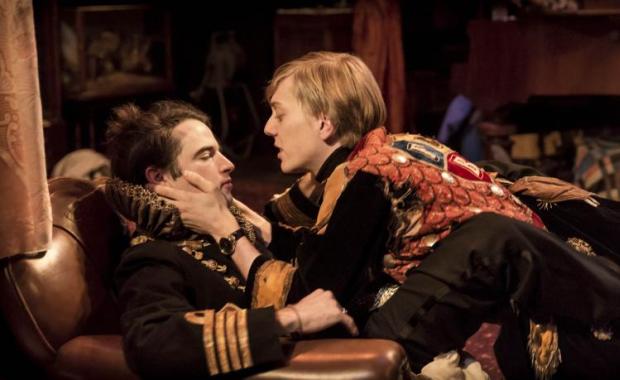
Ever since J.M. Barrie first gave us the boy who never grew up, Peter Pan figures have consistently captured the imagination. Robin, the damaged, boyish figure at the centre of Polly Stenham’s new play, is a direct descendant of this tradition, a self-declared “landed gypsy” whose not so magical but no less mythical Neverland is an old country house populated with faded rugs and creaking suits of armour.

Tracing a recurring theme in Stenham’s work, Robin’s isolated kingdom is a world dominated in turn by the suffocating presence and crippling absence of an intoxicating, unstable parent. His mother, wild, untamed novelist Lily, has brought up her youngest son in rural isolation, schooling him at home and feeding him on a diet of nature and art. Horrified by the glowing smartphones and information onslaught that he finds in London, the musically gifted Robin has returned home, drink and drugs in tow, to a childhood paradise that is being steadily snatched away from him. In this world of teetering privilege, property, land and identity are all inextricably wound up with one another, as the fight for a threatened way of relating to the world becomes inseparable from a desperate battle to hold onto the family home.

For all the domestic tumult and personal pain, however,No Quarter seems also to chant a eulogy for Britain, for a green but fading land of wild stags and lost boys, for a fled and empty mythology. A Jerusalem for the bare-footed, bohemian upper classes, there is a mingled air of both scorn and mourning for a way of living that was never really any more than a pretty story. Like the stuffed animals that clutter Tom Scutt’s meticulously detailed set – a haunting, gloomy shrine to taxidermy – this hermetically sealed rustic utopia is simply a mirage, death dressed up in the feathers of life. Every detail of Jeremy Herrin’s production hints at the same sense of slowly shattering illusion, right down to the dressing-up chest and the repeated use of Eurythmics’ ‘Sweet Dreams’; all an ephemeral reverie, an alluring narrative of a way of life and a nation that is drawing inexorably to its close.

Delicately linked to this atmosphere of illusion, there is also an intriguingly self-reflexive note to a piece of art that is essentially about artists. In the opinion of Robin’s elder brother Oliver, a politician who has fled the chaotically creative nest, caring only about art is just another way of caring about oneself. This immediately invites reflection on the potentially indulgent nature of what we are observing, a comment on the world that faces accusations of being just as futile and self-serving as Robin’s petulant hedonism. At times Stenham seems to conspicuously revel in her language, breaking the spell of the action with long and often beguiling speeches on the state of the world beyond these four walls; Herrin and actor Tom Sturridge give Robin as much bohemian swagger and jagged broken edges as the role can contain, crafting a young Rooster Byron for the crumbling halls of privilege; Scutt’s design, a hoarder’s heaven, is a lesson in excess.

Yet Robin – who for all his self-absorption and glaring faults remains the fiercely beating heart of the piece, particularly as brilliantly realised in the wiry, charismatic figure of Sturridge – strikes a blow against such charges. Making things, he protests, is the opposite of death; a way of revolting against the ugliness of the world. This argument recalls Simon Stephens’ observation that, however bleak the content, making theatre is an essentially optimistic act – an act in which this particular production is ultimately engaged. While the piece never quite seems to settle on either Oliver’s or Robin’s way of looking at the world, the final chord that it strikes is, despite everything, a mutedly hopeful one. Its vision of today might be dark and muddled, but it frames the receding myths of the past with a hint at the possibility of a better future.