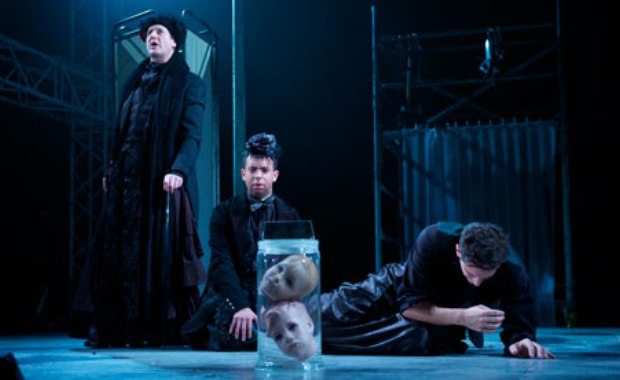
Macbeth, Globe Theatre

Originally written for Exeunt.

At the Globe to Globe festival, murder has never been such a social event. All of the major scenes in this brashly vibrant Polish production seem to occur at lavish parties, under the watchful if drink-blurred vision of the witches, here recast as a gaggle of gloriously camp transvestites. In these hedonistic surroundings, as a slurring, stumbling Duncan attempts to strip and unapologetically feels up Lady Macbeth, the plot-propelling act of violence seems more of an escalation of well-oiled passions than an act of calculated ambition. This is homicidal guilt figured as one long hangover, as Michał Majnicz’s increasingly dishevelled Macbeth howls his way through murder after murder.

Despite possessing such a familiar plot, little is recognisable about this reimagining of the play. Numerous inexplicable alterations have been made to Shakespeare’s text, including the addition of a scene-stealing witch named Lola, who might well have been inspired by the Kinks track. But while it may bear only a passing resemblance to the Scottish Play that British audiences are used to, this Macbeth has clearly been designed as a visceral experience rather than a linguistic, intellectual one. To overcome the language barrier, Teatrim Kochanowskiego have drawn on pop culture and visual bravado; colourful, explosive images assault our retinas, while music – everything from Michael Jackson to ‘I Will Survive’ – throbs away in the background. It is messily joyous spectacle, tragedy in the style of Steps rather than Aristotle.

Grasping for any overarching metaphorical unity to tame this sensory riot produces empty hands. There are loosely recurring motifs, the most prominent of these being an overt, swaggering sexuality that lends the production its cautious ‘adult content’ warning. Majnicz and Judyta Paradziń as the bloody handed couple crackle with mutual lust, a sexual desire that seems tangled up with their murderous acts, while one witch unexpectedly indulges Macbeth with a blow job following his ascent to the throne. Amid a circus of playful, riotous colour, one of the production’s most genuinely disturbing images is presented in a scene in which Lady Macduff is brutally raped. Yet when reassembled, these strands do not weave into any identifiable shape. If there is a defining texture to the piece, it is one of vague seediness pasted over with sequins and glitter.

No matter how fragile the basis for its interpretation, however, the sheer visual audacity of this production is enough to provoke a wistful yearning for more aesthetic creativity in British theatre. Flaws aside, this is an ideal marriage of production and festival, eventually embracing the party atmosphere that seems to buzz from the Globe. It may not be Macbeth as any of us know it, but this is anarchically beautiful, visually ingenious, vodka-drenched fun.

The Taming of the Shrew, Richmond Theatre

Ah, that old problem of the Shrew. This most irksome of Shakespeare’s plays is itself resistant to being tamed, often refusing to bend to directorial interpretations that try to smooth its rough, arguably misogynist edges. It is not a play that I can profess to having much personal fondness for and one that I doubt I will ever come to love, but the Royal Shakespeare Company’s latest attempt certainly has a spirited if slightly over-enthusiastic stab at it.

In director Lucy Bailey’s vivid vision of this troublesome play, the battle of the sexes boils down, ultimately, to sex. Bed is not just the setting for consummation of marriage, but the location for Petruchio and Kate’s entire twisted courtship, with Ruth Sutcliffe’s triumphant, sheet-draped set denoting both subtext and end point. The sparring couple’s struggles are, in this context, simply a bizarre and extended form of foreplay. The bed is also the seat of dreams, making it an appropriate stage for the fantasy drunkenly dreamed by Christopher Sly, another man with sex on the mind who is kept present amongst the action throughout in the humorous form of a gamely slurring, staggering and burping Nick Holder.

But this interpretation is not all about crude gestures, winks and nudges and a tumble between the voluminous sheets. Sex is intriguingly associated with money and, by extension, power. When Baptista, after marrying wild Kate off to Petruchio, offers younger daughter Bianca’s hand in marriage to the man who can make the highest offer, her suitors illustrate their wealth and ‘hangings’ with sexually suggestive actions indicative of their generous endowments – financial or otherwise. Meanwhile, the very crudeness of making the bed a public arena stresses the crudeness and cruelty of the marriage market, in which women and sex become commodities. By breaking away from these rigid, narrow-minded practices, Petruchio and Kate finally reach, by comparison, a more natural union.

The central relationship between ‘shrew’ and ‘tamer’ is of course the focus, carrying the burden of the piece. The sparky, wild dynamic between Lisa Dillon and David Caves bears this burden with attitude, as the pair constantly dance around once another, grapple and come to blows. Bailey has cultivated a particularly physical pairing, presenting us with two misfits who can barely stay still; Caves’ Petruchio paces, struts, fidgets and at one point even drops into press-ups, while Dillon’s hands yo-yo from hips to dishevelled hair in conveying Kate’s anger and agitation. Thus, when rare moments of forgetful stillness do arise, a strange sort of understanding seems to leap the gap between them, eventually bringing them together.

For all its bold and sexy swagger, however, Bailey’s production does not quite surmount the hurdle of this play’s undeniably tricky gender politics. Although Dillon delivers Kate’s final submissive speech in mockingly sarcastic tones, she cannot overcome the meaning behind the words, which are not sufficiently explained away by the relationship that Bailey has crafted. To negotiate the plot’s inherent difficulties we are sold a messed up love story, but despite the sexual chemistry it is a romance that struggles to be credible. Both Kate and Petruchio are certainly screwed up outsiders, but their behaviour in this production is often so outrageous that it becomes difficult to care too deeply for them.

This is sexy, brash, vigorous and often very funny fare, but it fails to fully redeem a play that still feels more than a little unpleasant. In the end, Bailey’s striking if not all that subtle bed concept says it all, in a production that gives us a lot of lust without very much love. As Petruchio and Kate finally, ecstatically jump beneath the sheets, we are left in little doubt that the sex will be great, but the morning after looks to be on rockier ground.

The Taming of the Shrew runs at Richmond Theatre until 24 March then continues on tour.

The woman’s part: is single-sex casting sexist?

Originally written for The Guardian.

At a performance before Christmas of Propeller’s Henry V – not the funniest of Shakespeare’s works – theatregoers, including myself, were in stitches. The source of our mirth was the scene in which the French princess Katherine and her maidservant attempt to polish their English – a good old-fashioned language gag. But the riotous laughter owed less, I suspect, to the script than to the fact that Katherine had a five o’clock shadow.

Men on stage in dresses, it would seem, hold an eternal fascination. The pantomime dame has become as quintessentially festive as mince pies and tinsel, cross-dressing comedians can raise a belly laugh without even opening their mouths, and all-male casting exercises continue to tickle, intrigue and divide audiences.

Propeller’s decision to be an all-boys’ club has, of course, good historical precedent. Shakespeare wrote with male actors in mind, a fact that becomes relevant to the playful gender games initiated when women disguise themselves as men.

There is, of course, one major drawback to putting men in corsets, even in Shakespeare. As pointed out by Jo Caird in a blog for What’s On Stage, all-male casting filches some of the few great roles written for women. Citing the “chronic under-representation of women on the British stage”, she considers Propeller’s casting policy to be unjustifiable, an argument that carries a lot of clout.

It is difficult to imagine, however, similar objections being raised against exclusively female casts. All-female casting has become almost as common a practice as its male counterpart and is often credited with producing illuminating re-examinations of gender. Just think of Theatre Delicatessen’s exploration of the ways women contort themselves into prescribed roles in their all-female interpretation of A Doll’s House, or the Globe’s experiment a few years back in balancing its all-male productions with The Taming of the Shrew and Richard III performed by casts consisting solely of women.

But if all-female productions can be hailed as delving deep into the tangled gender politics of classic texts, surely the same can be argued of any cross-dressing production. Whether conceived as radical re-interpretation or mere giggle-inducing gimmick, I can’t help but feel that any production that makes a decision so extreme is inherently playing with gender, even if that’s not the primary purpose.

If nothing else, this technique is oddly alienating. In Propeller’s bloody take on Richard III, director Edward Hall and his cast made few concessions to femininity, with not a wig in sight and female attire that was cursory at best. The production’s hulking men in skirts consequently provoked an almost Brechtian jolt, roughly picking up the audience and putting them back down at one remove from the scenes on stage.

By making the familiar unfamiliar and levelling gender differences, single-sex casting can make us look afresh at plays that have become an accepted part of our cultural fabric. This allows audiences to reassess not only the gender relations in these classics, but also the ways in which men and women still treat one another in today’s society.

With Mark Rylance preparing once again to don his petticoats as Olivia in the Globe’s production of Twelfth Night, the theatrical gender-bending shows no sign of waning. It might not always be entirely fair, but single-sex casting remains one of the most effective ways of opening up the gender politics debate in classic plays. Perhaps it’s necessary to be exclusive in order to call for a more inclusive society?

Photo: Manuel Harlan