Fleabag, Soho Theatre

Fleabag-at-Edinburgh-2013-DryWrite-courtesy-Richard-Davenport-41-600x399

Originally written for Exeunt.

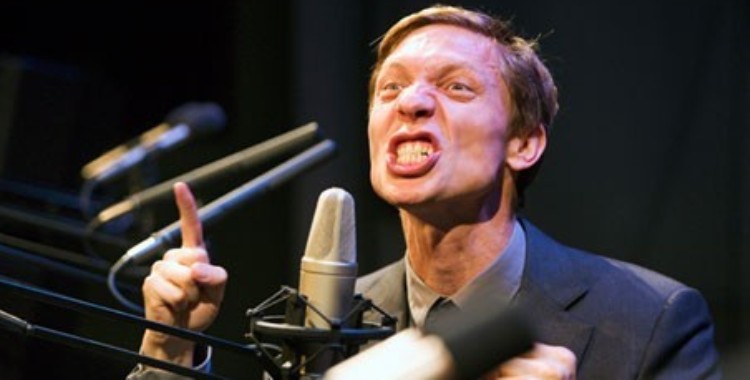
“It’s not fucking funny,” retorts Phoebe Waller-Bridge at one point in her blistering one-woman show, slicing through the audience’s laughter. But Fleabagis funny. Very funny. A riotous clash of confessional stand-up and exposing monologue, the brilliance of the piece is in its ability to land a joke at the same time as shaking its foundations. It leaves you laughing one moment and questioning your response in the next.

As well as funny, Waller-Bridge’s play is audaciously filthy. Her uninhibited protagonist reels off a giddying litany of wanks, threesomes and one night stands, heedless of boyfriends or menstrual cycles. The eponymous Fleabag – she is never offered another name – flits seemingly carefree from encounter to encounter, always on the lookout for the next no-strings-attached fuck. These brief liaisons are at once joyous and grubby, walking a fine tightrope between sexual liberation and humiliation – and not without the odd wobble.

The real power of all this X-rated content, hilarious as it often is, lies in the surprising lack of shock that Fleabag’s confessions provoke. It’s uncomfortable, yes, and the unflinchingly dirty anecdotes necessitate the odd sharp intake of breath, but there is little that really, substantially shocks. In a mirror image of Waller-Bridge’s disturbingly blank expression as she searches through every last genre of porn – gay, Asian, anal – we have ceased to be surprised by the sex that seeps into every last corner of modern society.

It is this over-sexualised society that Fleabag is the ultimate product of. She might have a distressingly one-track mind (“I’m not obsessed with sex,” she protests, “I just can’t stop thinking about it”), but if she does it is as a direct result of the world in which she has grown up. And if this pervasive presence of sex was not enough, the play also hints at the conflicting roles in which women are cast by society. Sexual freedom is popularly portrayed as a cornerstone of gender equality, in a through line that can be traced straight from Sex and the City to its ironic, grittier younger sister Girls, but at the same time women face criticism for pandering to the sexual fantasies of men. Does being a “slut” or disliking one’s body make a woman by default a “bad” feminist?

This is the sort of question that the piece is careful not to answer – at least not definitively. The complex ambivalence of the tone is personified in Waller-Bridge’s dazzling realisation of her protagonist, an individual who is both defiant and damaged. Beneath the swaggering sexual bravado, we see vulnerable glimpses of grief and loneliness, but as soon as she begins to soften Waller-Bridge complicates matters again with another jagged edge, another comic flourish. Just as the script is scattered with perfectly formed gags, Waller-Bridge’s comic timing is flawless, speaking of an impeccable control that is at odds with the spiralling chaos of the life she narrates.

And in the end comedy is the play’s killer weapon. Waller-Bridge brashly defies any claims that women aren’t funny, but Fleabag’s ability to make others laugh is intimately and troublingly tied up with the gathering wreckage of her personal life. The stylistic nods to stand-up are no accident; this is a woman who makes a stand-up routine out of her life, craving laughter almost as much as she craves sex. Through her relentless joking and her pushing at the boundaries of what can be joked about, Waller-Bridge is finally able to turn the piece on its audience, confrontationally folding a personal narrative outwards to make us squirm in our seats. After all, we’re the ones laughing.

Photo: Richard Davenport.
Bigmouth, Soho Theatre

600x600.fitdown

(Disclaimer: this was technically a preview, but to be honest it’s hard to imagine the performance being any more phenomenal than it already is)

About halfway through Bigmouth, with the tiny part of my brain not transfixed by Valentijn Dhaenens’ electrifying performance, I start to muse about framing and juxtaposition. As Dhaenens powers his way through speeches by Goebbels and Socrates, Bin Laden and Reagan, the obvious hits me: this is all just quotation. Bigmouth is essentially a patchwork history of political rhetoric, a series of stitched-together snippets from speeches stretching back thousands of years. The art, however, is in the curation.

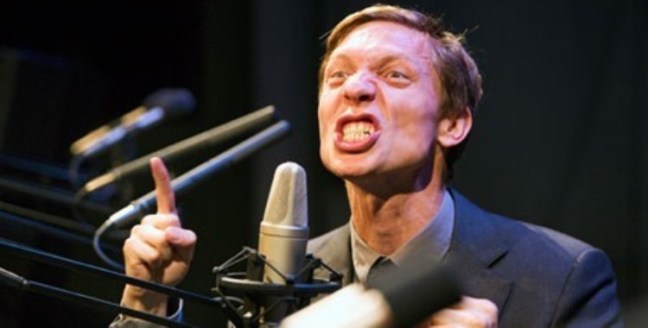
In an astonishing hymn to the power of oration, Dhaenens’ extraordinary solo performance recreates extracts from a diverse range of speeches, from calls to arms to elegies to desperate pleas, all using just his own voice and a long table of microphones. Punctuating these speeches are various sequences of voice looping and snatches of song, by turns haunting and bewildering (the most vivid example being a slowed down rendition of ‘Smells Like Teen Spirit’, making it the second time that song has provided one of my favourite theatrical moments after Benedict Andrews’ Three Sisters last year). The combined effect is a dazzling assault of sound, a relentless machine-gun bombardment of words. Except for brief glugs of water, there’s no let up.

This is, first of all, a stunning display of one performer’s virtuosity and versatility. Flipping with lightning agility between accents, languages and physical mannerisms, Dhaenens is a shapeshifter, morphing seamlessly from orator to orator (or, if not always quite seamlessly, the seams themselves are as interesting as anything else). He is just as compelling when (literally) spitting with rage as when calmly – almost seductively – curling his mouth around some of the most dangerous political rhetoric in history.

And make no mistake, words are dangerous, even more so when tripping persuasively from the mouths of consummate public speakers. If Dhaenens’ wide line-up of public figures from across the years demonstrates that not much has changed when it comes to the art of verbal persuasion, another steady constant is the influence of the orator themselves. While styles of delivery vary wildly, it soon becomes clear that the success – or otherwise – of a speech lies largely in the hands (or mouth) of the speaker. The selection of speeches seen here might range from the inspiring to the morally repugnant, but it’s terrifying how much more blurred those lines can seem when rhetorical tricks come into play.

One particularly striking segment of the show interweaves two speeches by Joseph Goebbels and General Patton at the height of war in 1945, jumping deftly between the two sides. Goebbels is all creepy composure, while a shouty Patton drips with all-American testosterone, but the message of their speeches is essentially the same; both are calling for all-out war, asking their listeners to do whatever it takes to win. Sometimes it’s not the words you use, but the manner in which you clothe them.

Which brings me back to those ideas of framing, selection and juxtaposition. Why has Dhaenens chosen these particular parts of these particular speeches? Why has he placed this speech next to that speech? Why insert those specific songs? As demonstrated by the example above, quotation is not a neutral act, particularly when that act of quotation also involves sitting different snatches of borrowed speech alongside one another. On another occasion, by stringing together a series of short speeches from iconic US figures to the backing of ‘America’ from West Side Story, Dhaenens is instantly commenting on the American Dream and the supposed promise of the West without using a single word of his own. Aptly, this is also in a sense what politicians do, curating the facts and the rhetoric that make the point they are seeking to hammer home.

And there’s something that this process says not only about politics, but also about theatre and performance. I often think about how influential the framing of a piece of theatre is in guiding audiences’ reception of its political message (as a thought exercise, imaging putting a piece of fascist propaganda in a subsidised London theatre; it would almost certainly be read as a damning ironic comment on the material rather than an endorsement of the political view it portrays). The sheer force of Dhaenens’ performance, meanwhile, is a powerful demonstration of how words can be propelled by their delivery and how performance itself has the ability of transforming the fabric of the material it works with. Perhaps it really isn’t what you say, but how you say it.

Pastoral, Soho Theatre

600x600.fitdown1

Originally written for Exeunt.

We’re all familiar with the terrifying threat posed against our planet by global warming, but what if it was nature that turned on us for a change? Thomas Eccleshare’s Verity Bargate Award-winning ‘first play‘ imagines just this, offering a madcap mix of mythology, nostalgia and post-apocalyptic narrative tropes. His motley group of protagonists, anchored by the excellent Anna Calder-Marshall as good-humouredly grumbling old spinster Moll, face not nuclear holocaust or zombie apocalypse, but the creeping invasion of grass and trees. Nature, it would seem, is rebelling, thrusting roots through concrete and branches through windows. Saplings are sprouting up in Paperchase and there are deer on the loose in Aldi.

This is catastrophe played firmly for laughs – Day of the Triffids reimagined as a sitcom. As the escape route planned by Moll’s young protectors Manz and Hardy is rapidly cut off, the trio are soon joined by a fleeing family, establishing the confined and somewhat ridiculous conditions conducive to quick-fire comedy. The running gag of flora and fauna taking over the local high street seems at first to promise some cutting comment on fiercely branded consumer culture, but instead it’s just an excuse to make spiky quips using familiar chains. While the long-awaited Ocado man – a late capitalist Godot – is a beautifully witty touch, the laughs can’t quite escape the feeling of being at the expense of ideas. Eccleshare has hit on a promising concept but rapidly submerged it in humour.

This black comedy all plays out in the precarious space of Moll’s flat, which Michael Vale’s skeletal metal design renders immediately open to the plant life that later wrestles its way in. Despite the momentary alarm engendered by the progressively collapsing room, however, there is little peril evident in this environment, even if it does involve some scene-stealing foliage. A creaking tree – not aided on press night by technical difficulties – provides about as much menace as birdsong, its swooping canopy more comical than threatening. While we’re often told about the encroaching danger of nature’s seemingly unstoppable onward march, the danger is never seen, only reported.

Eccleshare also leaves us in the dark as to the cause of this environmental anomaly, a decision that opens the way for interpretation but leaves questions hanging frustratingly in the air. Is the sudden overgrowth to be understood as a punishment for humanity’s thoughtless neglect and abuse of its natural environment? And does the play’s newly green and pleasant land herald a return to a golden age of natural harmony? This is certainly implied by the wistful hints of mythology, encapsulated in the youthful hope of Polly Frame’s bolshy yet faithful Arthur, an eleven-year-old boy with an ancient king as his namesake. Yet such intriguing suggestions still feel slightly underdeveloped, tangled in the swiftly growing branches.

As the play concludes with an outpouring of tongue-in-cheek sentimentality, its attempted archness looks remarkably like maudlin slush, a fate from which it’s just about saved by the simple tenderness of Calder-Marshall’s and Frame’s performances. There’s no denying Pastoral’s appealing ambition and often joyous eccentricity, but in the end it’s all too content to settle for a neat emotional pay-off over genuine complexity.

Photo: Simon Kane

God’s Property, Soho Theatre

Gods-Property_Credit_Helen_Maybanks-600x545

Originally written for Exeunt.

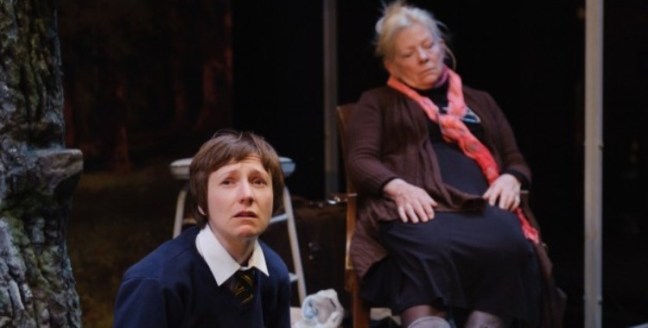
Through the door in the back wall of Ellen Cairns’ set, visible in brief, snatched glances as performers slam it open and closed, the world is all askew. The outer walls of a Deptford housing estate unsettlingly loom, threatening and out of kilter, yet at the same time oddly flat. It’s a fitting metaphor for the crooked, broken realm of Arinze Kene’s play, where identities are doubled and conflicted and the world of the protagonists teeters dangerously on a precipice. But despite rapidly rising stakes and an imposed sense of urgency, the play too exists on something of a level plane, never quite achieving the texture that its early scenes tantalisingly promise.

Kene’s premise revolves around the reunion of two mixed-race brothers in 1980s Deptford, at the height of local tensions. Chima returns home from ten years in prison to a cold, aggressive greeting from Onochie, the younger sibling who neither knows nor welcomes him and who stubbornly seeks to reject his own Nigerian heritage. The initial conflict over racial identity that wedges itself between the estranged brothers is quickly joined by the divisive ghosts of Chima’s past, a past whose consequences gradually smash their way into the kitchen where the siblings haltingly renegotiate their relationship.

As the brittle, wary Onochie, Ash Hunter is all youthful bravado and prickly contradiction, a moody wannabe skinhead not yet grown into his bovver boots. Explosions of wounded anger are offset by moments of startling tenderness, particularly when bouncing off girlfriend Holly, the local white girl whose entanglement in the crime for which Chima was accused acts as a catalyst for escalating revelations. Unwittingly caught in the eye of this storm, Ria Zimtrowicz’s Holly is a lightning bolt of teenage attitude and optimism, precisely and hilariously capturing the naivety, awkwardness and bolshily faked confidence of adolescence.

Michael Buffong’s production is at its best when continuing in this observational vein, hitting delicately and often poetically on truths about both human relationships and the knotty process of defining one’s own identity. Through the contrasting experiences of Onochie and Kingsley Ben-Adir’s older, battle-scarred Chima, the question of whether it’s ever possible to choose one’s racial identity is probingly posed. The piece’s structure and characters begin to unravel, however, as the reality of the situation and of Chima’s past is delivered in a series of unnecessarily heavy punches – a blurted name, the discovery of a letter, a furious outpouring of truth.

Throughout this heightened drama, the family kitchen is a room under siege from all angles, on the point of collapsing from the weight of external pressure. It’s a pressure that is reflected in Cairns’ design, a detailed domestic space that crumbles away unevenly at the edges, giving way to a city ruptured by violence. This is the London of mass unemployment and the Brixton riots, an almost apocalyptic urban environment that the production repeatedly reminds us of. The contemporary parallels and resonances are never pointed at, but are ever hauntingly present.

The grim familiarities of this environment also mouth the unspoken question of whether anything has really changed. Onochie may be, as he proudly declares, “made in England”, but Kene’s recurring references to blood – both its inheritance and its spilling – suggest that it’s what runs in the veins that continues to matter in our society. Just as its conclusion remains suspended, the question of change is one that this production decides not to answer, but still it seems to hang in the air, as unresolved and off-centre as the world outside. While the piece as a whole may lose its way, the view framed by Cairns through the doorway says it all.

Photo: Helen Maybanks

The Kingdom, Soho Theatre

Originally written for Exeunt.

Just as a man’s home is his castle, of his life he is king. Or so goes the notion subscribed to by the ambitious young Irishman at the heart of the lyrical stories told by Colin Teevan’s three toiling labourers, chipping away at secrets and received certainties with the same sweaty vigour with which they hack at the rocks littered at their feet. With unobtrusive poetry that lilts to the swing of the spade, three men weave myth, dream, tragedy and defeat, drawing a direct line from the doomed heroes of Ancient Greece to the thwarted dreams of the tortured Irishman, the chancer who seemingly grasps at fate only to find himself clenched in destiny’s stony grip.

The ironic kingdom of Teevan’s play is the abandoned Irish homeland, a country shrouded in both romance and fear. In a tale told through three generations, the other promised kingdom – that of heaven – is discarded in favour of a more earthly and all too ephemeral set of riches. But in place of the usual tale of the plucky young Irish lad seeking his fortune in England, Teevan presents us with narrative suffused with myth. The familiar echoes of Greek tragedy begin to overlay what opens as three stories but gradually emerges as just one, the trio of tales meeting with a creeping inevitability, like the crossroads at which the story’s crucial narrative hinge is located.

As hinted at by the mound of rocks reaching to the ceiling of the Soho Theatre’s small upstairs space, there is much about the building of status, of a better life, of a future just out of reach. Anthony Delaney’s grinning young man greets opportunities with wide eyes, all youthful excitement with just a glimmer of greed, while his older counterpart Owen O’Neill holds on to what he has constructed with tight fists. These grasping figures are counterpointed by the next generation above, embodied in Gary Lilburn’s bowed, broken, but grimly wise old man. As all three men shapeshift, taking on different roles and picking up dropped narrative threads, distinct moments in time collide and merge. Past and future are always present.

Often moving as heavily as the exhausted workers, Lucy Pitman-Wallace’s understated production can feel like a toil, particularly in the opening minutes. Between the labour there is a suffocating stillness, a stillness that respects the haunting movement of the narrative’s slow revelation and that evokes the thick black air of its gloomy tunnel setting, but that also threatens to let the piece turn stale. It’s a delicate line between contemplation and boredom. This stasis, broken only by the distracting movement of digging, lays all the burden on Teevan’s symbolism drenched script, a burden it fails to fully support.

In contrast with the evidence of the earth that spreads around the three performers, the lyricism of the text embraces the suffering but not the grit. Failing to acknowledge the tension between the tragic fall from grace and the grinding of the working man back into the mud from which he dragged himself, the play’s bleakness is of the same romanticised kind that is frequently attached to “the kingdom” itself. We learn much of myths, but little of men.

Photo: Robert Day