A Streetcar Named Desire, Young Vic

ben-foster-and-gillian-anderson-in-a-streetcar-named-desire-89975

“I don’t want realism. I want magic.”

In Secret Theatre’s version of A Streetcar Named Desire, Blanche’s famous line raised a light, knowing chuckle from the audience. The character might have been referring to her inclination towards fantasy and illusion, but her words could well have been a mantra for the production, which turned Tennessee Williams’ play and all its well-worn visual tropes inside out. Those words, spoken in that context, also posed an implicit question. Why, on the stage, do we settle for realism when we could have magic?

I’m reminded of the frustrated words of Eugene Ionesco: “I personally would like to bring a tortoise onto the stage, turn it into a racehorse, then into a hat, a song, a dragoon and a fountain of water. One can dare anything in the theatre and it is the place where one dares the least”. In theatre, where one thing always stands for another – when the relationship is one of metaphor – why do we still insist that those two things look alike?

Partly liberated by the secrecy bound up in the project (show titles are not released in advance), Secret Theatre’s Streetcar somehow freed the play of all its – and particularly Blanche’s – baggage, presenting us instead with its exposed innards. It understood theatrical representation as metaphor in its most playful sense; chunks of watermelon stood in for poker chips, and Blanche’s endless glasses of liquor became liberal drenchings of water. It was not quite magic, but it certainly wasn’t realism.

By comparison, Benedict Andrews’ new production feels sort of drab, dull even. First, let’s be clear: Andrews’ take on Streetcar isn’t exactly realism. There’s a stylishly skeletal revolving set, garish washes of coloured light, scene changes underscored with Swans and Chris Isaak. But in between the vivid flashes of colour and music, it’s naturalism by another name. Matt Trueman has coined the perfect term for it: “realishism”.

That “ish” is apt. This Streetcar is interesting-ish, elegant-ish. It puts a slight spin – both literal and figurative – on Williams’ play, but never enough to leave us giddy. Or put it this way: if you were expecting another classic done in the same vein as Andrews’ storming, vodka-fuelled Three Sisters, prepare to be disappointed.

On the main stage of the Young Vic, Stella and Stanley’s cramped, claustrophobic apartment is a metal husk of a building. Magda Willi’s set strips out walls, leaving only the framework of the rooms through which an audience can peer. The characters are at one level exposed and at another trapped. This is the cage that Blanche knocks against, that Stella has no desire to get out of.

Andrews’ production sets this space in almost perpetual motion, turning it clockwise, anti-clockwise and back again on the wide revolve. It’s slightly reminiscent of Ian MacNeil’s smoothly spinning set for A Doll’s House on the same stage, but while that design offered fleeting, cinematic tableaux between scenes, this keeps everyone queasily turning throughout. The sensation is one of constant shifts, but the only direction in which any of it can go is round in dizzy circles.

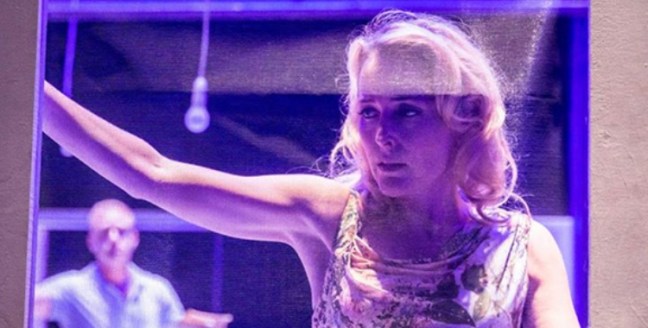
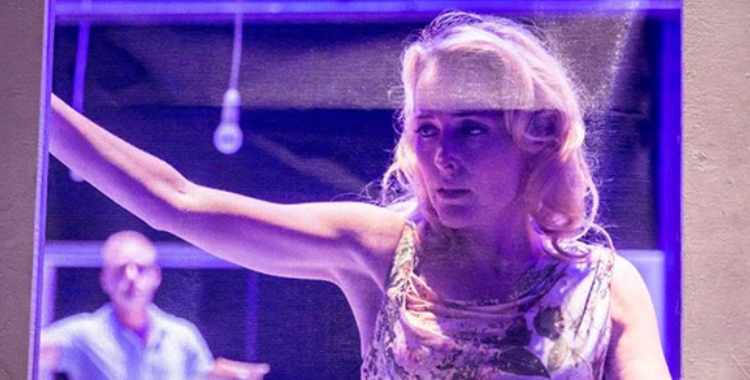
Like any repetitive cycle, however, this one begins to get boring. In the first half, the pace is swift and the tension tight, coiled like Stanley’s unpredictable temper. But the momentum drops away after the interval as the production follows increasingly familiar tracks. Andrews might half-heartedly update Williams’ play, kitting it out with Ikea furniture and skinny jeans, but Gillian Anderson’s Blanche is just as we expect her: flirtatious, fragile Southern belle, all carefully composed but rapidly cracking mask. Her downfall is competently conveyed, but never quite tragic.

While Anderson fails to break the mould as Blanche, Ben Foster’s war-damaged Stanley is an intriguing take on the role. Rather than picking up the obvious cues from Williams’ descriptions of the character as primitively animalistic, Andrews and Foster seize on Stanley’s military history, suggesting a man broken by conflict. When his first major outburst arrives, it is truly explosive because it seems to come unbidden; this is not a man of naturally violent passions, but one shot through with an anger he is unable to control.

Stanley’s reconciliation with Vanessa Kirby’s Stella, immediately following this scene, is another of Andrews’ successes. Their bodies meet in a rush of passion, their movements adopting a tango-like quality under the hot red glow of Blanche’s Chinese lampshade. The production is studded with little moments like this, small scenelets that elevate the quality of the rest. They are too sparsely positioned, however, to entirely rescue the bland expanses in between.

It’s unclear, meanwhile, just what Andrews’ updating achieves. His Three Sisters wrenched Chekhov’s play out of any specific temporal context, brilliantly locating it on a timeless, abstract plane. The setting for Streetcar, on the other hand, is recognisably modern, but with few concessions to that modernity in Anderson’s performance. What the time shift does highlight, however, is the play’s gender politics. Watching, I’m more aware than ever of the limited borders of Blanche’s horizon. As she says at one point, her role as a woman is to entertain, to be beautiful. And the beer-drenched masculinity of Stanley’s poker games is not much of an alternative, trapping men within a system of rules and expectations that is just as restrictive, if endowed with a bit more power.

These hints at an implicit gender critique, however, dissolve into obvious and borderline offensive imagery. To leave us in no doubt of either Blanche’s troubled mental state or the pressures of femininity heaped onto her, Andrews puts Anderson into a candy pink dress and wonky tiara, hair ruffled and face smeared with make-up. Southern belle transformed into dishevelled Barbie princess. It’s the crashingly unsubtle culmination of a dismayingly uninventive telling of this character’s trajectory, casting little light on its themes of mental health and sexual politics. From a director whose interpretation of Three Sisters was so bursting with invention, it’s a bitter disappointment.

Photo: Johan Persson.

Happy Days, Young Vic

image1

“The function of utopia is a critique of what is present.” – Ernst Bloch

I find myself thinking a lot about utopia, optimism, hope and idealism, as well as theatre’s place in that matrix of positivity. Perhaps it’s because, at heart, I think I’m an essentially optimistic person. As an optimist (most of the time) and as a theatre lover, it’s unsurprising that I invest the theatre I see with the possibility of hope, however small. Whether it’s Jill Dolan’s infectiously passionate Utopia in Performance, which greeted me like an embrace after weeks of burying myself in theory which all seemed to disavow theatre’s radical and optimistic potential, or the hopeful striking of a match at the end of Lucy Ellinson’s border ballad, it’s those slivers of optimism which always catch my attention.

Predictably, then, I was struck by that opening quotation from Ernst Bloch. It dragged my mind back to a discussion that Dan Hutton and I had on Exeunt a few months ago, in which we jumped off from Andrew Haydon’s (slightly disingenuous) positing of hope and critique as two sides of a dichotomy, opening into a consideration of hope in the theatre we were seeing at last year’s Edinburgh Fringe. One of our shared conclusions was that there can in fact be critique within a hopeful narrative, a point that Bloch’s statement succinctly nails. The same, I think, might be said of discourses steeped in optimism. Just as utopian thought can function as critique, so too perhaps can optimism.

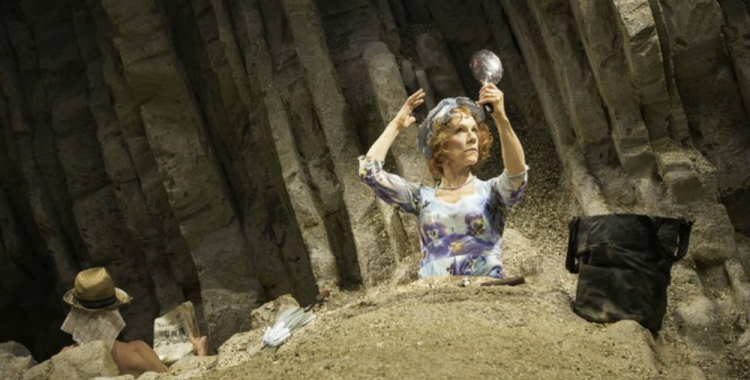
The scorched world of Samuel Beckett’s Happy Days is clearly not a utopia of any description. Indeed, it would not be much of a stretch to describe it as a dystopia. In Natalie Abrahami’s new production at the Young Vic, the striking prison of earth in which Winnie is trapped is less a mound of sand and more an inhospitable, rapidly eroding rock face, sloping sharply down towards the audience. Within Beckett’s demanded limitations, Vicki Mortimer’s design draws out both the precarious nature of Winnie’s predicament and the yearning, upwards movement that pulls in vain against her cruel, unexplained confinement. Add to this sound designer Tom Gibbons’ chillingly discordant “bell”, slicing Winnie’s time into regimented portions of waking and sleeping – not to mention the encroaching possibility that the sand will soon completely bury her – and it looks like a fairly hopeless situation. So what are we to make of Winnie’s stubborn optimism?

Optimism, according to the Oxford English Dictionary, can be defined in two distinct ways. The first, more commonly used definition is hopefulness in a forward-looking sense; the placing of hope in a future outcome. The second definition, however, is the belief that “this world is the best of all possible worlds” – optimism grounded in the here and now. By this definition, as I look around at the grim state of the world we presently live in, I would class as a pessimist. Winnie, however, with her repeated, irrationally cheery “this will have been a happy day”, is an optimist by any definition.

Or is she? Her refrain, significantly, is “this will have been a happy day”, not “this is a happy day”. The happiness is always contingent, always deferred. This statement is often followed, after a pause, by the qualification “so far”, again haunting her contentment with the spectre of future calamities (unsurprisingly, one might argue, given the ever-present threat of suffocation by sand). Time itself is manipulated throughout the play, as in much of Beckett’s work, further complicating matters. Winnie seems, at certain points, to have destroyed the notion of change and the passage of time as a sort of coping mechanism. She insists, illogically, that “nothing has occurred”; even when her umbrella bursts into flame, she calmly observes that it will be back in its old place by tomorrow. Yet there is a definite routine to the way she lives out her days, and a habitual gesturing to both past and future. Her experience of time is less a stretched out, purgatorial present as it is a fluid, mutable marker of existence, and thus her brittle optimism cannot find a firm foundation in any tense.

Juliet Stevenson’s remarkable performance in the Young Vic’s production highlights every last nuance of Winnie’s complex, ambivalent relationship with optimism. Her first expression is an almost grotesque grimace of joy, her face stretching to form a strained mask. There is, proceeding from this moment, a certain deliberateness to Stevenson’s movements, at times becoming an almost mechanical precision. Held static, the thwarted physicality of the rest of her body is channelled through her arms, which she holds like those of a dancer. Each calculated flick of a finger seems invested with some unspoken emotion.

There is something similarly deliberate about Stevenson’s speech – appropriately, for a woman whose existence balances hazardously on words. There is always an effortful edge to her insistent pronouncement of the word “wonderful”, while another of her stock phrases, “the old style”, veers in delivery from cheery to wistful to mournful, eventually becoming stained with desperation. One of Stevenson’s great skills is her ability to load words with heavy yet never overstated meaning; “wife”, rolling laboriously from her lips, is invested with multiple accusations, sighs and hopes. At other times, by contrast, there is an ironic relish to her sentences and a wry ring to her laugh. Out of the bleak, Beckettian gloom, Stevenson’s humour glints brightly.

The overwhelming impression created by Stevenson’s performance is of a woman assaulted by feeling yet grimly determined to remain in control. Her delicate, virtuosic hopping from emotion to emotion is always wrenched back to a dogged cheerfulness, as she fixes her smile with the same care that she fixes her hat. Even her crying is contained, her hands pressing tears back into her eyes. Winnie’s optimism, at least in this production, is not blind or ignorant, nor is it the babbling of a woman who has lost her mind. Optimism emerges as a choice, but it is an unstable one. It has to be worked at.

The more I think about it, the more Winnie’s optimism (if indeed optimism the right word) feels like an apt comment on the situation we find ourselves caught in, particularly at this present moment. Returning to those two definitions, the optimism that many of us feel right now is firmly future tense. We believe, or at least we hope, that things will one day be better; therein lies the critique, as for the situation to improve it must first be flawed in some way. Yet to get by from day to day we, like Winnie, must find some optimism in the present. The system thereby bends us towards the second definition of optimism and the acceptance that ours is “the best of all possible worlds”. Unable to fully resign ourselves to this, perhaps we also hover somewhere between the two, determinedly injecting our lives with cheer and deferring, along with conflicted Winnie, our own happy days.

For another consideration of optimism in Happy Days, see Dan Hutton’s essay

Photo: Johan Persson.

Open dialogue

Colchester 24.4.13 Theatre Arts Society and Frequency Theatre ViTW Reception 2 (2)

Originally written for The Stage.

The post-show discussion does not have the best of reputations. What should be an opportunity to share thoughts and gain artistic insights often becomes a stilted Q&A, a one-sided stream of anecdotes, or an unspoken contest to see who can ask the most intelligent question. But what about a post-show discussion for people who hate post-show discussions?

One of those people – by her own admission – is Lily Einhorn, project manager of the Young Vic’s Two Boroughs community engagement scheme. The project offers free tickets to residents of the boroughs of Lambeth and Southwark, many of whom Einhorn noticed were attending the theatre on their own. Recognising the lack of opportunity these theatregoers might have to discuss the work they were seeing, and acknowledging that the usual post-show format might alienate or intimidate them, Einhorn set about creating an alternative.

The Two Boroughs Theatre Club is modelled on the book club format: rather than being plunged straight into discussion immediately following a show, recipients of Two Boroughs free tickets are invited back after they have all had a chance to watch and reflect on a production. And just as a book club would never dream of inviting the author, Einhorn is firm that no members of the artistic team should be present for the discussion facilitated by the Theatre Club.

“I thought it would be really nice to have a group where the creative team are strictly not allowed,” Einhorn explains, “because I wanted it to be a comfortable atmosphere where people felt like they could say anything they wanted without fear of offending anyone, but also without fear of feeling like they’re stupid.” She continues, “it’s about unlocking something in them and saying: ‘your opinions are as valid as anyone else’s opinions’”.

Einhorn’s brainchild has been run in partnership with Guardian writer and Dialogue co-creator Maddy Costa, who has similar reservations about the traditional post-show format. “We all kind of hate the post-show discussion where everyone’s trying to ask the most interesting question,” she says. “So Lily and I both agreed that we don’t even go to those things; what we wanted to create was something different.” Their Theatre Club is designed to be as welcoming as possible, doing away with the hierarchies that usually characterise post-show events and creating a space that allows for relaxed, open discussion. The response has been enthusiastic, prompting Costa to try it out at other theatres, both through Dialogue and in association with theatre producers Fuel.

Einhorn and Costa are not the only ones seeking alternative models to the post-show Q&A. Camden People’s Theatre, for instance, has created a format it calls Talk Show Club, in which discussion is led by another theatre-maker who has not been involved with the show in question. China Plate, meanwhile, has adapted the post-show events surrounding its latest tour of Mess to suit the specific needs of both production and audience. Caroline Horton’s show is based on her own experiences of anorexia, opening up numerous issues around eating disorders. In recognition of this, China Plate are currently touring the show in association with the charity BEAT, taking it into schools and colleges as well as theatres and running a tailored series of discussions and workshops designed with psychiatrists from Kings College Hospital.

While numerous practitioners are currently experimenting with different formats, the idea of a model that eschews the post-show set-up of questions and answers is not entirely new. The National Theatre’s Platforms programme, which has been running almost as long as the theatre itself, is decidedly not post-show. Instead, the building runs regular events in the slot before its evening shows, ranging from straightforward discussions about the productions in the current repertoire to conversations that address the programme more obliquely. In the past, for example, Platforms have hosted numerous comedians and politicians, as well as a memorable encounter between atheist writer Philip Pullman and the Archbishop of Canterbury.

“It isn’t about being immediately reactive, audience wise, to what you’ve just seen,” says Platforms programmer Angus MacKechnie. “It’s either about making a choice to learn more about what you have seen on a previous occasion or coming to prepare yourself in advance of seeing it, usually on that night.” As a result, MacKechnie suggests that “it’s a different kind of commitment from audiences and we get a different kind of relationship with the audiences”. Because of the absence of an educational focus, MacKechnie explains that these events also offer audience members the opportunity to ask questions that they might not normally voice.

The desire to make critical conversations around theatre more inclusive and accessible is a feature that many of these initiatives share. The Theatre Club discussions might be guided by Costa, but the principle is that everyone in the room is equal and free to share their thoughts. “I am not the person with all the answers,” Costa makes clear, “I go in with as many questions as anyone else.” In line with this approach, Fuel’s co-directors Kate McGrath and Louise Blackwell make it clear that the Theatre Club events represent “one of the key ways that we are building new audiences and making our work more accessible”. Lorna Rees, one of Fuel’s local engagement specialists and a regular organiser of post-show events, puts her attitude simply: “for me there are no ‘silly questions’”.

Crucially, all of these events are about contact and conversation. MacKechnie insists that at the National Theatre “we don’t just drop the curtain and that’s it, you haven’t got any more contact with us”, while for Einhorn the Two Boroughs Theatre Club is about “prolonging and enriching” the theatregoing experiences of its participants. The conversation itself, meanwhile, is one in which exclusive, specialist vocabulary is exchanged for straightforward, honest expression. For Costa, it all comes down to a simple but vital distinction: “Theatre Club is a place where we don’t ‘speak’ theatre, we talk about theatre, and those are two very, very different things”.

Conversation Starters

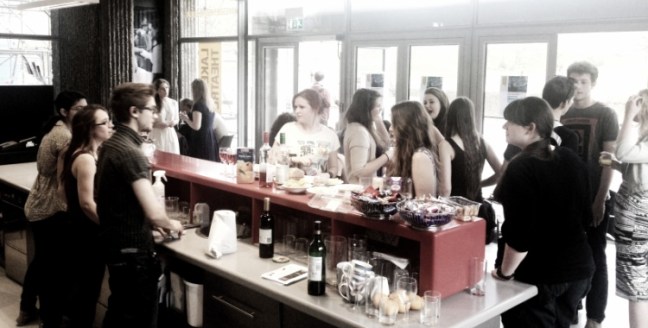
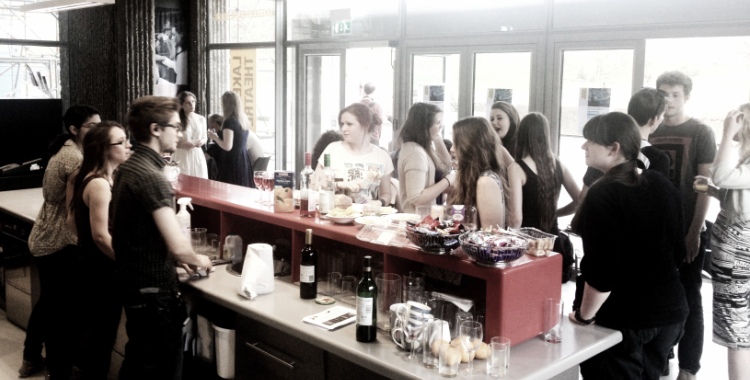
  • Maddy Costa and Fuel have found that offering refreshments instantly shifts the mood of a post-show event, transforming it into a welcoming social context. As Kate McGrath and Louise Blackwell put it, “you don’t have to spend a lot on hospitality, but you do have to be hospitable”.
  • It can also help to move the discussion out of the theatre space. While the National Theatre’s Platforms have successfully used the stage, Lorna Rees suggests that sometimes the auditorium “can be quite intimidating and not conducive to discussion”.
  • Involving the audience does not have to be difficult or complicated. Costa explains, “I always start by just getting a quick show of hands, did you like it, did you not like it, something very simple like that”.
  • Angus MacKechnie recommends experimenting with the format and fitting it to the context of discussion. “In terms of format, form should follow function,” he says.
  • Fuel point out that it must be clear where and how the event is taking place, so they recommend sending out invitations, putting up flyers and making sure box office staff are fully briefed.

Photo: The Lakeside Theatre, Colchester.

The Events, Young Vic

events-600x336

Originally written for Exeunt.

“It’s important to turn dark things into light,” says Claire, the anguished figure at the heart of David Greig’s new play, not quite convincing herself. The Events,Greig’s response to his conflicted feelings about the Norwegian massacre committed by Anders Breivik, is driven by a similar desire and tempered by similar doubt. As much as its protagonist, The Events searches for understanding, redemption, hope. What it finds is nothing so straightforward, but it is all the more compelling for the complexity it excavates on stage.

While sparked by a discussion between Greig and director Ramin Gray following the Breivik atrocity, this is not about what happened in Norway in July 2011. Instead, the events of the show have ripped apart a small, unspecified seaside community, where a boy has shot and killed several members of a local multicultural choir. Claire, the leader of the choir and a survivor of the massacre, is searching for answers. How did this happen? Why did it happen? Did the perpetrator have a reason, or must his actions be put down to “evil”?

Through the character of Claire, played with compassion and complexity by Neve McIntosh, the play prods at the insistent human desire to understand. Without understanding, Claire’s rage is impotent, directionless. In search of either an object for her hatred or an explanation that might pave the way to forgiveness, Claire hunts everywhere for answers, interrogating in turn the murderer’s father, his schoolmate, the leader of the right-wing political party whose ideology he laid claim to. But the more details are added to the sketch, the more the picture is obscured.

The succession of individuals questioned by Claire in her search for the truth are all played by Rudi Dharmalingam, who also represents the perpetrator of the central atrocity. This canny choice by Greig and Gray can be read in a number of ways. On the one hand, Claire seems to be seeing the face of the murderer in every place she looks, unable to escape him even in the embrace of her lover. The playing of all other roles by one actor also creates an intriguing quality of slipperiness; the killer is both everywhere and nowhere, inhabiting each last crevice of her consciousness while at the same time taunting her with his elusiveness. The ambiguity is enhanced by Dharmalingam’s performance, which meets Claire’s desperation with a refusal to emotionally engage, delivering each line with the same blank, lightly mocking intonation.

The impression we receive is that of a woman caught in a self-constructed labyrinth of questions, finding herself more and more lost with each new turn. There’s a certain disjointedness to the scenes, an apt sense of confusion and dislocation that hints at the incomprehensibility of what Claire is trying to piece together. Claire is a woman unmoored; unmoored from her faith, from those around her, from a previously solid sense of reason and logic. Buffeted by the currents of grief, rage and an utter failure to understand, she is alone in a sea of uncertainty.

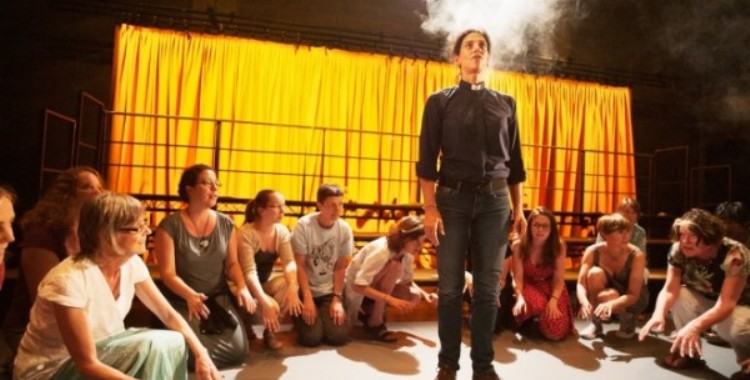
Claire’s struggle is reminiscent of certain strands in Chris Thorpe’s There Has Possibly Been an Incident, both in the subject matter – Thorpe’s play also features a massacre with hints of Breivik – and in its staging. In There Has Possibly Been an Incident, individuals are isolated down to the level of voice, which speaks against the blank, bland backdrop of Signe Beckmann’s minimal design. Here, Chloe Lamford’s set is similarly, masterfully simple. The stage is relatively bare, furnished only with a few rows of benches, a garish orange curtain, a piano, stacks of plastic chairs and tables loaded with teacups. The visual cues that this design offers are all painful reminders of the choir rehearsal room, but more important is the yawning empty space in its middle. In this space, McIntosh’s tormented Claire searches for ways to fill the gap, not just investigating but also acting, playing out different outcomes and solutions.

Sharing the sparsely furnished stage with McIntosh and Dharmalingam throughout the show is a local choir, different every night. This touch, which on paper has the sound of a gimmick, is in fact the production’s masterstroke. On the level of the play’s narrative, their role is one of haunting, suggestive of how something – the soul, God, the accusatory whispers of the dead – can remain present even in its absence. The choir’s presence and the songs they add to the piece also nod towards the potentially redemptive and community building power of music, which at first has a flavour of bitter irony, but eventually sweetens into something like hope.

On the level of the production, meanwhile, the choir does something even more interesting. Arranged on a bank of seating directly opposite that in which the audience is arrayed, the singers act as witnesses; mirroring the audience, they struggle alongside us to grapple with the questions the play poses. Their lack of slickness or preparation also adds a vital roughness, a slightly messy and unpredictable edge that makes the piece all the more truthful and affecting. At one moment during the performance, I notice one of the choir members raise a hand to her mouth, an involuntary but striking movement that focuses my attention on the theatrical dimensions of the event – the fact that we are sharing a public space and collectively processing this effort to understand.

In his introduction to the playtext, Gray writes that “Every act of theatre revolves around a transaction between two communities: the performers onstage and the improvised community that constitute what we call an audience”. His choice of the word community is no accident. The Events is all about communities – or “tribes” – with no small amount of tension contained in that notion. Community in the sense encapsulated by Claire’s choir is overwhelmingly positive, yet it is also in the name of community, or of protecting a certain community, that atrocities like this are committed. Greig’s intricate, finely tuned arguments have a habit of sharply pivoting, challenging our assumptions and once again subjecting everything to knotty ambivalence.

In the end, how these events and their wounding repercussions read is down to each of the individuals in our improvised community, the audience. It is easy to take despairing doubt from what we are presented with, but it’s equally possible to seize on hope. Near the end, a crucial moment in the narrative is suddenly ruptured by the intervention of a choir member, who reads from a script explaining the different between chimps and bonobos. While chimps solve conflict with violence, bonobos prefer sex to aggression, greeting their enemies with embraces. Humans, we are told, share exactly 98% of our DNA with each species. Which, therefore, do we most resemble? The implication, like that of the whole production, is that it for us to decide.

Photo: Stephen Cummsikey

My Perfect Mind, Young Vic

my perfect mind-165

The stage for Told by an Idiot’s latest show is decidedly wonky. Michael Vale’s white platform design is raised at one side, the other side sloping dangerously downwards; the props that sit on it valiantly fight against gravity, occasionally losing and sliding helplessly down the smooth surface. It’s an off-kilter setting for an off-kilter show, a cheeky nod to the zaniness and confusion to come. It also creates an inbuilt sense of battle, of upward struggle. The performers must always climb uphill or come tumbling down.

The defiant yet playful struggle in question is that of actor Edward Petherbridge, who in 2007 suffered a severe stroke just two days into rehearsals for a production of King Lear in New Zealand. What he has constructed together with Told by an Idiot and presented on stage with co-performer Paul Hunter is a recovery of sorts, though it’s never quite that simple. Instead, this is a piece of theatre as complex, messy and densely layered as the mind itself, jumping frenetically from memory to fantasy to present thought, barely pausing to take a breath. The result is a mad blend of stream of consciousness and wacky comedy, a gloriously surreal journey through Petherbridge’s experience that ends up being as much about theatre as it is about the human mind.

With an acting career spanning more than half a century, including a stint in Laurence Olivier’s National Theatre Company in the 1960s, it’s somewhat inevitable that an excavation of Petherbridge’s mind will be teeming with theatrical anecdotes. Olivier himself makes regular, hilarious cameos, while other names that Petherbridge drops with relish include Noel Coward and Ian McKellen. More than just a series of wistful showbiz reminiscences, however, My Perfect Mind also unpicks the very concept of drama, staging a constant slippage between several different overlapping fictions and realities. In this sense, the workings of theatre reflect the workings of the mind; we, like the performers, are always negotiating a number of different identities, always treading a delicate line between truth and imagination, with the two sometimes indistinguishable.

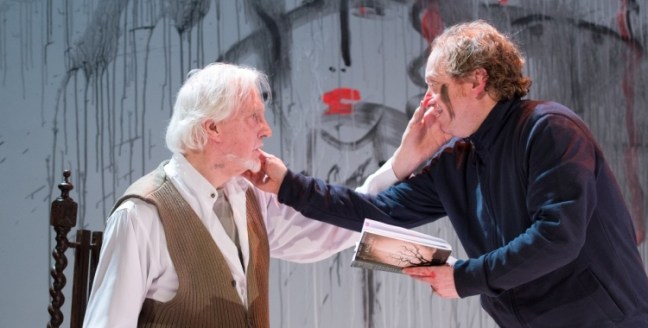
The most prominent of the fictions being juggled is King Lear, the text of which is studded throughout the show that Petherbridge, Hunter and director Kathryn Hunter have pieced together through devising and improvisation. This element of the piece is tragic in more than the Shakespearean sense, as we’re frequently confronted with the spectacle of a man snatching at a role that was cruelly wrenched away from him. The show is both Petherbridge’s chance to finally be Lear – at times with mournful, compelling commitment – and his poignant admission that this dream role will most likely continue to elude him. Instead he’s offered a fool’s version of Lear, in which the tears are just as likely to be induced by laughter as sadness.

And it is very funny. Told by an Idiot’s distinctive brand of humour is madcap and chaotic – all wigs and clowning and racing around the stage. On paper, it doesn’t sound like a neat fit with classical actor Petherbridge, but in practice it works beautifully. He and Hunter make a fantastic if unlikely double act, Petherbridge veering between unabashed, self-mocking luvviness and wearily sardonic asides, while Hunter is every inch the witty, mischievous fool, rapidly switching roles to play all the other figures populating Petherbridge’s memories. It’s rough around the edges, revelling in its own thrown together quality, but always knowing. Beneath that archness there’s also something tender and quietly hopeful, recognising the fragility of human life while celebrating the reviving reinvention of the stage. At the heart of it all is a theatrical cliché made fresh by its own promise of renewal: the show must go on.

Photo: Manuel Harlan