A Stroke of Genius

my perfect mind-171 (2)

Originally written for Scout London.

“I suppose circumstances have conspired to make some kind of happy ending,” actor Edward Petherbridge reflects, a smile in his voice. It’s an unlikely comment, given that Petherbridge is discussing the major stroke that he experienced while rehearsing for a production of King Lear in New Zealand in 2007. One day he was preparing for one of the greatest tragic roles in the theatrical canon; the next, he was barely able to move.

Petherbridge describes the “episode” – he rarely uses the word stroke – as “completely unexpected and swift and sudden”. But while the stroke initially left him physically debilitated, unable to even move his thumb and index finger together, he soon discovered that the role of Lear was still stubbornly lodged in his mind, word for word. It was this extraordinary discovery, paired with a continuing fascination with the part he was robbed of, that eventually led to Petherbridge’s “happy ending” in the form of a show in which he finally gets to play Lear – sort of.

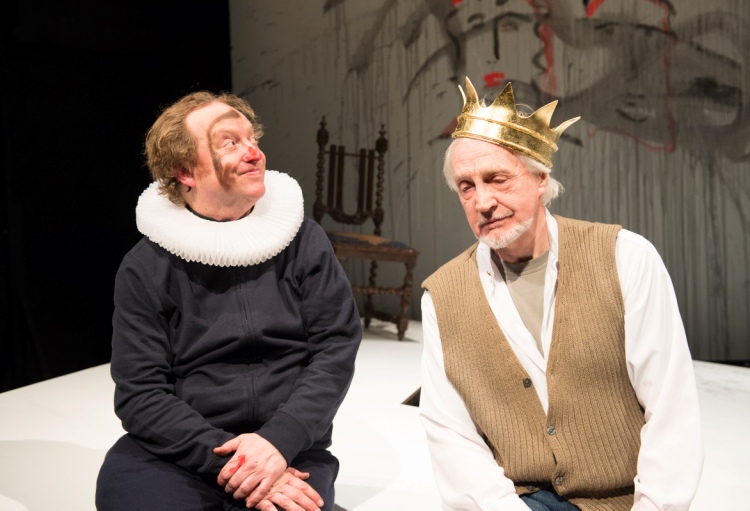
“I said to Paul Hunter in an idle moment when we were doing The Fantasticks together that I thought we could take a two-man Lear to the Edinburgh Festival,” Petherbridge explains. “He said, ‘well I might have a better idea than that, which is a show about you not doing Lear’.” The final product, emerging from a process of improvisation and devising, is My Perfect Mind, currently on tour ahead of a run at the Young Vic. Marrying Petherbridge’s experience with chunks of text from King Lear, co-deviser and performer Hunter describes the piece as a “strange, dreamlike journey through Edward’s brain”. Petherbridge plays himself and Lear, while Hunter single-handedly takes on all the other roles, from Petherbridge’s doctor to Lear’s fool.

“I don’t think either of us knew quite what the show would be that we might come up with, and I’m still rather amazed at what it is,” Petherbridge admits. Despite the trauma of the stroke, he tells me that there was little hesitation in taking Hunter up on his initial suggestion and mining those difficult experiences for theatrical material. This surprising lack of trepidation might even have something to do with the consequences of the stroke itself. “I heard on the radio not long after the stroke that the synapses that generate regret are often disabled by the brain damage that comes with it,” Petherbridge says by way of explanation.

While the nightly re-enactment of such a painful episode might sound challenging and emotionally exhausting, Petherbridge plays down these difficulties, turning again to Lear. “Someone asked me last night whether I found it at all painful or difficult,” he says, “but it’s no more painful than Lear’s much more gargantuan difficulties; mine pale into invisibility when compared with his.” He pauses for a moment, before adding, “and if acting isn’t a pleasurable experience, why do it?” This joy for acting and the theatre, which has clearly driven Petherbridge’s long and successful career, seems to have had an almost medicinal effect in the aftermath of the stroke and throughout the process of making this show. Indeed, Petherbridge refers to it fondly as “doctor theatre”.

Despite Petherbridge’s openness to chronicling his experiences for the stage, however, dealing with such personal subject matter has not been unproblematic. Hunter is frank is about the occasional discomfort of his own position in the process, saying “I’d be lying if I said there weren’t moments when I went ‘is this OK?’” He also speaks about the “responsibility” of what they are doing in grappling with this topic, but he emphasises the importance of comedy in the piece. “I think the thing that was really key was the sensitivity around the stroke, because Edward was very clear that he didn’t want to dwell on that too much or in any way to become maudlin or sentimental, and I think we’ve avoided that by treading quite lightly around it.”

The result, told in the absurd and madcap style characteristic of Hunter’s theatre company Told by an Idiot, is dreamlike and ever-shifting, rapidly jumping between Petherbridge’s life and the fictional world of Lear. As Petherbridge puts it, “it’s like a kaleidoscope of different bits of my life that Paul has shaken up”. There’s an evident connection between content and form, narrating the brain’s complex recovery from trauma in a way that reflects the extraordinary and often unexpected quirks of the human mind.

“To see the show might be like going to a seminar on Lear when you’ve taken a dose of LSD,” Petherbridge goes on to suggest, with evident glee at the comparison. “I know nothing about LSD firsthand,” he continues, “but I believe there are good and bad trips. I am hoping that the experience of seeing the show is a good trip.”

Photo: Manuel Harlan

Hattie Morahan

Originally written for Exeunt.

Never was a door slam so deafeningly resonant. The escalating dramatic action of A Doll’s House hinges – quite literally – on the moment that Nora finally shuts the door on her husband and children, walking away from a life that has hemmed her in. It’s a climactic moment that has been variously read as a statement against stifling patriarchy, as the shocking action of an uncaring and irresponsible mother, as an inescapable tragedy. But for Hattie Morahan, who is just about to return to the role of Nora in Carrie Cracknell’s production at the Young Vic, the play’s famous culmination is just one of its many facets.

“One is aware of that whole phenomenon and I can totally understand it, but it’s a phenomenon that’s built up around a single act,” she says of the debate surrounding the play’s conclusion, going on to describe readings that focus on that act as “incredibly reductive” ways of looking at Ibsen’s masterpiece. “It’s quite an incredible arc to go on from the start of the action to the end, and I think if it’s all geared towards the door slam then that actually distorts what the play is,” Morahan continues. “The play is about a marriage and it’s about a particular family. I think the more you can honour the detail and the particularities of those individuals and the mess that they’ve made of their lives, the more that her leaving will resonate in whatever way it does with the people who see it.”

This approach lends a richly detailed texture to Morahan’s Nora, a woman perpetually caught between ringing laughter and crushing despair. As she juggles her husband, her young children and the creditor knocking insistently at the door, small moments are repeatedly on the cusp of betraying her carefully hidden turmoil – a flutter of the hands, the startled catching of a reflection. Like Ian MacNeil’s elegantly revolving set, this Nora glides swan-like through the play, all composure on the surface, while frantically churning the water beneath. She also emerges as frequently spoilt and manipulative, a slyly wheedling flirt with a fragile strain of naivety.

“I’ve never really found I have any trepidation about making characters unlikeable,” Morahan reflects on her interpretation of the role. “If anything I’m far more drawn to people’s flaws and when they behave badly than someone who’s heroic or pious – I’ve got a weird reflex against that. I think my gut instinct is to try and reduce heroism and make it human.” She also believes that to do justice to Nora as written by Ibsen, a character with “such a skewed view of the world and her place in it”, it’s necessary to draw out the less palatable aspects of her personality. “She behaves really appallingly,” says Morahan, “and it’s only through the action of the play that you discover why that is.”

It’s a role that demands overt performance, both in the central theatricality of Nora’s dancing of the tarantella – here a display of sensuality that collapses into distracted frenzy, an arresting physicalisation of Nora’s desperation played out under a twitching spotlight – and in the unrelenting performance of her marriage to Torvald and the display she feels compelled to put on for other men. “The performative element, as I understand it, seems to have come right from when she was a child,” says Morahan. “There’s a shame or an inappropriateness associated with just being herself; she’s always got to be what pleases other people – specifically men.” When this audience dissolves, as Morahan explains, Nora is left with a yawning gap in her identity.

“I think that’s one of the most terrifying things she realises at the end. Her marriage has been such a stressful time that she’s had not a moment to really breathe or consider who she is or what it means to be happy, or if she is happy. One of the shocking realisations at the end is that when all that is taken away, underneath the performance she doesn’t know who she is – there’s a sort of void. She’s never been given the self-worth or the self-esteem to value herself as an entity when it’s not in a pleasing shape for men.”

Morahan explains that the aim shared by Cracknell and designer MacNeil was to somehow replicate the play’s original sense of accusatory familiarity for its bourgeois audiences: “yes it’s nineteenth-century, and yet half-close your eyes and you could be in a shabby chic apartment in West London”. She also gives much credit to Simon Stephens’ new version of the script, which “seems to have one foot in the nineteenth century and one foot in now, without ever drawing attention to it”. It is not a self-conscious, pointed updating, yet like the design it applies a light contemporary gloss. “It’s sort of miraculous,” says Morahan. “The words, as you’re saying them, feel of their time and yet utterly now. It’s very deft.”

This evocation of the now within the context of the past immediately raises the much asked question of what A Doll’s House has to say to us today. What the freshness of this interpretation raises is how many of the difficulties that are grappled with in the play remain sadly relevant in the twenty-first century, particularly in relation to female experience. “The gender politics are weird,” Morahan muses on this topic, “because in so many respects things have utterly transformed in terms of the independence that women have nowadays, but equally, in terms of a kind of insidious sexism – when we’re not talking about wage differences or glass ceilings or third world gender problems – I think there are still these same tensions.”

These tensions and the delicate balancing act that many modern women find themselves negotiating today were also explored in the short film Nora, made through a collaboration between the Young Vic, The Guardian and The Space, and sitting alongside and in dialogue with the production. Taking inspiration from the premise of A Doll’s House on what Morahan calls “a very crude level”, it is instead more of a probing meditation on contemporary motherhood and what glossy women’s magazines have enshrined as “having it all”.

It’s a now ubiquitous phrase that Morahan uses wryly: “On appearances you’re having it all – your mothers have won all the battles and here you are. The questions the film asks are to do with happiness and to do with satisfaction and what this is all for – what have we actually gained? It was fascinating to do, because it did make me think about how roles have changed and how expectations have changed, but we’re still trying to work out what that balance is. Whatever it is, it’s going to be messy; there are no perfect answers.”

For now, Morahan is back in rehearsals with the rest of the company, rediscovering the play after several months away from it. “It feels a bit backwards,” she says of the experience of returning to a production, with a role that was fully formed but now needs to be re-excavated. There is also added pressure for this run, as Morahan goes back to the role that won her the Evening Standard and Critics’ Circle awards. She admits that this enhanced level of expectation has caused some anxiety, but for the most part she describes this second rehearsal period as “liberating”, an opportunity to truly inhabit the play and make new discoveries.

“It’s a bit like knowing you have to jump into a really freezing cold swimming pool,” Morahan laughs. “You know it will be fine when you’re in.”

Photos: Johan Persson