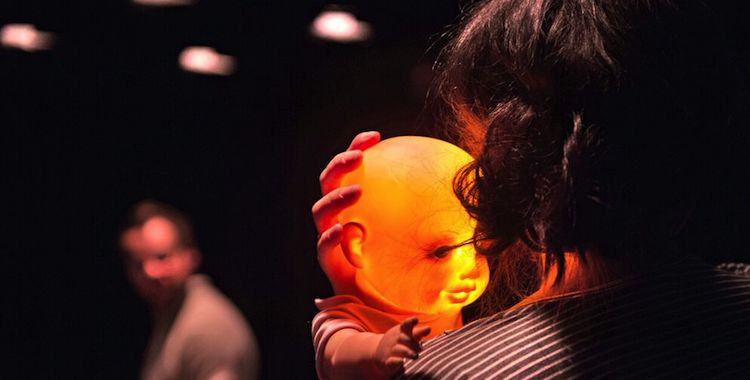
In the Night Time (Before the Sun Rises), Gate Theatre

unspecified

As a child – like so many children – I was afraid of the dark. In those long nights when I was stubbornly holding my eyes open against the threatening gloom, my mum would read to me from Martin Waddell’s Can’t You Sleep, Little Bear? In the book, Little Bear doesn’t like the dark. To Big Bear’s exasperation, he won’t go to sleep at night. What is he afraid of? Big Bear asks, again and again.

“The dark all around us,” he replies.

In the Night Time (Before the Sun Rises) unfolds a little like a storybook. Even its title has a fairytale ring to it. Once upon a time, Man and Woman (nameless urban archetypes) meet. On the street, maybe, or in a bar. They go on dates. He tells bad jokes. They fall in love.

And then they have a baby. A child is born – though, Nina Segal’s play insists, this isn’t a religious story. This child is just another child. And like so many children, it cries. The newborn bawls ceaselessly through the night, driving its parents to distraction. We join them in one narrow, dark sliver of one of these sleepless nights, as fatigued desperation gives way to hallucinatory fears. Slowly, inexorably, all the terrible things happening elsewhere in the world seep through the four thin, brittle walls of the child’s bedroom.

The two sleep-deprived protagonists are at once specific and generic. They’re both invested with just enough personality that we feel we know them a bit (she believes marriage is a misogynistic institution, he smokes though he knows he shouldn’t), yet they remain blank enough for us as audience members to project something of ourselves onto them. A bit like characters in storybooks.

Segal’s dialogue oscillates between third and first person, while performers Alex Waldmann and Adelle Leonce always seem to be both in and out of character at the same time, flickering constantly between narrating and representing. It feels vital that they don’t ever become too particular, too easy to dismiss. This is not just about them, in the same way that fairytales are never just about Cinderella or Sleeping Beauty. This is for all of us who have brought or will bring or might bring another human being into this world. This incredible, broken, fucked-up world.

As a teenager, I devoured dystopian fiction. I wasn’t alone. Dystopias seem to strike a chord with those trapped, awkwardly, between childhood and adulthood – perhaps, as Laura Miller suggests in the New Yorker, because “the typical arc of the dystopian narrative mirrors the course of adolescent disaffection”. In all those scorched worlds, seemingly far removed from the one I was growing up in, I found something to identify with.

Those imagined apocalypses, though, have never quite receded as I’ve got older. They remain, somewhere in my own personal store of fears, multiplied by the threats of climate change, terrorism, mutating viruses. The dark all around us.

Again, I’m not alone. In a recent essay on Aeon, Frank Bures argues that the apocalypse has never been easier to imagine in the hyper-connected world that we currently live in, but that it’s also an age-old anxiety. “The apocalypse wasn’t coming,” he realises. “It was always with us.”

In Blasted, a war zone explodes into a Leeds hotel room, violence tearing through Western comfort and complacency. Though In the Night Time owes a considerable debt to Sarah Kane’s play, here the domestic chaos of the child’s bedroom is never completely ruptured by the horrors beyond its walls. Instead they intrude and then recede, and then intrude and recede again.

It’s a small space, the stage at the Gate, and director Ben Kidd exploits that. It easily becomes one of the too-small rented flats that families squeeze into across this city, filled with accumulating stuff. At the start of the show, the two characters and all the detritus of their lives are wrapped up in clingfilm. Tearing through this plastic membrane, birthed into the performance space, Waldmann and Leonce begin to construct the fragile lives of their characters. A picture frame here, a string of fairy lights there. All the things that we invest with the meaning of a relationship.

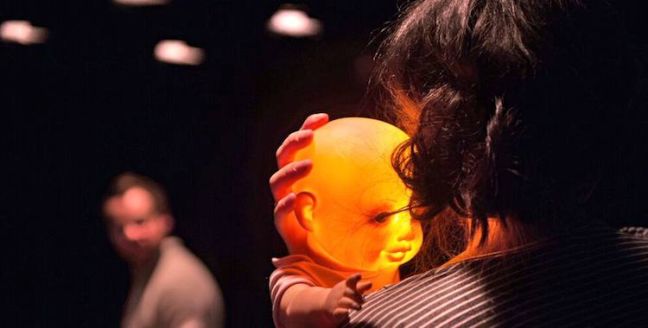
With a child, of course, comes more stuff. Even the baby itself, a plastic doll with a flashing alarm in its head, arrives in an Amazon box. And littered with all the familiar junk of infancy – nappies and bottles and plastic, so much plastic – the stage already begins to take on a disordered, calamity-hit aesthetic, while the two parents circle one another like enemies in a war of their own. All it then takes to bring fears of conflict, crisis and disease crashing into the room is for this precariously constructed space to collapse entirely, possessions flying like shrapnel.

“The two things are not connected,” the characters repeat again and again about different events – an insistent and increasingly desperate refrain. Of course, it only reinforces the reality that they are. Somewhere, far away, people are dying. Here, in a rented flat in an overpriced city, parents are placating their screaming child with “plastic sacrifices”. The two things are connected. Comfort in one part of the world depends on suffering elsewhere.

Bures suggests that now, in the globalised twenty-first century, the nature of our apocalyptic visions has changed:

“Today our fears are broader, deeper, woven more tightly into our daily lives, which makes it feel like the seeds of our destruction are all around us. We are more afraid, but less able to point to a single source for our fear. At the root is the realisation that we are part of something beyond our control.”

This pervasive, unsettling fear is what reverberates through Escaped Alone, Caryl Churchill’s latest, compellingly strange play at the Royal Court, and it’s also what reverberates through In the Night Time. The Man and Woman feel acutely that imminent destruction is everywhere around them, but they feel powerless to fix whatever it is that has broken. Catastrophe and everyday life, meanwhile, are so closely knitted together that neither can overcome the other. The war zone never obliterates the child’s bedroom. The end of the world is both there and not there.

The apocalypse isn’t coming. It’s always with us.

As an adult, inching ever closer to 30, it starts to feel as though babies are everywhere. Facebook is suddenly full of them: a whole timeline of chubby cheeks and dimpled smiles. Female friends without kids begin, for the first time, to plan their lives within a slim reproductive window. At the same time, news headlines seem to scream the foolishness of bringing a child into a world fraught with so much violence and crisis and pain. Still, there’s only so much time, the world keeps reminding us. Tick tock. Better make your mind up.

Duncan Macmillan’s Lungs cleverly stretched out one couple’s conversation about whether or not to bring a child into the world, revealing how a private decision is also one of agonisingly public responsibility. What justification can there possibly be for placing another carbon footprint on an already overburdened planet? In the Night Time is, in some ways, the “after” version of that play. This couple have already had a child – “for all the right reasons,” they assure us – but are left wondering if in fact they’ve made a terrible mistake.

Both play and production occasionally strain this point. The repetitive rhythms of the play’s speech are apt, echoing both storybook narrative convention and the circular arguments of denial that so often greet situations of crisis, but they can also begin to grate. After the first wave of chaos, meanwhile, the staging gives itself few places to go. Waldmann and Leonce must simply pick their way through the plastic rubble of the set, an image that gradually loses its power as the piece goes on and the momentum begins to slow. With the exception of a tinny chorus of toy sounds, playfully reinforcing the ridiculousness of this plastic shrine the two characters have erected to their child, the second half of Kidd’s production never quite matches up to the first.

In its evocation of present anxieties, though, In the Night Time is pretty damn potent. I might not have a child of my own, or be thinking about bringing one into the world any time soon. But those fears, that feeling that we inhabit a broken world and that – even worse – we are all selfishly failing to fix it, get me right between the ribs. Segal and Kidd manage to create the uneasy feeling that apocalypse is always right round the corner and that we as flawed human beings are each at once responsible and helpless. In the end, the show suggests, all we can really do is confront that dark all around us, waiting and hoping for the dawn to break.

https://www.youtube.com/watch?v=Bbw_vk2SCnU

Photo: Bill Knight.

Escaped Alone, Royal Court

Escaped-Alone-600x450

Originally written for Exeunt.

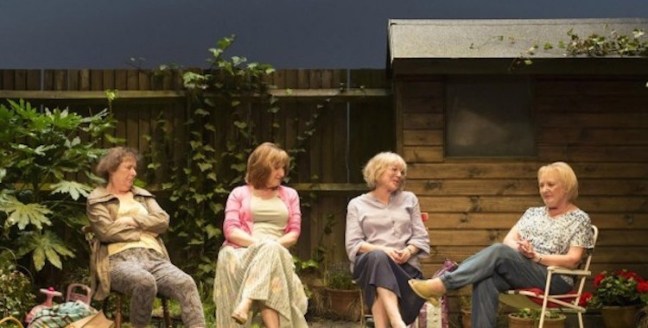
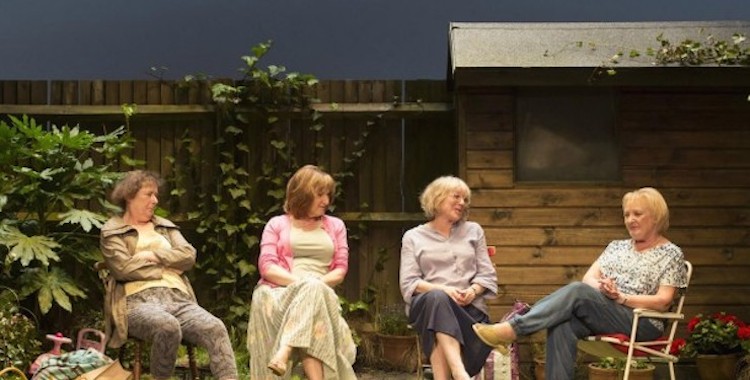
It’s not just the tea that’s brewing in Caryl Churchill’s new play. Beneath the sharing of a nice cuppa, something much nastier is simmering away. While four older women sip from their mugs in a sun-bathed garden, premonitions of catastrophe lurk behind their innocuous chit-chat, breaking through in pitch-black interjections. Over the course of less than an hour, the world ends seven times over: with floods, with disease, with fire. Sugar, anyone?

Escaped Alone is a bristling, baffling thing. Running at a brisk 55 minutes, it’s somehow huge and minute all at once. Compared with the formal somersaults of some of Churchill’s previous work, though, the structure is deceptively simple. It’s split into two alternating parts: in one, old friends Sally, Vi and Lena drink tea with neighbour Mrs Jarrett in Sally’s garden; in the other, Mrs Jarrett steps out of the frame of this scenario to deliver bleak missives from humankind’s downfall. Or, as the Royal Court’s blurb pithily puts it: tea and catastrophe.

Churchill’s title is borrowed from the Book of Job (“I only am escaped alone to tell thee”), and there is something oddly Biblical about this play, with its visions of apocalypse and its undercurrents of allegory. Linda Bassett’s affable yet enigmatic Mrs Jarrett plays the unlikely harbinger of doom, sent to warn us all of out-of-control, man-made catastrophes. Or perhaps warn is the wrong word, as these various Armageddons are all relayed in the past tense, laced with the bitter tang of inevitability. There is nothing to be done.

There are nightmarish touches of brilliance to these imagined disasters. In one, we are told – with characteristically surreal Churchill flair – that “the chemicals leaked through the cracks in the money”. Another conjures a world in which food is siphoned off to television programmes, leaving the general public to starve in front of cookery shows. There’s visceral horror, in images of survivors trapped alone underground and people eating rashers of their own fat, knocking up against inky dark humour – even if the gags do feel a little easy at times, airdropping in wry topical references to selfies and property developers.

Churchill is having no less fun in the garden-bound half of the play, in which her female quartet execute scenes of meticulously choreographed gossip. They chat about their grandchildren, about their pasts, about what superpower they’d like to have. This chorus of banalities is all delivered in distinctive Churchill half-sentences, clipped and careful. There’s clearly a shared vocabulary among these old friends. And again it’s rich with terrific moments. In one sequence, the women simply sing The Crystals’ hit “Da Doo Ron Ron” and it’s an absolute joy. Each character also takes their turn to break from the conversation and segue into a strange, disturbing monologue. It’s Sally’s inner voice that startles most, spilling out a breathless and absurd speech about her debilitating phobia of cats. Delivered with mounting intensity by the excellent Deborah Findlay, shoulders rounding protectively while hands nervously flutter, it’s one of the show’s highlights.

It’s the join between the play’s two halves that is more troubling – both interestingly and frustratingly so. You could say crisis and tea are never far apart, but otherwise the relationship between garden and apocalypse is left deliberately opaque. James Macdonald’s taut production at once maintains this ambiguity and gestures towards possible links. The small pauses in conversation – subtle and precise – suggest something more beneath the chatter. Miriam Buether’s design, meanwhile, has more than one nod to the void opened up by Mrs Jarrett’s bleak interludes. The garden, overgrown and vivid and lit by a bright, warm glow, is a sort of idyll, but there’s an odd emptiness to the grey-blue skies above that makes it feel as though it could be the last green refuge in the universe. Looked at this way, its contrast with the blackness that engulfs the intervening scenes, intensified by a flickering red neon surround, seems less stark than it first appears. For all that, though, it’s hard sometimes to fight the suspicion that these are simply two interesting scenarios to riff on, and that the whole is given less attention than its (admittedly intriguing) parts.

Nonetheless, Escaped Alone is never less than watchable, thanks in huge part to its fantastic cast. Much has been made of the fact that this is a play for four women in their sixties and seventies – a demographic still seen with shameful rarity on our stages. While the swift running time means that we can only ever get shards of these characters’ personalities, they’re pretty damn fascinating shards, giving the actors plenty to work with. Alongside Bassett’s slippery Mrs Jarrett and Findlay’s cat-fearing Sally, Kika Markham does delicate work as Lena – introverted yet occasionally spiky (“I do get out,” she indignantly insists) – while June Watson peels back surprising layers in unexpected ex-con Vi.

If there’s anything that holds the piece together, it’s the incessant, latent fear of the present moment that we live in. The paralysing terror that Sally feels when confronted with the idea of cats and the wilful delusion that has become a coping mechanism (“I have to believe there are no cats. And then briefly the joy of that”) might well stand in for any number of twenty-first century threats: ISIS, climate change, global pandemics. Mrs Jarrett’s catastrophes, meanwhile, are a potent cocktail of ancient fears and very contemporary preoccupations. It can often feel that we are living in the end times – or perhaps just on the brink of them – a feeling that Churchill uncannily captures. This is, to quote REM, the end of the world as we know it.

Now then, who wants a cup of tea?

Photo: Johan Persson.

This Will End Badly, Southwark Playhouse

Ben-Whybrow-in-This-Will-End-Badly-3.-Credit-Ben-Broomfield-600x401

Originally written for Exeunt.

The title of Rob Hayes’ latest play is a promise. This will end badly. And not just for the trio of troubled protagonists whose stories his fragmented, three-part monologue rapidly snaps between. The whole male sex, contorted under the pressures of modern masculinity, comes out of this badly. As his portraits of wounded, angry men make clear, it is not only women who suffer under the rigid, oppressive structures of patriarchy. Hayes’ prowling alpha male character, describing tactics for picking up women, puts it most succinctly: “it exists within a framework”.

The framework of the piece itself, however, is often unclear. It begins confusingly: performer Ben Whybrow, intense from the outset, rattles through the words at astonishing speed, clearly speaking from more than one perspective – but whose? Only gradually do three distinct (and sometimes less distinct) voices emerge. One man, reeling from a recent breakup, is suffering from a case of extreme constipation; it’s almost two weeks since his girlfriend left him and he still can’t take a dump. Another is trapped by different forces, confined to his flat by chronic anxiety and OCD, frantically turning switches on and off. And a third is on the hunt for casual sex, in the process of making his latest conquest. If the three are occasionally difficult to distinguish from one another, it’s surely deliberate. These three men represent three jagged shards of modern masculinity, all harmed and harming as part of the same, long-entrenched system.

The central scatological metaphor – immediately signalled by the toilet in one corner of Jemima Robinson’s otherwise sparse set – can’t be missed. A lot of shit has built up here, and it’s not so much hitting the fan as poisonously accumulating. The message may not be subtle, but it lands with force in Clive Judd’s relentlessly fast-moving production. These men are emotionally as well as physically constipated, blocked up by a world that tells them to control their feelings, to project confidence, to dominate others. What we see is a male culture that has little room for vulnerability or tenderness; a culture in which suicide – the statistics of which one character obsessively lists – might seem like the only way out.

There are points of meeting and overlap with Chris Goode’s furious, scaldingMen in the Cities, another collection of voices from men flailing under the violence of patriarchy. Next to Goode’s piece, though, This Will End Badly feels strangely incomplete, stating rather than interrogating its points and at times doing little more than replicating the abuse it examines. It is also, unlike Men in the Cities, overwhelmingly preoccupied with the predicament of the straight white man in today’s society, a choice that sharpens its focus but at the same time narrows its scope.

The pick-up artist – his monologue tellingly titled ‘Meat Cute’ – is in many ways the most interesting and the most problematic of the three men put on stage. He speaks in the plural first person, always ‘we’ and ‘us’, as if acting as a conduit for the entire gender. He could also be a conduit for countless opinion pieces and online comments about sexual politics and consent, mansplaining the media’s impossibly contradictory standards of femininity (“How do you even know what you’re supposed to want?”) and toying dangerously with rape apologism. Hayes’ introduction of these issues is blunt and bludgeoning, especially when knocking up against the humour elsewhere. When occupying this role, meanwhile, Whybrow often delivers lines directly to (always female, as far as I could tell) members of the audience, with an aggression that wavers between the ironic and the downright violent. It raises a serious question, especially with material that may be a trigger for some: when does a representation of harm become simply harmful?

This is not a question that This Will End Badly really attempts to address, instead using these difficult moments as part of its (admittedly formidable) critical arsenal. Still, it’s a disturbing and intense window on the twenty-first century man, its abrupt conclusion leaving behind a lingering sense of unease. The urgent implication, as the whole destructive cycle prepares to start again, is that if something doesn’t change then things will continue to end badly – again and again and again.

Photo: Ben Broomfield.

Herons, Lyric Hammersmith

A scene from Herons by Simon Stephens @ Lyric Theatre Hammersmith. Directed by Sean Holmes. (Opening 21-01-16) ©Tristram Kenton 01/16 (3 Raveley Street, LONDON NW5 2HX TEL 0207 267 5550 Mob 07973 617 355)email: tristram@tristramkenton.com

The herons of Simon Stephens’ play are vicious. Vicious and beautiful. They swoop down to catch their prey, still and composed until they go in for the kill.

There’s more than a hint of the animalistic to director Sean Holmes’ and dramaturg Joel Horwood’s new version of Herons. In the soggy Darwinian playground that designer Hyemi Shin has created, everyone gets dragged underwater at one point or another – though categories of predator and prey are never quite as simple as in the natural world that both play and production evoke. The footage of primates that plays constantly on a large screen above the action dares us to watch the unfolding events like a David Attenborough documentary, but it’s far more complicated than that.

If the landscape of the stage is a playground, then teenagers are its main inhabitants. While adults lurk on the sidelines, this is decidedly adolescent territory. As well as the playground, with its garish roundabout and bobbing sit-on horse, Shin’s set suggests all the abandoned, concrete spaces that kids flock to. This one happens to be a canal lock, water gradually trickling through its gates, but it could just as easily be a deserted car-park or grubby underpass. It’s an in-between sort of place, a no-man’s land for those stranded between childhood and adulthood.

One such stranded individual is Billy, the child of a broken marriage and the butt of his classmates’ jokes. A year ago, his dad found a dead girl in the river and reported the boys who killed her. Now Scott – the young brother of one of the murderers – is promising revenge, tormenting Billy with the help of his two guffawing sidekicks. They are cruel in the way that only children are, ruthless and cunning in pursuit of their prey.

The fragmented, out-of-joint aesthetic of the set extends to Holmes’ production, in which scenes jut sharply into one another and the rules of time and space are frequently disrupted. Horwood has cannily chopped and rearranged Stephens’ text, creating the breathless sense that everything is happening at once. What might be calm, quiet exchanges between Billy and his Dad, fishing at the water’s edge, become truncated and immersed into the all-pervasive brutality of schoolyard bullying. Scenes never quite end, the performers remaining on stage to watch what comes next, their presence looming and ominous.

There’s more than a hint of Secret Theatre, its legacy shimmering like the light reflected off the water. It’s unsurprising, perhaps, given that Holmes, Horwood and Shin are all involved. Yet here some of the most interesting aspects of that project – bold design, a resistance to naturalism, a sense of exploration and surprise – are married to another of the Lyric’s core purposes: its commitment to young people. Two Bugsy Malone alumni (Max Gill as Billy and Sophia Decaro as Adele, the young girl who befriends him) return in this production, while impressive performances are delivered by all of the teenage cast (alongside Ed Gaughan and Sophie Stone in compelling turns as Billy’s parents). We see, for a change, young people actually played by young people – and with nuance and complexity to boot.

There are aspects of the play that are inevitably jettisoned by Holmes and Horwood’s short, sharp shock of an approach. The tenderness that tempers the cruelty – in moments between Billy and his alternately tough and gentle dad, or in the delicate connection that Adele finds with Billy – only briefly glimmers through the darkness in this version, while there are few moments in which to pause or reflect. What it does do brilliantly, though, is blur the fine line that separates bully from victim, particularly in its portrayal of tormenting and tormented Scott (a fantastic, production-stealing performance from Billy Matthews).

Unlike in the animal world, here the food chain is forever shifting. Predator becomes prey. The heron swoops. The cycle of fear and violence starts again.

Photo: Tristram Kenton.

Tipping the Velvet, Lyric Hammersmith

TippingHomepage11

Note: an incredibly late response to this production, appearing so long after the show’s run because I submitted it for the Observer Anthony Burgess Competition (which, needless to say, it wasn’t shortlisted for).

“This is not how the show ends!” So goes the protest of the music hall MC in the closing scene of Tipping the Velvet, the Lyric Hammersmith’s knowingly theatrical stage adaptation of Sarah Waters’ novel. David Cardy’s mansplaining cockney narrator is finally having his control challenged by Nancy Astley, the protagonist whose sexual awakening he has nudged and winked his way through for the last three hours. She has some problems with his telling and she’s ready – finally – to answer back. So who owns this story?

Writer Rebecca Solnit, weaver of her own exquisite stories, describes a book as “a heart that only beats in the chest of another”. Without the lifeblood of readers pumping through them, novels are just so many empty ventricles. Since its publication in 1998, Tipping the Velvet has pulsed beneath the ribs of millions of readers. The heart metaphor, indeed, seems especially apt for a novel that means so much to so many. A landmark in lesbian fiction, Waters’ tale of an imagined queer subculture glittering beneath the soot and grime of Victorian London has countless ardent fans.

It’s easy to see why the story of oyster girl turned music hall star Nancy has become so fiercely beloved. Tipping the Velvet is a sumptuous, enveloping read, packed with both period detail and lush imaginative embellishment. At the novel’s opening, Nancy is leading a drab, ordinary life in Whitstable, working in her parents’ oyster parlour and spending evenings with a local beau. Then, one night at the music hall in Canterbury, she sees Kitty Butler, a male impersonator or “masher”. It’s love – and lust – at first sight. In the course of a musical number, Nancy’s life is transformed.

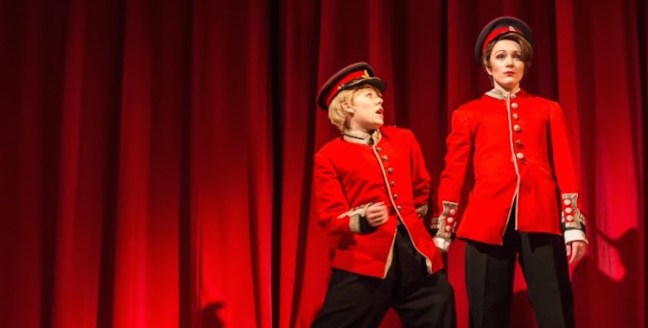
Nancy’s infatuation is as much with the greasepaint and glamour of the music hall as it is with the gender-bending Kitty. And it’s this aspect of the novel that playwright Laura Wade and director Lyndsey Turner have seized on in adapting it for the stage. It makes sense: relocating a narrative to the theatre, why not emphasise its already theatrical elements? So Nancy’s journey of self-discovery becomes a series of music hall acts, ranging from the colourful to the ridiculous, all firmly rooted in the Lyric’s own music hall past.

There’s always been a hint of the fantastical to Tipping the Velvet. Waters herself describes the book as her “attempt to write a Victorian-style novel telling a very lesbian story in a way that was half-authentic but half-anachronistic too”. It’s semi-historical fiction: a sexy twentieth-century riff on lavish Victorian storytelling. Dickens with dildos. Nancy herself, meanwhile, is a chameleonic figure, forever shrugging on a new performance as changing circumstances demand.

It’s wise, then, to approach her tale with some fictional flourish. Gritty realism was never going to serve this narrative well, so it’s for the best that Wade and Turner, along with designer Lizzie Clachan, have embraced a more flamboyant approach, decorating the drama with gaudy painted backdrops and circus acrobatics. But Waters’ novel is no straightforward carnivalesque romp. It’s not with sex or spectacle alone that a novel steals its way into readers’ hearts. Nancy’s story is also passionate and heartbreaking, full of all the giddy vertigo and crushing despair of first love. It is as devastating as it is joyous.

The Lyric’s production, though, has only the one tone. That’s the problem with music hall: it’s designed as a vehicle for broad comedy and thigh-slapping entertainment. But emotional nuance? Not so much. It’s a form – with its insistent gags and relentless visual humour – that demands we laugh. When the object of that laughter is a tender, tentative relationship between two women, though, it’s uncomfortable at best and wildly offensive at worst.

The form also makes it tough to care about its characters. Nancy’s yearning, hot and urgent, should be palpable. In this version, though, Sally Messham – excellent in every other respect – struggles to reach across the gulf opened up by the production’s self-conscious style of choice. Her Nancy, at once bold and tremulous, contains just the right blend of naivety and defiance, but she is forever kept at one remove from the audience. Her romances, first with Laura Rogers’ self-assured and ambitious Kitty and later with socialist force of nature Florence (a no-nonsense yet soft-centred Adelle Leonce), are oddly distant.

There is, admittedly, fun to be had in this adaptation. At times rivalling the Lyric’s much-loved pantomime, the music hall turns deploy their share of ingenuity in moving the narrative forward. Nancy’s breathless journey to London, where she follows rising star Kitty as her dresser and later her fellow performer, is all conveyed through a busy chorus of voices and sound effects; the two women’s hesitant attraction is a tiptoeing dance of suppressed flirtation. For the music itself, Victorian favourites are traded for music hall arrangements of the likes of Prince’s “Kiss” and Miley Cyrus’s infamous “Wrecking Ball”, recalling the a capella numbers that Turner memorably inserted into Wade’s earlier play Posh and wittily filtering the past through the present.

But by forcing Tipping the Velvet into this tight music hall frame, Wade and Turner have smashed it into troublingly small fragments. Each miniature scene whisks past before it can have any real impact, sticking around only as long as it takes to deliver a punchline. Unlike the intense, confessional prose of Waters’ novel, this is a frustratingly interrupted narrative. More worryingly, the curtains have a habit of swishing closed right at the moment the female characters are nearing intimacy. When we do get lesbian sex, it’s studiedly metaphorical: performers twirl and sway in coy aerial acts. The implicit message is that this desire is to be hidden, kept safely behind curtains or cloaked in metaphor.

Most problematic of all is the leering, ever-present master of ceremonies, doling out enforced jollity regardless of the emotional tenor of the drama. Brandishing his gavel – regularly employed to stop and start the action – Cardy’s narrator is two parts East End geezer, one part sleazy uncle. His telling of Nancy’s Sapphic adventures is painfully patronising, enclosing everything on stage within the voracious male gaze. There is a purpose to this, establishing a dominant framework in order to eventually dismantle it. But why can’t this female narrative, told by a female creative team, reject patriarchal frameworks entirely?

Solnit has another startling metaphor for stories. They are “compasses and architecture, we navigate by them, we build our sanctuaries and our prisons out of them, and to be without a story is to be lost in the vastness of a world that spreads in all directions like arctic tundra or sea ice”. By insisting on the music hall framing, Wade and Turner have robbed Nancy of her story. She’s left without direction or shelter, stumbling blindly through act after whimsical act.

The production’s nadir coincides with Nancy’s – though not in the way its creators might have intended. Betrayed by Kitty and utterly bereft, our protagonist trudges aimlessly through the streets of London, suddenly finding herself amid the meat and guts of Smithfield Market. In the novel, this is a moment of complete, all-consuming despair. On stage, by contrast, Nancy is hauled up in a harness, dangling alongside a row of puppet pig carcasses for a musical number that nudges the ridiculous into the realm of the offensive. It’s greeted not with empathy for the character’s suffering, but with muffled snorts of embarrassment.

So, again, whose story is this? You can tell a lot about a narrative from its ending. Waters’ novel closes with “a rising ripple of applause”, as though in the quiet contentment that Nancy finds with Florence she has finally stepped onto the right stage and into the right story. At the Lyric, on the other hand, Nancy wrestles back her story with just enough time to hide it away again, as the heavy velvet curtain falls on her and Flo’s private happiness. Wade and Turner do at least problematise the fashion of their storytelling, but Nancy is granted only enough narrative agency to bring about her own disappearance. And that, ultimately, is the most worrying music hall turn of them all: the vanishing act.