Hangmen, Royal Court Theatre

590x494.fitandcrop

I thought of Mark Lawson while watching Hangmen. Mark Lawson, as he made very clear three years ago, is no fan of the scene change. And Hangmen has one of the most drawn-out, deliberate, metamorphic scene changes I’ve witnessed on stage. A big, bold, statement-making scene change.

Martin McDonagh’s new play opens in the dying days of the death penalty. Famed Lancashire hangman Harry and his assistant Syd are just doing another job, getting on with the nine to five. The world, though, is about to change. With the condemned man eventually dispatched, at the end of the first scene Anna Fleischle’s entire detailed prison cell set shudders upwards, slowly disappearing from sight. The hangman’s dangling noose, lit by a single shaft of light, is lifted away.

It’s a stunning transition and a symbolic shift from one age to another. When the lights come up on the Oldham pub run by Harry and his long-suffering wife Alice – just as impressive in its detail – it’s two years later and hanging has just been abolished. Around them, too, the signs of change are creeping in, even if their old-fashioned boozer is still clinging to the past. Rock’n’roll music is everywhere and Harry and Alice’s “mopey” daughter Shirley is a new breed of teenager. The social revolution is on its way.

Before it arrives, though, a spectre from Harry’s body-littered past (233 hangings, he unwisely brags to a local newspaper reporter) is about to return to haunt him and his family. Remember that hanging in the first scene? Well there’s a question mark over the hanged man’s guilt – a question mark that soon marches into Harry’s pub, along with a menacing stranger from the south. Just what is it that this intruder wants, and what has it got to do with the man who died protesting his innocence two years ago?

As expected from McDonagh, Hangmen is a masterclass in plotting, complete with a couple of twists that have the whole audience collectively, audibly gasping. It’s good old-fashioned narrative theatre, full of unexpected turns and vivid dialogue, and brilliantly done in Matthew Dunster’s carefully pitched production. It’s also dark as the pints of Guinness passed over Harry’s bar, full of cruel humour and simmering with the threat of violence. We all know what McDonagh is capable of by now; the grim and grisly never seems far away.

Much of the play’s sinister undertow comes in the form of Johnny Flynn’s Mooney, the peculiar, scruffy-haired stranger who saunters into Harry’s life and Shirley’s affections. David Morrissey is perfectly cast as the reluctantly retired hangman, all no-nonsense bluntness and blokey self-importance, as is the brilliant Reece Shearsmith as Harry’s stuttering and uncertain former assistant Syd. Yet somehow it’s Flynn who stands out, his shifting, swaggering sense of menace as hard to pin down as Mooney’s questionable intentions. Is he a psychopathic serial killer, or just a serial piss-taker?

McDonagh’s a bit of a piss-taker himself, gleefully pastiching British (and particularly Northern) culture of the 1960s and tricking his audience at every turn. And, of course, Hangmen is funny. Very funny. Even if the laughs – prompted by jokes as unapologetically (and sometimes problematically) offensive as you’d expect from McDonagh – sometimes leave the sour aftertaste of a bad pint. This is the unsavoury side of Britishness, suffused with casual racism and misogyny, whose habits and traditions might – like the death penalty itself – be better resigned to the past.

Fifty years on from the abolition of hanging in the UK, Hangmen is not the play to examine the ethical intricacies of the death penalty or the complicated ins and outs of the justice system. It would never want to be. Still, though, between the laughs it shows a nation on the brink of change, as well as the nastiness that can sometimes be wrapped up in nostalgia. The paraphernalia of Harry’s trade might be lifted away, but its ugly traces remain.

Photo: Simon Annand.

Tonight I’m Gonna Be The New Me, or Who’s in charge of this story?

428Nl3vVPFetgh7eQSytWC9skjrpgctp9aWvDuQfNQk

“It’s nice to be documented,” says Jess Latowicki to the audience, “right?” Over our shoulders, lurking in the shadows, is Tim Cowbury, the other half of Made in China. He’s taking notes: notes on Jess, notes on us. He’s the writer here. Well, sort of, explains Jess. This is his show. Only, at the same time, it’s not.

Who’s in charge of this story?

I’ve always thought of humans as storytellers. As a writer, perhaps that’s no surprise. When Galen Strawson, in a recent article for the ever-brilliant Aeon, quotes Oliver Sacks writing “each of us is a narrative, this narrative is us,” I’m nodding my head. Stories – at least for me – feel like a way of understanding the world, of communicating. Reading Hannah Nicklin on the theory of the “storied self” – the idea that we build and reinforce our sense of identity through stories (the story “I’m a writer” or “I’m a runner”) – I felt a jolt of recognition.

But Strawson questions that truism that we construct ourselves through stories. He argues that it’s “false that everyone stories themselves, and false that it’s always a good thing”. Life as experienced from day to day, he reasons, has neither the shape nor order of a narrative. He throws various spanners into the narrative machinery, from the common experience of a fractured or multiplied self (W Somerset Maugham: “I recognise that I am made up of several persons”) to the fragility and fallibility of memories (James Salter:”There is no complete life. There are only fragments”). The more I think about it, the more I find myself conceding that he might have a point.

Perhaps, instead of using stories to organise our internal memories and experiences, we tell the story/ies of our lives for and through other people. Or, without quite knowing it, they tell their own stories through us. It’s one idea among many that Made in China’s new show, Tonight I’m Gonna Be The New Me, toys with. Jess, on stage in sequinned hot pants, is in one sense being authored by Tim. He’s written the script and he’s manning the lights, controlling how Jess – and, via her, himself – are seen. This is his story.

In reality, of course, it’s a lot more complicated than that. Made in China are a duo, and while it’s easy to identify Jess as performer and Tim as writer, they are very much co-authors of their work. During the performance, too, questions are constantly being raised over authorship and agency. Jess challenges Tim, twists his words, throws the piece off-balance again and again. There’s an uneasiness around the male gaze – Jess wiggling her hips, under the lights controlled by Tim, watched by him and us – but at the same time a playful subversion of it. It’s never anything so simple as the image of a woman being authored by a man, instead engaging that dynamic in order to upend it.

Then there’s the story itself. In between scripted sparring between the couple – the acknowledgement of their real-life relationship sitting (deliberately) uncomfortably beneath the increasingly personal sniping – Jess narrates over and over the fiction of Tim’s heroic death [insert “Death of the Author” gag here]. It’s a strange sort of wish fulfilment, targeting another of the ways in which we inconsistently self-narrativise at the same time as the culture we live in scripts us. This death – written, remember, by Tim – attests to a cultural (and typically masculine) desire to prove oneself, to be the hero, to die young yet live forever in the memories of others. It’s a story we’ve heard before.

But in Jess’s ironic delivery, it’s drained of all heroism. The restless, independent man going off to find himself, the brave confrontation that ends in tragic self-sacrifice – from Jess’s lips it all sounds pathetic, unoriginal, like the script from some old, half-remembered movie. Which, of course, it is, as is the image following it of the grieving hoards and bereft girlfriend at the funeral. And then, as Jess describes in meticulous, ludicrous detail the outfit she wears to mourn Tim, a new script – a new story – breaks through: that of advertising and vacuous women’s magazines and the empty fetishisation of things. Narratives tell Jess and Tim, rather than the other way round.

“Do you ever get the feeling that someone is putting words in your mouth?” asks Jess, eyeballing a member of the audience. “Say yes,” she quickly instructs them.

“Yes.”

That interest in self-narrativising – or unwittingly allowing our lives to be narrated by others – folds into my persistent interest in scripting and authorship, an interest that Tonight I’m Gonna Be The New Me absolutely shares. As well as being (sort of) scripted by Tim, Jess puts words into the mouths of various audience members, asking them questions and feeding them the answers. We have a role here, but it’s tightly controlled – so long as we choose to play along. The fault lines between the scripted and the unscripted visibly shift.

Similarly to the slippages between text and performance that I’ve been thinking about in Action Hero’s work, in Tonight I’m Gonna Be The New Me Jess and Tim also play with the slipping and sliding boundaries between themselves as writers, performers and people. How much of this is scripted? How much of this is them, Jess and Tim the real-life couple, and how much of it is “Jess” and “Tim”? Who’s doing the scripting, and who’s being scripted? Who has the power here?

When I spoke to Jess and Tim just before they took Tonight I’m Gonna Be The New Me to Edinburgh, they joked that they had ended up making the same show as Action Hero. Wrecking Ball (at least from what I’ve seen at work-in-progress stage) has different concerns at its core, but there are some striking similarities. Those similarities also extend to Actress, the latest from Sleepwalk Collective. Three shows made by couples; three shows interested in authorship and performance and the dynamics of the male gaze.

Just as there’s a lot more in those other two pieces, there’s a lot more that Tonight I’m Gonna Be The New Me is also “about” (modern relationships, autobiography, the one-woman show, the representation of romance in pop culture). But there’s something all three shows are doing, in varying ways, that keeps niggling at me. Something about who is controlling the story. Something about all those agency-robbed women written by men. Something about how the cultures and structures we live within insidiously script us, and how we might read those scripts while subverting them.

Because whether or not we understand and organise our own lives through stories, stories are still important; stories are still how we understand the lives of others and how we hope they will understand us in turn. And so asking “who’s in charge of this story?” is never a trivial question.

Photo: David Monteith-Hodge.

Song from Far Away, Young Vic

image11-600x337

Originally written for Exeunt.

Willem is a man who never listens to music. He clamps headphones over his ears, but all they play back to him is the sound of his own breathing. It reminds me of something Hannah Nicklin wrote after seeing Carmen Disruption at the Almeida: “I put my headphones in with nothing playing which is the closest I get to this city.”

Willem is the speaker and protagonist of Song from Far Away, Simon Stephens’ latest play, and the two cities whose muffled pulse he hears through headphones are Amsterdam and New York. The old world and the new. Returning to Amsterdam following the sudden death of his brother, disillusioned banker Willem is not unlike the alienated figures who wander through Carmen Disruption, experiencing the city of his youth as “a chorus of rattling trams and bewildering underwear billboard posters and cafés and railings shuttering off unfinished building work”. A noisy, meaningless place.

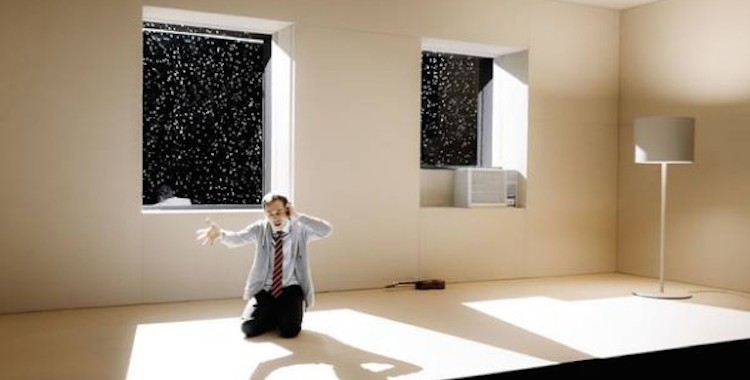
Walking through Amsterdam, Willem repeats a line uttered by the Singer in Carmen Disruption and by self-destructing rock star Paul in Birdland: “none of this is real”. As that echo suggests, Song from Far Away shares many of the themes that recur in Stephens’ recent work: home, disconnection, the hollowness of late capitalist cities. Even Jan Versweyveld’s calculatedly bland design has the perfect clean lines of every antiseptic, impersonal space that threads through these plays. Whether the room on stage is meant to be the elegant hotel where Willem stays in Amsterdam or the apartment that lies waiting for him in New York, it’s a cool, blank canvas of a space.

On that canvas, Willem composes a series of letters to his dead brother, letters that narrate his fraught and awkward homecoming. After leaving twelve years ago with barely a backward glance, he’s forced right into the grieving heart of his family. Numb and remote, all he does is upset them. Delivering the one-way correspondence as a monologue – always addressed to the invisible ghost of his brother, never to us the audience – Eelco Smits is raw and exposed, both figuratively and literally. Shedding his clothes, he stands on stage stripped of everything his new life has clothed him in, back home with nothing to protect him from the cold.

That coolness seeps right through Ivo van Hove’s stylish but distanced staging – and not just in the flurries of snow that fall behind Smits. It’s also a production that’s very still. Incredibly, precisely, frustratingly still. Whereas van Hove’s stunning take on A View from the Bridge turned Arthur Miller’s play into a ticking bomb, all of us holding our breath as we waited for it to go off, any tension bleeds from Song from Far Away. Though Versweyveld’s deft shifts in lighting move us through the hours, the production has the feel of one of those endless, sleep-robbed nights: slow, static, full of thoughts. It’s numbing, just like Willem moves numbly through his grief.

Feeling sneaks in though, often in the mournful, fractured melody of Mark Eitzel’s music. Just one song ribbons through the narrative, first heard in an anonymous bar and then echoing across the days Willem spends in Amsterdam. We hear it in snatches and phrases, like the half-remembered tunes of the past, until finally it forces its way through – a startling shaft of pure emotion, singing “go where the love is”.

Song from Far Away is a play that echoes with emptinesses. The emptiness of grief with no expression. The emptiness of a city that has long ceased being home. The emptiness of hotels and airports and characterless apartment blocks. The emptiness of the promises we build our lives on: the hollow assurance that it will all be worth it in the end. Like the inky blackness that lies behind the set’s two large windows, such promises are shown to conceal a vast nothingness.

But it’s hard to connect with emptiness, on the stage even more so than on the page. Stephens’ play begs to be re-read almost as soon as the curtain call has finished, yet as theatre it has an oddly detached quality. The first time Willem – the man who never listens to music – hears the song of the title, he says it “caught my heart in its hand”. Song from Far Away struggles for the same heart-squeezing grasp. 

Photo: Jan Versweyveld.

Rory Mullarkey

1536Oresteia-700x455

Originally written for The Stage.

“I’m bad at being told what to do,” says Rory Mullarkey with a grin. The playwright, raised in a military family, quickly found that taking orders wasn’t for him when he tried to join the army as a teenager. A few years later, fresh from studying Russian at Cambridge University, a stint at drama school in St Petersburg was similarly short-lived. “My temperament just was not suited to being told what to do for a year.”

The same unruly streak runs through Mullarkey’s plays. Cannibals, the play that made him the youngest writer ever staged in the Royal Exchange Theatre’s main house at 25, contained a whole section written daringly in Russian. His Royal Court debut The Wolf from the Door playfully set violent insurrection in the green and pleasant land of rural England, while Pentabus commission Each Slow Dusk deliberately eschewed accepted First World War narratives.

Avoiding or subverting convention, Mullarkey says, has paid off. “I wrote stuff for a while and sent it off to places, but when people really started to take notice of it and put it on was when I’d abandoned all desire to do anything that was what I thought I was supposed to do.”

The acting might not have stuck, but Mullarkey’s fascination with Russia did. He reels off a long list of Russian authors – Dostoyevsky, Lermontov, Goncharov, Chekhov, Pushkin, Gogol – whose influence has seeped into his writing. “I read and re-read those guys until they were in my metabolism, because I loved what they said so much; not only their stories, but also the philosophical weight of the feelings they express.” Learning Russian as a teenager at Manchester Grammar School, he fell in love “with the sounds of it, with the way the words move”.

It was Mullarkey’s Russian that got him his first gig out of university. While performing in his own play on the Edinburgh Fringe, word of the show spread to director Lyndsey Turner – Mullarkey’s “number one living inspiration” – who asked to read the script.

Discovering that Mullarkey could speak Russian, she quickly set him to work on a series of translations for the Royal Court, offering a crucial foot in the door. It was also a steep learning curve.

“Going through 20 plays and every single line, seeing it in one language and making it work as an active line in English – it’s probably the best education I could have asked for in making sure the dialogue I was trying to write was going to be active,” he says.

The Edinburgh Fringe show that got Mullarkey noticed back in 2007 – “I wouldn’t be here if I hadn’t done that,” he insists – was directed by one Robert Icke. Now, eight years later, both men have found themselves tackling The Oresteia, Aeschylus’s epic trilogy of Greek tragedies – Icke for the Almeida Theatre, Mullarkey for Shakespeare’s Globe.

“I’ve always loved it as a thing because it’s huge and ambitious,” says Mullarkey of the play cycle, adding that “it feels like it’s got this huge, monolithic weight behind it.”

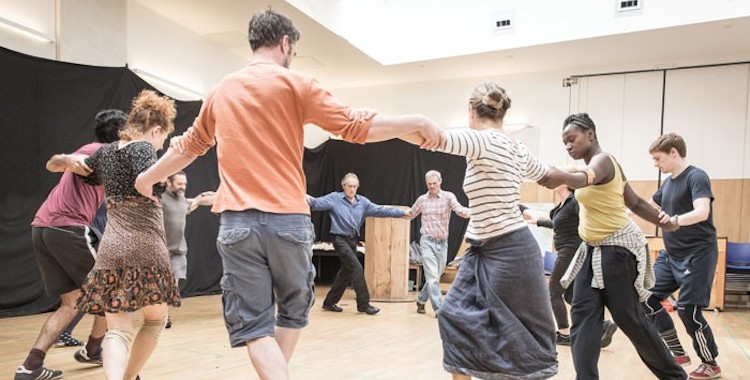
Mullarkey and Icke’s new takes on The Oresteia are just the crest of a huge wave of Ancient Greek drama on British stages. Another Oresteia is coming to Home in Manchester later this year, while the Almeida continues its Greeks season with Bakkhai and Medea, alongside a summer festival of related events. That’s not to mention another new version of Medea at the Gate Theatre, Greek myths for kids at the Unicorn Theatre, and National Theatre Wales’ epic multimedia retelling of The Iliad.

What is it about these ancient narratives that speaks to us so powerfully now? Mullarkey suggests that in an age of globalisation and inconceivably powerful market forces, “our world feels a lot more confusing and abstracted and we feel further away from the decisions which affect our lives”, an experience that Aeschylus’ trilogy timelessly captures.

“It takes all of those things – foreign policy, the economy, discussions about gender and politics as a whole– and boils them down to the thing that is ultimately the most tangible thing of all, which is blood.”

Greek tragedy also offers plenty of scope for reinvention. As Mullarkey puts it: “The texts are these extraordinary stories but ultimately they’re blank canvases for adaptation and production.”

He’s seen Icke’s radical reworking of The Oresteia – “It was like listening to someone else tell you a story you’ve heard before” – but his own adaptation opts for a different tack, focusing instead on the role of the chorus. Rather than worrying about fidelity, Mullarkey suggests that it’s about the theatrical journey of the trilogy.

“The Oresteia takes the audience through such an extraordinary cycle of events,” he says. “That’s what you’ve got to try and get from doing a production of it: you come out of it having been through something.”

Photo: Marc Brenner.

Edinburgh 2015

streetperformer22-LST051825

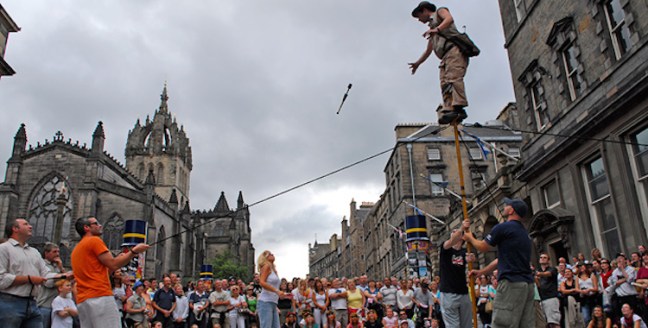
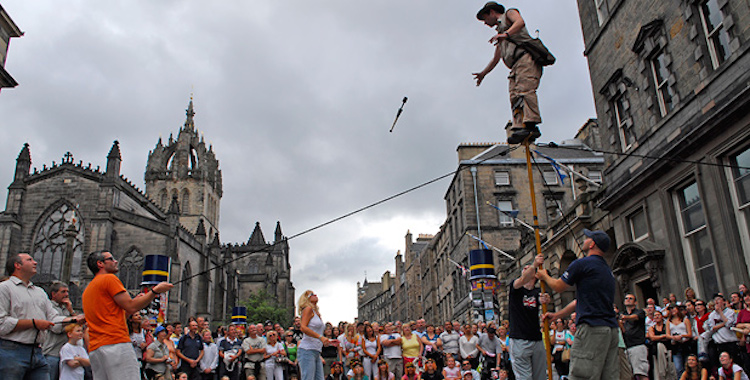
Now that I’ve just about recovered from the Fringe (and the inevitable Fringe cold), here’s my annual round-up of links to reviews and features written over the course of the festival. You know the drill by now.

Exeunt:

The Sunset Five
The Hitchhiker’s Guide to the Family
If I Were Me
Five Feet in Front (The Ballad of Little Johnnie Wylo)
Heartbeats & Algorithms
Citizen Puppet
Hair Peace
O No!
Ringside
64 Squares
The Eulogy of Toby Peach
Going Viral
Paradise Lost (lies unopened beside me)
Current Location
Electric Dreams
E15
The Paradise Project
A Question of Faith (The Christians and The Gospel According to Jesus, Queen of Heaven)
You’re Not Like the Other Girls Chrissy
This Much (or An Act of Violence Towards the Institution of Marriage)
Portrait

Fest:

Speaking Up for Free Speech (feature)
Impossible
A Gambler’s Guide to Dying
I Am Not Myself These Days
Traces
Births, Deaths & Marriages
Tar Baby
The Biggest Marionette Circus in the World
The Modern Lovers (feature)
My Name is… 
Dolls
Penny Arcade: Longing Lasts Longer
Key Change
Happy Birthday Without You
God’s Waiting Room
Fiction
After Freedom: New Rhythms of Soweto
Idiots
Brute
Othello: An All-Female Production
I Got Dressed in Front of My Nephew Today
The Litvinenko Project
Blake Remixed
Titus Andronicus: An All-Female Production
The Church of Malcolm
Wail
Scaramouche Jones
Our Ladies of Perpetual Succour
Quizoola!
Daggers MacKenzie
The Bastard Queen!