Are We On The Same Page? Approaches to Text and Performance

download

The relationship between text and performance has been and remains a source of friction within British theatre. Frequently, it has been used as a way of superficially dividing different practices and establishing antagonist binaries between theatre-makers. In recent years, the rise of what Hans-Thies Lehmann famously defined as postdramatic theatre has mapped old divisions onto a new vocabulary: we can now speak of the dichotomy between dramatic and postdramatic theatre.

However, as theatre-makers continue to experiment with theatrical form, this dichotomy offers a limited picture. In an article for the Guardian Theatre Blog in 2009, Andy Field subverted existing binaries by suggesting that ‘all theatre is devised and all theatre is text-based’. But despite such challenges to the ways in which we understand the status of text in relation to performance, the schism between supposedly ‘text-based’ and ‘non-text-based’ practices persists in the ways theatre in this country is supported, staged, and studied.
In an attempt to look beyond this schism, we invite academics, practitioners and commentators to join us in questioning the relationship between text and performance and its significance for contemporary British theatre practice.

Questions that we hope to address on the day include, but are not limited to:

  • What do we mean by an ‘open’ text?
  • Can a text ever be completed?
  • Is there anything a text makes impossible?
  • Is it ever possible to be faithful or unfaithful to a text?
  • To what extent can we think of the text as authoritative?
  • How do different theatrical performances transform a text?

Schedule

10.00am Registration
10.30am Introduction from Catherine Love and Caitlin Gowans
11.00am Tim Crouch in conversation with Catherine Love
12.30pm Lunch
1.30pm  Panel 1: Beyond the ‘text-based’/‘non-text-based’ divide (Chris Goode, Duska Radosavljevic, Andy Field, Jacqueline Bolton, Andrew Haydon, chaired by Catherine Love)
3.00pm Coffee
3.30pm Panel 2: Possibilities of text, narrative and performance (Vicky Angelaki, Rory Mullarkey, Deborah Pearson, Cathy Turner, chaired by Caitlin Gowans)
5.00pm Symposium ends

Booking

Krapp’s Last Tape and All That Fall

b8TcYuD3sxavzNLCqWAyXLyFrVPhHrAhZsqnVU1T0h8,jxtkY-PMBITRKmy3wijIflLBuDTxfyE9yPygKaGon3I

How do you solve a problem like Beckett? Or maybe the question should be: how do you solve a problem like the Beckett Estate?

Since his death in 1989, Beckett’s plays have been vigilantly policed, with new interpreters required to be scrupulous in their following of the playwright’s detailed instructions. One example: in his excellent book Drama: Between Poetry and Performance (2010), W. B. Worthen cites a Performance Licence Rider from February 2000 attached to a licence to perform a number of Beckett’s short plays:

There shall be no additions, omissions, changes in the sex of the character as specified in the text, or alterations of any kind or nature in the manuscript or presentation of the Play as indicated in the acting edition supplied hereunder; without limiting the foregoing; all stage directions indicated therein shall be followed without any such additions, omissions, or alterations. No music, special effects, or other supplements shall be added to the presentation of the Play without prior written consent. (p.208)

That doesn’t leave much room for interpretation. There’s also a certain irony involved in the issuing of a rider like this. It is, in Worthen’s words, “writing meant to constrain the implementation of dramatic writing already said fully to constrain its proper use in the theatre” (p.208). The purpose of the Estate is to protect the authority of Beckett’s texts, yet the necessity of such protection points to a chink in that authority that Beckett’s gatekeepers would otherwise seek to deny. The authority of the theatre text is limited; to borrow a favourite phrase from Michael Goldman, performance always materialises something “in excess” of the words on the page, no matter how detailed those words might be.

But watching some Beckett productions, you’d be forgiven for missing that “excess” of theatricality. Perhaps out of fear of the Estate, perhaps out of reverence for the playwright, too often “new” versions of Beckett’s texts surrender to deadening fidelity. In trying to be slavishly loyal to authorial intention, theatre-makers rob the plays of what has made them enduringly brilliant. Beckett’s world is one of theatrical images that startle and bruise, not raise weary yawns of familiarity. When David Jays explains why he and Waiting for Godot have parted ways, I get it. As he puts it, new interpretations of plays should be about “creating acts of theatre rather than acts of worship”.

I’ll ‘fess up to a bias here. As a researcher, I have a fair amount of intellectual investment in the idea that text is not a prescriptive set of instructions for performance. But I don’t think I’m making a particularly controversial argument. As a director, Beckett himself made changes to his own works in performance, the cutting of the Auditor from Not I being perhaps the best known example. This suggests that he understood – in a way his Estate sometimes seems not to – that each new performance context shifts the relationship with the text. Without that understanding, we might as well banish Beckett’s work to the page, treating it as literature rather than material for performance. Too much reverence does neither playwright nor audience any favours. And it doesn’t exactly help to dispel the persistent idea that Beckett is hard work: impenetrable, fenced off and reserved for the faithful few.

The pretext for banging on about all of this is the Barbican’s International Beckett Season, which just came to a close over the weekend. As well as the Sydney Theatre Company production of Waiting for Godot that finally put an end to Jays’ long, ambivalent relationship with the play, the season offered a reading of the short story Lessness alongside new(ish) renditions of Not I, Footfalls, Rockaby, Rough for Theatre, Act Without Words II, Krapp’s Last Tape and All That Fall.

I caught the latter two on Friday night and was immediately struck by the contrast between them. They are, for a start, two very different pieces of writing, if both recognisably “Beckettian”. In each there’s the silence, the loss, the absences; the pairing of comedy and melancholy; the unrelenting fucking loneliness of being alive sometimes. But while Krapp’s Last Tape takes place in a gloomy, sealed-off space, its protagonist all alone in the darkness, All That Fall is a rich aural tapestry of rural Ireland, full of voices and landmarks.

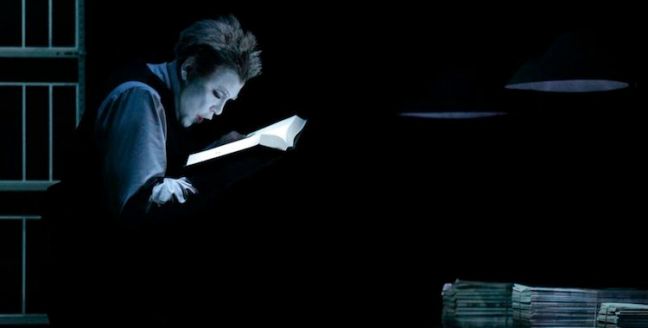
More than that, though, the productions from Robert Wilson and Pan Pan Theatre respectively have tackled the restrictions of staging Beckett in intriguingly different ways. Wilson’s production layers onto and stretches out Beckett’s structure, the essential shape of which is left (naturally) intact. The opening sequence, before Krapp begins listening to the voice of his younger self, becomes an extended prelude. Face white and hair on end, every feature down to his red socks evoking the clowns of silent cinema, Wilson stares out at the audience while a storm rages outside the box-lined walls of Krapp’s study, the sound almost deafening. It goes on. And on. When finally Krapp (past and present) begins to speak, the words are all carefully in order, but they’ve been given a strange, cartoonish gloss.

Wilson’s production is crisp, precise, consistent. The aesthetic, monochrome apart from that teasing glimpse of red, is part-comic strip, part-silent movie. The light is stark and exposing, in sharp contrast with the surrounding darkness – much like the juxtaposition between clowning comedy and gnawing despair. This is Krapp as deathly, fearful and purged of depths; a pale shell of a man, condemned to the folly of missed opportunities and playing to an audience long gone. Conceptually, it all adds up. But I don’t feel the play. Watching from my comfortable seat, the chill of loss and loneliness never touches me. By painting on top of what’s already there, Wilson’s version becomes all surface.
atf-1

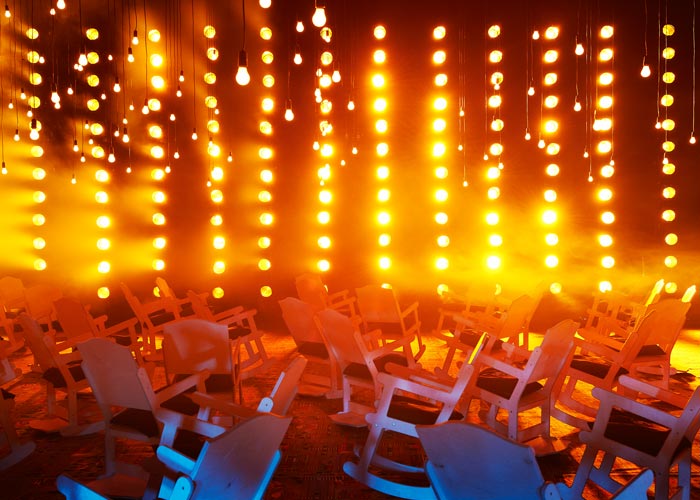
Pan Pan Theatre’s All That Fall, on the other hand, adds in order to strip away. Conceived for radio, Beckett famously said that the play was “written to come out of the dark”. Here, the darkness remains, but it’s given intermittent illumination. Rather than staging the play as such, Pan Pan Theatre have created an experience that attunes its audience’s attention. The Pit at the Barbican becomes a listening installation, a landscape of wooden rocking chairs, glowing lights and dangling bulbs. It is astonishingly beautiful, a cocoon of a place that I wish I could escape into every time I listen to radio drama.

Seated in our rocking chairs, we listen to the shifting voices and sounds of All That Fall with the delicate accompaniment of Aedín Cosgrove’s lighting design. Stripped of other visual references, our focus is directed in a way that it rarely is today when we listen to the radio (I’ve even taken to making myself close my eyes when listening to radio plays as a precaution against distractions). Unobtrusively evocative, the brightening and darkening of the lights, forming ever-changing patterns, subtly hints at the play’s narrative and themes, coaxing us into different emotional states as the journey of Maddy Rooney winds its melancholy way to the station and back. Even the gentle rocking movement of the chairs is in tune with the piece, the repetitive rhythm mapping onto the lilting Irish accents and the tides of loss, time and memory. It might no longer be a radio play in the precise way it was originally intended, but Pan Pan Theatre’s version feels in many ways like a purified, distilled experience of All That Fall.

My opening question is the wrong one to be asking, really. Plays aren’t problems to be solved; the very idea of a solution, with all the definitiveness implied, goes against the ever-shifting, ever-transforming nature of theatre texts. So does the iron rule of an Estate for whom honouring a text can only mean strictly obeying it down to the last letter (it’s possible even to ask what “obeying” really means when moving from one medium to another). To borrow once again from Worthen, texts written for performance are “designs for doing”. They beg for enactment, not exhumation.

Or, in short: Love Beckett. Hate the rules.

Top photo: Lucie Jansch.
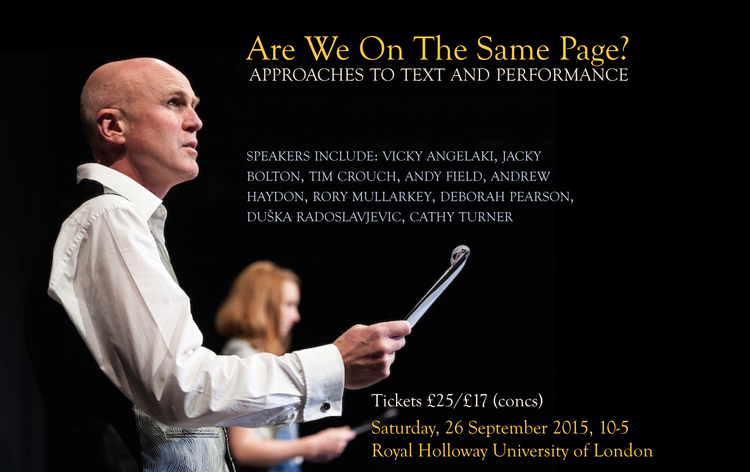
Image of an Unknown Young Woman, Gate Theatre

image

What’s in an image?

The power and potential deceptiveness of the image has become something of a recurring theatrical theme over the last few years. The most interesting thing by far about Chimerica was its ambivalent relationship with the iconic photograph at its heart, set against the backdrop of an image-saturated world. It followed The Witness, a play in which an image comes back to haunt the man who captured it, and was followed in turn by The Body of an American, which again revolves around the act of witnessing and the images that come to stand for entire conflicts.

Now, in Elinor Cook’s new play Image of an Unknown Young Woman, one small snippet of video footage both sparks and stands for a whole revolutionary movement. A woman – a young, beautiful woman – a young, beautiful woman wearing an eye-catching yellow dress – is shot during a protest. Video images of this act of brutality go viral, concentrating international media attention on a nation whose sufferings had previously been ignored. One pretty girl, one instantly iconic snapshot, does more than hundreds of deaths.

Cook’s revolution unravels in an unspecified country under an unspecified oppressive regime. While that device of “unspecified country” (especially when “Middle Eastern” or, as was the case a couple of decades ago, “Eastern European” is nestled in the middle) can often carry a whiff of racism, here the vagueness feels justified for a change. Although the play has echoes of various protests and revolutions across the world in recent years, it feels as though it could just as easily be happening on the streets of a Western city. The point is both closeness and distance – as hammered home by the parallel narrative of a wealthy Londoner’s frustrated desire to help.

In fact, Image of an Unknown Woman is constructed from a series of parallel narratives, all running along neighbouring tracks but – with one exception – never quite meeting. Ali (Ashley Zhangazha) and his girlfriend Layla (Anjana Vasan) deal with the fallout from uploading the video that sparks the uprising; lonely, rage-filled Candace (Susan Brown) confronts an ethical dilemma as she gets tangled up with a charity – fronted by Nia (Wendy Kweh), an activist who has escaped the regime under attack – that is not what it seems; and one woman (Eileen Walsh) simply picks her way through the carnage in search of her missing mother. Running around and between them is the three-strong chorus (Oliver Birch, Emilie Patry and Isaac Ssebandeke), taking on the murky, shape-shifting roles of leaders, protestors and commentators.

When I spoke to Cook about the play, she uncomfortably described “the girl in the yellow dress” – as the nameless subject of the video becomes known – as a sort of brand. As grotesque as the idea may be, it speaks powerfully to what captures the collective imagination in an information-flooded, fiercely consumerist age. People need a catchy slogan, a bitesize backstory, a striking image. This is also an idea that Christopher Haydon’s production and Fly Davis’ design have latched onto. With the audience configured in traverse, sliced down the middle by a catwalk-like stage, the entire space of the Gate’s auditorium is decked out in hazard-tape black and yellow. Aside from the costumes, the yellow of the young girl’s dress – and subsequently of the popular protest movement – is the only colour permitted to pierce the gloom. Armbands, balloons and scattered sheets of paper are all in keeping with the revolutionary “brand”.

The whole thing is as stylish and carefully coherent as the design, remaining immaculately consistent in its concept even as it evokes the noise and chaos of revolution. On the one hand, the pleasing sharpness of the aesthetic feels a little obscene, as if cleaning up the mess and blood of violent conflict into something almost pretty. Yet for that very reason it’s a brilliant artistic choice. This is what we as observers clutch at, what catches our attention: narratives that knit together, images that are neatly ideological, colours as bright and as vivid and as far away from those troublesome shades of grey as possible.

Haydon’s production is also effortlessly, unshowily diverse in its casting, both reinforcing the everywhere-and-nowhere quality of the play’s unspecified setting and actually looking something like the world beyond the Gate’s walls. Seeing Image of an Unknown Woman on the same day as reading Stephen Berkoff’s comments about the supposed “reverse racism” of ring-fencing the role of Othello for black actors, I was doubly aware of the importance of such a simple act. Sure, let’s have conversations about theatrical representation, but those conversations can’t be stripped of context. Until there’s real representation at all levels – until all theatre reflects the make-up of the UK population as a matter of course – any suggestion that the few roles reserved for BAME performers should be up for grabs for their already over-represented white counterparts smacks either of wilful ignorance or veiled prejudice (and that’s before we even consider the cultural history of blackface and all its racist connotations).

Representation is equally a concern for the play itself, which interrogates not just the impact that images gone viral can achieve today, but also the nature of the images that go viral in the first place. It’s no coincidence that the emblem of this revolution is young, female, attractive, blonde. As Nia puts it, this is an image of violence that is “palatable”, clear-cut – even titillating, as hinted at in the frenzied social media hubbub that opens the play. It’s a stark illustration that only some representations of suffering provoke a response and certain lives continue to be valued over others (as countless news stories in just the past few months alone have demonstrated). Indictments of twenty-first-century society don’t come much bleaker than that.

Photo: Iona Firouzabadi.

Violence and Son, Royal Court

image9-600x337

Originally written for Exeunt.

“Sometimes you start out stupid you end up being nasty.” That seems to be the diagnosis handed out to modern masculinity in Violence and Son, Gary Owen’s knotty new play at the Royal Court. In a society in which aggression and casual sexism are passed down like bad joints, brutality is a fact of life. Misogyny is inherited, violence inevitable. 

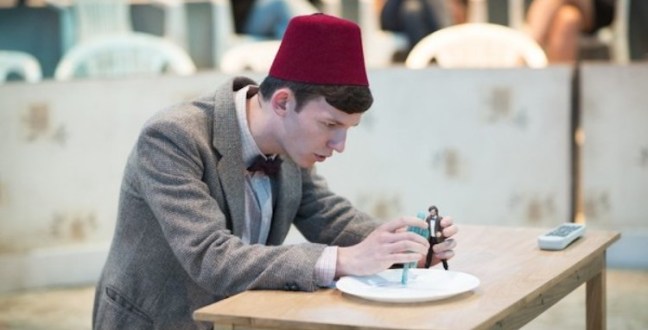
The words are spoken by Rick, whose nastiness has a habit of rearing its head after a few pints. There’s a reason the locals call him Violence (Vile for short). But for the last six months his life in the Welsh valleys with girlfriend Suze has been invaded by Liam, the teenage son he’s never known. On the surface, the pair couldn’t be more different. Liam is gentle, nerdy, prone to sporting a fez à la Matt Smith in Doctor Who. Still mourning for the loss of his mother, he sharpens his wit with sardonic swipes at his dad, avoiding Vile’s fists when he’s had a gutful. They are, as Liam puts it, getting used to one another.

In the confined circular space of Cai Dyfan’s set, ominously reminiscent of the boxing ring, father and son square up. It all starts amiably enough. Home from a Doctor Who convention with schoolfriend Jen – the Amy Pond to his bow-tie wearing Doctor – Liam agonises over their shifting relationship and bats away crude but well-meaning advice from Rick. It’s will-they-won’t-they meets odd couple comedy, peppered with gags and simmering with menace. There’s always the sense of something more lurking underneath, but Hamish Pirie’s canny production keeps the tone deceptively light and playful, the laughs rarely letting up.

Then, of course, comes the flip. It’s one of the oldest dramaturgical tricks in the book, but Owen and Pirie pull it off with gut-punching precision. The hints have all been dropped – the nickname, the undertow of discomfort, the troubling pub punch-up anecdote – but from the moment blood is drawn the mood suddenly turns with a queasy lurch. Rick and Liam’s relationship graduates from good-natured tussling to something altogether nastier, before Liam turns out to have more in common with his old man than we – or he – first thought.

Violence isn’t just the nickname of Liam’s aggressive, booze-dependent dad. It seeps into everything, from piss-ups down the pub to the delicate dynamic between father and son. And in a world in which violence is the norm, consent and complicity become increasingly tangled. Where is the line drawn between what’s acceptable and what’s not? What happens when actions and words are saying two different things? When is it worth standing up for yourself, and when is it better to be quietly complicit in the role of victim?

The play is one of questions rather than answers. Although Owen refuses to blur lines when handling sexual violence and consent, what he does do is place an individual act against a complex backdrop of normalised violence. It’s a risky tightrope to walk, but both play and production manage to withhold judgement at the same time as resisting the position of apologist. No remains no, yet we are dared to fall in love with Liam as a character, complicating our response to his actions. As the 17-year-old protagonist, David Moorst is all defensive wit and squirming awkwardness, his spiky charm covering up the fresh grief of losing his mother. Both in the way he shrinks – sometimes barely perceptibly – from his father and, later, in the stubborn set of his jaw, the scars of masculinity are beginning to show.

Rick, too, is harmed by the same violence he perpetrates. Jason Hughes puts in an astonishing performance as the reluctant father, torn between his habitual aggression and the genuine desire to do right by his newly returned flesh and blood. Even in the most light-hearted of moments, there’s a flicker of danger perpetually behind his eyes, a fuse waiting to be sparked. In one scene, as Rick’s impulse to comfort his son struggles to find any expression other than violence, his shoulders convulse with the effort of wrestling down his emotions. It reminds me of Men in the Cities and Chris Goode’s description of the artwork that gives the show its name: “each man is drawn contorted in a different way, in his own way, flailing”.

Offered such a grim and nuanced look at the state of masculinity in the twenty-first century, it’s easy to underestimate the complexity of the two female characters. Morfydd Clark’s Jen especially is a meticulous study of teenage confusion, forever painfully calculating between what she wants, what she’s been told to want and what society has taught her she will get. It’s terrifying, yet not at all surprising, to witness the extent to which she’s already accepted the sexism that pervades everything from Doctor Who to the local pub where gropes are standard. Being a woman, Jen seems to have worked out, is all about finding and playing the right role. One wrong step can be disastrous. And though the role of Suze is the least developed of the quartet, as played by Siwan Morris we get glimpses of the tension between her instinctive tenderness and the internalised misogyny that makes her loyal to Rick. Men writhe dangerously inside their own skins; women put up with the lesser of many evils. Patriarchy shits on everyone.

Tonally, as well as thematically, Violence and Son is quite a feat, handling the greyest of ethical grey zones with the same deft hand as the opening comedy. In the end, though, Owen pushes the seesaw too far the other way, driving his point into the ground. The pressure of the final plot contrivance threatens to crush the closing scene, making unnecessarily explicit what is up to that point brilliantly subtle. Still, it’s an analysis of masculinity and a portrait of twenty-first-century society that’s hard to shake off.

Photo: Helen Maybanks.

We Want You to Watch, National Theatre

Bettrys-Jones-three

Ever since seeing Alice Birch’s searing Revolt. She said. Revolt again last summer, I’ve thought of it as the feminist play for my generation. A generation raised with the base assumption of equality into a world we slowly realise has been cruelly mis-sold to us. A generation oddly cautious about the word “feminism”. A generation that briefly thought maybe the battles had been fought and won, when actually we just have to fight ever more insidious forces. For this generation and the ones immediately following it, this is the play that I want other young women – and men – to discover and have their minds blown by. It’s raw and angry and sad and fierce and funny and lost and searching and hopeless and hopeful.

We Want You to Watch is in the same vein. But where Revolt wrestled with everything it means to be a woman today, from the politics of the bedroom to the ever-present threat of violence, Birch’s new collaboration with performance duo RashDash isolates just one issue: pornography. A deliberate provocation, it starts from an extreme position, as Abbi Greenland and Helen Goalen’s characters set out to ban all porn – the good, the bad and the ugly. As one of the pair puts it, “we want it obliterated”. Rip it up and start again.

Of course, it’s not as simple as that. We Want You to Watch is conscientiously self-aware, problematising its demands at every turn. There are interjections, bathed in sudden, glaring light: “Can we just say we’re completely pro sex”; “This has just been about heterosexual porn – that is a failure. This is not an apology”. Greenland and Goalen’s objections to pornography are met with eloquent defences, turning the argument over and over. What hard evidence is there of a link between violent porn and violent behaviour? How can you control the choices of consenting adults? Isn’t the banning of porn just censorship, pure and simple?

This is all explored in episodic fashion, leaping from one surreal scenario to the next. First, Greenland and Goalen are cops in the interrogation room, trying to prove the connection between torture and murder and the watching of violent porn. Then they’re in ballgowns, petitioning the Queen, then confronting the little boy of today who will be the porn addict of tomorrow. Failure follows failure, while the supply of porn – packaged in value cans, cheap and on demand – constantly renews and multiplies around them in Oliver Townsend’s simple but striking set.

Watching it, I think of the bit in Fleabag where Phoebe Waller-Bridge’s character clicks joylessly through porn, listing all the different genres with empty, staring eyes: gay, Asian, anal. I think of the ‘Porn Girl’ monologue in Nothing and the speaker’s guilty, scared admission that she was turned on by “the bits where something felt wrong”. I think of Bryony Kimmings in Credible Likeable Superstar Role Model, plucking out her niece’s eyes to protect her from seeing all the fucked up nastiness that’s just a swipe and a click away at any moment.

All that and more surfaces in the gaudy metaphor of We Want You to Watch. As ever in RashDash’s work, ideas are expressed as much through bodies as through language. As the subject of Greenland and Goalen’s interrogation rebukes their arguments, the two performers buckle to the ground, limbs contorted in defeat. Later, expressing what watching porn feels like, their bodies thrash violently across the stage, the effect vivid and queasy. The pornography that seeps into everything is never seen, but its imprint leaves an indelible stain on the movement. Birch’s words can bruise too, especially in a heartbreaking speech delivered to the next generation.

The further Greenland and Goalen pursue their mission, though, the more strained and stretched the metaphors become. Eventually, they track down a teenage internet hacker, frantically defending their position while responding to ever more ridiculous demands. There’s only so far the dramaturgy of failure can go, and as the piece goes on it verges dangerously close to tedium, its once fierce arguments now weary and sluggish. There’s an aptness in that, of course, but it increasingly struggles to land. Beginning to feel restless, I wonder if the hard-line starting point is as much of a burden as a provocation.

That said, there’s an appealing boldness in staking out an uncompromising position, in refusing to accept “the shittest consolation prize on the planet”. In the unapologetic yet problematised stance of We Want You to Watch, there are echoes of both Revolt and RashDash’s last show Oh, I Can’t Be Bothered, which tussled just as painfully with the idea of romantic love and the suffocating demand to find “The One”. In the tackling of another feminist issue, I was hoping for a collision of those two approaches, each complex and messy and exhilaratingly theatrical. We Want You to Watch isn’t quite it. But like Revolt, it prises these conversations open, using anger and a stubborn refusal to back down as a way of pushing forward its central debate. And even in its failure, it dares to dream of a new start.

Rip it up and start again.

Photo: Richard Davenport.