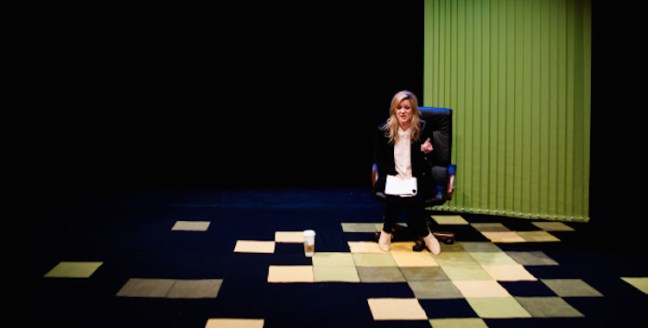
There’s something behind Olivia Poulet’s eyes. It might be steely pragmatism. It might be desperation. It might be suppressed disbelief at the spectacularly awful script she is determinedly trying to sell. It might, worse, be genuine passion for the regurgitated tropes she’s trotting out. It might even be dollar signs, if the starlet she’s pitching to gives the nod.
Mark Ravenhill’s monologue is a witty parody of the film-studio hard sell, the product of its title a slice of syrupy Hollywood cliché – the kind that rots your teeth. Girl meets boy. Girl goes on journey. Love over all else. It’s sharp, clever, self-satisfied. Only in the (nervously gesturing) hands of Poulet does it become something more than that. As a riff on the cynical, opportunistic practices of movie executives, Product is arch and entertaining. As an essay on shit-shovelling desperation, it’s blackly depressing.
Poulet is Leah, the producer charged with getting a star name on board for a new project. Problem is, the project in question is Mohammed and Me, a post-9/11 mash-up of romcom and jihadism with a cameo from Osama Bin Laden (yes, really). Sitting in for Julia, the actor selected to save this rapidly sinking ship, we’re treated to Leah’s increasingly frantic pitch as she takes us on the emotional journey of “three-dimensional” lead Amy. “I would love to see you play three-dimensional,” she croons at us, smile fixed.
Folding the War on Terror into classic chick-lit formula, Mohammed and Me is the doomed love story of a 9/11 widow and a suicide bomber – or, in appearance-obsessed Hollywood-speak, a Versace-clad businesswoman and the “tall, dusky fellow” she finds herself sat next to on a flight. Step aside Romeo and Juliet; this is a star-crossed romance like no other. Leah walks us through the movieland Holy Trinity of attraction, separation and reunion, with bomb threats and prison break-ins thrown in for good measure. “This is the world of the heart,” she earnestly intones, with all the persuasion of one who’s never had call for the organ.
It’s clearly tripe, with Ravenhill using the godawful script in Leah’s hands as a vehicle for taking pops at everything from Hollywood’s casual misogyny to its obsession with sex and violence (the two often barely distinguishable from one another). There’s a transformation montage scene, a blandly identikit mother/aunt/neighbour figure – “she’s too old to fuck, too old to kick ass, but we still have a place for her in our world” – and a suitably slushy soundtrack. Tick, tick, tick.
But what Poulet does in Robert Shaw’s production is give the money-making behemoth of Hollywood human context. Darting her eyes from side to side, appealing to us with her ever-moving hands, narrating the plot of Mohammed and Me with desperate abandon, Leah has the look of a woman possessed. What she’s possessed with, exactly, is ambiguous. At moments, she seems swept away by the story, eyes closed in its telling. At others, she’s practically gagging on this material, correcting herself mid-sentence: “This material is fab – is going to be fabulous once it’s punched up”. Either way, there’s a constant undertow of desperation and self-deceit, hinting at all the things we force ourselves and others believe in the name of self-interest.
Having the monologue spoken by a woman (it was originally performed by Ravenhill himself) also twists it in intriguing directions, glazing the misogyny with an even sourer coating. When Leah patronisingly says that she “cried like a woman” and jokingly refers to her listener as a “bitch”, you sense that she really means it. Especially in Shaw and Poulet’s interpretation, this isn’t just about the movie industry; it’s about all those oppressive internalised narratives – of sexism, of racism, of greed – that twenty-first-century capitalism shoves down our throats. The scariest suggestion is that we might just end up swallowing them.
Oxford’s residents have a history of taking a stand. Over the years the city has been home to the likes of Emily Wilding Davison, Percy Bysshe Shelley, Tony Benn and John Ruskin. During the English civil war, it had associations with the radical Levellers movement, two of whose members were executed near Gloucester Green. The city’s Ruskin College has long been a symbol of workers’ education, as well as hosting the inaugural Women’s Liberation Movement conference in 1970. But as Oxford celebrated its radical history last year, theatre-maker Chris Goode and the Oxford Playhouse were more interested in what it means to be radical today.
Commissioned for the Playhouse’s Radical Thinking season, the show Stand – now on at Battersea Arts Centre in London – celebrates the ordinary and extraordinary ways in which local people are standing up for what they believe in. For some, that means activism in a familiar form: campaigning, demonstrations, occupations. For others, it’s simply about being a parent. In the show, Goode has captured and told six of these stories.
The Oxford Playhouse asked its community a simple question: when was a moment you stood up for something you believe in? “I feel like the callout set the bar quite high,” Goode reflects. “There’s something nicely self-selecting about it, because it means that the people who want to talk really want to talk.” Having chosen his six storytellers, Goode interviewed them all over a couple of weeks, gathering the material that would later be performed by his cast of six actors.
The stories they found were as varied as the people sharing them. There’s a climate campaigner, a woman who works with refugees, a mother, an activist who campaigned to save the alternative community at Oxford’s Jericho boatyard, one of the founders of the Reclaim Shakespeare Company, and a man in his 80s who has spent most of his life protesting against animal testing.
Isn’t there a danger, though, that these eclectic narratives just end up serving a structure imposed by the theatre-makers? Goode’s answer to that question is to be constantly confronting it. “I just think being really aware is half of the task,” he says. “You have to let go of your agenda quite often, because it has to be about the people rather than about the issues that you’re trying to articulate.” All of the interviewees speak, for example, about their childhoods, offering a portrait of their personalities as much as their acts. “I think one of the virtues of Stand is that you see everyone in quite high resolution,” says Goode. “Hopefully you get a real sense of the details of people’s lives, so that they’re not just mouthpieces for certain points of view.”
That said, Goode admits that he and his team always had the aim of inspiring their audiences, with the hope that they in turn will go on to stand up for their own causes. “I felt like there had to be that call to action embedded in the show,” Goode explains, “quite gently, but definitely there.” For that call to action to be heard, though, the show has to connect with audiences who might feel worlds away from the activists sharing their stories – “you have to feel like you’ve been listening to people like you,” as Goode puts it. That’s where the human detail comes in.
“One of the really nice things about the people we found is that they were all really quick to talk about themselves in ways that pointed at moments where they’d failed, moments when things had gone in an unexpected direction – moments of daftness,” says Goode. Activism has its fair share of the ridiculous alongside the serious – “bizarre situations where they’re superglued to something or they’re wearing a costume in a peculiar place”. And what Stand’s storytellers all share, like so many of us, is a guilty feeling that they could be doing more: “Even among really hardcore activists, there’s always someone who’s more hardcore.”
Stand was also an opportunity to present people’s courage in a new light. “People don’t often see themselves in that way,” says Goode, “they don’t see their own bravery.” One example is Jan Thomas, who wanted to celebrate her adopted daughter’s small stand against injustice, but found to her surprise that Goode was more interested in her story as a mother. “I felt I had done nothing special,” she tells me. Since taking part in the project, though, she has been bolder in taking a stand, joining some of her fellow participants in their campaigning activities. “After seeing Stand and meeting the others I resolved to be much more active in standing up for the things I believe in.”
A big part of the project has been about engaging new audiences with the work of the Playhouse, not least through performing the show in a local community centre. “I think there’s a perception around Oxford Playhouse, as there is around a lot of venues and organisations of that scale, that they’re slightly fortressed,” suggests Goode. “It felt really important to them as well as to us that this was a way of opening up some different doors.” Producers Hannah Bevan and Michelle Walker describe Stand as unlike any other show the Playhouse has ever worked on, adding that “to be bombarded with audience responses ever since the show opened about how joyful and inspiring they found it was nothing short of a dream”.
“I’ve never done anything with quite such a strong local focus,” adds Goode, questioning how that might translate to audiences during its London run at BAC. “There’s definitely a strength in that specificity, but I don’t know whether it’s a crucial strength yet.”
Just days after Goode and I spoke, Battersea Arts Centre’s Grand Hall was hit by a devastating fire, followed by an overwhelming show of support for a venue with a radical history of its own. It seems that in Battersea, as in Oxford, there continues to be a tradition of standing up for what matters.
Binaural sound technology is nothing new. The technique of binaural recording, which creates the sensation of 3D sound for those listening through headphones, has been around in one form or another since the end of the 19th century, when it was used in the transmission of theatre and opera performances over telephone lines. What’s more novel, however, is its use in theatre.
Director David Rosenberg has long been aware of the potential of binaural sound. “I first came across it through my dad,” he remembers. “My dad was a physiologist working in the area of soundand he was doing work with binaural sound when I was about 10.”
The technology was not put to use in Rosenberg’s theatre-making, however, until he and sound designers Ben and Max Ringham started creating experimental scratch performances with theatre company Shunt, of which Rosenberg is a co-founder.
“Ben and I and David developed that interest together,” Max Ringham tells me, recalling their early experiments at the Shunt Lounge under London Bridge station in the mid-2000s. “First of all, we were working with an illegal radio transmitter and we would set up impromptu illegal radio stations to send audio out to people.” From these illegitimate beginnings, the trio gradually refined their use of the technology, eventually putting it to full use in the 2007 show Contains Violence at the Lyric Hammersmith.
In Contains Violence and subsequent shows Electric Hotel and Motorshow, Rosenberg explains that the use of binauralsound was “about trying somehow to bridge the visual gap between the audience and what they were watching”. In each piece, audience members were positioned as onlookers, with the sound pumped through their headphones immersing them in distant spaces, be those hotel rooms or car interiors.
But there are problems with this as a technique. “There’s a hierarchy of perceptions,” says Rosenberg, with sight at the top. “Sight occupies the very safe territory where lots of other sensations then attach themselves to what you see,” he continues, using the example of an experiment in which participants attributed different sounds to the same set of moving lips. “Sound is not a precise thing in the way vision is,” Ringham compares the two senses. “When you look at something you can see the clear relationship between a tree and a car, for example, whereas there’s an element of subjectivity with sound about where things are coming from.”
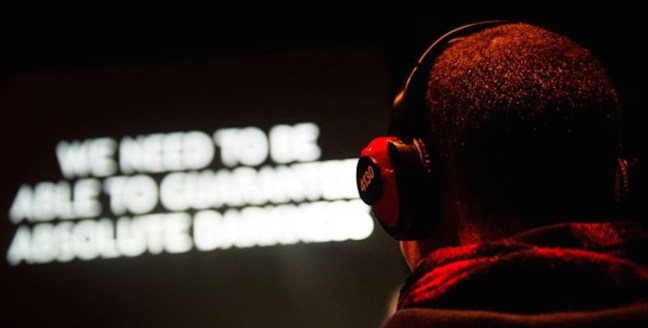
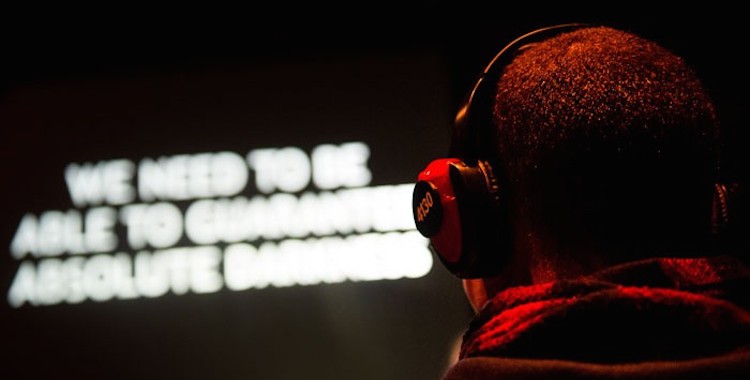
This explains why, for their latest experiments with binaural sound in Ring and Fiction, Rosenberg and his collaborators have plunged audiences into darkness.
“We wanted to completely change that hierarchy and have images created by the sound,” Rosenberg explains their thinking. “Deprived of other sensations, the audience become incredibly sensitive to the sound.”
Ring, created by Rosenberg, Ben and Max Ringham and writer Glen Neath, enveloped audiences in inky blackness and placed them at the centre of an unnerving aural experience. “With Ring, we were really looking at how to expand the role of the audience within this set-up and how to make them the subject of the piece,” says Rosenberg, “so they find themselves deeper and deeper within a performance that they have a role in, that they have a reason to be in.”
While audio performances often raise the question of what qualifies them as theatrical, it was this positioning of the audience that ensured that Ring remained a live experience and one that could not just be listened to at home. “The show for the audience is about being in a room full of people,” says Rosenberg. “You need to be in that situation in order for it to make sense.” Neath agrees, going as far as to claim that this work heightens the liveness of the theatre: “It feels like one of the most live experiences I’ve had in the theatre.”
Robbing the audience of their sight, meanwhile, has given greater scope for the sound. “The darkness is such a massive gift for us,” Ringham says. “It’s brilliant, because it means to start with everyone thinks you’re about 10 times better than you are. Your sense of hearing is so much more heightened in the dark and people’s focus is absolutely on what they’re hearing, because they have nothing else.”
As a sound designer, Ringham relishes the new opportunities that binaural technology allows. “The geek in me really enjoys throwing sounds around,” he says. He remembers a moment during Electric Hotel, in which the audio feed tricked audience members into believing that they could hear people speaking from among them. “Every night, watching 500 people turn around and look over their shoulder to see who was talking behind them when there was no one there, was quite a big thrill.”
Like any technological development, however, it has its challenges. “There are lots more facets to take on board when you’re trying to create it,” explains Neath, as well as lots of theatrical devices that are ruled out by the use of headphones and, in the cases of Ring and Fiction, the complete darkness. “There were so many things that you couldn’t do and you had to find a way round.”
Lessons have been learned along the way, such as the sound designers’ discovery that “people’s perception of things in a space has a limit; people can only hold three separate things in a 3D environment in their head and know where they’re coming from”. Ringham insists, therefore, that it’s important for theatre-makers working with this sound to keep it simple and not attempt to do too much at once. He also stresses that it’s “incredibly important” to use high-quality recording equipment in order to create the best experience. “There’s the KU100, which is the industry standard best and nothing sounds quite as good, to be honest.”
So what makes this technology so exciting for theatre-makers? “The main thing is a question of intimacy,” says Rosenberg. “With all live events we’re trying to create some sort of intimate relationship between the audience and what they’re seeing. How do you keep that intimacy when you have increasingly large audiences?” Binaural sound, which can create the sensation of a performer whispering directly into each and every audience member’s ear, is one answer.
Intimacy also seems to be the lure for audiences. Observing the growing interest in binaural sound across the theatre industry, Ringham suggests that “it’s more and more of interest to people as they’re more interested in an immersive type experience. It’s an incredible way of transporting people and putting them into different environments.”
This sensation of immersion is central to Fiction, the team’s second show using binaural sound and complete darkness. This time, the show puts audiences in two places at once: the room of the theatre, and the dream world that the sound transports them to. “The principal difference is that we’re taking the audience to a lot of different locations and there’s been quite a lot of discussion about how we actually record that,” says Ringham.
The effect of this sound, Neath hopes, is “something magical”, allowing audiences to suspend their disbelief even as they are made aware of the physical space they inhabit. “This is not real, but we challenge you not to believe it.”
The other night, I got sucked into a general election coverage black hole. Sat in bed, clicking through article after article, eyes fixed wide open when I should have been asleep. I was – I am – terrified. Then, a day or so later, I read this by George Monbiot on the train, hands shaking a little with fury. So much – climate change, the housing crisis, extreme inequality – is fucked, and the media is worrying about what Ed Miliband looks like eating a sandwich.
Likewise, there’s been a lot written about election theatre in the last few weeks and months. And yes, there is a lot of exciting political theatre that’s been programmed ahead of the country going to the polls. But amidst all the uncertainty and spin and sly manoeuvring, what leave more of an impact are those reminders of who the outcome of today’s vote is really going to impact upon. It’s the theatre about people, as much as the theatre about politics, that I find lingering in my mind.
I’m proudly voting Green today (a privilege, I confess, of living in a Labour ultra safe seat and not having the agony of worrying about letting in the Tories by splitting the left-wing vote – fuck first past the post, by the way), but Owen Jones’s argument for supporting Labour – especially in marginal constituencies – is pretty persuasive on this point. As he puts it, there might not be a huge gap between Conservative and Labour, but a hell of a lot of people fall into that gap. Increasingly, it looks as though the coming days are going to be a scrappy, close-fought fight, and the real winners or losers won’t be those sat in Parliament, whatever side of the House they end up on.
Take the characters who populate Beyond Caring. Since Alexander Zeldin and his cast started working on the show a couple of years ago, zero-hours contracts have become a key election issue, but Beyond Caring isn’t really “issue theatre”. It’s just about people. Weary, ignored, cruel, tender, stubbornly hopeful. People making the best of a shitty situation, cleaning up – literally and metaphorically – the mess they’ve been landed in.
Three cleaners on zero-hours contracts work a relentless 14-day cleaning job, alongside disillusioned full-time worker Phil and needlessly cruel night-shift boss Ian, venting his frustration in small displays of power. Ultimately, though, they’re all people who have been let down, forgotten, left out of the “aspiration nation”. But none of this political commentary is explicit. Instead, the hyper-naturalistic texture of Zeldin’s production simply puts us in the same room as these people, watching as they lead their precarious, unremarkable lives. “Just pay attention,” the show seems to be saying. Just look.
—
A memory: I’m about to cross the road outside Euston Station when I notice a man appealing to passersby. They all ignore him. I walk over, awkward, asking if I can help. He needs money for somewhere to stay tonight but he feels as though he’s running out of options. I listen. He tells me his name. I tell him mine. I try to offer some feeble advice, but honestly I don’t really know what support systems – if any – there are for him to access in the short term. I have to leave, so I give him what little cash I have on me and tell him I hope he finds somewhere. It’s not enough.
I cry, quietly and inconspicuously, all the way to my destination. Guilt itches at me – why didn’t I stay for longer than those few minutes? why, so often when I’m walking somewhere in a hurry, don’t I stop at all? – but mostly I feel a sort of helpless anger. All the talk, all the policies, all the posturing, have suddenly become a sharp kick in the stomach.
But then I think about the inevitability of that moment dissolving into the texture of my day, slowly melting into all the other experiences and conversations and worries. I think about the luxury and privilege of forgetting. I think about how I’m already turning that encounter, that man’s life, into a narrative. I wonder if that makes me just as bad as those who ignored him.
Tone-wise, Stand is perhaps as far from Men in the Cities as Chris Goode’s practice gets. After I see the show at BAC, Hannah Nicklin suggests that it’s the latter’s gentle counterpart; they’re two different sides of the same coin.
Men in the Cities is angry. Exquisitely, excruciatingly angry. It’s the raw, bruised cry of rage that is sometimes the only response to the world we live in. Rip it all down and start again. The same energy that’s channelled towards destruction in Men in the Cities is directed into positive, life-affirming action in Stand, be that campaigning against climate change, fighting for animal rights, or simply raising children with the strong sense of justice that allows them to take a stand in turn. All of those who share their stories of standing up for something acknowledge all that is wrong with the world, but they continue nonetheless.
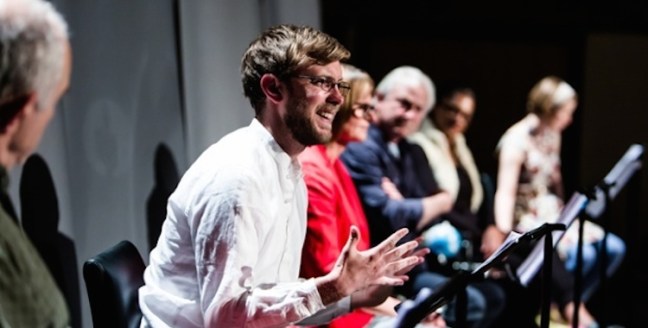
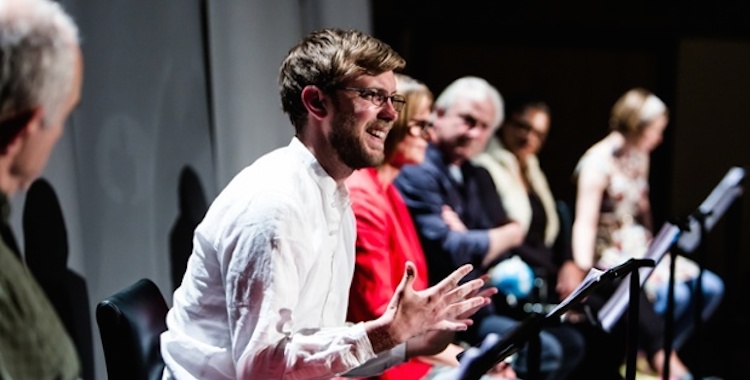
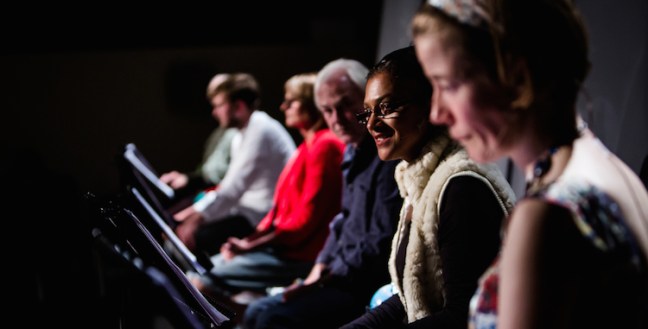
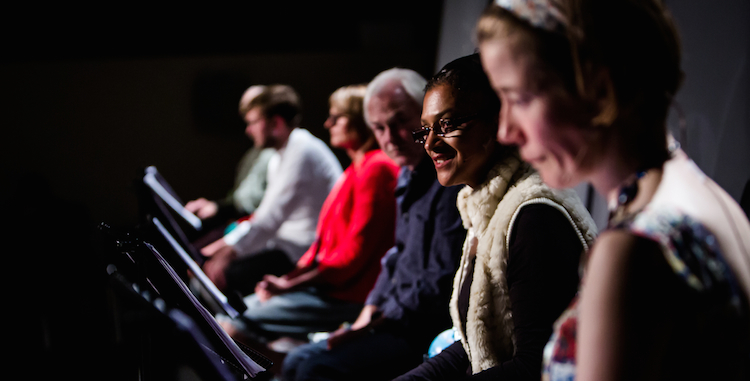
Although Stand is a collection of individual narratives, gathered from people in Oxford, I’m struck by how communal they all feel. None of these stories are about us, say the six people sat on stage. It was him, it was her, it was all of us. It feels apt to be sat listening to these stories of action and community in BAC’s Council Chamber, a room soaked in the history of its local people, in a building whose motto “Not For Me, Not For You, But For Us” has taken on new meaning in recent weeks.
Confronted with just how fucked up the world is, it’s easy to feel guilty or helpless or both. My conscience is constantly pricked by the need to do more, while my anger is deflated by the feeling of being too small to make a difference. Handing out a few leaflets for the Green Party, or signing a petition, or spending a couple of minutes talking to a homeless person on the streets – they all feel like miniature, cowardly acts, ways of soothing that itchy conscience without really doing very much. Even the much bigger, much braver acts described by some of the individuals in Stand are just tiny drops in a vast ocean.
But there is something, however small, in stories. Watching Stand with Hannah, it reminds me of a moment near the end of her show A Conversation With My Father, in which someone suggests that what she is doing – telling stories – is the real way to initiate change. It is, at the very least, one way. Stories are how we shape our lives and our place in the world, so if we tell those stories differently then maybe – just maybe – we’re somewhere on the way to acting differently.
—
And there’s something about who gets to tell their stories and whose stories are told for them – or not told at all. On the same day as seeing Beyond Caring for a second time, I go to an afternoon performance of Turning a Little Further, a show devised with local female carers as part of the Young Vic’s (brilliant, as far as I can tell) Two Boroughs project. Partly inspired by Happy Days, recently in the main house, it’s a shifting portrait of women up to their necks not in sand but in other demands and responsibilities that weigh just as heavy.
“We have not given anyone a voice,” insists the short programme note, “we have simply allowed those voices to be heard.” And that’s the sense you get from the piece, which is filled with this wonderful, poignant, ecstatic cacophony of voices. It’s also properly beautiful – all glitter and soft coloured light and flowing, joyful movement. At one captivating point, bodies shoal and move as one mesmerising mass under a low amber glow; at another, a swing becomes a simple symbol of freedom and play.
It’s difficult too. “I’m choking on my own heart,” says one woman – a line that sticks in my own throat. Often, the struggle of just navigating daily routine is painfully felt, as is the indignity of being swept aside by government and society alike. What’s also felt in the room, though, is the sheer joy of this space of creation and escape, a space that feels increasingly under threat. “This,” I want to shout, “this is why theatre matters.”
Together with Beyond Caring, it’s a sharp reminder of what’s at stake in the fight ahead of us – today, yes, but also in the days after that, and the days after that. So many of the women in Turning a Little Further talk about being invisible, about not being heard. I don’t want to be part of a society where those voices are left to fade away entirely.
—
Finally, because it’s the sort of day when I either have to be a bit idealistic or collapse into tears, I’ll be singing this in my head on the way to the polling station.
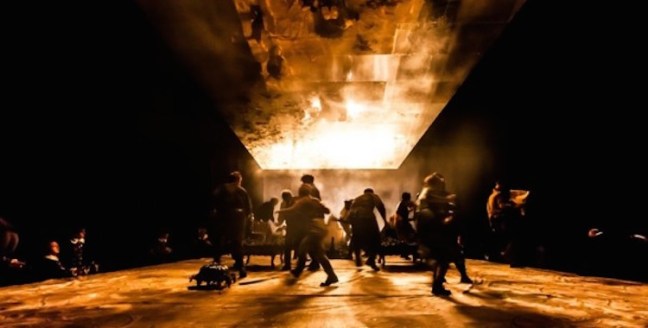
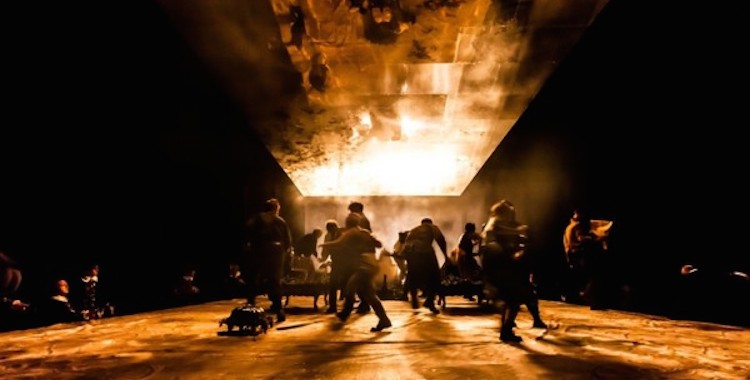
Light Shining in Buckinghamshire begins with a feast. In the National Theatre’s new production, the safety curtain opens to reveal a vast table heaving with food. Overstuffed pies; plates spilling over with fruit; a whole, glistening pig. An obscene bounty. Around the edges, heedlessly stuffing their faces throughout the people’s battles and declarations, sit a shadowy host of figures in gowns. The poor scrabble while the rich gorge.
It’s one hell of a metaphor – and one hell of a table, at that. Es Devlin’s raked design spreads greedily across the stage of the Lyttelton Theatre, occupying our entire field of vision. Above, a huge slanted mirror reflects back the candlelit opulence, while a gilt throne looms at the back of the stage. This is what the impoverished idealists and revolutionaries of Caryl Churchill’s Civil War play, dwarfed by the finery that surrounds them, have to contend with.
Eschewing textbook Cavaliers and Roundheads for a focus on the radical far-left groupings of the Levellers, Diggers and Ranters, the sympathy of Churchill’s play lies with those dismantling the banquet. Her history is one of workers persuaded to fight by a fervent belief in the imminent arrival of Christ on earth; of radical thinkers and penniless hopers; of the heady possibilities of a nation without a monarch; and, finally, of those who would freely distribute rights to speech and land being crushed by those unwilling to relinquish their power. In this telling, it’s a war fought on heavenly promises for ultimately earthly spoils.
That’s where, again, the central metaphor comes in. Bit by bit, the opening feast is stripped back to the earth from which it came, as Devlin’s set undergoes an extraordinary transformation. But while the people may till that newly uncovered soil, it soon returns to the hands of a small elite. As revealed by the Putney Debates of autumn 1647, slap-bang in the middle of the play, the Civil War quickly becomes a battle not for freedom but for land. For Oliver Cromwell and his allies, this is the sticking point; democracy is not to come at the price of their privileged property rights.
Churchill’s is a play full of proclamations, of speeches grand and simple. We, the audience, are very deliberately addressed, positioned almost as witnesses. During the pivotal Putney Debates, the house lights are gently raised, daring us to speak up. Later, Steffan Rhodri’s butcher stares right out at us, refusing to sell us any more meat. We’ve had more than our fill.
All that speaking, though, doesn’t always make for compelling drama. Lyndsey Turner’s production is a gorgeous thing to look at, with all the light, shade and careful composition of a series of paintings, yet like paintings the scenes too often feel static and poised. The rawness of anger and revolution has been given a pretty, polished sheen. There are some briefly breathtaking moments of theatricality – the voluminous tablecloth taking on a life of its own, or the wooden slats of the table being made to give way to the soil beneath – but for the most part it’s all talk and backdrop.
There are obvious, though not forced, resonances. We live in a time that feels similarly on the brink of an apocalypse – though one heralded by climate change rather than Christ – and we’re approaching the most genuinely unpredictable general election in decades. Again, we face both possibility and despair. And seeing the show on St George’s Day, the nationalist rhetoric tugs on the ear, speaking of all the ways in which pride for one’s country has been – and continues to be – used to mobilise people. But “for England” (or Britain) only ever really means for a select few.
In a subtle touch, Soutra Gilmour’s costumes suggest that the distance of rulers from ruled is temporal as well as economic. While the aristocratic chorus are got up in period gowns, the non-specifically scruffy Diggers, Levellers and Ranters could have been plucked out of various points in history – right up to the present day. One would-be revolutionary even pulls out a thermos. This has been going on for hundreds of years, Turner’s production seems to be saying, and those at the top still have yet to change.
This plays out on an epic scale, with the already large cast (Leo Bill, Joshua James, Trystan Gravelle and Adelle Leonce all stand out from the considerable crowd) supplemented by a community company of more than 40. There are an awful lot of bodies on stage. This is less the fragmented experience of war suggested by the play’s many small scenes and vignettes and more of a mass event, with a crowd of other players always lurking in the background. While this breadth can give a powerful sense of “the people”, however, the sheer size and ambition of the production – like the lavish spread it opens with – all feels a bit much. It’s a plea for the earth coming from the heart of the feast.

 Catherine Love