Harry Melling has an ear for the poetic and an eye for the gritty. His debut play has a little of both. It opens with him swinging from a lamppost, body straining upwards while coloured lights pulse around him. A moment later, he’s on the ground and in the dirt, gathering up the detritus of the night before. These two images capture in miniature the existence of Melling’s nineteen-year-old door-to-door salesman: a boy reaching upwards but forever pushed down.
Peddling is a slippery, shimmering thing, its wordy, meandering text requiring concentration but rewarding the attention it demands. There are moments when both rhythm and language are briefly reminiscent of Kate Tempest, with that same delicate skill of spinning lyricism from the urban and everyday. Melling’s pedlar boy, a young offender set to work hawking j-cloths and loo rolls (“life’s essentials”), could be a brand new ancient; a trampled god of 21st-century London, flinging poetry and unexpected wisdom into the unheeding night air.
Inside the gauze walls of Lily Arnold’s set, the action of Peddling appears hazy, as if trapped behind the gloom and smog and anonymity of a city seething with people. Traipsing through London with his wares – “professional doorstep-hopping” – Melling’s protagonist bears witness to a stratified urban landscape, where the cosy, affluent households of Hampstead and Muswell Hill sit in stark contrast to those who come knocking on their doors. For all the fancy postcodes he names – those telling little combinations of letters and numbers, freighted with social significance – in Steven Atkinson’s production the Boy (he’s never named) stamps in circles around the same sorry patch of earth. Round and round.
In one of those comfortable houses with its comfortable postcode, the Boy comes across a ghost in the form of a woman in the form of a social worker. She doesn’t recognise him, but he recognises her. This sudden, destabilising encounter offers opportunity for destruction, answers and redemption, with the Boy seeking out a little of each. Melling has us follow him as night melts into day and day melts into night, tracing the winding path he takes on the search to understand his past, his present and his future.
What Melling is strongest on is the sheer, crippling indignity of not being recognised as a fellow human being. His protagonist is denied a name and a place to lay his head, cast out onto the uncaring streets with just a badge on his chest and a box of items for sale. His life is reduced to transactions. He knocks on doors. He sells dishcloths and buys fags. He receives the sum of his life in a box full of papers, thrust into his arms with the words “this is you”. Just a series of notes and records, the traces of his long exchange from hand to hand, institution to institution; “a long list of yesterdays”. When he begs for his name to be acknowledged, crying “I am something made of flesh and blood”, it rings out with rage and desperation.
Elsewhere, though, Peddling can be a little heavy-handed with both its points and its symbolism. When we get a glimpse of the Boy’s childhood, the loss-stained memory of innocence feels all too familiar, recalling a trope seen many times before. A long interlude describing a dream, meanwhile, shows the strain of reaching for profundity in a way that the rest of the play doesn’t need to, leading the attention to drift. The real poetry here is in the pedestrian, its power generated by a distinctly and devastatingly everyday despair. And through it all Melling’s restless, intermittently explosive protagonist prowls like a caged thing, stamping down the dirt and blinking up at a city sky that has swallowed all the stars – “a punishment for not taking good enough / care of one another”.
“Our cancerous culture atrophies through the very real lack of a will to live: to idolise death is to reinforce that.” – Jon Savage
I’m reading about Ian Curtis and I’m thinking about death.
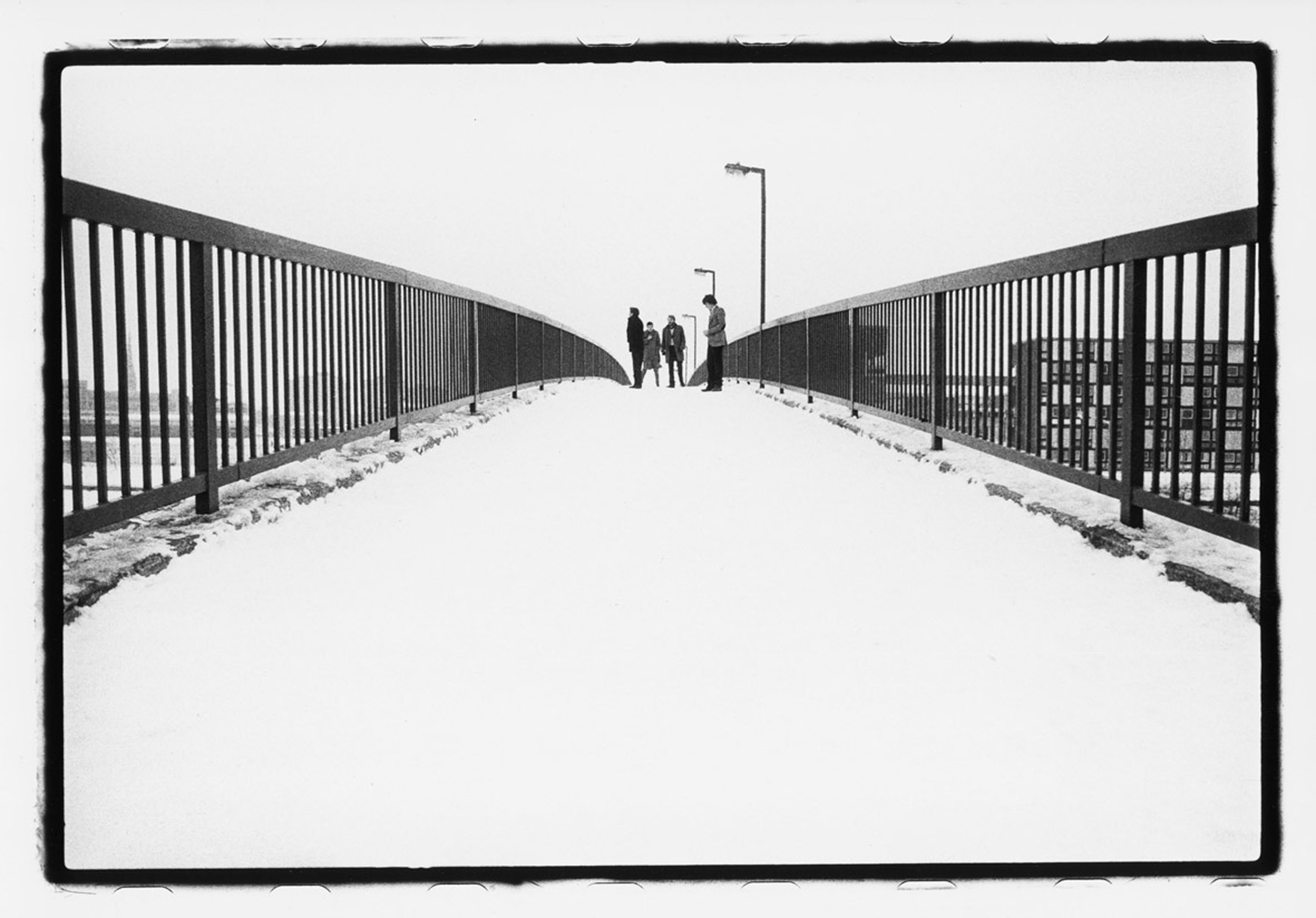
Last week, in a moment of impulsiveness – the kind that always seems to seize me in bookshops – I bought a biography of the Joy Division frontman written by his widow Deborah Curtis. My fascination with the band and its lead singer was reignited by the BBC’s excellent documentary, in which Curtis’s absence gaped like an open wound, and by seeking out Jon Savage’s review of Unknown Pleasures immediately afterwards. Like so much that was written about Joy Division during their short life, it now feels eerily prescient, its question “where will it end?” having been provided with its devastating answer.
As Savage wrote following Curtis’s death in 1980, “Death is romantic, exquisitely sad; it provides an easy package, an easy full-stop”. This is the narrative not just of the rock’n’roll mythology that Savage is critiquing in the aftermath of Curtis’s suicide, but of a whole culture that stretches from Thomas Chatterton in the eighteenth century to the so-called “27 club” in the twentieth and twenty-first. Why else, after all, would I be sitting here writing this? There’s a continuing, irresistible fascination that surrounds all these short-lived figures: Romantic poets Byron, Shelley and Keats, youth icon James Dean, too too many musicians. Their names – Janis Joplin, Jim Morrison, Brian Jones, Jimi Hendrix, Kurt Cobain, Amy Winehouse – have become a roll-call of romance, fame and tragedy.
It’s dangerous, yet alluring. Unlike Curtis, who spoke from his teenage years onwards about dying young, I’m far too giddily in love with life to understand this impulse, but I’m captivated by it nonetheless. There’s a stubborn romantic streak in me which is apparently drawn to the morbid as much as the beautiful. Or maybe it’s just intensely human; a heightened instance of that odd, doubled attitude that we have as a species towards death. I’m reminded of the chilling yet matter-of-fact opening of Karl Ove Knausgaard’s A Death in the Family, in which he writes about “the collective act of repression symbolised by the concealment of our dead” at the same time as death is everywhere in society, decorating newspapers and television screens. We’re fascinated by those who die young, perhaps, because they represent a confrontation with the reality that the rest of us simultaneously stare down and avert our eyes from.
Knausgaard continues: “If the phenomenon of death does not frighten us, why then this distaste for dead bodies? Either it must mean that there are two kinds of death or that there is a disparity between our conception of death and death as it actually turns out to be, which in effect boils down to the same thing: what is significant here is that our conception of death is so strongly rooted in our consciousness that we are not only shaken when we see that reality deviates from it, but we also try to conceal this with all the means at our disposal.”
The reality of death gets covered up by the myth. Premature death becomes cultural immortality.
This contradictory attitude towards life and death is right at the (still beating) heart of 27. I’ve seen and written about Peter McMaster’s show twice now and still it haunts me, the sudden memory of images from it catching me out and leaving me slightly breathless again. It’s full of astonishingly, agonisingly beautiful moments, as the bodies of McMaster and fellow performer Nick Anderson embrace and struggle and support one another. In this physicality, it feels at times as though the show is a demonstration of being alive, together with all the joy and pain that involves.
But it’s also about death. The title is a reference to the “27 club”, the show in part acting as a sort of homage to all those artists. Their music forms the soundtrack, from “Break on Through to the Other Side” to “Back to Black” to the heart-punching “Cry Baby”. And it’s about McMaster, also 27 and teetering between past and future. There’s lots about growing up, letting go, moving on, but also – as McMaster makes explicit early on – about wanting to die. It’s a show about wanting to die and it’s a show about wanting to live.
The signs of death litter the stage, which is carved out as a space of ritual and liberally scattered with ash. McMaster and Anderson begin the show in skeleton bodysuits, a gesture both macabre and playful, before later stripping to their bare skin. For all its fascination with the ceremonies and myths of dying, though, 27 can’t get away from life. In a generous (and often, let’s be honest, squirmingly hilarious) sequence, the two naked performers invite us to touch parts of their bodies, to feel their hearts pounding in their chests. It’s a moment that seems to say “look how alive we all are”. Look how alive we all are, together, in this space.
“I’m a strange new kind of inbetween thing aren’t I not at home with the dead nor with the living” – Antigone
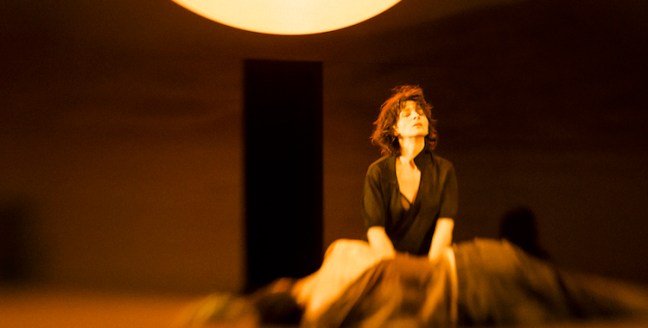
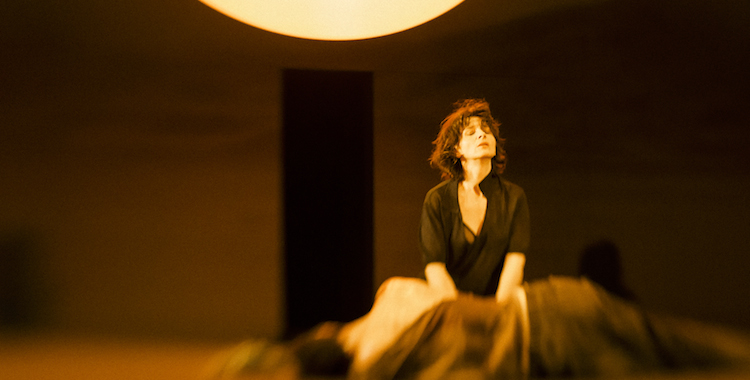
In tragedy, death is a certainty. Throughout Ivo van Hove’s new version of Antigone at the Barbican, though, it’s even more of a constant presence than usual, hanging like a shroud over everything else. Van Hove’s is a production – and a protagonist – half in love with death. In Anne Carson’s precise, poetic translation, Antigone is repeatedly a bride to her grave, wedded to her end even while still alive. Clothed head to toe in black, from the moment she steps on stage Juliette Binoche gives the impression of being not quite of this world, as though she is only passing through on her way to the other side.
At one point, a member of the chorus (who all double interestingly as other players in the action) lingers over the word “uncanny”, pronouncing each syllable with conspicuous care. And this Antigone is uncanny. It feels oddly suspended, hovering on a plane between life and death. Initially, what I take for its cool detachment and flat delivery is distancing and frustrating. Instead of visceral immediacy, van Hove gives us poise and elegiac calm. Even when the outbursts of passion do arrive, as they must, they feel oddly controlled, as if every last word and gesture were carefully measured.
It’s easy to see, then, why it reads as lacklustre, but it’s all too deliberate for that. For me, the distance and control speaks of a shadowy elsewhere, a place saturated with grief and already half swallowed up by death. The cut-out circle at the back of Jan Versweyweld’s sleek, spare design is sun and moon and a bright, gaping portal to the next world. The same sense of ritual that frames 27 pervades Antigone – most obviously when Antigone defiantly buries her brother Polyneikes, but elsewhere too. And in a piece of doubling that is surely not accidental, the dead come back as messengers for the living.
It takes its time, but I find this controlled, funereal approach gradually tightening its grasp, and by the end I’m scrunched forwards in my seat, utterly compelled. But what is it that’s engrossing me? The supposed romance of a woman consumed by grief and obsessed with death? The uncanniness of this meeting between life and death, both painted in beautiful if muted colours? The possibility of taking aesthetic pleasure from something so painful?
There’s something stultifying, if strangely compelling, about this romantic myth of early death. It speaks of a culture in which the only conceivable future is one of oblivion and individual fame, rather than one that people work together to construct.
At the end of Antigone, after the drama has reached its devastating climax, the chorus detach themselves from the tragedy, gradually becoming dispersed individuals. The portal between life and death is closed up and these figures resume the busy, self-contained activities of modern life, oblivious to the suffering of Patrick O’Kane’s Kreon as he writhes on the raised surface of the stage, while the Velvet Underground’s “Heroin” plays hauntingly underneath it all (“I’m gonna try to nullify my life,” Lou Reed sings). It’s a snapshot of atomised 21st-century life: we consume, we forget, we move on. Death is just another form of entertainment.
There’s more ambivalence at work in 27. If Antigone is detached and distanced, McMaster’s show is thrillingly – sometimes claustrophobically – close. We are never allowed to forget that we are in the same space, participating in this strange ritual alongside one another, whereas there’s a sense of a huge gulf between us in the audience and the small figures on stage at the Barbican. 27 doesn’t deny the appeal of dying young or the fascination of all those idolised dead, but it’s wrestling with something that is in many ways harder than that “easy full-stop”: the challenge of living, of moving into the future together.
Writing in response to Unlimited Theatre’s Am I Dead Yet?, I suggested that “if we can get better at dying, maybe we can get better at living too”. Our view of death – the ways in which we confront and conceptualise our inevitable end – says a lot about the culture in which we do our living. Perhaps, in order to really move forward, we need to rethink both.
“Turning around to the next set of lives Wondering what will come next.” – Joy Division, “Passover”
Twice in the last twelve months, I’ve taken a mental health questionnaire – not in the office of a doctor or psychologist, but in the theatre.
At one point in Are You Lonesome Tonight?, Ellie Stamp’s playful but urgent interrogation of mental health, creativity and the perils of diagnosis, she reads out a list of statements and asks us to lower our arms – which are raised at the start of this exercise – as soon as we hear one that describes our experience. Mine is down like a shot; before long, everyone’s hands are back in their laps. And the statements? They describe the symptoms of a recognised mental disorder.
There’s a similar device used in This Room, which takes an affecting look at the treatment of mental illness and what it really means to “get better”. At the start of the show, theatre-maker Laura Jane Dean reads from a list of unwanted, “intrusive” thoughts, later gently asking us which of these thoughts we’ve ever had. They range from worrying that the door has been left unlocked to the sudden, unwelcome, unnerving thought of slitting your wrists or throat when looking at a sharp knife (yep and yep).
Both question the idea of some kind of mental “norm” and divergences from that norm. Both trouble the dichotomy of “ill” and “well”. Both create a space where we can look at ourselves and each other and maybe, just maybe, collectively admit that we’re not OK. And that’s OK.
In This Room especially, well and not well are allowed to sit alongside one another. The room of the title is a doubled, overlapping space, referring both to Dean’s bedroom, where her crippling anxiety began, and to the room where she underwent cognitive behavioural therapy following her diagnosis of obsessive compulsive disorder. These are spaces at once comforting and terrifying, safe and perilous. No more powerfully is this the case than when Dean recalls the time her therapist accompanied her home, permeating the divide between the two rooms, and urged her to confront her fear of hurting herself in her sleep.
Meanwhile the room of the performance, haunted by the presence of those two other rooms, feels like an archive of anxiety. Dean’s medical notes, from which she reads at several points, are housed in boxes and blu-tacked to the walls. From another box, Dean produces a handful of tights, bundled away out of fear that she would use them to hang herself in the middle of the night. As she clutches them in tight fists, holding them out to us, these everyday objects take on an almost alien quality, the fear they represent becoming tangible and heavy in the room.
This Room is full of moments like this, when worry seems to vibrate through the air and tingle on the skin. Dean reads from her case notes into a microphone, her speech faster and faster and faster, skipping along at the pace of her anxieties. She stands on a chair and gazes out at us in a long, suspended moment. The lightbulbs suspended from the ceiling flare and flicker like neurons firing in the brain. All the while, Melanie Wilson’s lightly throbbing soundscape gives voice to the background buzz of unease, its constant hum occasionally bursting into crescendos of panic and fear.
As a viewer, it’s impossible not to be present in the room – this room – and be uncomfortably aware of that presence. At times, as in the vacuum cleaner’s raw and affecting show Mental, the intimacy almost feels too much. Should we really be here? Is it right for these delicate experiences and thoughts to be relived for us? As a result, the power dynamic between performer and audience is one that is always in flux, creating a sense of shared responsibility for this space we’re all in, a space where we might not all be OK.
The questions “am I OK?” and “are we OK?” are ones that are left open. This Room feels like a searching, reaching gesture rather than one that ever reaches a destination or closes a fist around its object. There can be no neat resolution, no satisfying arrival. Because when the thing that harms you is part of how your brain works, how do you get away from that? Where does the illness end and the person begin? And if being “ill” is who you are, then what does it mean to get better?
On paper, Harajuku Girls is an intriguing prospect. Francis Turnly’s play promises to examine the social and economic pressures on young Japanese women through the journey of two friends from innocent cosplay to less-than-innocent image clubs in twenty-first century Tokyo. The marketing blurb’s emphasis on image and fantasy, when I first read it, strikes me as having lots of mileage: it poses implicit questions about who is looking, whose desires are really being indulged, who is in control. Plus, it’s directed by Jude Christian, whose assured and striking production of I’d Rather Goya Robbed Me of My Sleep Than Some Other Arsehole at the Gate last year immediately grabbed my attention.
Which makes it all the more disappointing when it struggles to land. Expectations can be dangerous things and unfair markers against which to judge a production, but Harajuku Girls is muddled by any measure. To its credit, it is trying to do a lot – too much, perhaps, causing it to wobble under the weight of its own ambitions. Through the story of best friends Mari and Keiko, Turnly casts his gaze on various of Tokyo’s less savoury aspects, from panty shops to love hotels, while at the same time attempting to tackle big questions around agency, tradition, family, freedom, sexual politics, consumerism … the list goes on and on.
At the centre of this web of ideas is Haruka Abe’s naive but determined Mari, a would-be actress who is quickly persuaded to put her talent for role-play to profitable use when her parents refuse to support her through drama school. Her rebellious trajectory might be familiar, but her particular brand of teenage defiance opens up underexplored avenues. Spurred on by Keiko, Mari joins her friend in working at an image club, where the two one-time cosplayers once again don outfits, this time to act out the sexual fantasies of a constant parade of men. They claim to be calling the shots, but bit by bit their grasp on events slips away from them. As a counterpoint to this murky underworld, meanwhile, we see odd glimpses of Mari’s strict, concerned parents and her childhood friend Yumi, whose dead-end job offers little argument for pursuing more legitimate employment.
For all the themes knocking around, though, it’s sometimes hard to locate the critique – by no means obligatory in a piece of theatre, but it feels strangely lacking in a play that’s so clearly aiming its fire on something. Is it the exploitative, unseen owners of the image clubs who are to blame? The pressures from family and culture that send Mari and Keiko to one of these establishments? The entire industry of illicit sex? The continuing vein of misogyny and discrimination that runs through the society of both play and audience? All of the above? By the end, I’m still not sure. Acknowledging complexity is one thing, butHarajuku Girls seems, like its protagonists, to progressively lose its way, not helped by a production that is just as unsure.
After so vividly capturing the bright, plastic, grubby allure and repulsion of modern capitalism in Goya, Christian’s depiction of Tokyo’s seedy underside is oddly diluted. What should be garish, flashing neon is instead muted watercolour. It all just feels a bit lacklustre, from the tentative performances to Cécile Trémolières’ ungainly, laborious set design. As the actors shift around bits of furniture between scenes, their attempts to keep up momentum with bursts of “aren’t we all having such fun?” laughter and dancing are increasingly strained – apt, maybe, but awkward to watch. If this absence of colour and animation is the point – as well it could be given the subject matter – then the production lacks the confidence to fully make it, instead leaving that promising premise mired in a tangle of question marks.
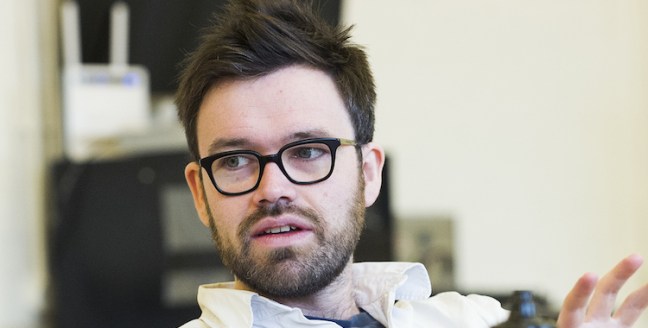
Ben Kidd is puzzling over what it means to be a director. Does it mean being in charge of a production? Is it about getting the most out of actors? Is it to do with serving the vision of another, or being the author of your own work? “Being a director only really consists in making decisions,” he eventually concludes. “You’re trying to assemble as many people as you can who you think are really really good at what they do – designers or writers or actors or whatever – and then you’re basically saying ‘that and not that’.”
We’re chatting in the bar of the Young Vic, something of a spiritual home for Kidd. It’s the theatre where he was given some of his early assistant directing opportunities, where he received the Genesis Future Directors Award in 2012, and where his Dublin-based company Dead Centre are about to present the London premiere of their show Lippy. “The Young Vic was somewhere that I found a like-minded assortment of people who thought about directing as a thing,” he explains.
Kidd arrived at directing via acting after training at Bristol Old Vic Theatre School. While training and working as an actor, he was “schooled in this idea that a director helps actors to connect with the text and delivers the play”, an idea that he has progressively broken away from. “There’s a perception of the director as being someone who is either birthing or yielding somebody else’s vision,” Kidd observes, adding that he is more interested in how directing might involve an element of autobiography.
“When I think back to who my gods were growing up, they weren’t theatre directors,” Kidd says. Instead his idols were writers and musicians – he names Bob Dylan and Patti Smith – who poured something of themselves into their work. “It would have been nonsensical if all their work didn’t bear the hallmark of who they were as people,” Kidd suggests. He believes that the same should be true of directing; he wants to “create a new thing in the world”, a thing that bears his signature as a creator.
“If you go and see a Katie Mitchell play, they basically all look the same and feel the same in a sort of profound way,” he offers as an example. “That’s not a bad thing. That’s because she’s in there, her politics are in there, her concerns are in there, and she’s filtered those concerns through artistic practice. That is what real artists do.”
Mitchell has clearly been a major inspiration for Kidd in the process of discovering what directing means to him. He recalls a workshop during which she demanded of the participants: “What do you want to achieve? Find out what you want to achieve and then find out the best way to achieve it”. Whether working with Dead Centre or freelance directing for the likes of the Young Vic and Headlong, this is advice that Kidd has tried to stick to.
He admits, however, that building a career as a director is “really hard”. Despite winning the Genesis Future Directors Award, directing a main-stage tour of Spring Awakening for Headlong last year and gathering a string of awards for Lippy, Kidd still only directs part-time, a situation that is common among directors in the UK. “It does seem to be that directors’ pay hasn’t kept up with pay elsewhere in the industry,” Kidd says, reflecting on the recent research into directors’ fees. “We subsidise the industry because there are loads of us who really want to do it and will kill for a job.”
On the one hand, this lack of money can be liberating and encourage greater risk-taking. As Kidd puts it, “you gain the bloody mindedness to make what you want because you’re not going to make a living from not doing it, so you might as well do it.” But on the other hand, the financial insecurity of making theatre can restrict who enters the profession and impoverish it as a result. “An art form probably is better if a wider section of society is in it,” says Kidd, “it’s going to have more interesting stories.”
Kidd has another thought about the role of the director. “I think that the job is just about returning an audience to a sensation you had when first read a play, or when you first heard of an idea,” he says. The best shows, he suggests, are built around points when that sensation is briefly captured and the mood suddenly changes – what a friend of Kidd’s describes as “David Bowie moments”. “Great plays often hinge on a moment or a series of moments that are a shift in atmosphere, a shift in emotional resonance, a dropping out of the world. Something happens where the world changes.”




 Catherine Love