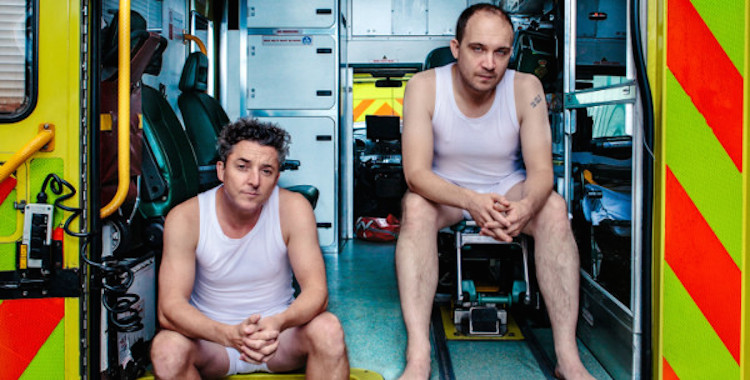
Hope, Royal Court Theatre

590x494.fitandcrop

Local politics isn’t sexy. It’s the support crew that cleans up while the rockstars break out their set list of strained smiles and hollow promises on the next main stage. I still remember, as a child, my dad frustratedly filling us in on the council meetings he attended as a school governor; the high point, if I recall rightly, was a farcical dispute about bins.

Hope, therefore, is not particularly promising as a theatrical premise. A local Labour council struggles to make budget savings? Not exactly thrilling. But actually, Jack Thorne’s play feels like the perfect drama for the present political moment. In the context of the Royal Court’s revolution themed season, it might not be the most rousing call to arms, but it depicts the possibility for change on a level that actually feels within reach. It makes politics ordinary, turning its gaze on the crippling everyday impacts of austerity in a way that most national politicians seem incapable of imagining.

Thorne’s councillors are in an impossible position. With £64 million of savings to make by 2017, it’s a miserable matter of deciding on the marginally lesser of many evils. Should cuts be made to care for the elderly or the disabled? Where can savings be made on Sure Start Centres? As for the local library and museum – forget it.

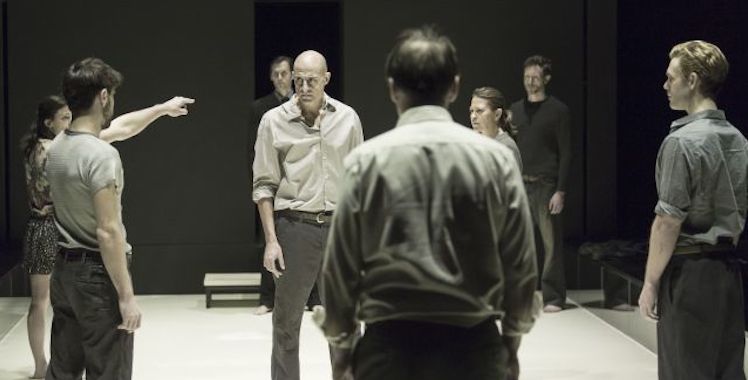
Thankfully, though, Thorne’s play is not all hand-wringing budget meetings. At its centre is deputy council leader Mark, a tortured would-be idealist who is desperate to be a good man in dire circumstances. After his similarly tormented turn in Utopia, Paul Higgins seems made to inhabit characters crumbling under pressure, hair more dishevelled by the minute and body curling up further and further into his suit jacket. Compounding the difficulty of the cuts, Mark’s ex-wife Gina (Christine Entwisle) gets wind that her day centre for the disabled is going to be slashed and mounts a big, social media-savvy campaign, while his relationships with precociously intelligent son Jake (Tommy Knight) and fellow councillor and sometime lover Julie (Sharon Duncan-Brewster) come under increasing strain.

Like Mark, everyone on the council wants to “do the right thing” – a phrase that becomes more and more fraught as the play goes on. Never was there more proof that the road to hell is paved with good intentions. Stella Gonet’s Hilary is cool and pragmatic, but beneath her armour she’s utterly committed to the town she serves, as is well-meaning, unassuming Lata (Nisha Nayar). At the more idealistic end of the scale are Julie – who also has to juggle the expectations of her council veteran father George (Tom Georgeson) – and recklessly principled Sarwan (Rudi Dharmalingam).

It’s the latter who acts as the catalyst for change, urging his fellow councillors to take a stand. Sometimes, though, principles come at a high price. The fate of the council serves to animate the precarious balance between what is right and what is pragmatic, highlighting the complexity of the decisions currently faced by local government. The choice seems to be a bleak one: either make devastating cuts yourself, or have others make even worse ones for you.

Thorne also turns his attention to the wider predicament of the modern Labour party and the erosion of solidarity by Thatcherite principles of individualism. In a slightly clunky but politically perceptive speech, former council leader George mourns the death of the party he has dedicated his life to and the political fervour that seems to be in retreat: “Idealism is dead. Solidarity is dead. It’s been destroyed by pragmatism and hatred and shame.” At the same time, though, there’s something freeing about this dissolution of past touchstones; “we don’t represent anything any more,” George observes, so perhaps now is the time to make bold decisions for the better.

Theatrically, Hope is not about to set pulses racing, but its plain, sober style feels just right. John Tiffany’s unshowy production contains all the scenes within Tom Scutt’s meticulously realised town hall design, its drab detail a constant reminder of the realities these characters are working within. No giant ball ponds here; this form of political rebellion is not fun (as Russell Brand famously promises) but hard and boring, as real change often tends to be. Revolution is just as likely to be a long slog as a sudden spark of action.

There is, at times, a slight tendency to use characters as mouthpieces for debate. George in particular feels a bit like the weary, battle-hardened voice of old Labour, while Mark and Hilary’s conversation about the advantages or otherwise of principles acts as something of a gloss on the council’s choice of course and its consequences. But however contrived, Hope‘s conclusion somehow, quietly yet insistently – and against all odds – engenders the sentiment of its title. Change probably will be slow and frustrating and involve a hundred painful compromises along the way, and it will probably have a lot more to do with bins and libraries and day centres than the Russell Brands of this world would have us believe, but there’s still the possibility that, if we just try, we might begin to make the world a better place.

Why is it important?

viewbridge

Another morning, another angry-making article about theatre criticism. Today’s harbinger of doom is Tim Walker, recently axed former theatre critic of the Sunday Telegraph, bemoaning “a bloodbath among my fraternity” (what a telling choice of words there). You can probably save yourself the depressing read and guess the gist of what he’s complaining about.

Loathe as I am to treat Walker’s opinion with the seriousness that a response implies, there’s a grain of something in his article that I worry goes deeper. There’s plenty in it to get the blood simmering: the quoting of an anonymous theatre impresario’s dismissal of “young, spotty” critics, the barely veiled contempt for online writers, the suggestion that the Daily Mail “takes theatre criticism seriously” (ha!). As a young and, yes, often spotty theatre critic (my skin doesn’t seem to have received the memo that I’m 25), it’s hardly surprising that I’m a bit irked by it. But there’s one sentence in particular that had me fuming over my breakfast this morning:

“The fact is the serious newspapers and the theatres have the perfect relationship because the demographics of their respective clients are pretty much identical: middle-class, affluent, and, of course, getting on a bit.”

Is this what theatre criticism is supposed to be about? Selling pricey cultural products to the middle-class and middle-aged? Obviously, I don’t think so. But I worry that the picture Walker paints here is not solely his own. This, for many people, probably is what theatre criticism represents: something distant, cosy and irrelevant, hawking a few more tickets for that West End show with whatshername off the telly in it. And it’s not a kind of theatre criticism I really want to be part of.

Also slightly enraging, but on a much more manageable scale, were Sunday night’s Evening Standard Awards. Mostly I think of them as a bit of dressed-up silliness that might better be titled “Most Famous People on Stages This Year”, but it’s still irritating when some of the best productions of the last twelve months don’t even get a look in. Most of my Twitter feed was outraged about the lack of awards for Ivo van Hove’s production of A View From The Bridge, and understandably. Meg Vaughan, however, offered a challenge to those venting their spleen:

“What good is an electrifying night at the theatre if the only effect is to have us all up-in-arms when a bunch of self-serving capitalists on the ‘advisory panel’ at the Evening Standard Awards don’t recognise its greatness as we feel they should? Yeah, they woz robbed. Categorically. But if we can’t protest that decision with anything other than “But… but… but it was just THE BEST innit!” then it’s not worth fucking protesting at all.”

Later in the same post, Meg demands “Why is it important?” And I wonder if that might be a better way of thinking about both theatre and criticism. Why is it important? What does this work of art contribute to the world and my understanding of it? What relevance or impact does it have beyond the plush seats of the auditorium? Why, quite frankly, should anyone bother with this at all?

Because if theatre and the column inches it generates are only really of any interest to the “middle-class, affluent, and […] getting on a bit”, then we might as well hold the funeral now. If that’s the case, then it’s not just theatre criticism that’s dying, it’s theatre too.

Luckily, I think we can put the brakes on the hearse for now. When I look back over the last year, that question “why is it important?” still has an answer. Because an astonishing student production of Road – a play I previously associated (and not flatteringly) with GCSE Drama – made me really fucking furious about the legacy of Thatcherism and the coalition government of today. Ditto Beyond Caring, the washed-out, bleakly hyper-naturalistic aesthetic of which I still think of every time I get angry about zero hours contracts. Because I went on a protest march and found myself thinking about Hannah Nicklin’s A Conversation with my Father. Because I saw three other shows about activism that made me want to take immediately to the streets. Because This Is How We Die made me feel like I’d burst right out of my skin and still gives me tingles every time I think about it and everyone deserves an experience like that. Because I struggle to imagine any kind of therapy more effective than the morning I sobbed and smiled my way through Every Brilliant Thing in Edinburgh feeling as though it was made just for me in that particular moment. Because for a fleeting pause during Am I Dead Yet? I stared the thought of death right in the eyes.

I could go on. But the great thing is, I don’t really need to, because there are loads of brilliant critics out there writing about theatre as if it actually means something. As if it might just be important. And yes, there are problems for us to face and questions for us to answer. At the moment, I very much doubt that this blog or any of the other online platforms I write for reach any of the people who I really want to convince that this stuff matters. But acting as though it matters is a start. And if newspaper criticism as Walker sees it is just about serving a privileged, ageing minority, reinforcing in the process the idea that theatre is not really “for” the majority of the population, then perhaps it’s not such a loss.

Chimera: The play about the twin inside

Chimera suli holum

Originally written for The Guardian.

We all have moments when we don’t quite feel ourselves. For some, though, fragmentation of the self is a biological as well as a psychological fact. Chimerism describes the medical state of having two sets of genetic material; it means, in other words, containing your own twin inside you.

This rare medical condition provides the unsettling premise for Deborah Stein and Suli Holum’s collaboration Chimera, which opens at the Gate theatre in west London this week. The show, written by Stein, performed by Holum and co-directed by the two women, tells the story of Jennifer Samuels, a scientist and mother who learns that she possesses two sets of DNA. Shaken by the discovery, Jennifer struggles to hold her splintered self together, while coming to terms with the idea that – genetically at least – her son is actually her nephew.

While Jennifer may be fictional, her crisis of identity stages an experience that is real. “The condition of being a medical chimera literalises something that I think is a pretty universal feeling,” Stein suggests, discussing the multiple versions of ourselves that we try to integrate on a daily basis. She was introduced to the science by Holum, who was intrigued by a true story she heard on the radio about a woman who discovered that her sons did not share her DNA. The pair decided to pursue the idea because, as Holum puts it, “neither of us could figure out immediately how it could be a play, how we could take this phenomenon and theatricalise it”.

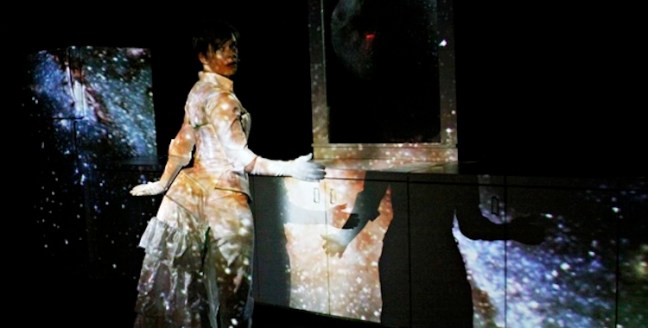
Stein and Holum found their answer in a close weaving of form and content. As the show’s sole performer, Holum inhabits multiple characters, including Jennifer and her 19-year-old son Brian, while projections dance over her body and the smooth surfaces of the kitchen set. “Meaning is created by having these multiple voices in one body,” Stein explains, “because it’s about the condition of being more than one person, and one person, at the same time.” The kitchen, meanwhile, allows for “an exploration of surfaces and what lies beneath,” at the same time as suggesting and disrupting the traditional domestic sphere of the mother. “We do all kinds of surprising things with something that looks very simple and mundane,” says Holum.

The use of technology in Chimera, meanwhile, is an extension of the show’s central idea that “science and technology have got to the point now where they are showing us things that we have no framework for understanding”. Stein goes on to compare the way in which technology disrupts the lives of the play’s characters to how it has forced her and Holum out of their comfort zone as theatre-makers. What she has come to realise, however, is that the contradiction she initially perceived between the live theatrical experience and digital technology does not really exist. “Theatre is about being in the now, in the present moment, and our present moment has so much to do with screens and video and computer technology.”

What Chimera doesn’t do, its creators insist, is offer any answers to the scientific, moral and philosophical questions it throws open: questions about how far science and technology can define our existence, and the extent to which, if our sense of self is torn in two, we can be held accountable for our own actions. “We realised as we were working our way through the questions the play raises that we weren’t making something that answered those questions,” says Holum. “We realised we were working with questions big enough that they couldn’t be satisfactorily answered – and what we were creating was an event that didn’t tell the audience how to feel or think about something, but rather invited them to begin thinking about something and then carry that conversation forward after the event is over.”

“It sits in this really uncomfortable place of asking the audience to actually think and talk about things that we don’t usually get to think and talk about,” Stein adds, describing the play as a “stew” of ideas that we rarely consider alongside one another. “There’s pretty hard science in it, and then there’s also this story about a mother who doesn’t want to be a mother.”

This investigation of motherhood, it turns out, has been more provocative than the science, suggesting that Stein and Holum have hit on a collective raw nerve. In post-show discussions, the pair explain, it is Jennifer’s attempted flight from her responsibilities as a mother which has attracted the most debate. In this way, Chimera has travelled from the chilling but faraway realm of rare scientific phenomena to the more close-at-hand experiences of the theatre-makers and their audiences.

This journey is typical of the pair’s process, Holum tells me. “We start with research material, then we very quickly branch out pretty far afield from the original sources as we dive deeper and deeper into the process to unearth really what it was that drew us to the material.”

The questions they have arrived at are questions about identity, about motherhood, about the philosophy of science. But most of all, Holum suggests, Chimera asks what we believe in and where we find meaning.

“In the end we’re all searching for meaning, we’re all searching for a way of making sense of it all.”

Photo: Stephen Schreiber.

Village Halls, Village Voices

unnamed-2-600x395

Originally written for Exeunt.

A robin perches, quivering, on a line of barbed wire. Sun dances across the snow. Uniformed men run, smile, play football and shake hands; one slips a bar of chocolate into the pocket of another. And a message flashes up on the screen: “Christmas is for sharing”.

“Everything looks great in that Sainsbury’s advert,” says playwright Rory Mullarkey, voice stained with a mixture of anger and disbelief. We’re chatting in a corner of the pub in Tirril, our conversation drifting towards the familiar iconography that has been rolled out for the centenary of the First World War. This advert, Rory comments wryly, represents the “Disneyfied” version of the conflict. It’s not an image that he or his play Each Slow Dusk – which we’re in Tirril to see – is interested in.

“I feel like there’s a perceived World War I narrative that you can see from War Horse all the way through to the Sainsbury’s advert,” says Rory, naming all the tropes that we’re familiar with from our stages and screens. “You’re not ever getting any closer to what the First World War actually was, you’ve just experienced a traditional narrative except that the obstacle has been the First World War.” To get underneath that perception, to scratch away at what the legacy of that war actually means, he suggests that it’s necessary to move beyond this sanitised remembrance. The real picture, of course, is far from beautiful.

“It was mud, it was blood, it was guts, it was horror.”

The sky is a brightening grey when I arrive in Tirril earlier the same day, wan sunlight just tickling the edges of the clouds. The darker grey and black of the Reading Rooms stands out against it, the inscription “1914” on the building’s facade eliciting a little shiver. Talking to local promoter Jimmie Reynolds once inside, he explains that the coinciding of the hall’s 100th birthday with the centenary of the First World War was one reason for wanting to bring in Each Slow Dusk. And it’s important for people to think about these things, he adds later over a cup of tea.

Tirril, a small village at the edge of the Lake District, is just one of the many rural areas Each Slow Dusk is visiting on its tour with Pentabus. The piece has been designed specifically for village halls, from the initial commission to the direction and design. Rachael Griffin, Pentabus’s managing director and my guide for the weekend, explains that this process allows the company to tailor the shows they produce for rural venues and audiences. Pentabus sketch the initial outline, then the writer is given freedom to fill it in. For Rory, the constraint is a creative one.

“It sounds like a slightly mystical thing to say, but I believe that the piece of work or the play is always out there somewhere and it’s my job to make a series of decisions to allow it to come to me and be present. If you know something like how many actors it is, how long it has to be or whatever, that’s a parameter that can significantly aid your creative thinking.”

As part of the writing process, Rory also visited some of the village halls the show might tour to – an opportunity to “imbibe” their atmosphere. The village hall as a building has a distinct identity, one caught up in history, community and nostalgia. Stepping into Tirril’s chilly, high-ceilinged Reading Rooms, I’m immediately hit by memories of my own village hall growing up: Christmas fairs, bring and buy sales, bad discos spent slugging Panda Pops.

The get-in is almost a performance itself. After a much-needed cup of tea – problems on the road have contributed to the company’s general exhaustion – rigging, lights and set are swiftly hauled out of the Tardis-like van. A month into the tour, this is a slick operation by now, but still one involving a precarious amount of kit to be installed on the hall’s compact stage. On the first night, one of the actors tells me in the pub later, it took a good few hours to dismantle everything after the production; now it requires just one.

When I grab a few minutes to talk to Jimmie, he explains that Each Slow Dusk is a relative risk for the Reading Rooms, which is more likely to receive music and live entertainment. People just want a good night out, he says. There’s also a danger, given the outpouring of art to mark the centenary, that audiences have “First World War fatigue”. Speaking to Rory later in the afternoon, though, I have a feeling that Each Slow Dusk may well challenge the narrative with which we’ve all become so familiar over recent months.

“I thought I would try and write the most open thing I possibly could,” Rory tells me, just a couple of hours before I see Each Slow Dusk. On the page, the first act barely even looks like theatre. Rather than dialogue, it consists of a long series of poetic stage directions. All action, no talk. It’s easy to see both how it represents a risk for promoters like Jimmie and how it fulfils Pentabus’s aim, articulated to me by Rachael, to bring rural audiences work which is ambitious in form and content.

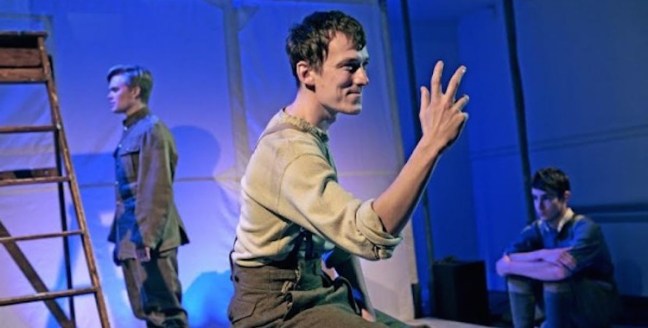
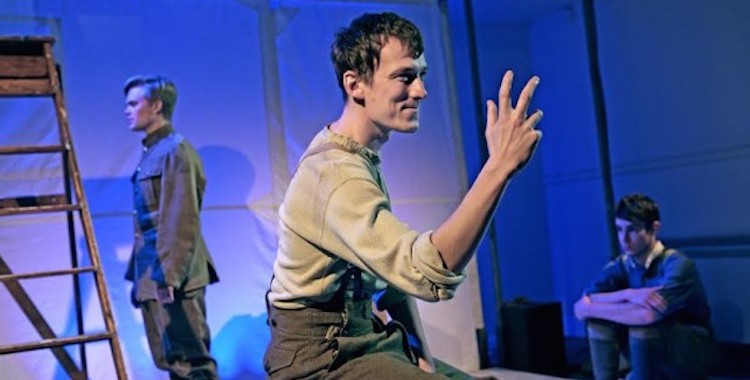
Staged, however, it soon makes perfect sense. The actions belong to three different soldiers: a Captain, a Corporal and a Private, played by David Osmond, Lee Rufford and Sam Heron respectively. All are the same age – nineteen and a half – and all have been sent out on night patrol. The Captain is reluctant, the Corporal pumped with excitement, the Private terrified but determined to prove he’s not a “fucking coward”. Not directly interacting with one another, the three performers instead direct their lines to the audience, describing their actions in the present tense. The style takes a while to settle, but then it grabs a firm stranglehold on the audience.

The writing is more prose than drama and might at first glance be dismissed as novelistic. Yet it soon becomes clear that there is something intensely theatrical about both the rhythm of the lines and the terrible forward movement of the actions they describe. Despite the simplest of stagings from Elizabeth Freestone, subtly enhanced by Adrienne Quartly’s sound design, there’s something incredibly dynamic about it all. And, problematically, it’s kind of thrilling. The play asks us, guiltily, to acknowledge that there might be something exciting about the heat of conflict, even in the midst of all its undeniable horrors.

The three unnamed soldiers also offer a complex picture of the First World War and those who fought and died in it. The absence of names plays with the way in which soldiers have been “loaded with the freight of social commentary,” in Rory’s words, while at the same time refusing to allow each of these characters to be reduced to the mere symbol of “soldier”. The Corporal in particular challenges our collective idea of the First World War soldier as saintly victim. Here is a soldier who revels in what he does, who is proud of his skill in fighting and killing, and who would happily take the battlefield over a lifetime of picking potatoes.

“There are as many kinds of soldier as there are kinds of person,” says Rory, skewering – as his play does – the popular image of identical, “lovely lads” sent off to be slaughtered. “Those ‘lovely lads’ were just exactly the same as any lad is nowadays; they were just as likely to swear, just as obsessed by sex, just as violent, just as moody. They were human beings, and it felt like it was important to write something which didn’t cast them in the mode of victim the whole time – that they had agency and dignity.”

As the audience move around the hall during the interval, chatting to neighbours and buying raffle tickets, there’s a definite sense that we are in their space. This is first and foremost a place for community rather than one for theatre, and it shows. The size and warmth of the audience – a far cry from small-scale tours which often struggle to fill half the seats in a studio theatre – feels like a vindication of the idea that you really get theatre to talk to people’s lives by taking it to them. But entering an audience’s midst rather than extending them an invitation requires a different creative thought process.

“You’re making a very different kind of statement if you’re going to someone’s home with a show and you’re bringing it to them,” Rory suggests, stressing that he wanted to write a play that “would feel generous and warm and alive to a village hall audience”. So while Each Slow Dusk might be challenging in lots of ways, it was important for everyone involved that it speaks to the audiences it is going out to.

Rachael and Rory talk about the directness that feels right for these village hall spaces, but there is also something around proximity. The actors are right there, barely separated from the audience, and available for a chat in the small gap between the end of the performance and the get-out. On this particular night, the presence of the playwright adds an extra ripple of excitement and Rory finds himself, to his slight bemusement, signing playscripts.

Before I leave the following day, a cup of tea and a chat with Sue Hayward – the seasoned promoter in nearby Arnside – sheds some more light on the programming of this and other events. Many of her comments confirm what I see during the interval: audience members relish the intimacy, the opportunity to have professional performers come right to their doorstop and hang around for a conversation afterwards. Theatre is demystified.

One thing that I hear about repeatedly is the level of loyalty that rural audiences have for their village halls. In a way that most venues can only dream about, they trust in and care about the space and will attend performances more for the location than the specific offer. This then allows the volunteer promoters, who are often embedded at the heart of the communities they programme for, to take risks. Sue can take a punt on contemporary dance, inviting Compagnie T d’U to Arnside for the first time next year. And Jimmie can welcome Pentabus to Tirril, where a full audience sit rapt for an hour and a half in front of Each Slow Dusk.

“We’ve got a real remembrance industry,” Rory observes during the course of our conversation about the First World War. The second half of his play, fast-forwarding 100 years, takes us to the heart of that industry: the battlefields tours of France. We are now addressed by a female speaker (Joanna Bacon) who is grappling with the meaning of remembrance in the same way as those of us in the audience. How do you come to terms with the events of a century ago? How are you supposed to feel about the distant dead?

“I was sad when I thought about them, I don’t know,” says the (again unnamed) speaker. “I was sad, I guess.” Her uncertainty is our uncertainty; her ambivalence reflects every time the two minutes silence has felt like an empty obligation rather than a meaningful act of remembrance. As she speaks, showing photographs of her trip across the battlefields, I think not just of the monolithic memorials flashing up on the screen, but also of the sea of poppies surrounding the Tower of London. I think about how the act of remembering has become distanced, abstract and aestheticised, utterly divorced from the mud and blood and entrails so vividly described in the first half of the play. It has also become big money: the tourist routes, the themed cafes and restaurants, and, yes, the Sainsbury’s advert.

Once again, appearances deceive. The second act seems at first like a major departure from the first, but eventually the two halves meet as echoes resonate across the interval. Together, the two acts acknowledge how, whenever we look back at the First World War, we are inevitably seeing it through the lens of the present. And Each Slow Dusk demands that we think about that present as much as we think about the past. Or, as this contemporary speaker asks, “Where are we now?”

Photos: Richard Stanton.
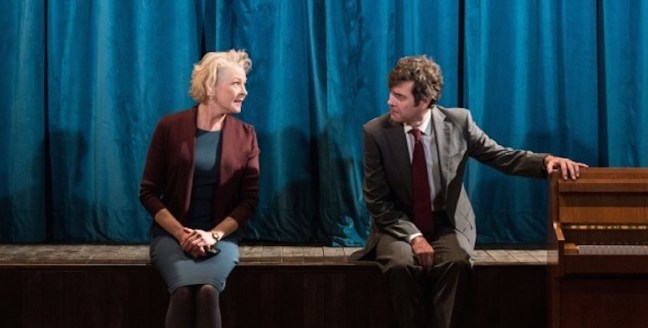
Am I Dead Yet?, Bush Theatre

block-600x400

Originally written for Exeunt.

There’s a strange paradox at the heart of our treatment of death. On the one hand, we’re surrounded by it. 24 hours news channels spew out the numbers, names and circumstances of the dead; an endless stream of murders, casualties, epidemics. But on the other hand, death as a reality unmediated by a screen is shrouded in silence and ritual. Death is everywhere and nowhere.

This is the backdrop to Am I Dead Yet? Making a show “about” death opens up a vast range of possibilities; as someone commented to me after the show, it’s like making a show “about” life. Wisely, then – and a tad ironically, given their name – Unlimited Theatre have established limits to their scope. Their starting point is twofold. Firstly, they acknowledge that particular tight-lipped uneasiness that surrounds death and its invisibility while in plain view. Secondly, they fasten onto the idea that, thanks to advances in medical science, death might now be better thought of as a process – and, increasingly, a reversible process – than as a single moment in time. If our idea of death is changing, they reason, then we’d better start talking about it.

Double act Chris Thorpe and Jon Spooner have multiple strategies for starting that conversation. Part Grim Reaper, part storyteller, part clown, each performer approaches the subject of death with both humour and seriousness. The structure, for the most part, is governed by a pair of interlaced stories and a series of musical interludes. Electric guitar snarls defiance towards death; voices gently, lyrically tell of two coppers finding a severed head, or of a little girl slipping unobserved through a sheet of ice. In between, Thorpe and Spooner offer facts about the process of the body shutting itself down and a guest paramedic performs the best CPR demonstration you’re likely to witness.

The science that Unlimited draw on, while sometimes sounding far-fetched, is – either brilliantly or terrifyingly, depending on your perspective – steeped in research. It is now technically possible to raise people, Lazarus-like, from the dead. But rather than looking too closely at the science itself, Unlimited are more interested in what this might mean for us as human beings – not medically, but psychologically, socially, politically. Most compellingly, they raise the all too plausible possibility of a society stratified according to access to life-extending technology. What happens when death is no longer a reality for one portion of humanity?

Rather than penetrating much deeper into any of the ideas they raise, however, Unlimited leave the extra mental legwork to us. Small details open up spaces for thought: the involuntary laugh of a policeman clutching a human head prompts reflections on our often unpredictable emotional responses to death, while the possibility of snatching people back from the dead provokes an unspoken question about what happens to that part of ourselves that makes us who we are. It’s refreshing – if a little scary – to have the room for this kind of thinking created in public.

Still, some of the individual threads could be pulled a little further; as it currently exists, certain elements of the show feel as though they stop just short of the idea they are reaching towards. Or perhaps that’s the point. There is, however, something appealing and surprisingly optimistic about creating a communal space in which we might be able to begin confronting and talking about death. And if we can get better at dying, maybe we can get better at living too.