Embrace the Problem: Duncan Macmillan

1984

Originally written for Exeunt.

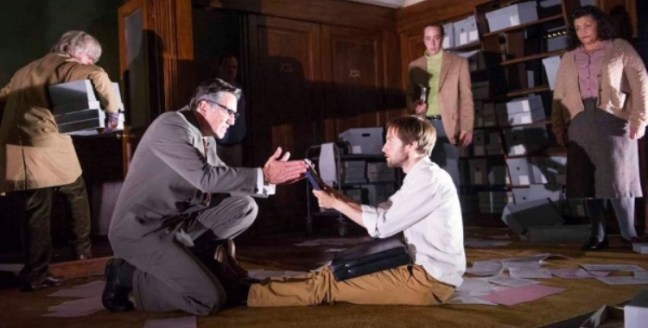
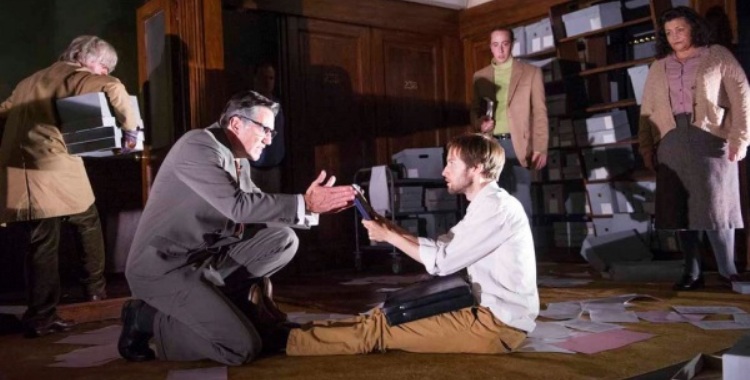
Duncan Macmillan is remembering a piece of advice from Edward Bond that has stayed with him. “He said this brilliant thing,” the writer and director recalls, “which is that there’s a tendency in some directors to solve the problem. You identify the formal problem or the staging problem or something, and then solve it somehow. And he says good dramatists instinctively know that the problem is all you’ve got, that you should never solve the problem.”

This insight – don’t solve the problem – was something of a starting point for Macmillan and co-adapter Robert Icke’s acclaimed stage version of 1984 for Headlong. George Orwell’s culturally ubiquitous novel is a tangle of contradictions, none of which the pair wanted to unravel. “It seems absurd and a real shame to iron out all the creases,” says Macmillan. “I think there’s something really exciting about going, ‘what do these creases do for the novel, and how do we find a theatrical form in which to communicate those logic bumps?’”

The answer to that question was found in a structure that could simultaneously hold all possible readings of Orwell’s novel – an exemplary instance of doublethink. “There’s a lot in the book that quite deliberately complicates the narrative, and we didn’t want to solve that by undermining it and just opting for one particular reading of it,” Macmillan explains. Every possible interpretation is allowed for.

Central to their complex, cerebral version of the novel is the oft-neglected Appendix, which no previous adaptation has attempted to tackle. Macmillan is adamant about the importance of this seemingly dry, academic postscript, which Orwell himself insisted was integral to the tale. “It’s like telling a really long, convoluted joke and then missing out the punchline and feeling like you understand the joke even though you’ve not heard the punchline yet,” he argues.

What Macmillan and Icke found frustrating about previous adaptations – and what they have studiously avoided – was the tendency to hone the novel down to the narrative of protagonist Winston Smith’s experience, stripping away its philosophical and political content. “There’s a tendency to over-simplify,” Macmillan suggests, going on to insist that “if you present a literal universe on stage, it’s not accurate to the book”.

Instead of opting for a literal narrative, Macmillan and Icke have held onto the subjectivity of the novel, which offers readers intimate access to Winston’s unreliable mind. In doing so, their main reference points have been cinematic – “film can do subjectivity in a way that theatre sometimes struggles with,” Macmillan suggests. He names the likes of Eternal Sunshine of the Spotless MindMulholland Drive (“it’s a deliberate puzzle”) and The Shining.
These pop cultural influences are also apt for one of their target audiences. Macmillan relates how both he and Icke remember a moment in their teenage years when their minds were opened to the possibility that theatre might be just as exciting as films and computer games; one of their ambitions in creating this adaptation was to offer the same revelatory experience to a new generation of youngsters. “We really wanted to blow those kids’ minds.”

As 1984 moves to the West End to embark on its third run, Macmillan’s enthusiasm for the show is remarkably undimmed. He doubts that he and Icke will ever be truly finished with the piece; despite reading the book dozens of times, they keep returning to pore over each last line, making tweaks to their adaptation as they go. Macmillan offers a neat Orwellian analogy: “Each edition of the Newspeak dictionary is smaller and smaller, because they’re eliminating words from it, and we’ve sort of been doing a similar thing.”

Throughout the process, Macmillan and Icke have worked in tandem, equally doling out the duties of writing and directing. “Quite early on we realised that the usual boundary line between being a playwright and being a director just wasn’t helpful and that we’d automatically started parking tanks on each other’s lawns,” says Macmillan. Reflecting on his metaphor, he is quick to add, with a laugh, “that makes it sound more oppositional and more aggressive than it actually was”. In fact, the partnership has been amicable and creatively fruitful, directing both theatremakers towards bolder, sharper ideas. “It’s been a huge amount of work,” Macmillan admits, “but two heads – in this case – have been better than one, and it hasn’t been a messy, grey compromise. We’ve always pushed each other to make the idea better.”

Another great collaborator of Macmillan’s is director Katie Mitchell, with whom he is currently working on a new project for the Saltzburg Festival. Macmillan finds Mitchell “really trusting and empowering”, praising the passion of her involvement with every element of a production. “She has such artistic integrity as a theatremaker,” he says, “and political integrity as well. I found that really, really galvanising.”

Thanks to working with Mitchell, Macmillan is now much more confident about making work with political intent, something that he suggests “we can find very hard to do in Britain”. The pair’s latest show, The Forbidden Zone, has an explicitly feminist agenda, setting out to “reposition our understanding of certain women and women’s roles in the First World War”. The project has involved extensive research, highlighting for Macmillan just how difficult it is to unearth female perspectives in a history written by men. “One of the things we wanted to do was rehabilitate the writing from that period, this fascinating writing done by so many women, and also these really extraordinary female figures who haven’t been given the right kind of attention,” Macmillan says.

He and Mitchell also recently worked together on the German premiere of Macmillan’s playLungs, or Atmen, which continues to play in rep at the Schaubuhne in Berlin. Despite the script’s strict instructions that the play should be staged with no set and no lighting or sound changes, Mitchell has placed the two performers in her production on bicycles, powering the lights throughout the show. This simple, eco-friendly concept acts as a constant visual reminder of the high environmental stakes that provide the backdrop for Macmillan’s two-hander, in which a couple agonise at length over whether or not to have a child.

“She’d understood the gesture of what I was trying to communicate and I think she added something really interesting to it,” Macmillan reflects on Mitchell’s directorial interventions. “In Katie’s production you really get a sense of the time pressure and the physical pressure, and you also get a sense of the environmental pressure because the carbon neutrality of that production is so visible and audible at all times.”

Macmillan has worked in yet another way on Every Brilliant Thing, a project with Paines Plough and Pentabus which goes on tour in its latest incarnation next month. The piece began as a story written by Macmillan, in which a child starts a list of everything that is wonderful in the world as a way of coping with their mother’s suicide attempt. As in the story, the list soon took on a life of its own, welcoming contributions from the public and transforming into an installation created by Paul Burgess and Simon Daw. Now, the story and the installation have been incorporated into a show, performed by Jonny Donahoe of Jonny and the Baptists and involving members of the audience each night.

“That began as sort of a necessity of the time pressure and the formal constraints we set ourselves, and has now become an inherent part of the project,” Macmillan explains the audience involvement. “There’s something about seeing real people responding live in the moment rather than actors pretending to be other people that feels very true to the project. It cuts out all the pretending of it and it just becomes very honest and open and responsive.”

Although Macmillan is looking forward to getting back behind his desk and focusing on his own work again, he anticipates that the various collaborations he has been involved with in recent years will continue to have an effect on the way he writes. “I guess I’m bored with certain approaches to making theatre and I’m really looking for people who inspire me and are prepared to work with a writer in different ways,” he says. “I’m not as interested as I once was in just sitting in an office and sending a play away.”
Keep it moving: Jeremy Herrin

Wolf-Hall-14-2013-541x361

Originally written for The Guardian.

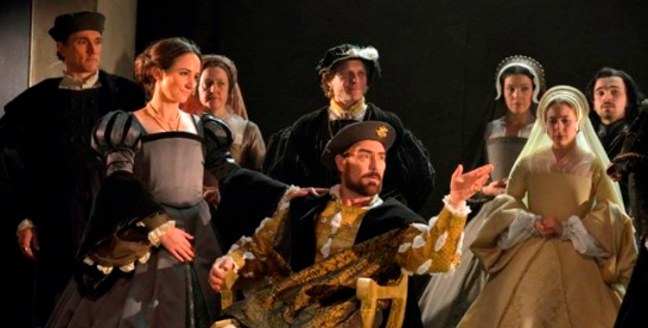
“It’s about using the power of the words,” says the director Jeremy Herrin. He is reflecting on the Royal Shakespeare Company’s stage adaptations of Wolf Hall and Bring Up the Bodies, the meaty Hilary Mantel novels that have achieved the double feat of topping bestseller lists and winning literary prizes. At more than 1,000 pages combined, the books pose a formidable challenge to adapters.

“You’re very conscious that there’s an enormous amount of material and a limited amount of stage time,” says Herrin, summing up the dilemma. Working closely with the playwright Mike Poulton (“it’s got to be collaborative”), Herrin resolved to create a driving momentum at the centre of the drama, moving the action along swiftly enough to keep audiences engrossed throughout the two three-hour productions: “I don’t like to keep an audience waiting.”

Discussing the adaptations, Herrin repeatedly mentions the importance of “moving forwards”, stressing the dynamism of his approach. Mantel’s novels, which trace the turbulent politics of Henry VIII’s reign through the behind-the-scenes figure of Thomas Cromwell, are dense with court politics. The stage versions navigate this by hopping rapidly from location to location with minimal fuss. In telling this fictionalised historical narrative, Herrin was keen to avoid some of the more familiar tropes that have congealed around representations of Tudor England, devising, instead, a stage language that “could hint subtly at modernity”.

“You can find out a lot about who we are now by looking through the prism of history,” Herrin suggests, arguing that it is this “sense of where our nation was defined” that continues to inspire our fascination with the Tudor era. “It’s one of those stories that every generation can look at again and find different meaning in,” he says. “There’s also a sort of horror about the tyranny underneath those facades that we’re really keen to revisit and to analyse.”

Central to the stage productions is the characterisation of Cromwell, with which Herrin is particularly pleased. “Ben Miles was always the right man for the job,” he says. “It’s a gargantuan feat, in terms of pure stamina and precision. He does six hours of the most sublime, subtle, very clear, very specific acting.”

After a successful initial run, the move from Stratford-upon-Avon to London’s West End, where the double bill opens next month, presents another challenge for Herrin. Of the change of stage, he says: “We’ll have to find the right performance language to fit in that room.” It’s “a chance to have another go at it and tell the same story under different circumstances”.

At the same time as preparing for the London transfer, Herrin has been settling into his new job as artistic director of touring theatre company Headlong. For the man once dubbed “Britain’s busiest director”, the added workload should not be a problem, but filling predecessor Rupert Goold‘s shoes is no mean feat. Herrin shrugs off the pressure, simply saying, “I’m really grateful to Rupert for doing his job so brilliantly”.

Herrin is now in the midst of his first season in charge, with an updated version of Frank Wedekind’s Spring Awakening out on tour and a new co-production with the Royal Court coming up this summer. For Herrin, the priority is to “keep doing what we do really well” and – as with all his work – to continue making the theatre that inspires him.

“I’m interested in theatre that’s exciting and exhilarating, and that goes into territory that will create debate and will be firmly about what’s going on in the world.”

Photo: Keith Pattison.

Return to the Globe

Untitled

Originally written for The Stage.

By now it is a truism that Shakespeare’s plays explore universal themes, but the Globe has taken this idea further than most. From its riverside base in London, the theatre has increasingly attempted to live up to its name and showcase Shakespeare’s work on an international level, both by touring its own productions and bringing in companies from around the world.

The pinnacle of the theatre’s international ambition to date was the 2012 Globe to Globe Festival, which invited productions of all 37 of Shakespeare’s plays in different languages, performed by companies from all over the world. Festival director Tom Bird describes the feat as a “huge, ambitious and difficult thing to pull off”.

The first challenge was to decide which countries and languages to include, which Bird and his team tackled by choosing to focus first and foremost on communities living in London. The other starting point was the desire to make the programme as varied as possible – “we always wanted to mix it up”.

The resulting festival attracted a diverse range of audiences, made up of regular visitors to the Globe and a huge influx of new theatregoers who came to see Shakespeare performed in their native languages. Bird quotes the astonishing figure that 81% of Globe to Globe audiences had never been to the Globe before, far exceeding the festival’s targets. The programme also “confounded expectations of what we think we can do with those plays”.

Following the festival’s success, the Globe has made a commitment to continuing this international strand and is once again bringing back three Globe to Globe companies this year: Indian company Arpana, Fundación Siglo de Oro from Spain, and Deafinitely Theatre, whose work uses British Sign Language.

Sunil Shanbag of Arpana, who will be bringing back their Gujarati version of All’s Well That Ends Well, describes the chance to perform at the Globe as a “once in a lifetime opportunity” – or twice in a lifetime, in their case.

“It’s a very giving space,” he says. “It’s the kind of place where audiences feel welcome; there was a lot of generosity. It’s a very different kind of relationship that you share with an audience at the Globe, so as I keep telling people, it’s very hard to fail at the Globe.”

For Shanbag, the priority was to make the play work for Gujarati audiences, but he has been overwhelmed by the response beyond the Gujarati community, especially from Shakespearean academics. He suggests that Arpana’s version, which drew on popular street theatre aesthetics, worked because “the very powerful emotions that run through Shakespeare’s plays – of love, hate, betrayal, loss – these are elements that are very similar to the elements that you find in Indian storytelling”.

Similarly, Fundación Siglo de Oro’s Rodrigo Arribas notes similarities between Shakespeare’s plays and the theatre of Spain’s Golden Age. After presenting Henry VIII in 2012, this year the company are performing Lope de Vega’s Punishment Without Revenge, which Arribas says shares Shakespeare’s “profound capacity for dissecting the psycho-emotional nature of human beings with their desires, ambitions, perversions, doubts”.

For Deafinitely Theatre, who presented their version of Love’s Labour’s Lost at the 2012 festival, Globe to Globe brought different challenges. “Our language is very dependent on eye contact and really focusing on each other,” says artistic director Paula Garfield, “but with the Globe you can’t do that. You have to focus on the whole audience, which is surrounding you, so it’s about projecting outwards, upwards, across.”

The company have found that the festival had a positive impact on their audiences, continuing their project of bridging the gap between deaf and hearing theatregoers. They hope to continue this with their new version of A Midsummer Night’s Dream this year, which has been chosen to be as accessible as possible.

Never shy of a challenge, the Globe’s latest international project involves touring Hamlet to every country in the world over the next two years, coinciding with the anniversaries of Shakespeare’s birth and death. Explaining the impetus, Bird says, “we wanted another huge ambitious project to really get our teeth into and to reflect the relationships we had all around the world”.

The project recently received criticism from Amnesty International for its decision to visit North Korea as part of the tour, but Bird insists that “every single country means every single country”. He explains, “we want to be inclusive and not exclusive and to have conversations with as many people as possible”.

As for Shakespeare’s ability to translate across cultures, can any play be truly universal? “We feel that there’s probably nowhere in the world that won’t enjoy engaging with Hamlet in some way,” Bird says. “The play is such an extraordinary story that we really feel like anyone can enjoy it.”

Photo: Ellie Kurttz

The Fanny Hill Project, Camden People’s Theatre

main

Behind even the most misguided shows, there is usually the nugget – however small – of a good idea. When I first saw The Fanny Hill Project in Edinburgh last year, the good idea at its heart was obscured by the messy, distracted production created around it. TheatreState had paired John Cleland’s erotic novel with the contemporary tale of co-director Tess Seddon’s experience as a model in a foot fetish club in New York, and from there departed into a sprawling exploration of women’s representation in the 21st century. As I wrote in my review at the time, “A feminist piece about modern representations of women is not short of targets, which is perhaps where TheatreState’s fierce but confused satire falls down”. The show had bags of ambition, but precious little focus.

The Fanny Hill Project v2.0, as TheatreState have cheekily christened it, is an impressive transformation, excavating the central idea of the original piece and making it into the show it always had the potential to be. Other than retaining its core concept, the show is unrecognisable, adopting an entirely new structure. Whereas the initial production was all over the place, its madcap scenes loosely strung together, here it has been honed down to its essentials and marshalled into a tight, effective framework. Shedding all the accessories that got in its way first time round, the show is now completely built around its twin narratives of two women – one 18th-century, one 21st-century – who end up selling their bodies.

This structure also allows Seddon and fellow performer and director Cheryl Gallacher to return to the spotlight, whereas previously they were hidden in the background or absent entirely. It’s a wise choice, as the pair have a compelling dynamic and an effortles way of inviting in their audience. In a fun little preamble, they coax us all into playing “I have never”, most beloved drinking game of eager-to-impress students. This quickly becomes a way of introducing Seddon’s shady past, which in this version – unlike before – she takes full ownership of. When Seddon first revealed this secret, she explains, Gallacher was desperate to make a show about it; in return, Seddon dug up Cleland’s novel and presented Gallacher with the challenge of Fanny Hill. There’s eye-rolling reluctance from both parties.

So the two women, Seddon as herself and Gallacher as Fanny, do battle in their attempts to tell their stories, while Jordan Eaton observes proceedings from behind a DJ booth at the back of the stage. Each chapter, linking together events in the lives of the two protagonists, is announced into the microphone by Eaton, wrenching away narrative control from the very people whose narratives are at stake. The quickfire sections are separated by a bell – ding! – with more than a hint of the boxing ring. Women here are repeatedly interrupted and sidetracked in the authoring of their lives, competitively pitted against one another while the audience problematically look on.

Performance is key. Thanks to the knowing structure and the winking self-awareness, we are constantly reminded that this – like the outfits the performers switch between – is all put on. When Seddon and Gallacher throw shapes to David Bowie’s “Let’s Dance”, their moves fiercely mock the “sexy” tropes of contemporary music videos; the artificiality of pillow fight fantasies is gleefully pointed up by the use of a fan to scatter feathers into the air around the two giggling performers. And we begin to wonder whether “Tess” and “Cheryl” – the versions of themselves that the performers present on stage – are also carefully constructed performances. Is the appealing kookiness that they adopt just another role that women are expected to fulfil? (my Manic Pixie Dream Girl alarm starts to go off)

The Fanny Hill Project v2.0 still leaves questions unanswered, but now in a way that feels apt and intentional. The closing scene, rather than departing in bewilderment, leaves a powerfully bitter taste in the mouth. What if, TheatreState suggest, the only way of getting one’s voice heard as a woman in a casually misogynistic culture is to conform to the image that culture insidiously projects? If you can’t beat ’em, join ’em. It’s a troubling thought, and one that hangs in the air long after the feathers have fallen to the ground.


Rachel Chavkin: Riding the Elephant

??????????????????????????????????????????????????????????????????????????????????????????????????????????????????????????????????????????????????????????

Originally written for Exeunt.

For a theatremaker whose work has a distinctly American flavour, Rachel Chavkin has a surprisingly close relationship with British theatre. The artistic director of The TEAM, a company who have made a name for themselves interrogating modern American identity, was last over here with Mission Drift, which had its first London run at The Shed last summer after premiering on the Edinburgh Fringe in 2011. When we speak, she is in Newcastle for rehearsals of her new stage version of Catch 22 at Northern Stage; other ongoing projects include a collaboration with Chris Thorpe and a new TEAM show being made in partnership with the National Theatre of Scotland.

“It’s the culture of theatre here,” Chavkin explains the continuing appeal. In contrast to American theatres, which rarely have in-house bars or restaurants, she is drawn to the community that gathers around theatres in this country, where people meet to socialise and extend the conversations started on the stage. “The idea that the theatre is a building of culture and life has had a huge influence on my work with The TEAM and my sense of what I want theatre to be doing in the world.”

For her latest project, however, Chavkin is making work for British audiences without the company of The TEAM. The idea of adapting Catch 22 for Lorne Campbell’s first main stage season as artistic director of Northern Stage was first suggested in early conversations about the programme, as it emerged that Chavkin had long nurtured an interest in Joseph Heller’s novel. When they discovered that Heller himself had already written a stage adaptation of the book, Chavkin was the obvious choice for director.

She describes the novel, which follows the nightmarish experiences of Captain John Yossarian during the Second World War, as an “extraordinary piece of philosophy and absurdism”. The novel offers a formidable challenge in its presenting of events out of sequence, mirroring the rule of its title in its circular, repetitive structure. It is the book’s more philosophical strands that Chavkin hopes her production can draw out, conveying the “feeling of existential despair” that the narrative builds to.

“The sense of purgatory, of Yossarian caught in this kind of purgatorial loop, that’s the driving idea behind this production and behind the staging,” Chavkin explains. While Heller’s script brings with it certain limitations, she tells me that “the back story and wealth of worlds that Heller presents in the novel has a profound impact on how we’re able to understand the play”. The novel is informing how she presents the “space around the text” and has influenced an aesthetic which contrasts an atmosphere of celebration and fun with the unremitting devastation of conflict. “War is great, other than the war part.”

The advantage of the novel is that, despite not being able to directly consult the writer about the production, there are pages upon pages of additional material available at Chavkin’s fingertips. In this sense, she suggests, “you sort of do have the writer with you”. Chavkin explains that as a freelance director she is more accustomed to working with writers on new plays, a practice that has increasingly fed into the way she creates work with The TEAM.

“When The TEAM was first beginning to create, and for many years of our company’s life, we would always try to fix problems by rewriting them,” Chavkin recalls. “We always turned to writing first and foremost if something didn’t make sense to us. And actually now I have become much more protective of each individual writer’s contribution within The TEAM. Because as a freelance director I have to protect a new writer or a new play all the time, from both myself and the actors, who just may not understand it yet. Sometimes it means that there should be a rewrite, but very often it means there’s some different logic at work in a play and you just have to work a little bit harder to understand that.”

While Chavkin’s different creative processes have points of convergence, she also discusses contrasts between her work as a freelance director and her projects with The TEAM. Whereas The TEAM’s process tends to be “very gnarly and pretty horizontal”, there is a much clearer hierarchy in place when Chavkin is directing elsewhere, though she stresses that she is still “deeply interested in what the acting company and designers might bring to a show”.

Chavkin is working in a slightly different way again on Confirmation, her current project with Chris Thorpe. It is being written by Thorpe, but as director Chavkin has been deeply involved in the research and development of the show. The piece, which is going up to the Edinburgh Fringe this summer, investigates confirmation bias – the unconscious bias that leads us to interpret the world around us in ways that support our existing beliefs. Chavkin describes it as “a very aggressive force in our lives” and discusses how eye-opening their research has been.

“The image that a lot of the research uses is the rider and the elephant,” she says, explaining that the rider represents the conscious, rational brain, while the elephant is our unconscious. “The elephant is a much, much larger force than the rider, and the idea is that the rider can to a certain degree guide which way the elephant wants to go, but actually in most cases our rational brain exists to try to explain and justify to ourselves why the elephant is doing what it’s doing. The most surprising thing is the degree to which we are governed by our unconscious.”

It is going to be a busy Edinburgh Fringe for Chavkin this year, who is also presenting a workshop performance with The TEAM and the National Theatre of Scotland. The new collaboration between the two companies indirectly approaches the question of Scottish independence, exploring the national mythologies of both Scotland and the USA. Using the Scottish Enlightenment as its starting point, it traces the journey that the ideas emerging out of that era have made over the years, right up to the present day.

“The idea is that America was this place where all the ideas coming out of the Scottish Enlightenment actually got, like a petri dish, to act upon,” says Chavkin. “350 years later, I think America is finding itself in a somewhat bankrupt place with this radical misunderstanding of what Adam Smith wrote as our national religion, in terms of this incredibly unfettered capitalism.”

Talk of unfettered capitalism recalls Mission Drift, which took an epic, breakneck ride through 400 years of American history, from the earliest settlers to the twinkling spires of Las Vegas. There is undeniably a certain continuity that can be traced in The TEAM’s thinking, from the research into disaster capitalism that informed Architecting through to this latest project. “I think that’s a common theme in all our work,” Chavkin admits. “Something that comes up as an idea in one piece ends up developing and shifting and morphing into the germs of what inspire the next piece.”

Chavkin makes it clear that the new show, tentatively titled Scottish Enlightenment Project, is not explicitly dealing with the Scottish independence referendum and will not appear in its finished form until after the vote, which is a very deliberate decision. But again, as with so much of her work, it asks the questions that sit right at the heart of national identity. “Who do we want to be? What kind of democracy do we want to be? What are our values?”