The Rep Tide Turns

-C2-A9RWD10-20Faction_The-20Robbers_-36

Originally written for The Stage.

Repertory theatre might just be staging a comeback. While the Lyric Hammersmith undergoes major building work, the Secret Theatre company is occupying the untouched auditorium with a year-long programme of work driven by the ensemble. Elsewhere, Vicky Featherstone began her Royal Court tenure this summer with a festival featuring an ambitious weekly rep programme, while English Touring Theatre is exploring a repertory structure with Tonight at 8.30, its upcoming production of one-act Noël Coward plays.

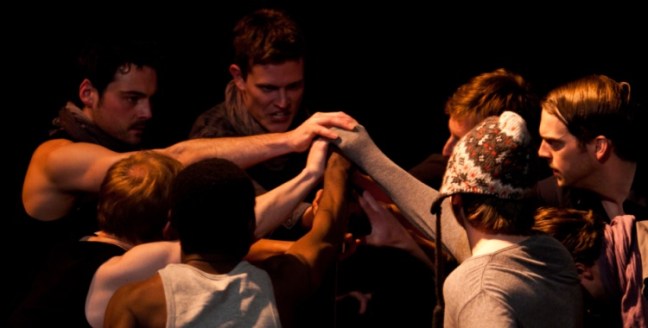
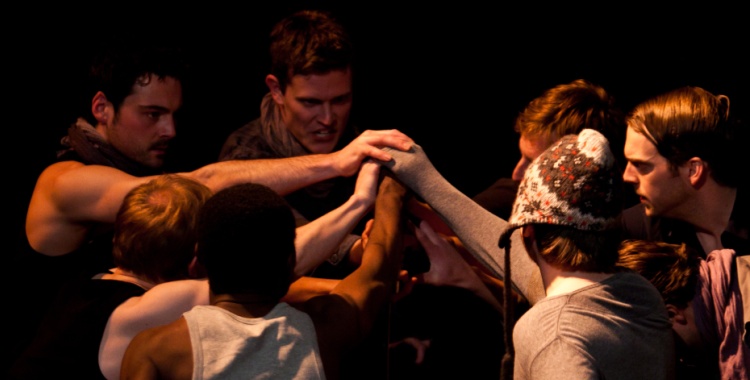
The freshly vaunted advantages of the rep model will come as no surprise to The Faction. The company, which recently celebrated its fifth birthday, has been working towards this model from the moment of its conception, guided by artistic director Mark Leipacher’s passion for ensemble theatre and muscular versions of classical texts. The company’s ambition is bold but simple: a permanent ensemble, a home venue and a rolling repertoire.

While many have mourned the decline of the great British repertory theatre, which acted as a fertile training ground for the likes of Judi Dench, Ian McKellen and Derek Jacobi, The Faction looks to the continent rather than to the past for its chief inspiration. The company’s model is drawn from that of German theatres like the Schaubühne in Berlin, where a large repertoire of plays is presented by a resident ensemble.

“The idea for The Faction was always an ensemble theatre company following the model of a German theatre,” Leipacher explains. “Because it doesn’t really exist over here; even when rep was alive and well, that’s not the format that our rep model had in the UK.”

What The Faction’s ensemble approach does share with the old British rep model, however, is its focus on the actor. At a recent conference, playwright Simon Stephens – who is currently working as a dramaturg for the Secret Theatre ensemble – suggested that the UK’s freelance culture “can stifle bravery in acting performance”. This is just what The Faction hopes to reverse.

“Any director will tell you it’s a requirement to try and make the rehearsal room a safe place,” says Leipacher, “so that an actor can arrive without the need for ego, without inhibitions, and have the confidence in order to experiment and to play. I think with an ensemble that’s inbuilt.”

Although The Faction is still some way from its ultimate aim of a permanent ensemble performing a repertoire of plays all year round, this will be the third consecutive year that the company has presented an eight-week rep season at the New Diorama Theatre. Leipacher tells me that these rep seasons are “essentially a small model of how we want to work full time”, with the plan being to slowly extend these towards a year-long programme. He admits that it’s a “gradual process”, but the final aim is unwavering.

This year’s programme represents a blend of old and new for the company. It is remounting its Peter Brook Award-winning production of Friedrich Schiller’s The Robbers, which Leipacher describes as a “quintessential Faction show”, as well as returning to Shakespeare to tackle Hamlet for the first time. Completing the season is Thebes, an audacious attempt to weave together Sophocles’ and Aeschylus’ accounts of the Oedipus dynasty. Unlike the more defined thematic threads of previous rep seasons, Leipacher says that “the only condition this year was that they had to be plays that really excited us as directors, as a company – meaty, big, epic material that played to our strengths, that pushed us into new areas.”

Epic is the key word there. This sense of scope – both in terms of narrative and emotion – is what keeps The Faction returning again and again to classical plays. Leipacher insists that “there is no better material”, citing the plays’ timelessness and “universal themes” in contrast to new writing’s preoccupation with the zeitgeist. “It’s much more about human experience, about jealousy, about love, about responsibility,” he continues, “something that’s applicable to everybody and to any time. The purpose of doing the productions now is to do them for this time.”

As much as Leipacher enthuses about what excites The Faction as artists, the company is equally focused on its audience. Leipacher is adamant that repertory theatre offers a richer experience for theatregoers, with whom the company is able to “extend a dialogue” over a longer period. Audiences also have the opportunity to see the ensemble in a range of different roles, which Leipacher argues allows them to “enjoy the craft of the production and the ethos of the company as part of their theatregoing experience”.

Geoff Colman, Head of Acting at Royal Central School of Speech and Drama, is in agreement with The Faction about the advantages of the rep model for both theatre makers and audiences, describing it as “a place of experience, experiment, continuing development and trust”. He is also optimistic about the potential for bringing back rep under a new guise, adding, “I am convinced that other theatre makers will be looking at this reinvention of rep very closely”.

Discussing the experiments in ensemble theatre that are cropping up across British theatre, Leipacher says that “any movement towards that European model here in the UK is exciting”, but stresses the importance of longevity. It remains to be seen whether projects like Secret Theatre will go on to create longer term change, but Leipacher hopes that the Lyric and others will make the same commitment to ensemble theatre that is central to The Faction’s ethos. “Hopefully it’s the beginning of a tidal shift.”

Hippo World Guest Book, Caryl Churchill Theatre

HIPPO-WORLD

It’s a bit of a bold statement, but I think Chris Goode’s Hippo World Guest Book might just be the best piece of theatre to be made about the internet to date. Except, strictly speaking, it’s not actually about the internet at all – at least, not in any straightforward sense. As Goode tells us at the beginning of the show, none of the words in the main body of the piece are his; apart from the pre-recorded introduction, he has not written any of what is about to be performed. Instead of sitting down at a blank word document and trying to tackle the unruly behemoth that is our online world, Goode has borrowed from it. He doesn’t comment on the internet as much as comment from it.

The vast majority of the text in the show comes from the eponymous Hippo World Guest Book, which is exactly what it sounds like: an online guest book on a website for (surprisingly vociferous) hippo fans. Left unmoderated, this web page is a fascinating microcosm of online commenting culture, beginning in a spirit of giddy optimism but quickly beginning to sour. Goode has edited down hundreds of pages worth of comments into a one hour slice of highlights, though he’s clear that each individual comment has not been meddled with in any way. What we hear is exactly how the commenters wanted to express themselves – a thought that is, as Goode points out, quite extraordinary to reflect on at certain points.

In his little preamble – the introduction to the introduction, if you will – Goode tells us that he stumbled across Hippo World and its oddly compelling guest book by accident, but the subject of the comments he goes on to read feels significant. Or rather, it is significant because of its insignificance. I can think of few things more innocuous than a fan site for, on the face of it, a pretty uncontroversial animal. Because of this innocuousness, the subsequent bile of the trolls who begin to occupy the site is all the more startling, while the lack of any meaningful connection to politics or world events makes it a strikingly pure metaphor for internet behaviour. Where Theatre State’s choice of forum topic (arts funding) in A Lesson on the Benefits of Being a Troll felt a little manipulative, the benign indifference that I suspect most audiences feel towards hippos functions to focus attention on the intent of the comments rather than their specific content (I may be wrong here; my fellow audience members might have had extremely strong opinions about hippos).

The arrangement of the space and Goode’s performance within it also feel important. There’s a very low-fi aesthetic to the piece – so low-fi, in fact, that it would be easy not to think of it as an aesthetic at all, just to accept it as a man reading from a stand. To the side of where Goode reads from the guest book, there is a small table arrayed with a hippo stuffed toy, a candle and a framed photo of Hippo World’s founder. These are all produced, along with the guest book (actual printed pages slotted into a plastic file), from a pretty unassuming Morrisons bag. The candle is lit at the start of the performance, as the recorded, storybook style introduction outlines the utopian beginnings of Hippo World, and remains gently flickering away until the guest book finally becomes a neglected wasteland of casino spam.

There’s something deeply melancholy about this journey from optimism to antagonism to a void occupied only by advertising. It is, of course, a metaphor for the web – and a particularly powerful one in the midst of renewed concerns about Twitter abuse – but it also feels like something of a sad allegory for all of our utopian endeavours. This sense of melancholy is underlined throughout by Goode’s extraordinary performance; even as it is properly laugh-out-loud, tears-streaming-down-the-face funny (and it is very, very funny), there is a subtle underlying layer of sadness, a heavy knowledge of what is to come. Goode takes on the sighing character of a god watching his creations rip one another to shreds, as if he knew all along that it could only end this way. But then there is also such gentle care in the presentation of passion and hope – even if it comes in the form of “I LOVE HIPPOS!!” – hinting that perhaps things could be different, perhaps there is something in the attempt to carve a space for shared enthusiasm and love.

As Matt Trueman reflected in a great piece for the Guardian a while back, exploring the internet in the space of the theatre is extraordinarily difficult, and any show that attempts to do so runs the risk of appearing dated almost as soon as it appears. Online developments simply move too fast, so therefore anything that attempts to be technologically innovative and of the moment is almost bound to fail. Instead, what Hippo World Guest Book does so brilliantly is to acknowledge the mechanics of theatre as much as the mechanics of the internet. Rather than attempting to evoke the sleek, digital anonymity of the internet, Goode makes a point of the analogue intimacy of his surroundings. Attention is deliberately drawn to the simplicity of the props, the physical presence of the pieces of paper from which Goode reads, the co-presence of performer and audience members in the same room.

I would suggest that all the best pieces of theatre about (or touching on) the internet – those that really capture something of its spirit, its complexity, its effects on human thought and behaviour – are those that recycle its habits with a simultaneous awareness of the context of the theatre. I’m thinking of the multiple-tab structure of Narrative; the short, sharp bites of theatrical data in Love and Information; the riotous clash of diet tips, “likes” and cat videos in Vivienne Franzmann’s bonkers piece for Open Court’s Collaboration project. Because while perhaps theatre is ill-equipped to deal with the technological intricacies of the networked society, it is perfectly positioned to explore the predicament of individuals and communities within it.

By way of a postscript, I have to say that I’m intrigued (if not also a little horrified) by the idea of a durational performance reading out every single one of Hippo World’s comments …

Hard Work? Not I

The following owes a huge debt to Stewart Pringle, who got me turning a lot of this around in my head after a fascinating conversation in the Royal Court bar. It’s also influenced by some of my dim memories of the thinking in Nick Ridout’s fantastic book Stage Fright, Animals and Other Theatrical Problems and the tiny bit I’ve so far read of Passionate Amateurs, which will no doubt add more thoughts to the mix …

Not-I1-600x390

If there’s one thing we all know about Beckett, it’s that it’s hard. Hard for its would-be scholars (as I quickly learned at university), hard for actors, hard for directors held to the strictures of the dead playwright and his famously inflexible estate. We as audience members are encouraged to look upon Beckett’s work as difficult, serious art, while for performers it is a daunting but defining challenge. Apparently, for all involved, it’s hard work.

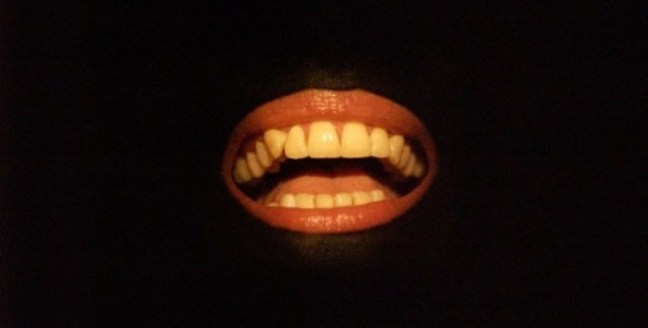
This is certainly the impression that has been generated by the marketing and media coverage heralding the Royal Court’s latest Beckett offering, a trilogy of short plays headlined by breakneck monologue Not I. In a piece for the Guardian, performer Lisa Dwan insists “There is not a single aspect of Not I that isn’t difficult”; a short behind-the-scenes feature on BBC News (see below) is almost exclusively focused on the physically strenuous nature of the performance; headlines have all zoomed in on Dwan’s record time (an admittedly remarkable sub-nine minute verbal sprint); and even the show’s poster frames the performance as an ordeal, with Dwan’s eyes seeming to appeal to us from above the black make-up surrounding that all-important mouth.

And yes, the experience of becoming Mouth – the body part that must appear suspended in darkness above the stage for the short length of Not I – sounds fairly horrific. As Dwan describes for both the Guardian and the BBC, the performance requires her to be strapped into a contraption mounted on a high platform, with her eyes and ears covered for the duration. Then there’s the text itself, which loops, jumps and scratches like a record, its frenzied repetitions and rapid stream-of-consciousness construction offering no footholds for the memory. Pair that with the demanded speed and Beckett’s strict instructions for its delivery, and Not I reads like a nigh on impossible feat; it’s not surprising to learn that Billie Whitelaw originally described it as “unplayable”. The role of Mouth might sometimes be described as “the female Hamlet”, but no one is listening to “to be or not to be” with a stopwatch in hand.

All of this emphasis on the “how” of Not I is both striking and slightly paradoxical. Theatre tends to be notable for the erasure of its own work; we are invited to partake in illusions, to forget the labour that has produced what we witness on stage. There are, of course, exceptions to this, but more often than not we view theatre as a place of leisure rather than one of work. It’s strange, then, that the work of producing Not I is what has dominated the discourse around it. And not just the strain of the labour involved, but the mechanics of the illusion – pulling back the magician’s veil to reveal how it’s all done.

In some ways, arguably, this unveiling is appropriate. In his review of Not I, Stewart Pringle suggests that “Dwan’s achievement in delivering such a diamond-dense performance is to shave away a little more of the actor, of the polluting falsity of the theatre”. Beckett’s classic note was “don’t act”, demonstrating his desire to get at something beyond the art (or artifice) of performance. At the same time, however, it seems to me that what Beckett was digging towards in his rejection of the usual flourishes of theatre was a visceral rawness that nonetheless depends upon a very theatrical device. The precision with which the disembodied mouth is imagined underlines its importance as a stage image – one that is bold, uncanny and oddly hypnotic. But it’s slightly less hypnotic when you’re thinking about the make-up Dwan is wearing or imagining the straps holding her hidden body in place.

This is noted by Matt Trueman in his brilliant interrogation of why he failed to “get” Not I. He remembers being distracted throughout the performance by just the kind of mechanics discussed above, noticing occasional flashes of exposed cheek that destroyed the illusion of the disembodied mouth. I didn’t experience that same distraction myself (I might as well admit at this point, at the risk of echoing the rhapsodies of others, that the whole thing exerted an almost hallucinatory power over me), but there was, on some level of my brain that wasn’t preoccupied with the relentless shower of words and the unsettling sense that the tiny, glimmering mouth was swaying in the dark, a dim, unhelpful awareness of the sheer technical achievement of the piece. I would consider this awareness of the show’s construction as an intended effect of Walter Asmus’ production, but every other meticulously calculated element of its staging – in particular the deep, inky blackness that envelopes the audience, focusing our attention exclusively on the hovering mouth – seems intent on immersing spectators in the experience, not setting them at one remove.

I wonder, then, what the obsession with “hard work” in relation to this production might say about popular perceptions of theatre as an art form, about the idea of work in our society, and specifically about the attitude to labour within theatre. Without even getting into the economic intricacies of paying artists, which are currently the subject of much vital discussion, I would suggest that there is a tension around theatre and work that is not easily dissolvable. Going to the theatre is an activity typically associated with leisure time – something to do after work, or at the weekend. As such, audiences don’t tend to like being reminded that this is a workplace too, and the majority of the time theatre obligingly covers up the work that goes into making it. Alongside this, however, is a popular suspicion that making theatre is simply too much fun to count as proper work, met with artists’ ever more desperate protests that they do work hard – honest.

It was a small revelation to read Alex Swift‘s words, in response to the whole artists and money debate, that “work is not a moral good”. He is, of course, right, but we all (myself most definitely included) act as though it is. On the other hand, I don’t believe that the notion of hard work, when uncoupled from monetary value and profit-driven ideas of productivity, is actually a bad thing in itself, but that’s another discussion. The reason I wanted to bring Swift’s comments in here was to highlight something simple but often ignored about how our society is built on a generally unquestioned assumption that hard work equals good work. This assumption is applied to theatre too, but with a tricky double bind: you have to work hard (not too much fun allowed), but you can’t possibly let us know that you’re working hard, because that would just be embarrassing for everyone.

So how does this loop back around to Beckett and the popular take on Not I? This is just an idea – and a rather uninterrogated one at that – but I wonder if it comes back to that distinction between art and entertainment that Andrew Haydon recently discussed. He argued that in this country at the moment we’re “pretty much taught to hate, fear and mistrust art”, while funded theatre is required to succeed as entertainment in order to vindicate the public money that has gone into making it. Looked at from this angle, Not I (and much of Beckett’s work in general) falls into an odd place. It’s not really entertainment, certainly not in the way that War Horse or One Man, Two Guvnors are entertainment, but it’s revered rather than hated as art – though it might well still be feared.

As well as and connected to Beckett’s position in the canon, I want to tentatively suggest that it is precisely the “hard work” of Not I that makes it acceptable as a piece of art. There is, to echo Swift, a sense of “moral good” in the effort that this piece is supposed to require from audiences, who attend in an attitude of self-improvement (one that is, as an aside, problematically tied up with class; Beckett productions are, as Trueman points out, something of a “bourgeois experience”). The punishing labour demanded of the performer, meanwhile, is also something to be admired, something that cannot be mistaken – God forbid – for having fun. Not I soars above the fraught battleground between art and entertainment because it can be seen as a serious, hardworking endeavour for all involved.

For me, though, the experience of watching Not I was far from hard work. Hard, in a sense, maybe, but not in a way that I connect with the slog of work (though of course that depends on the kind of work we’re talking about). Blinking up at the miniscule mouth – you somehow expect it to be bigger, despite knowing that would be impossible – the rest of the world seems to melt away into the darkness. And time dances, sometimes faster, sometimes slower, but never the steady tick, tick, tick of the working day. If anything, the astonishing speed is one of the least interesting things about the production, or at least it is its effects that matter, rather than the record-breaking time it achieves (here I’m reminded of Gatz, which was also framed as “hard work”, and in which the much-discussed length was again less interesting than everything else it was doing).

There are plenty more fascinating and important things to be said about theatre and work, and theatre as a place to contemplate work (see Nick Ridout’s books), but I don’t think that viewing certain productions as something audiences need to work at* is particularly helpful or illuminating – on the contrary, it can be both elitist and alienating, not to mention damaging the case for art by restricting it to work that ticks a certain box marked “difficult”. If we really want to rescue art, I’m not sure an appeal to hard work is the answer.

*Just a note: when I mention shows that audiences need to “work at”, I don’t think I’m talking about the same thing as theatre that makes audiences think – that kind of theatre is often very enjoyable to watch at the same time as it is intellectually stimulating, and feels nothing like hard work. In any case, it’s more a distinction between the ways in which work is discussed than a comment on the work itself.

The Duchess of Malfi, Sam Wanamaker Playhouse

???????????????????????????????????????????????????????????????????????????????????????????????????????????????????????????????????????????????????????????????????????????????????????????????????????????

If there’s one thing a new theatre building is capable of doing, as I noted in a blog earlier this week, it’s to refocus our attention on the space in which performance takes place. We’re all too apt to comment on site only when it is accompanied with the word “specific”, ignoring the fact that every piece of theatre is inflected by its surroundings. In considering the first production at the Globe’s new indoor Jacobean theatre, therefore, I’m inevitably going to end up discussing the venue as much as – if not more than – the show. Here, I’m comforted and encouraged by Matt Trueman’s idea of theatre criticism as a team sport; you’ll doubtless be able to read better commentaries on the play and the performances elsewhere, allowing me to happily riff on architecture, candlelight and acoustics.

On stepping inside the new Sam Wanamaker Playhouse, the first thing you notice is the wood. From seats to stage to pillars, the whole place is fashioned from the stuff. Other than the beautifully painted ceiling, it’s mostly left bare, immediately drawing attention to the materials used. What is also striking upon entering the space is its intimacy. In stark contrast with the Globe’s 1,500 capacity, the Sam Wanamaker Playhouse has seats for just 340, all of which – right up to the top gallery – feel thrillingly close to the compact stage. Under the dim, shimmering illumination of candlelight, the shadowy auditorium is claustrophobic, sometimes almost oppressively so. The closeness is at once exciting and unsettling.

All of which makes John Webster’s The Duchess of Malfi the perfect play to open this space. This is a play in which notions of dark and light, concealment and illumination, are central to both action and themes. It is a play in which closeness of all kinds recurs throughout the plot, and which features a series of enclosed spaces, from the locked chambers of the Duchess and Antonio’s secret marriage to the rooms where the Duchess is later imprisoned and tormented by her brothers. It is also known that The Duchess of Malfi was originally performed indoors, in the Blackfriars theatre on which the Sam Wanamaker Playhouse is partially modelled, and was in all likelihood written for an indoor space. Watching it by the flickering light of candles, this makes perfect sense.

Intrigued as I was by the idea of theatre by candlelight, its effects are far more complex and enchanting than I could have anticipated. “Magical” is a word that seems to naturally leap to the lips of those watching, and it’s easy to see why. Candlelight is adjustable, allowing for far more controlled variation than the temperamental daylight that productions have to work with in the Globe, yet it still has an attractively unpredictable quality. Its unstable glow can throw odd shadows or create momentary illusions, making the Playhouse a gloomy palace of the imagination. There’s something dreamlike about the experience of spectatorship in this light, illuminating the dark passions and rich textures of Webster’s play far more effectively than an over-reaching barrage of sophisticated lighting effects.

It’s tempting to focus on appearances, but the acoustics of this space have just as much of an impact on the theatrical experience as all the candles. While the Globe can take on the character of a booming arena, instantly creating epic scale with the addition of heavy drum beats or clamorous trumpet calls, the aural landscape of the Sam Wanamaker Playhouse is far more delicate, fixing the ear’s attention on all its subtleties. This is in part to do with the enhanced intimacy – there is simply less space for the sound to reverberate around – but it is also an effect of the very fabric of this building. Not knowing a great deal about the workings of sound, it could be the shape of the space, the arrangement of the pillars, or simply all that wood, but whatever it is it creates a wonderfully ghostly soundscape for this production. When the voice of the dead Duchess is heard, echoing Antonio’s words from various positions around the auditorium, it’s easy to believe that these intonations emanate from some supernatural sphere.

So what of the production itself? I’ve touched on some of its effects, combined with those of the space, but it deserves a slightly more thorough assessment. If Dominic Dromgoole’s interpretation has an overall texture it is, in accord with its surroundings, dreamlike, descending increasingly into the nightmarish. In a light that can never really be described as bright and is often reduced to an ominous gloom, Webster’s more outlandish plot devices – the wax figures with which Ferdinand cruelly tricks his sister come to mind – take on the sinister edge that was perhaps originally intended. But this is also a production that is unafraid to highlight the more ridiculous aspects of the play. A grim humour suffuses the piece, while James Garnon’s Cardinal is deliciously, laughably evil, summoning snorts of mirth from the audience even as the corpses fall. Murder, it turns out, is often rather funny.

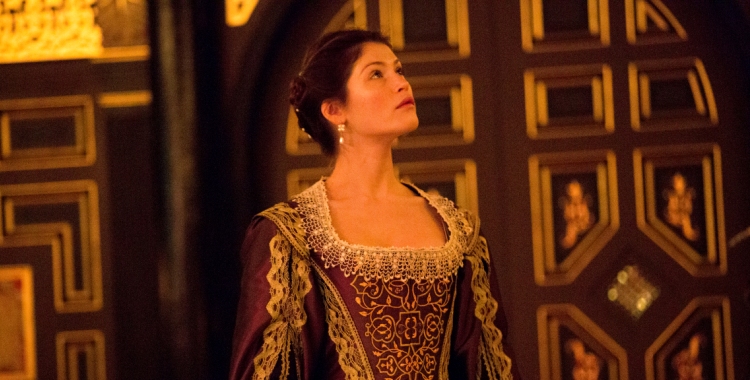
Gemma Arterton, meanwhile, makes a dignified and deeply feeling Duchess. There is a girlishly rapturous yet vulnerable quality to her doomed passion for Antonio, but when facing imprisonment she is still and stonily composed. The dark, grimy flipside of Arterton’s captivating protagonist is found in her twin brother Ferdinand, here rendered particularly repellent in the able – if sweaty – hands of David Dawson. A quick mention too must go to Alex Waldmann, who I last saw as Orlando in the RSC’s joyous As You Like It, and who here once again offers an earnest, convincing portrait of a man bowled over by love. But what’s really fascinating about watching these performances is their movement through the space, still feeling their way around this new theatrical dynamic, but with a tentative grace. Even the lighting of the lowered chandeliers – a necessary intrusion on the action – has a sort of choreography to it.

The other thing that strikes me is the sheer theatricality of Webster’s play in this context. The playwright’s wit can get forgotten amidst the gore and grotesquerie, but it is present and correct here, presented with a lightly knowing air. I find my attention particularly drawn to small comments in the text that refer to the framework of the theatre, while the simple mechanics of this stage cause performers to implicitly, unfussily acknowledge their doubled status as actor and character, comfortably delivering the potentially awkward asides. This self-awareness feels particularly pronounced in the case of Waldmann’s Antonio, who in the course of a couple of scene changes physically brushes up against the fate that awaits him, casting his eyes towards it with an interesting attitude of resignation.

What most excites scholars about the Sam Wanamaker Playhouse, of course, is its identity as a sort of theatrical time machine. It is a space in which to rediscover plays like Webster’s in their original context – or at least as close to that original context as we’re likely to get. Theatremakers can experiment with the use of candlelight, the style of performance, the musical arrangements, all the while making notes against what we already know about Jacobean theatre. For anyone with even the slightest interest in history, this romantic notion of recapturing the past is undeniably appealing.

I’m fascinated to learn, however, that – unlike the Globe – the Playhouse was not built as a direct reconstruction of any one theatre. It is instead intended as representative of indoor Jacobean theatres in general, while at the same time paradoxically representing a fictional building, one that never historically existed. As well as offering the kind of flexibility that the Globe’s association with Shakespeare will never quite allow, this ambiguous identity makes the Sam Wanamaker Playhouse a theatre of the imagination in every possible sense, revealing as much about our contemporary conception of history as it does about the history it attempts to reanimate. It is itself a performance of the past. And what could be more magical than that?

If you fancy some more reading, the Guardian’s features on the Sam Wanamaker Playhouse by Andrew Dickson and Dominic Dromgoole are both well worth a look, while Dan Hutton’s excellent analysis of space in The Commitments is pretty essential.

Photo: Mark Douet

L’Après-Midi D’un Foehn, Platform Theatre

photo1

Originally written for Exeunt.

A plastic bag, a pair of scissors, a circle of fans. These are the modest opening ingredients for the surprise hit of last summer’s Edinburgh Fringe, a new version of which is now being shown as part of the London International Mime Festival. The buzz around Compagnie Non Nova’s show in Edinburgh was improbable to say the least. The show, described in a tone of breathless yet ridiculous wonder by those who were lucky enough to stumble across it, essentially involves a chorus of dancing plastic bags. Not the most auspicious of premises.

But the giddy superlatives thrown at L’Après-Midi D’un Foehn in Edinburgh turn out to be wholly justified. It is rare, as an adult and particularly as a regular theatregoer, to be truly knocked out with wonder, but Compagnie Non Nova achieve this feat with the least likely of materials. Plastic bags, fluttering in the bare branches of trees or skittering along the pavement with leaves and cigarette butts, have become almost emblematic of rubbish. A symbol of throwaway consumer culture – the ultimate trash. So it is doubly surprising how beautiful they are rendered by Compagnie Non Nova’s ingenious transformation. Floating, falling, spinning in balletic poses, the flimsy stars of L’Après-Midi D’un Foehn are absurdly gorgeous to look at.

The show opens with performer Cécile Briand alone in the gloomy circular space, slowly and meticulously cutting and sellotaping a pink plastic bag into a vaguely humanoid shape. Briand’s unhurried precision is oddly captivating in itself, inspiring a still hush of expectant attention. So quiet and unapologetically dawdling is this beginning that when the plastic bag that Briand has carefully placed in the centre of the stage begins to rustle, billow and finally pirouette, the magic and delight are all the greater. Gasps and giggles ripple through the audience as this delicate plastic figure leaps and twirls, later joined by partners, playmates and antagonists, all of whom dance enchantingly to the strains of Debussy’s ‘Prélude à l’après-midi d’un faune’.

The piece feels so beautifully effortless that it is easy to underestimate the artistry involved. Thanks to some cleverly directed gusts of air (huge credit to Pierre Blanchet’s “wind design”), these plastic bags take on movement, grace and even emotions, inspiring the same sort of gooey, irrational affection as Tom Hanks’ ill-fated volleyball companion in Castaway. The combination of simplicity and ingenuity is remarkable; never did I think I would be able to say that I was emotionally invested in the fortunes of a plastic bag. As well as demonstrating the skill and invention of Compagnie Non Nova, this is equally testament to the extraordinary ability of music to invest the simplest of scenes with compelling drama, and to the inspiring power of the imagination.

There is, of course, the danger that – despite its undeniable beauty – this all becomes as insubstantial and throwaway as its fluttering protagonists. After all, how many different ways is it possible to manipulate plastic bags with just one performer and a few fans? There are a handful of moments in which the wonder begins to fade and the piece sags a little, but the company pull out just enough surprises to keep their audience enraptured, while the short running time is cannily judged. Carried on the undulating currents of the piece, my mind skips throughout between themes such as imagination, love, power, the creation and fragility of life – all lightly hinted at by Compagnie Non Nova’s fleeting images before being lightly blown away. The enduring impression, however, is of the beauty that art is capable of finding in the most unlikely of places.