Scene Changes: Theatre Criticism

As part of the National Theatre’s 50th anniversary celebrations, I spoke on one of the Scene Changes platforms on the subject of theatre criticism. I was part of a panel alongside Michael Billington, Andrew Clarke and Mark Shenton and the discussion was chaired by Dan Rebellato.

Value Judgements

Glorious-600x409

Originally written for Exeunt.

Who decides what makes art good? This nagging, age-old question was recently posed once again in the first of Grayson Perry’s Reith Lectures and was met with a multitude of answers. While debates about the categories of “good” and “bad” are far too knotty for a single piece of writing to untangle, one thing we can agree on is that critics tend to fall within that circle of cultural arbiters. So how do we distribute our approval? And what do we take into consideration when making those value judgements?

Around the same time as Perry was delivering his Reith Lectures, BBC Radio 3’s Free Thinking Festival held an event asking ‘Are Audiences Killing Culture?’ No doubt the title was meant as a provocation rather than a serious suggestion, but the very fact that this question can even be posed says something about how our culture assigns value. If audiences become the enemy of culture, then who is that culture ultimately for? And without an audience, how will it survive?

If art as the beleaguered, exclusive realm of the few sits in one corner, then perhaps opposite it is art that embraces its audience not only as spectators but as co-creators. Increasingly, works of contemporary art and theatre are being made with audiences as well as for them, recruiting participants to actively shape the final artistic material. Here the process is just as important as the product – indeed, for those who take part, it might be more important than what they eventually produce. But this, of course, presents a problem for the critic.

In a controversial essay published in Art Forum in 2006, Claire Bishop challenged the assumed political efficacy of the relational and participatory practices that she saw gaining momentum in contemporary art. In this article, she suggests that these practices are “less interested in a relational aesthetic than in the creative rewards of collaborative activity”, resulting in value judgments that ignore artistic criteria in favour of praising the work’s social and political ambitions. In response to this work, Bishop witnesses a problematic “ethical turn in art criticism”, one that she would see replaced with a more critical and interrogative discourse.

While Bishop has brought such arguments to the fore of art criticism, participatory theatre has not been subject to quite the same level of discussion between critics. As an art form, it also deserves its own theory and vocabulary; the huge difference between visual art and theatre, of course, is that theatre is a live experience that is not so easily reduced to a pure commodity, bringing process and product closer together in that sense. Lyn Gardner, one of the few newspaper critics to meaningfully engage with what is variously labelled as community, applied or participatory theatre, argued that we should not patronise this work by focusing too heavily on its social efficacy. Asking whether a critic should take the process into consideration when reviewing work of this nature, she concluded that “if the project has a theatrical manifestation – if an audience is invited and critics too – then it has to be judged on the basis of the performance”.

But this penetrates deeper than relational art practices or community theatre. As critics, are we always judging a final product? Does the process even matter, or is that not our concern? And if we do focus our attention purely on a finished performance and its supposed fixity, are we in some way complicit in commodifying that performance in a way that runs counter to the social potential of the live moment?

These are questions that I find myself repeatedly returning to as I engage in conversations with London Bubble about their latest intergenerational show. From Docks to Desktops has been collaboratively created by its participants, who have gathered experiences of working life from their local communities over a number of months. The resulting show, stitched together from these various stories, reflects the socio-economic shifts in a specific area of London and its impact on the people living there; it is, essentially, a community discovering and telling its own stories.

While thinking about From Docks to Desktops, I was fascinated to see a conversation between critic Matt Trueman and theatremaker Rajni Shah about her project Glorious,which involved a different group of participants in every area it visited. Trueman initially had what he described as an “allergic reaction” to Glorious and decided not to write about it, but after being approached by Shah he entered into a lengthy dialogue about his problems with the show. Throughout this conversation, Trueman is remarkably honest about his own habits as a spectator, while Shah admits that initially her main focus for Glorious was the participants rather than the audience. As she recognises, the participants get a week with the show, whereas an audience’s time with the piece is strictly limited and therefore they need a way into it. They need, perhaps – just as Trueman arguably needed – an appreciation of the process.

The process of From Docks to Desktops is inscribed in its performance. It is performed by the same participants who helped to gather the material that forms the piece and it is framed by the act of interviewing. This strikes me as a canny choice, allowing audiences that way into the stories being told, while at the same time allowing an appreciation of the work simultaneously on the levels of process and product. It also builds space for the encounter with its audiences – many of whom, of course, will be from the area it is concerned with, and some of whom will have contributed their stories to its creation.

The question of assigning value to this performance, however, will still prove tricky. Is the success of its process alone and the community of people it has brought together enough to make it “good”? Does that little moment of magic glimpsed in a rehearsal or a scratch performance contribute towards a positive judgement? Or does everything rest on one, supposedly final iteration of this collective story? And, to look at it yet another way, should the critic’s role in assessing work like this even be to pronounce an authoritative “yay” or “nay”? Is there not another shape the critic could adopt, as the initiator of conversations around this work?

There are a few things I know. I know that I don’t want to think about theatre purely as product. I know that I’m interested in process and I want to think about how an understanding of process might inform my criticism. And I know that I’m excited by the potential of criticism to spark wider conversations about theatre and engage people in dialogue about the culture they engage with.

Talking about theatre rather than speaking theatre, as Maddy Costa so brilliantly puts it. As for all the other questions I’ve asked, I’m not sure that I have any answers yet. But it feels as though these are questions that we, like Perry, should be continuing to ask ourselves. What makes theatre good, who decides, and how do they decide?

Tom Scutt: Deceptive Minimalism

Constellations-Duke-of-Yorks-credit-Geraint-Lewis-2-600x428

Originally written for Exeunt.

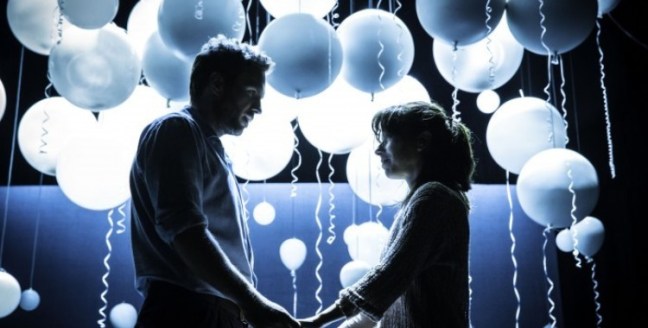
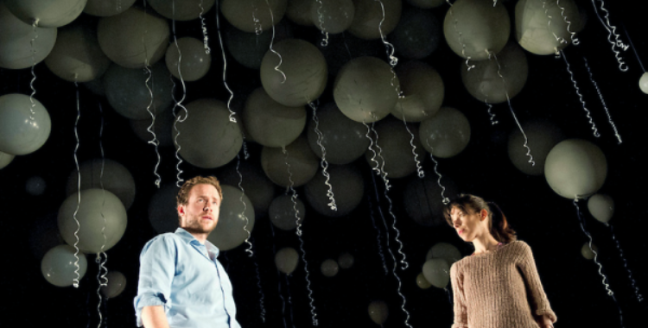
Watching Constellations, Nick Payne’s delicate exploration of love and the multiverse, I struggled to keep my eyes off the balloons. Like a birthday party run riot, Tom Scutt’s design was full of the things – white, weightless, hovering above the stage. Throughout the show, these floating objects spoke continually to Payne’s themes, lightly hinting at atoms, at possibilities, at easily punctured hope. In a similar way, 13 was refracted through the huge black box that dominated the stage of the Olivier, its nightmarish presence suggesting everything that was so disquieting about Mike Bartlett’s vision.

“It’s just a black box; it’s just a load of white balloons,” Scutt says when we chat in the Royal Court bar, acknowledging the simplicity of these designs with a smile. He goes on to describe his design for The Djinns of Eidgah, currently running in the Court’s upstairs theatre, as “just a load of string”. This simplicity, however, often contains within it great complexity. While Scutt’s portfolio features an impressive range of work – from the minutely detailed pub of The Weir to the magical landscape of Narnia in The Lion, the Witch and the Wardrobe – it can usually be characterised by an intellectual depth that belies its surface charm.

When I suggest that the deceptive minimalism of the sets for Constellations and 13 is what makes them work, Scutt nods, but jumps in to qualify the uncluttered clarity of these concepts. “You can tell when simplicity is simplicity because of ease and when simplicity is simplicity because of something that is constantly feeding the audience,” he explains carefully. For Scutt, design is always about feeding the audience, about offering them something beyond a straightforward setting for dramatic action.

As in Constellations and 13, Scutt’s designs have a habit of excavating something within the plays they contain. This is perhaps a result of Scutt’s process, which tends to involve more reading and writing than it does drawing – a “dirty confession” for a designer. “I can’t really design unless dramaturgically I know what’s going on,” Scutt tells me, revealing that his process is “very argy-bargy with other people’s roles in the team”. While he shies away from the term “collaborative”, which he feels is over-used, Scutt is keen to dissolve some of the misleading distinctions between creative roles, explaining that “it’s a completely fluid affair when I’m working with a director”. When he first worked with Natalie Abrahami, for example, she brought in a set of storyboards, while he arrived armed with a heavily annotated script.

Scutt’s way of working, which he describes as a “really rigorous process of elimination of ideas”, also means that the design often takes shape relatively late into the process. But when it does finally fall into place, he knows that it’s right: “I don’t know what anything is going to look like for so long, and then suddenly it just lands and it makes sense.” Despite the dramaturgical rigour of his process, however, the designs that Scutt has been most satisfied with have all been born from instinctive ideas that “won’t fuck off”. “It’s intuitive,” he says, “the gut just goes ‘this is right’.”

This was certainly the case with 13, which was “there all the time; I just couldn’t get it out of my head”. The monolithic revolving cube was “tonally right” for the play, Scutt explains, rather than drawing on one particular theme. The image of the box represented “science and religion in one, it was Pandora’s Box, it was nightmares, it was an alarm clock, it was an iPhone and a laptop, a black hole that you stare into, it was 2001 Space Odyssey, it was the blue box in Mulholland DriveA similarly multi-layered collage of ideas informed the design for Constellations, which alluded to “synapses in the brain and atoms and sperm and weddings and parties”, while at the same time combining great beauty and profundity with something “shit and basic and sort of mundane”. In both instances, the design seized on something in the metabolism of the play without taking any literal inspiration from the text.

Although these conceptual designs might be some of the most rewarding, they are also some of the hardest – “it always scares the bejeezus out of me,” Scutt laughs. “It’s what Carrie Cracknell would call hard good,” he continues. “It’s really satisfying, it’s really crunchy and you really have to get your head round it.” But, for all his enthusiasm for the minimal and conceptual, Scutt also makes a vital clarification about his more realistic designs. “When I do a ‘naturalistic’ design, or a perceived naturalistic design, it’s actually not at all,” he says, expressing frustration at readings of his work which underestimate the work being done just below the surface. Whether it is the wild, playful quality of the taxidermy that cluttered No Quarter in the upstairs space at the Royal Court, or the fractured, schizophrenic tone of his design for Cracknell’s production of Wozzeck for the ENO, there is always more to Scutt’s designs than immediately meets the eye.

“There’s way more thought that goes into these things than people understand,” Scutt says, referring as much to other designers as to himself. We discuss Ian MacNeil’s hauntingly elegant designs for A Doll’s House and Desire Under the Elms, while I later think of the seemingly stripped backed simplicity of Chloe Lamford’s set for The Events and the amount of work it is quietly doing in that piece. Scutt suggests that the nature of the theatre culture in this country means that some audiences – and particularly some critics – are not “visually astute”, and that the expectations of naturalism often lead to a misreading of ostensibly realistic designs. “If someone sees a chair, they go ‘ah, I know where I am’, and so they quantify it in terms that they can relate to,” he explains.

As well as falling foul of misunderstandings about how design enters into dialogue with a show, Scutt thinks that designers suffer from a rigid and often inaccurate distribution of creative roles by critics and commentators. This is highlighted particularly by awards, which sharply divide recognition into job titles – something with which Scutt and the whole creative team felt uncomfortable when Constellations was showered with nominations. “We all felt really weird that anybody could be split up in that way,” he remembers. “We made a thing; it wasn’t a play with a design, it wasn’t something that you could just whack on stage and it just happens that everything else is really nice. It was a thing, and it’s only what it is because of all the tiny little things that come together in a weirdly relevant way.”

Scutt’s suggested solution, as well as demystifying the roles of various different individuals in the theatremaking process, is to break down perceived hierarchies of creation. “We should all be as unimportant as each other,” he says, grinning at this idea. “I think that’s when it’s really exciting, because everyone’s opinion is valid and nobody’s opinion is wrong.”

This goes some way towards explaining Scutt’s latest challenge. He has recently been announced as one of the associates joining new artistic director Sam Hodges at the Nuffield Theatre in Southampton – a rare instance of a designer being offered a position of this nature. As part of a team that includes playwright Adam Brace and directors Blanche McIntyre, Natalie Abrahami and Michael Longhurst, Scutt will be offered an equal hand in decision making, marking a move away from the traditional division of roles.

“It feels like a really healthy and interesting step for me to be involved in decisions when it comes to programming and casting and the building, rather than just necessarily the designs,” Scutt says, adding that he is embracing the experience as a chance to learn and evolve as an artist. One of his first projects will be a reunion with Constellations director Longhurst to work on a new version of Caryl Churchill’s A Number, which is due to open in February.

The structure of a building and Hodges’ flexible approach to creative roles, meanwhile, might offer Scutt the space to continue following his gut. Because when design works best, Scutt suggests, it comes from instinct rather than intellect. “That’s how I feel design should work, that it works intuitively,” he reflects. “You don’t have to justify it; it just sort of happens.”

Photo: Geraint Lewis.

Billy the Girl, Soho Theatre

600x600.fitdown

Clean Break have forged a strong reputation for shining a light on the criminal justice system, offering vital female perspectives on stories that are often hidden. Katie Hims’ new play for the company, however, suggests that the most difficult aspect of incarceration might not be prison itself, but the challenge of adjusting to freedom.

The eponymous Billy is fresh out of prison – not for the first time – and determined to turn her life around. Brandishing fruit and rhapsodising about her new fitness regime, Billy has a “positive mental attitude”. Unfortunately, her positivity fails to extend to the mother she goes home to, for whom the return of her wayward daughter is the last thing she wants. Banned from crossing the threshold of her family home, Billy instead finds shelter in the caravan pitched up outside, from which she does battle with the past and tries to cling onto hope for the future.

Hims’ play is essentially a family drama, tightly focused around Billy, her mother Ingrid and her younger sister Amber. At its best, it explores the complex, fraught and occasionally tender relationships between the trio, all of whom defiantly refuse to conform to straightforward definitions of ‘good’ and ‘bad’. Billy teeters between infectious optimism and a dangerous urge for self-destruction; Ingrid is vulnerable one moment and manipulative the next; Amber is an apparent angel who goes shoplifting when she should be at choir practice. There is certainly love somewhere between them, but it is surrounded by the detritus of blame, resentment and regret.

This messy tangle of personalities and emotions would be material enough for a rich exploration of life after prison, but Billy the Girl is restrictively wedded to a structure of secrecy and revelation. The play tantalisingly brushes against moments of raw emotional truth, before frustratingly abandoning them in favour of the punch of a final twist. This denouement, while satisfying the narrative arc that we have come to expect from plays of this kind (damaging secrecy, dropped hints, climactic confession), feels unnecessarily contrived – a trick calculated to inject a fresh burst of drama rather than a revelation that feels truthful to the characters that have been so carefully crafted.

Rather than the uneven plot, it is through these characters, convincingly fleshed out by Hims, director Lucy Morrison and the cast, that the play really compels. Billy in particular is relentlessly, almost exhaustingly captivating at the centre of events. As played by Danusia Samal, she seems to feel with every last sinew, investing both hope and despair with unsustainably explosive energy. Christine Entwisle’s Ingrid is her polar opposite, each movement sighing with the fatigue of the years, while Naomi Ackie as Amber ricochets between the two, cheerfully but frantically attempting to reconcile them.

The emotional baggage heaved on stage by the three characters is reflected in Joanna Scotcher’s detailed, conspicuously cluttered design. The back garden of Ingrid’s home, dominated by the structure of the caravan where Billy takes refuge, is full of stuff. At first glance it seems straightforwardly naturalistic, but as the play goes on the boxes upon boxes that crowd the stage make their presence increasingly felt; this is no normal backyard mess, but rather a space that resonates with the conflicted states of mind of the women who populate it. The caravan too is loaded with meaning beyond its practical use, becoming a self-contained but flimsy symbol of escape – suggesting movement while ironically rooted to the spot.

Speaking as part of a panel discussion after the show, Hims explained that it was important to her that the play, despite all its heartbreak, should offer a hopeful note. This is evident both within the plot and – more successfully – at the level of character. Whatever its other flaws, Billy the Girl offers us three female protagonists with humour and resilience; characters who are allowed to be vulnerable without ever feeling like victims and who come messily, complicatedly and brilliantly to life on stage.

Inventing Theatre

Three-Kingdoms1-1024x683

Originally written for Exeunt.

Back in 2009, Andy Field wrote a piece on the Guardian Theatre Blog with the bold and frankly brilliant title ‘All theatre is devised and text-based’. His argument, essentially, was that theatre is theatre is theatre. As he explains, “To devise is simply to invent”, making distinctions between devised and text-based theatre ultimately meaningless. Whether something is brought into being based on a set of instructions or a collectively built model that is constructed in a rehearsal room, in the end it’s all just inventing.

It’s extraordinary to look back on this now and realise that Field’s argument was being made so persuasively four years ago, and yet the debate continues to rumble on. Only last month, I attended a conference at Reading University at which an entire heated session – prompted by a provocation from David Edgar that was certainly provocative – revolved around the binary that Field effortlessly dissolves. As blindingly obvious as Field’s breakdown of this dichotomy might seem, the institutional structures supporting British theatre, from development programmes to universities to theatre critics, perpetuate the cleaving of work into these two misleading categories.

Duska Radosavljevic’s refreshing new book, therefore, is more necessary than a glance at Field’s blog might suggest. Theatre-Making lays out its most important intervention in its very title: Radosavljevic proposes this term as the foundation of a new vocabulary for discussing contemporary theatre, bringing it all under the inclusive umbrella of making. While the context of current binaries is acknowledged with frequent reference to genealogies, the book is persuasive in arguing why they are now outdated, with the actual work that is being made often defying the restrictive terms in which it is discussed.

Radosavljevic makes the case for transcending existing binaries by documenting a range of different contemporary practices that challenge the straightforward categories of devised and text-based. The book moves through the staging of Shakespeare, processes of devising and adaptation, new writing, verbatim theatre and relational practices, demonstrating in turn how each of these different practices bridges the gap between devising and playwriting, as well as inviting audiences into a kind of co-authoring. Examples range from the Royal Shakespeare Company to Tim Crouch, from Simon Stephens to Ontroerend Goed.

As well as making the case for doing away with the devised/text-based binary more clearly and succinctly than any other text I’ve read on the subject, Radosavljevic adopts a striking and perhaps telling approach to the supporting criticism she draws on. While it is not uncommon to see newspaper critics referenced in academic texts on theatre, thus far the new forms of criticism that are evolving online have been largely ignored. It’s intriguing, therefore, to see an almost perfect balance in Theatre-Making between print and online writers – if anything, that balance is tipped slightly towards the latter.

This shift is highlighted in a section on Three Kingdoms, which is the production to provoke perhaps the most vociferous online reaction to date. After considering the critical debate at length, Radosavljevic concludes that “the most important outcome of the controversy around the Three Kingdoms reception […] was the way in which the blogosphere managed to outweigh the mainstream press in the depth of insight and its intellectual enquiry”. While this is one very specific example, it suggests that the potential for a new vocabulary of the kind advocated by Radosavljevic might lie in new forms of criticism rather than in the mainstream theatre press.

Having traversed a wide variety of contemporary theatre-making practices, Radosavljevic eventually concludes that these works, “emerging through the encounter between theatre and performance-making strategies”, represent a convergence of what Patrice Pavis defines as “text” and “mise-en-scene”. The implication of this convergence is that it “finally makes it possible for the text to be understood as one element of the theatre or performance-making idiom, thus transcending previously entrenched hierarchies”.

In light of developments that just happened to coincide with my reading of the book, Radosavljevic’s observations and suggestions seem to be vindicated at every turn. Returning again to Field, Forest Fringe (which he co-directs) have recently published the second issue of Paper Stages, described by them as “a festival of performance contained within the pages of a beautifully designed book”. This is not a blueprint for a performance event, but an event made into paper, ink and imagination.

This project demonstrates a deliberately playful approach to the text, with a gleeful lack of regard for the categories it has previously found itself forced into; Paper Stages is neither script nor record, but a set of suggestions for performance – even the word instructions feels too prescriptive. The book is what its reader makes of it, requiring them to reconfigure their own understanding of the relationship between text and performance.

Around the same time, I was also intrigued to see that Bryony Kimmings had published a script of Credible Likeable Superstar Role Model to coincide with the show’s run at the Soho Theatre. This is the culmination of a conversation between Kimmings and publisher Oberon that started last year, when Kimmings began to wonder how her work might take textual form. Would it be a kind of documentation, or a set of instructions that might allow others to reconstruct her shows? I have yet to see a copy of Credible Likeable Superstar Role Modelmyself, but I understand that large chunks of it take the form of poetic descriptions of the onstage action, acting not as stage directions, but also not quite as a straightforward record.

These are just two examples that spring immediately to mind. Everywhere artists are subverting restrictive and prescriptive understandings of the theatre text, but many of the structures around them remain out of step. The hope is that, following Radosavljevic, our critical vocabulary might begin to catch up.