Open dialogue

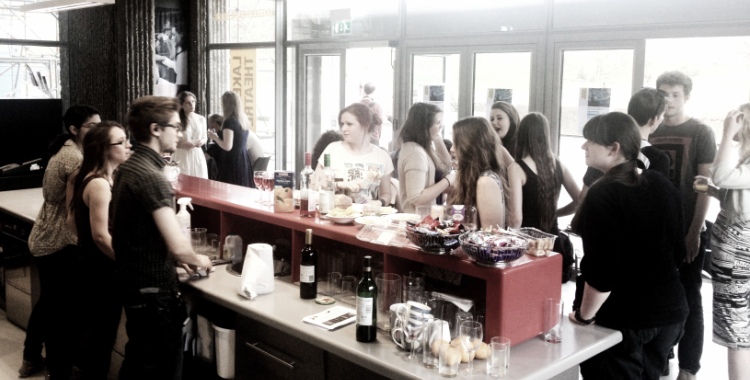
Colchester 24.4.13 Theatre Arts Society and Frequency Theatre ViTW Reception 2 (2)

Originally written for The Stage.

The post-show discussion does not have the best of reputations. What should be an opportunity to share thoughts and gain artistic insights often becomes a stilted Q&A, a one-sided stream of anecdotes, or an unspoken contest to see who can ask the most intelligent question. But what about a post-show discussion for people who hate post-show discussions?

One of those people – by her own admission – is Lily Einhorn, project manager of the Young Vic’s Two Boroughs community engagement scheme. The project offers free tickets to residents of the boroughs of Lambeth and Southwark, many of whom Einhorn noticed were attending the theatre on their own. Recognising the lack of opportunity these theatregoers might have to discuss the work they were seeing, and acknowledging that the usual post-show format might alienate or intimidate them, Einhorn set about creating an alternative.

The Two Boroughs Theatre Club is modelled on the book club format: rather than being plunged straight into discussion immediately following a show, recipients of Two Boroughs free tickets are invited back after they have all had a chance to watch and reflect on a production. And just as a book club would never dream of inviting the author, Einhorn is firm that no members of the artistic team should be present for the discussion facilitated by the Theatre Club.

“I thought it would be really nice to have a group where the creative team are strictly not allowed,” Einhorn explains, “because I wanted it to be a comfortable atmosphere where people felt like they could say anything they wanted without fear of offending anyone, but also without fear of feeling like they’re stupid.” She continues, “it’s about unlocking something in them and saying: ‘your opinions are as valid as anyone else’s opinions’”.

Einhorn’s brainchild has been run in partnership with Guardian writer and Dialogue co-creator Maddy Costa, who has similar reservations about the traditional post-show format. “We all kind of hate the post-show discussion where everyone’s trying to ask the most interesting question,” she says. “So Lily and I both agreed that we don’t even go to those things; what we wanted to create was something different.” Their Theatre Club is designed to be as welcoming as possible, doing away with the hierarchies that usually characterise post-show events and creating a space that allows for relaxed, open discussion. The response has been enthusiastic, prompting Costa to try it out at other theatres, both through Dialogue and in association with theatre producers Fuel.

Einhorn and Costa are not the only ones seeking alternative models to the post-show Q&A. Camden People’s Theatre, for instance, has created a format it calls Talk Show Club, in which discussion is led by another theatre-maker who has not been involved with the show in question. China Plate, meanwhile, has adapted the post-show events surrounding its latest tour of Mess to suit the specific needs of both production and audience. Caroline Horton’s show is based on her own experiences of anorexia, opening up numerous issues around eating disorders. In recognition of this, China Plate are currently touring the show in association with the charity BEAT, taking it into schools and colleges as well as theatres and running a tailored series of discussions and workshops designed with psychiatrists from Kings College Hospital.

While numerous practitioners are currently experimenting with different formats, the idea of a model that eschews the post-show set-up of questions and answers is not entirely new. The National Theatre’s Platforms programme, which has been running almost as long as the theatre itself, is decidedly not post-show. Instead, the building runs regular events in the slot before its evening shows, ranging from straightforward discussions about the productions in the current repertoire to conversations that address the programme more obliquely. In the past, for example, Platforms have hosted numerous comedians and politicians, as well as a memorable encounter between atheist writer Philip Pullman and the Archbishop of Canterbury.

“It isn’t about being immediately reactive, audience wise, to what you’ve just seen,” says Platforms programmer Angus MacKechnie. “It’s either about making a choice to learn more about what you have seen on a previous occasion or coming to prepare yourself in advance of seeing it, usually on that night.” As a result, MacKechnie suggests that “it’s a different kind of commitment from audiences and we get a different kind of relationship with the audiences”. Because of the absence of an educational focus, MacKechnie explains that these events also offer audience members the opportunity to ask questions that they might not normally voice.

The desire to make critical conversations around theatre more inclusive and accessible is a feature that many of these initiatives share. The Theatre Club discussions might be guided by Costa, but the principle is that everyone in the room is equal and free to share their thoughts. “I am not the person with all the answers,” Costa makes clear, “I go in with as many questions as anyone else.” In line with this approach, Fuel’s co-directors Kate McGrath and Louise Blackwell make it clear that the Theatre Club events represent “one of the key ways that we are building new audiences and making our work more accessible”. Lorna Rees, one of Fuel’s local engagement specialists and a regular organiser of post-show events, puts her attitude simply: “for me there are no ‘silly questions’”.

Crucially, all of these events are about contact and conversation. MacKechnie insists that at the National Theatre “we don’t just drop the curtain and that’s it, you haven’t got any more contact with us”, while for Einhorn the Two Boroughs Theatre Club is about “prolonging and enriching” the theatregoing experiences of its participants. The conversation itself, meanwhile, is one in which exclusive, specialist vocabulary is exchanged for straightforward, honest expression. For Costa, it all comes down to a simple but vital distinction: “Theatre Club is a place where we don’t ‘speak’ theatre, we talk about theatre, and those are two very, very different things”.

Conversation Starters

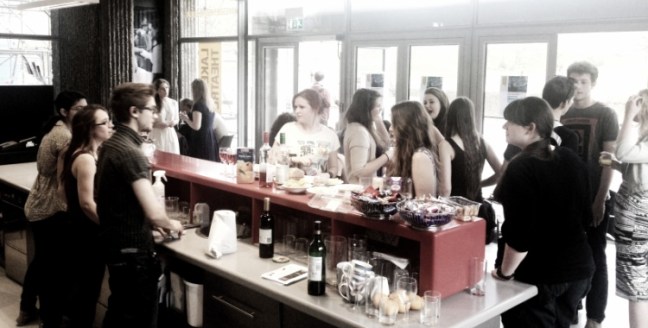
  • Maddy Costa and Fuel have found that offering refreshments instantly shifts the mood of a post-show event, transforming it into a welcoming social context. As Kate McGrath and Louise Blackwell put it, “you don’t have to spend a lot on hospitality, but you do have to be hospitable”.
  • It can also help to move the discussion out of the theatre space. While the National Theatre’s Platforms have successfully used the stage, Lorna Rees suggests that sometimes the auditorium “can be quite intimidating and not conducive to discussion”.
  • Involving the audience does not have to be difficult or complicated. Costa explains, “I always start by just getting a quick show of hands, did you like it, did you not like it, something very simple like that”.
  • Angus MacKechnie recommends experimenting with the format and fitting it to the context of discussion. “In terms of format, form should follow function,” he says.
  • Fuel point out that it must be clear where and how the event is taking place, so they recommend sending out invitations, putting up flyers and making sure box office staff are fully briefed.

Photo: The Lakeside Theatre, Colchester.

1984, Richmond Theatre

19841-600x374

Originally written for Exeunt.

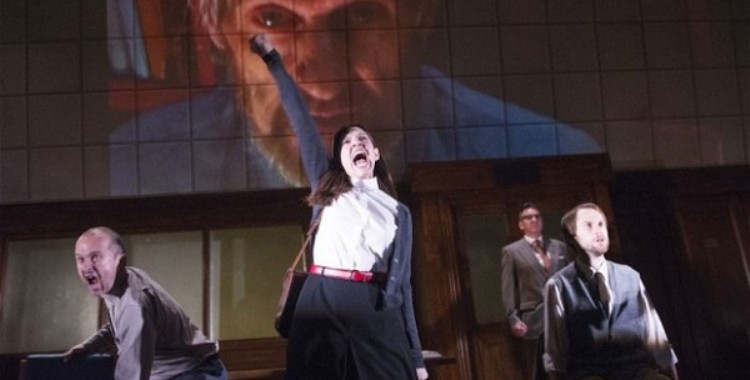
George Orwell’s chilling dystopian novel is best remembered for the features that have seeped into our contemporary cultural consciousness: Big Brother, Room 101, the Thought Police. But perhaps the real key to Nineteen Eighty-Four lies in its final, often overlooked pages. In Headlong’s bracing new version, adaptors Robert Icke and Duncan Macmillan use Orwell’s typically discarded Appendix as a means of re-examining his entire narrative, offering – in what sounds like a perfect instance of doublethink – an extraordinarily faithful transformation of the text.

Orwell’s dry, formal Appendix, entitled ‘The Principles of Newspeak’, begins with the seemingly innocuous words “Newspeak was the official language of Oceania”. Realising, like Orwell, the huge difference contained in a change of tense, Icke and Macmillan latch onto that crucial “was” and hang upon it their entire adaptation. In their nightmarish rendering of this dystopia, past, present and future are slippery, fluid categories, bleeding into one another before our eyes. What we are left with is the blank, continuous present that the Party envisioned, where the notion of history has been all but abolished.

This is achieved through the canny addition of a framing device, which tackles the troublesome Appendix by way of a book group interrogating Winston Smith’s tale. Imagining Orwell’s novel as an artefact, this structural flourish puts Winston’s experiences in direct dialogue with the future he hoped to speak to when starting his diary. And yet, in a conundrum that reveals the central problem of the Appendix itself, this textual artefact is not in fact Winston’s diary, but a third person account of his rebellion and suppression. How, then, has this document survived? Who has written it? And if it really has survived, who has allowed it to survive?

These questions are persistently posed by an adaptation that strikingly reconfigures Orwell’s text in service of a searching examination of what it is doing. Through an unsettling temporal slippage, the future framing of the narrative exists directly alongside Winston’s hatred for the party, his ill-fated love affair with Julia and his horrifying ordeal at the hands of the Ministry of Love. The world this structure creates is one where no firm foothold can be made on either the past or the future, one where uncertainty is the only constant, one where – most importantly – no document can be trusted.

The theatre, where a kind of doublethink is constantly in play, is the perfect arena for this dizzyingly intelligent interrogation of truth and fiction. Here, we are always caught in the process of accepting that an object on stage is at once one thing and another, a function of theatrical metaphor that Icke and Macmillan’s production repeatedly exploits. Mark Arends’ haunted, disorientated Winston always creates the impression of being both here and not here, dislocated from linear time. “Where do you think you are?” he is repeatedly asked, to which the answer is always bewilderment.

As well as the crossover between temporalities and characters, Chloe Lamford’s inspired set design epitomises this relentless doubling. The first part of the show is contained within a bland office space, all non-descript chairs, wood panelling and boxes of files. This serves as both the setting for the book group and the backdrop of Winston’s existence, demanding metaphor in order to function within the narrative. The only area external to this space is Winston and Julia’s short-lived retreat, which is at once hidden and exposed; it exists off stage, beyond our immediate gaze, but it is revealed to us via video footage on screens, putting us in the position of the ever-vigilant eye of Big Brother. In the final third of the show, meanwhile, this design achieves a breathtaking transformation, stripping away tangible referents in a process that mirrors Winston’s struggle to hold onto memory and reality, yet still refusing to fix itself on just one, determinable location.

And it does not stop with the design. Every last element of this production, from the discordant strains of Tom Gibbons’ sound design to Natasha Chivers’ accomplished lighting, which ranges from the unsettlingly anaemic to the blindingly bright, contributes to a disquieting atmosphere of uncertainty and uprootedness from time. We, like Winston, have nothing solid to grasp onto.

With Chelsea Manning, the NSA and Edward Snowden still dominating headlines, we hardly need reminding of the continued and disturbing resonance of Orwell’s 1949 novel. Headlong’s startling new production, however, suggestsNineteen Eighty-Four’s prescience in another, deeper way. Orwell’s vision, Icke and Macmillan reveal, penetrated beyond the structural framework of surveillance, right down to the disorientating experience of modern life under late capitalism. Like all the worst nightmares, its chill emanates from its uncanniness.

People Show 121: The Detective Show, Old Red Lion

detective-600x355

Originally written for Exeunt.

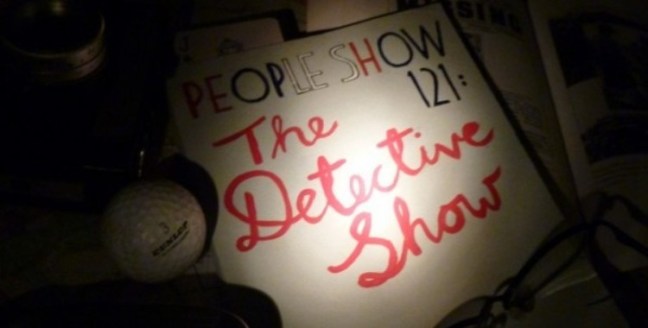
In The Coming Storm, Forced Entertainment’s latest offering, some critics saw an even greater self-reflexivity than usual; it was suggested that the show was in some way concerned with the company’s legacy and with deconstructing its familiar dramaturgical strategies. In the new piece from The People Show, an experimental company with a considerably longer history, there seems to be a similar focus. People Show 121: The Detective Show (the sheer accumulation of work indicated by the title alone is quite extraordinary) is as much a reflection on the company’s own techniques and its far-reaching influence as it is a dissection of the much-loved detective genre. It’s less whodunit, more how was it done.

Having been around since the 1960s, it’s hardly surprising that The People Show’s influence has rippled out to countless other theatremakers over the years. Now, however, the company is faced with the strange dilemma of being placed alongside the work it has spawned, much of which has caught up with – if not overtaken – its taste for experiment. As a way of acknowledging and negotiating this, People Show 121 makes no attempt to ignore or overcome the company’s history, which is immediately hinted at on stage by the presence of tireless original member Mark Long. Their techniques are flagged up, exaggerated, even lightly mocked for being hackneyed. As one performer apologetically explains, they are – like so many of the companies who were inspired by them – “just trying the postmodern thing”.

Here, the “postmodern thing” proves to be a knowing deconstruction of both detective narratives and the mechanics of theatre. In the rambling, charmingly chaotic plot, a hapless jobbing actor falls for an Agatha Christie obsessive with a dangerous secret to hide – a secret that soon sees her sprawled out inside the cartoonish chalk outline on the floor. Within the frame of this murder mystery, the structure of the show also manages to support a surreal game of Cluedo, a dancing Poirot and a hilariously hammy Italian waiter, along with plenty of over-the-top mime and some deliberately self-conscious narration.

It’s an intentional shambles, riffing on familiar detective genre tropes to generate laughs, while at the same time nodding to the now popular technique of presenting failure on stage. Performers Long, Gareth Brierley and Fiona Creese bicker between scenes, undermine each other’s performances and at times almost bring the whole piece crashing down around them, only to pick up the fragments of the show and carry on. It’s deliciously silly fun, effectively skewering a tactic of contemporary performance that has now become so prevalent it is danger of congealing into cliché.

Belonging to one of the generations created under the influence of The People Show rather than having direct exposure to the first shocks of its innovative approach, my perspective on this work is inevitably coloured by coming to it through its theatrical progeny. For me, however, the postmodern mickey-taking of People Show 121 – for all its undoubted fun – ultimately lacks any real bite of its own. Instead of offering the sort of bracing, experimental approach that has made them such a force over the years, The People Show attack an aesthetic that is all too familiar.

Gym Party

gym party-163-square

As an audience member, I have a slightly strange relationship with Gym Party. I went to two very early scratch versions, spent over an hour in a rehearsal room chatting about it with Made in China’s Jess Latowicki and Tim Cowbury, and saw a final work-in-progress at the Almeida Festival – before entirely missing the Edinburgh run. Now, catching it at BAC, it’s the fourth time I’ve experienced the show in some form (fifth if you count the extended conversation about it) and each time it’s been significantly different.

What has remained the same in each of these various incarnations, however, is the underlying impulse. Made in China want to talk about competition. It is, as Jess admitted when I spoke to them, a massive, nebulous topic. There are the more obvious types of competition – sporting events and talent contests – but it’s also a drive that motors almost every area of our existence and is deeply embedded within free market capitalism. As Jess says, “There’s always a winner in the free market, whether it’s Hollywood, or whether it’s banking, or whether it’s you got a new car but I got a better new car.” In whatever context it might be, individuals are constantly pitted against one another.

The desire of Made in China (at least, this is the impression I got from our conversation and from the various incarnations of the show that I’ve seen) is to address not the specifics of competition, but its troubling grip on us as a society. The various manifestations of competition, be it X Factor, a political debate or a game of one-upmanship between school kids, are all just symptomatic. What the company is attempting to do, by alluding to all these different varieties of real world competition within the frame of a staged contest that they compete in each night, is to playfully but powerfully draw our attention to how competition determines our interactions and what that might be doing to our society.

With such ambition and scope comes the very real possibility of failure. There is, after all, a hell of a lot to fit in there. What’s been fascinating about seeing the show at various stages of its development is witnessing just how much material has been hacked off, discarded and occasionally recovered along the way. Victims of the process included a scene in which performer Chris Brett-Bailey was tied to the floor, a sub-plot involving the gym party of the title, and a shrine to Hollywood actor Taylor Kitsch, an ardent espouser of hard work and American Dream ideals.

The show at the end of this process follows a smart and surprisingly tight structure, within which there is room for a certain amount of conflict, messiness and digression. Even the material itself sometimes seems engaged in an internal competition, but the rules of the containing contest are clear. The piece is divided – ironically, one might argue – into three parts. Rather than acts, however, these take the form of rounds. Competing in these rounds are Jess (Latowicki), Chris (Brett-Bailey) and Ira (Brand), all dressed in primary school PE-style shorts, T-shirts and plimsolls, with the added gaudiness of brightly coloured wigs. They all want their name up in lights; they all want to win. There are lots of things they’re willing to share, but not the glory of victory.

There is a light balance throughout between anger and playfulness, which is expressed in perhaps its purest form through the rounds of competition themselves. These start out innocuously enough, with a light-hearted blend of sports day activities and party games. Jess, Chris and Ira are up against each other in contests to see who can stuff the most marshmallows in their mouth or who can jump the furthest. It’s silly, entertaining, riotous stuff, even on the fourth viewing.

In the second round, we are taken into more personal territory with a series of votes based, essentially, on nothing but appearances. In this section there are obvious similarities with Ontroerend Goed’s latest show Fight Night (which, incidentally, I paired with Gym Party in an Edinburgh preview feature), but where Fight Night felt slick and smug, here there is an uncomfortable proximity between laughing pretence and very real approval or rejection. It’s often funny, but there are also odd, jolting lurches when the hollow meanness of the task suddenly hits you with horrible force. This feeling is to an extent replicated in the final round, in which the personal is brought right to the fore and the role of the audience is even more integral.

Following each of the rounds – and this is where the anger really bites – are the penalties for the losers. It might all seem like fun and games, but the punishments that ensue leave us in no doubt of the bitter consequences for those who find themselves unable to win. Here too the show carefully tiptoes the line between the fake and the real, the funny and the distressing. The most unsettling of these moments occurs when Jess, one of the losers, strips down to her underwear and stands on a platform while Ira brutally criticises her physical appearance. The genius of it is that Ira’s dry delivery still generates laughs – great guffaws that quickly sour in the mouth. Like so much competition, it’s hilarious and horrifying in the same moment.

The other key strand of the show, alongside the three rounds of competition, is made up of interweaved monologues from the performers. Each of them asks us to imagine them at a key point in their lives, all aged twelve. For Jess, it’s the mortifying aftermath of falling out with a group of friends; for Chris, a moment of betrayal at the school dance; and for Ira, it’s the first time she discovered the victory involved in acts of noble self-sacrifice. Juxtaposed with the frenzied tempo of the contests, these are delivered with captivating stillness, adding interesting shade to the bright and sometimes blinding light of the rest of the piece. This segment also produces one of my favourite moments of the show when the stillness is eventually broken by Chris, who takes up his guitar to perform a haunting rendition of ‘Everlong’.

Although it can sometimes feel as though the show has moved away from the reference point of its title, it is in these monologues that it regains its vital significance. The gym party – a distinctly American term, but one with a clear British equivalent – is one of the first serious competitions in life. The prize might only be to dance with the partner of your choice at arm’s length, but it’s a competition nonetheless – and a cutthroat one at that. The significance of the memories being pinned to the age of twelve, meanwhile, is perhaps that this is the age when we are on the cusp of competition turning nasty, when we are at the tipping point between that playfulness and anger. There is also something striking about the potent anxiety of adolescence, an anxiety that seems to be mirrored in our nagging impulse to compete. What if we don’t fit in? What if we’re lagging behind? What if we’re a failure?

These insistent, troubling questions bubble away beneath the whole piece, uniting what might otherwise seem like disconnected fragments. As well as the competitions and the monologues, we get the desire for fame and beauty; the desperate need for attention; the poison of David Cameron’s “aspiration nation” rhetoric, barely concealed within a blistering speech from Jess. There is also, crucially, a key element of competition being addressed through the relationship with the audience. They are here for us, the performers frequently remind us – to give us “bang for our buck”, as Ira puts it. If it weren’t for us, none of this would be happening.

It strikes me that there are a number of layers to this relationship with the audience. In one sense, we are like the television audience watching contestants being humiliated on talent shows, silently offering our complicit approval simply by choosing to watch. As the performers are keen to point out, our quiet acquiescence can be read as a “consensus”. Linked to this, we are also a necessary presence, both in a theatrical sense (though, interestingly, the knowing references to the theatrical contract have been diluted since earlier showings, wisely abandoning a pointed meta-theatricality in favour of a more all-encompassing construction of the audience’s role) and in a “democratic” sense. We vote and thus we are essential to the outcome. One individual succeeds, but they only succeed via the approval, aid or inaction of the collective, offering another fascinating perspective on how competition functions in our society. After all, what would the success of the individual mean without the presence of the group they outstrip?

They may involve their audience, but equally integral to Made in China’s approach is the desire not to offer us with ready-made answers. As Tim explained to me back in the summer, “the show won’t try and give answers and we never really have”. He went on to say that the company are much more interested in asking questions, in creating a provocation and leaving it up to audience members to go away and form their own opinions. As an audience member and as a critic, this is a tactic that I tend to find far more effective than work that simply tells me what I should think. If you make a straightforward argument, it can be disagreed with and therefore easily dismissed; if you ask a question, it has a habit of lingering for longer.

It’s interesting that this is an explicit aim of Made in China’s work, as there are ways in which some of the earlier versions of the show arguably did come close to offering answers, or at least to implicitly instructing audiences in their response. Without giving too much away, the ending that I saw in the Almeida Festival work-in-progress was far more shocking and confrontational, seeming to actively encourage an intervention from audience members. It was deeply uncomfortable and provoked a number of walk-outs. The final scene that the company eventually opted for in Edinburgh and at BAC, however, tones down the discomfort, still asking for the audience’s involvement but in a way that enables the conclusion rather than interfering with it.

I was intrigued by the dramatic shift in tone between the two different endings and in the different responses they provoked from an audience. At the Almeida, the atmosphere in the audience after the show was one of light shock; it was as if we had been collectively shaken, and were still reeling slightly from the force. At BAC, however, the aftermath was calmer, more thoughtful. On leaving the performance at BAC, my own position on these contrasting conclusions was ambivalent. There was something thrilling and violently galvanising about the original ending, which without doubt had more of an immediate impact than the modified one. On the other hand, the way that Made in China had eventually chosen to conclude the show made more dramaturgical sense, completing a structural circle rather than rupturing it.

Because I found myself torn but fascinated, and because I know Jess and Tim a little from our conversation a few months back, I emailed them the day after seeing the show at BAC to ask about the decision to change the ending. Given how much I talk about dialogue between critics and artists, it seemed like an interesting opportunity to initiate that kind of conversation. I made it clear in my email that I was simply curious, that I appreciated it was a slightly unconventional request from a critic, and that I would completely understand if they didn’t want to share the details.

Happily, though, Tim replied with a brilliantly thoughtful and articulate explanation of the company’s decision. Their interpretation of the reaction to the Almeida showings was that audiences were “getting and digesting our message before the show was finished”, resulting in an intervention within the theatre space rather than outside of it. This touches on a question I frequently find myself grappling with, namely whether action in the theatre can be a spur to action outside the theatre. I still don’t think I have an answer to that one. Made in China, however, “don’t want people to have the catharsis of righting wrongs within the theatre: they should save that for the real world”. Instead of intervening, audiences should leave “cursing their own passiveness and maybe (ideally) the fact that the show, like most of the power structures in our society, sneakily manipulated this passiveness of out them”.

It’s this idea of passivity and manipulation that I’m most intrigued by. Some of the most powerful experiences I’ve had in theatres have involved being uncomfortably torn between action and stasis, feeling the need to do something but not quite able to do it. It’s a feeling that is sickeningly familiar in a world where the structures around us so often reduce us to a state of perceived powerlessness. And it is this feeling, I think, that was missing from Fight Night – a helpful comparison to bring back in at this point.

When I saw the show in Edinburgh, I found myself slightly perplexed by how I could have so much admiration for the show’s intelligence yet be almost completely unmoved by it. Despite the machinations by which it cleverly revealed the failings of modern democracy, I was not left feeling angry or frustrated. There were a couple of moments during the show when the sharpness of its critique sent a slight shiver down my spine, but afterwards I found it all too easy to shrug off. It was so slick, so glib, so seemingly pleased with its own cleverness. Despite the obvious necessity of my presence as an audience member, I never really felt that I had any influence on the outcome – which is of course the realisation that Ontroerend Goed and The Border Project wanted to provoke, but that internal conflict that I described above can only be produced when there seems to be some possibility of making a meaningful intervention, however slim that possibility might be. I felt utterly distanced from Fight Night, in such a way that its impact barely touched me.

By contrast, Gym Party is injected with a certain sense of risk. Yes, we know that it’s theatre, that it isn’t “real”, but there’s somehow something more raw, more rough about it, which allows an audience – perhaps – to feel that their intervention is an actual possibility, that it might change something. The opportunity is there, and the weight of responsibility falls on our shoulders if we fail to take it. This is an extraordinarily delicate balance to strike. The piece must make us feel that we can act, yet at the same time disable that possibility. It has to build in its own failure.

Personally, though it gets far closer than Fight Night, I’m not quite sure the balance has entirely been struck. The first time I saw the ending, I felt horrified by how little action I took, but the event did offer the opportunity for others to intercede. The second time around, intervention was possible and yet not attempted, but the force with which the piece closed was weakened; perhaps the feeling of manipulation was greater, but the guilt was less. The comparison, however, begs an interesting question. Are we more affected by the opportunity to act within the space of the theatre, or by a piece that implicates us through our failure to act? In the spirit of Made in China, I’ll just leave that question mark hanging …
The Events, Young Vic

events-600x336

Originally written for Exeunt.

“It’s important to turn dark things into light,” says Claire, the anguished figure at the heart of David Greig’s new play, not quite convincing herself. The Events,Greig’s response to his conflicted feelings about the Norwegian massacre committed by Anders Breivik, is driven by a similar desire and tempered by similar doubt. As much as its protagonist, The Events searches for understanding, redemption, hope. What it finds is nothing so straightforward, but it is all the more compelling for the complexity it excavates on stage.

While sparked by a discussion between Greig and director Ramin Gray following the Breivik atrocity, this is not about what happened in Norway in July 2011. Instead, the events of the show have ripped apart a small, unspecified seaside community, where a boy has shot and killed several members of a local multicultural choir. Claire, the leader of the choir and a survivor of the massacre, is searching for answers. How did this happen? Why did it happen? Did the perpetrator have a reason, or must his actions be put down to “evil”?

Through the character of Claire, played with compassion and complexity by Neve McIntosh, the play prods at the insistent human desire to understand. Without understanding, Claire’s rage is impotent, directionless. In search of either an object for her hatred or an explanation that might pave the way to forgiveness, Claire hunts everywhere for answers, interrogating in turn the murderer’s father, his schoolmate, the leader of the right-wing political party whose ideology he laid claim to. But the more details are added to the sketch, the more the picture is obscured.

The succession of individuals questioned by Claire in her search for the truth are all played by Rudi Dharmalingam, who also represents the perpetrator of the central atrocity. This canny choice by Greig and Gray can be read in a number of ways. On the one hand, Claire seems to be seeing the face of the murderer in every place she looks, unable to escape him even in the embrace of her lover. The playing of all other roles by one actor also creates an intriguing quality of slipperiness; the killer is both everywhere and nowhere, inhabiting each last crevice of her consciousness while at the same time taunting her with his elusiveness. The ambiguity is enhanced by Dharmalingam’s performance, which meets Claire’s desperation with a refusal to emotionally engage, delivering each line with the same blank, lightly mocking intonation.

The impression we receive is that of a woman caught in a self-constructed labyrinth of questions, finding herself more and more lost with each new turn. There’s a certain disjointedness to the scenes, an apt sense of confusion and dislocation that hints at the incomprehensibility of what Claire is trying to piece together. Claire is a woman unmoored; unmoored from her faith, from those around her, from a previously solid sense of reason and logic. Buffeted by the currents of grief, rage and an utter failure to understand, she is alone in a sea of uncertainty.

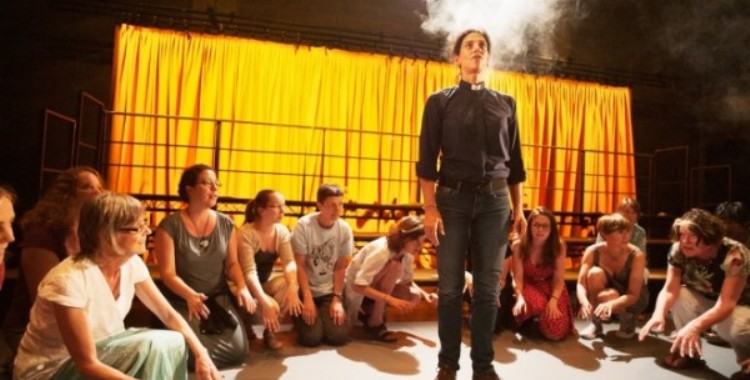
Claire’s struggle is reminiscent of certain strands in Chris Thorpe’s There Has Possibly Been an Incident, both in the subject matter – Thorpe’s play also features a massacre with hints of Breivik – and in its staging. In There Has Possibly Been an Incident, individuals are isolated down to the level of voice, which speaks against the blank, bland backdrop of Signe Beckmann’s minimal design. Here, Chloe Lamford’s set is similarly, masterfully simple. The stage is relatively bare, furnished only with a few rows of benches, a garish orange curtain, a piano, stacks of plastic chairs and tables loaded with teacups. The visual cues that this design offers are all painful reminders of the choir rehearsal room, but more important is the yawning empty space in its middle. In this space, McIntosh’s tormented Claire searches for ways to fill the gap, not just investigating but also acting, playing out different outcomes and solutions.

Sharing the sparsely furnished stage with McIntosh and Dharmalingam throughout the show is a local choir, different every night. This touch, which on paper has the sound of a gimmick, is in fact the production’s masterstroke. On the level of the play’s narrative, their role is one of haunting, suggestive of how something – the soul, God, the accusatory whispers of the dead – can remain present even in its absence. The choir’s presence and the songs they add to the piece also nod towards the potentially redemptive and community building power of music, which at first has a flavour of bitter irony, but eventually sweetens into something like hope.

On the level of the production, meanwhile, the choir does something even more interesting. Arranged on a bank of seating directly opposite that in which the audience is arrayed, the singers act as witnesses; mirroring the audience, they struggle alongside us to grapple with the questions the play poses. Their lack of slickness or preparation also adds a vital roughness, a slightly messy and unpredictable edge that makes the piece all the more truthful and affecting. At one moment during the performance, I notice one of the choir members raise a hand to her mouth, an involuntary but striking movement that focuses my attention on the theatrical dimensions of the event – the fact that we are sharing a public space and collectively processing this effort to understand.

In his introduction to the playtext, Gray writes that “Every act of theatre revolves around a transaction between two communities: the performers onstage and the improvised community that constitute what we call an audience”. His choice of the word community is no accident. The Events is all about communities – or “tribes” – with no small amount of tension contained in that notion. Community in the sense encapsulated by Claire’s choir is overwhelmingly positive, yet it is also in the name of community, or of protecting a certain community, that atrocities like this are committed. Greig’s intricate, finely tuned arguments have a habit of sharply pivoting, challenging our assumptions and once again subjecting everything to knotty ambivalence.

In the end, how these events and their wounding repercussions read is down to each of the individuals in our improvised community, the audience. It is easy to take despairing doubt from what we are presented with, but it’s equally possible to seize on hope. Near the end, a crucial moment in the narrative is suddenly ruptured by the intervention of a choir member, who reads from a script explaining the different between chimps and bonobos. While chimps solve conflict with violence, bonobos prefer sex to aggression, greeting their enemies with embraces. Humans, we are told, share exactly 98% of our DNA with each species. Which, therefore, do we most resemble? The implication, like that of the whole production, is that it for us to decide.

Photo: Stephen Cummsikey