Macbeth, Little Angel Theatre

macbeth1-600x525

Originally written for Exeunt.

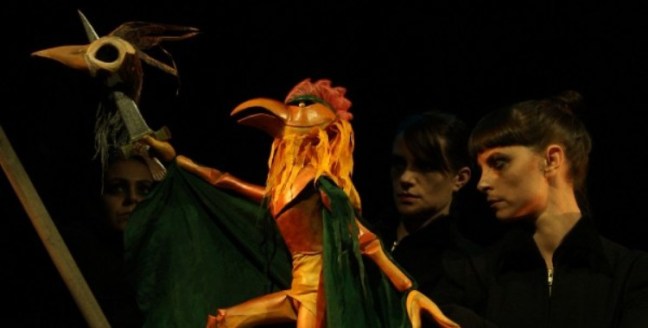
Ever pushing gently at the boundaries of what puppetry can and can’t do, the Little Angel Theatre’s latest challenge is a puppet adaptation of one of Shakespeare’s best known and bloodiest plays, opening this year’s SUSPENSE Festival of Puppetry. Challenge is the right word, as this is no easy feat to pull off, but somehow, with typical tenacity, the Little Angel just about manages it.

At the centre of this pruned-down reimagining of the play is a concept that casts all of Shakespeare’s characters as birds. The rank-climbing Macbeth is a proud cockerel, as are Banquo and Macduff, with Lady Macbeth as a preening chicken; King Duncan and his sons have been transformed into regal swans; the witches are recast as ethereal yet vicious carrion birds. Unexpectedly, this choice is borne out by the text, in which mentions of crows and other feathered creatures suddenly leap from the dialogue. There is also something in the pecking of the chicken and the swooping of the vulture that seems oddly appropriate for Shakespeare’s tragic portrait of grasping ambition, which comes across as all the more mean and ridiculous as a result.

Perhaps unavoidably, director Peter Glanville’s production is at its most successful when visual language dominates, flagging a little during the wordier sequences. It’s challenging to keep a soliloquy engaging when it spouts from the mouth of a puppet – even Lyndie Wright’s brilliantly animated designs can only suggest so much expression. The decision to use a pre-recorded soundtrack, however, is a canny as well as a practical one, adding an aptly unsettling sense of disembodiment to the dialogue that is at its most powerful during Macbeth’s encounters with the genuinely chilling witches.

In the captivating wordless scenes, the usual enchantment of the Little Angel’s offerings is swapped for an altogether more haunting variety of magic. In one spellbinding sequence, a doomed King Duncan is offered the graceful illusion of flight, while in another a battle is suddenly transformed into a thrilling, feather-shedding cock fight. The dark atmosphere, reflected in Peter O’Rourke’s gloomy set design, is also aided by James Hesford’s original score of ominous melodies and discordant notes.

Wright’s colourful array of beautifully crafted puppets are all operated by skilled puppeteers Claire Harvey, Lori Hopkins and Lowri James, dressed from head to toe in black. Rather than disappearing behind their puppets, these three figures take on a sinister significance within the performance, hovering omnisciently over the action like the circling witches and unceremoniously disposing of the mounting corpses. Playing with the manipulation that is a necessary ingredient in puppetry, this production delicately draws out themes of fate and pre-destination, leaving us in no doubt about the unseen hands guiding the action.

The Light Princess, National Theatre

LightPrincessNT3©-Binkhoff-Mögenburg_2-600x399

Originally written for Exeunt.

There can be little doubt by now that fairytales are a fertile source of artistic inspiration. And, as Angela Carter brilliantly proved with The Bloody Chamber,they are certainly not just for children. The long-awaited musical by Tori Amos and Samuel Adamson attempts to follow in this line of interpretation, adding considerable narrative and thematic padding to the 1867 tale by George MacDonald. Unfortunately, the result is less innovative than it is wedded to convention and archetype – not so much reinventing fairytale tropes as giving them a light prod.

The premise itself is intriguing. Althea, played by Rosalie Craig in a dazzling central performance, has no gravity. The princess hovers perpetually above the earth – not flying, but floating – unable to keep her feet or her thoughts rooted to the ground. Following the death of her mother, Althea’s head is in the clouds in more ways than one; she is buoyant in spirit as well as body, living in a fantasy of her own construction and incapable of taking anything seriously. Her opposite number is another motherless royal, Prince Digby, who reacts to grief not with escapism but with unrelenting sorrow. Thanks to the warring of their two nations, Lagobel and Sealand, the two are quickly set on a collision course – one that any fairytale fan can see will end in romance.

From the initial lengthy exposition onwards, the musical teeters uncertainly between straightforward fantasy and impish irreverence. In its most enjoyable moments, it is knowingly playful, referencing and occasionally sending up its fairytale heritage. Matthew Robbins’ animations, which lend a hand with the early storytelling, have an appealing picture-book quality, while the “once upon a time” framing of the narrative by Amy Booth-Steel and Kane Oliver Parry offers glimpses of arch wit. Elsewhere, however, the show slides all too smoothly into established patterns. There is nothing essentially wrong with conforming to fairytale conventions – they haven’t endured for hundreds of years for nothing – but The Light Princess never seems quite sure what it is doing with these inherited devices.

Equally, Amos and Adamson’s flimsy plot makes a cursory and often clumsy attempt at feminist revisionism. Mentions of Angela Carter in the programme notes – known, of course, for her own feminist appropriation of fantastical narratives – raise hopes that the piece itself all but dashes. Yes, Althea’s characterisation is a bit more complex than your average Disney princess, and yes the final tying up of loose ends raises a couple of cheers for strong women, but on the whole the storyline is hardly subversive. Even in the supremely capable hands of Craig, Althea is not a patch on one of Carter’s heroines.

Despite these flaws, however, there is a fair amount of enchantment in Marianne Elliott’s inventively staged production. Rae Smith’s design occasionally veers towards the indulgently saccharine, but at its best it conjures the spirit of heightened, wide-eyed wonderment that is at the heart of all good fairytales. There’s also some charming puppetry and a series of giddying acrobatics to create the illusion of Althea’s weightlessness – so giddying, in fact, that the sheer awe they inspire can be distracting. Craig, meanwhile, is stunning in the central role, achieving Althea’s floating physicality with an apparent effortlessness that must in fact be extremely effortful, while lending her belting voice to Amos’ surprisingly unmemorable score.

But just as the production seems about to sweep us off our feet – as during the aerial stunts of the unapologetically romantic first encounter between Althea and Digby, or in an altogether darker scene that finds its heroine suddenly earthbound – it struggles to maintain the flight that is so natural to Althea. Caught between playful subversion and faithfully rendered magic, The Light Princess fails to deliver on either.

Photo: Binkhoff Mögenburg

The Planet and Stuff, Polka Theatre

planet-001

Originally written for Exeunt.

How do we solve climate change? As opening questions go, it’s a biggie. It’s also a question loaded with optimism and arguably childlike naivety; it implicitly makes the assumption that climate change can be solved, and that humankind is capable of a collective effort to do so. But Tonic Theatre’s new children’s show is far from blindly optimistic.

The set up is simple: “volunteers” Joe and Becci, played by Felix O’Brien and Sarah-Jane Scott, are given half an hour to explain what is causing climate change and work out what we can do to solve it. The format is a gleeful mash-up of TED talk, kids’ documentary and Blue Peter-style demonstrations – complete with “here’s one I made earlier” fossil fuels. There’s also playful interaction from the audience and just a dash of good old panto conventions; whenever a big sign lights up, for instance, we can yell at the two performers to “get on with it!”

The show begins in fairly predictable if entertaining style, explaining global warming using jumper and blanket metaphors and recruiting the audience to throw around paper planes. Familiar explanatory techniques are deployed and people are plucked from their seats to recap what we’ve learned. This is smarter, however, than your average Newsround segment. Once the initial explanations are out of the way, a tension quickly emerges between optimism and pessimism, staging a latent debate about how best to present these ideas. Should we face up to the impending disaster we are wreaking on our planet, as Joe’s litany of catastrophes suggests we should, or should we stick with Becci and keep things fun? Is fear enough to make us change, or do we need to remain stubbornly positive despite the odds?

Similar tensions rear their head when we reach the solutions half of the show, which proves much harder than simply getting across the facts. The responses of world leaders are lightly hinted at in a section entitled “the blame game”, while Joe and Becci echo all our secret, selfish reactions to the suggestion that we might need to change. Complexity is embraced rather than skirted around, as possibility follows complication follows possibility. Each solution that is proffered is countered with a disadvantage, refusing to underestimate its young audience’s grasp of these thorny questions.

Variety, however, ends up being one of the show’s greatest strengths – in more than one sense. Aesthetically, the piece is colourful and richly textured, brushing off any residue of tedium that might have attached itself to the lecture format. The pace is brisk and the tools of performance are abundant, from sound to video to audience interaction, ensuring that the attention of young (and older) audiences is not allowed to dip for a second. Multiplicity also ends up being the vital saving grace of the ever more desperate answers that Joe and Becci throw at us. Each can be undermined, but we also have the choice to make these changes, to do what we can no matter how small, and – most importantly – to try.

Perhaps unsurprisingly, the central question is never quite answered. Climate change comprises a complex web of different causes and is – as this show reminds us with remarkable simplicity – symptomatic of the systems that order our lives. To suggest that there is a miracle cure would be patronising, misleading and ultimately irresponsible. Instead, there are multiple different answers, which it is up to us to wade our way through. Rather than imagining their future for them, the show asks its audience to imagine a different future for themselves. And therein, perhaps, lies its power.

Photo: Robert Workman.

The Various Lives of Infinite Nullity

Web-Infinite-Nullity-Summerhall_view

Revisiting a production for a second viewing is always a slightly odd experience. The performance is strangely haunted, inevitably occupied by the lingering ghosts of that previous encounter. Each movement appears like an echo of its last enactment and each moment is stained with a dreamlike residue of familiarity. The performance is at once the same and different.

This metaphor of haunting is particularly apt for Clout Theatre’s new show, in which the dead do not pester the living so much as the living revisit the dead. The three figures who populate the piece are stranded in a sort of purgatorial state, stuck in a relentless cycle of living and dying; kicking the bucket in ever more ingenious and gruesome ways, in between which they are desperate to achieve the semblance of life. Elements of the lives they have left doggedly return to them – unfinished business that refuses to release its hold.

I first saw The Various Lives of Infinite Nullity on the Edinburgh Fringe this August, in the suitably atmospheric surroundings of Summerhall’s Demonstration Room. Watching the piece then, although able to admire the stunning images crafted by Clout Theatre, I struggled to fully engage with it. That might, admittedly, have had as much to do with the context of Edinburgh as with the show itself. Let’s not pretend that seeing four or five shows a day leaves a critic in the freshest state of mind when approaching new work.

Whatever the reasons, I took a lot more from The Various Lives of Infinite Nullity on this second viewing. Particularly with heavily visual work of this kind, it strikes me that you often almost need two chances to take it all in and process it effectively. There were elements that I missed, had half-forgotten or didn’t fully consider the first time around: the grey wash that repeatedly floods the stage, suggesting the surreal tedium of this existence; the shadowy, ghost-like movements visible behind the set’s plastic shroud; the importance of the childhood motifs that keep popping up.

This final strand was one that particularly struck me when watching the show at BAC. In this second encounter with the piece, the childlike behaviour that often characterises the performances suddenly seemed hugely, glaringly important to the whole thing. There are hints – in the items of school uniform, in the water guns spewing fake blood, in the gurning, exaggerated throes of death – of familiar playground games; playing dead, only here they aren’t playing at all. This recurring element also adds to the heightened and often hilarious tone of the show as a whole, which insistently draws out the ridiculousness of both life and death. It’s at once funny, tragic and grotesque.

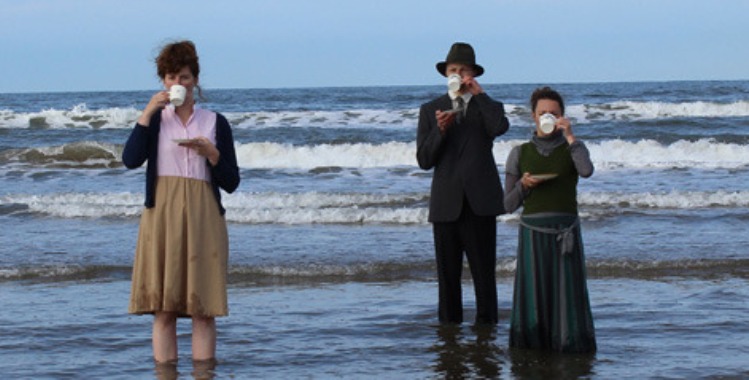
Previously I had complained that the various striking scenes that make up The Various Lives of Infinite Nullity “feel like a string of stage images and little more”. Revisiting this opinion, I still feel that the piece is a little slight, but its images speak powerfully for themselves. Tea cups – ever-present symbols of banality – suddenly slice open throats; fake blood splatters against plastic; an innocuous skipping rope becomes a deadly weapon; a performer’s face is horrifyingly drenched in red liquid.

And then, perhaps, the most effective image of all: a woman lying on the floor, draped in plastic, her incessant, trivial chatter slowly muffled by a downfall of earth. Buried alive and still worrying about what to cook for dinner. Moments like this are when Clout Theatre are at their best, tapping into the essential absurdity of everyday existence and presenting it with a flourish of the surreal.

Sharing Space: Kieran Hurley

Beatspress1

Originally written for Exeunt.

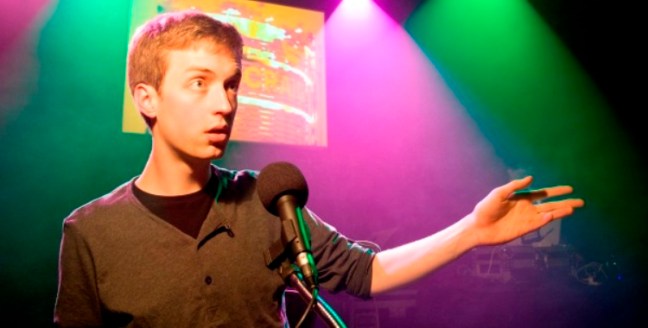
Kieran Hurley has a confession to make. The writer and performer, whose shows include HitchBeats and Chalk Farm, wishes he was in a band. As we chat over the phone about the love for music that has suffused so much of his work, he laughingly describes himself as a “frustrated bass player”. It’s not a unique frustration; playwright Simon Stephens has spoken of his youthful ambition to be a songwriter and once described himself, Sebastian Nübling and Sean Holmes as “three middle-aged men who all wish we were in the Clash”. Hurley even suggests that this band mentality is somehow inherent in collaborative forms of theatremaking:

“I was speaking to someone about this, a fellow theatremaker, and he said that any of us who have ever made theatre in a kind of devised way were just people who wanted to be in a band at school but weren’t really musical. I think there’s a way in which that maybe comes across in some of the work that I make that I perform in.”

This is certainly evident in Beats, the rave-meets-storytelling show that Hurley is about to bring to the Soho Theatre following a second run on the Edinburgh Fringe. For the show, which narrates the coming-of-age story of a young boy in Scotland against the backdrop of the 1990s rave movement, Hurley is joined on stage by a DJ, blending his words with a pulsing score of techo tunes – or, to be more accurate, “mid-90s ambient electronica and a bunch of acid house”. As Hurley explains, the music was an integral part of the piece from the word go.

“With Beats it felt really obvious straightaway that this was going to be a piece that was going to be performed by me and a DJ,” he says. The process of making the show began with Hurley and DJ Johnny Whoop in a rehearsal room together, listening to records and teasing out the narrative. Hurley remembers that there were times when he would find himself “writing to the music”, steering the narrative to meet the emotional pitch of a particular track – “the two were really symbiotic”.

It was also music that provided the first seed of an idea for the show. Hurley recalls thatBeats was born from an interest in the Criminal Justice Act of 1994 – a piece of legislation outlawing public gatherings to listen to music that consists primarily of “the emission of a succession of repetitive beats” – and an intriguing statement included in the sleevenotes of Autechre’s Anti EP. In this note, the group explains that the track ‘Flutter’ has been deliberately programmed to contain no repetitive beats; under the prescriptions of the new law, it could still be legally played at public gatherings.

“I just thought this was a really creative, playful, mischievous response to a really absurd law,” Hurley says. He was equally intrigued by the political echoes of the rave movement and its offspring, which started as a hedonistic movement but became increasingly politicised in the wake of the Criminal Justice Act, feeding into the direct action of Reclaim the Streets and the party protest movement. Hurley therefore describes the impetus behind Beats as a marriage between “a kind of interest in rave culture alongside an interest in direct action activism”.

Although the setting of the show might have attracted some initial doubts – “people were like, ‘why are you doing a show set in the 90s?’” – this choice to focus on the recent past has proved artistically fruitful. As Hurley recognises, there is something fascinating about a time that is not far enough in the past to be considered historical, but is also decidedly divorced from the present. “Certainly that kind of distance is interesting,” he reflects. “It allows you to look at a time and get stuck right into it in a particular way, in a way that’s not always as easy to do with what’s going on immediately around you.”

As well as looking at a particular cultural moment, one that Hurley insists is “ripe for further mythologizing”, Beats uses the context of the rave as a way of exploring ideas of shared space. For Hurley, the show is about “young people claiming space and what that might mean, even when it’s not politically framed” – a theme that he also identifies in Hitch andChalk Farm, which are about an anti-capitalist protest and the London riots respectively.

“The discussion of rave culture is a vehicle for a discussion of sharing space communally – the political power of being able to share space together and look each other in the eye,” Hurley continues. “And theatre is a wonderfully analogous form for exploring the power of community and shared space, because it’s what it is.”

For this reason, the context of the theatre space is vital to the dynamic of the show. “I am dead, dead clear that this has to be a theatre show and happen in a theatre,” Hurley says. “The reason the DJ is interesting, the reason the form is interesting, is because it’s happening in a theatre.” Within a theatre space, there is a certain tension between the real and the imaginary that does not exist at a live music event, a tension that Beats exploits. As Hurley explains, “what the piece can’t do is recreate in real terms the particular type of collective attention that a live music event or even a rave might contain, which is its own beautiful, amazing thing, but what it can do is gesture towards a description of that with a kind of collective attention that we have in the theatre”.

While Hurley might be emphatic about the necessity of performing Beats in a theatre context, the piece has nonetheless – as intended – attracted a young and often non-theatregoing audience. Seeing the show last year during its brief run at the Bush, my thoughts turned to A Good Night Out and John McGrath’s call for a popular theatre. Although his demands, which were in many ways specific to the context of writing in 1979, are not directly translatable to now, there is something in the atmosphere of the gig or the rave that seems to at least partly transcend class boundaries. Perhaps the very attraction of the band for theatremakers like Hurley is that popular music has a way of cutting across divides that theatre often struggles with.

Hurley is clear that it is the music in Beats that is bringing in a broader demographic, arguing that simply the presence of a DJ gives people “a hook to hang something on”. However, this new audience and its differing expectations has brought with it new difficulties for Hurley, difficulties that he is determined to grapple with. “If I’m going to be serious about saying ‘I like the fact that this show might appeal to people who might not normally come to the theatre’, then I have to be able to contain their presence in a way that’s not just about chucking them out because they’re shouting throughout the whole show. That’s been a really interesting challenge.”

In being mindful of his audience, Hurley is also deeply conscious of how his politics translate into his work. He says that he’s “not really that interested in a kind of agit-prop polemic”, although he is adamant that “all theatre is inherently political”. Instead of pursuing a model of theatre as manifesto, the politics in Hurley’s shows finds its expression through storytelling, a form that he confesses to being a little obsessed with.

“I’ve got a whole bunch of opinions about stuff,” Hurley says, “but my work isn’t just a vehicle for me to lecture on that; it’s got to be about a deeper, more complex point of connection and exploration, I think. So that’s where the whole human story comes in.” In a piece like Beats, which is ultimately a personal story about one young boy and his experiences, the narrative is “shot through with some political thinking about the world, but it’s not trying to be polemical”.

While nodding to the long tradition of storytelling – “I think that we, human beings, have always needed stories” – Hurley is firm in refuting any idea that the story form is conservative. The linear storyline is often associated with naturalism, but as Hurley points out, stories are not restricted to this one limiting incarnation. “I don’t think that stories have to be bound up with particular forms,” he says. “What sometimes happens is that narrative and story get conflated with stage naturalism, so people might feel that to reject naturalism is to reject stories.”

This rejection is one that Hurley refuses. Instead, as Beats emphatically proves, storytelling can take various different forms, feeling at once ancient and astoundingly new. Or, as Hurley puts it with typically eloquent simplicity, “stories can look like lots of different things.”

Photo: Niall Walker.