Vault Winner: Theatre Archives

AllsWell1981

Originally written for The Stage.

Think of the archive and the images that typically jump to mind are of dusty vaults and painstakingly catalogued documents. This picture could not be further from the ephemeral immediacy of performance, which for many is defined by its liveness. But what about the traces that theatre leaves behind?

After the final curtain call, a production leaves in its wake a whole swathe of material: costumes, scripts, director’s notes, programmes, set designs. For many theatres and companies, collecting and saving these objects is a central part of their work, establishing huge archives for future practitioners, students, researchers and theatregoers. How these archives are assembled, managed and disseminated can therefore have a significant impact on the theatrical influences passed down to the next generation of artists and audiences.

For theatremakers, the archive can be an invaluable source of research and inspiration, as well as a reminder of the tradition in which they are working. Geraldine Collinge, Director of Events and Exhibitions at the Royal Shakespeare Company, places the emphasis on “seeing the archive and the collection as part of our ongoing body of work”, positioning their current productions within the context of the company’s history. She also explains that the archive forms an important part of the creative process, often acting as a first port of call for directors starting work on a new production.

Similarly, the archives at Shakespeare’s Globe are a vital part of the ongoing life of the theatre. As Head of Courses and Research Dr Farah Karim-Cooper explains, supporting the creative team in the researching of new productions is one of the key roles played by the theatre’s archival material. “The main thing about the archive is that it’s not just a repository,” she stresses, “it’s a place where research is actually produced and feeds into the work of the organisation.”

And theatre archives are not just a useful resource for practitioners. Kate Dorney, Curator of Modern and Contemporary Performance at the Victoria and Albert Museum, notes that the appeal of their collections is surprisingly broad. “It’s a fairly even split between practitioners and researchers,” she tells me. “Directors and actors often come in to see videos to prepare for shows or auditions, designers come in for inspiration, we get lots of students, academics, TV and film researchers, family historians, authors – all sorts.”

With the advance of ever more sophisticated digital archiving systems, however, the way in which this material is accessed is shifting. Although Collinger thinks the move to digital has not affected archives quite as dramatically as it has other areas of the theatre industry, she says that “what is transformational is that more people will have access to them and they won’t be so rarefied”. As archives gradually become digitised, the information that they contain is increasingly accessible without the need to go to a physical archive, which often involves a complex registration process.

Dorney equally points to a “process of democratisation” around the online archive and to new opportunities for engagement. The V&A, for instance, recently produced Played in Britain: Modern Theatre in 100 Plays as an iPad app, collecting material from its archives in an interactive format. “The idea of the app was to give you the experience of coming into the reading room but having everything at your fingertips,” says Dorney. “It’s our attempt to make people understand how you can relate the different areas of the collection to something that you’re interested in.”

For other organisations, digital now sits at the heart of their archiving project. Sarah Grochala joined Headlong as an Associate Artist in August 2012 to work with the theatre company on their online presence, both around the shows they are currently producing and their production archive. The idea, Grochala explains, is “about giving people who didn’t have a chance to see the show a chance to look at some of the material that went into it, above and beyond a script, and to be able to create an idea of it in their head”. This material might include production images, programme notes, set designs or lists of research used by the creative team. The aim is to “give people a sense of the ingredients, not the cake”.

Continuing in that spirit of democratisation, Grochala is also clear that Headlong sees this material as having a potentially wide reach. Talking about making information “immediate and easily accessible” through the web, Grochala identifies the production archives as being of interest to audiences as well as to practitioners and academics. “It’s a sort of deepening of audience engagement and making sure that that engagement can exist both before and after the show as well as during it,” she explains.

However, the digitising of the archive brings challenges as well as opportunities. Grochala emphasises that Headlong’s project is a slow one, involving a painstaking process of recovery and curation, while Dorney doubts that another app will be produced by the V&A in the near future simply because of how time-consuming it is. Money is another issue, as the process of digitising is not cheap. As Karim-Cooper explains, it’s a project that “requires huge amounts of funding”, which for a non-subsidised theatre like the Globe forms a significant barrier. The desire to digitise is clear; it is simply a case of time and funds.

Despite all these digital developments, though, Collinge is doubtful that digitised archives will ever fully supplant the real thing. “That moment when an archivist pulls the First Folio out and you’re looking at those pages – there’s something very special there,” she says. “Admittedly having a digitised First Folio would be wonderful, but I think it would be a different and a new experience rather than one that would replace physical archives.”

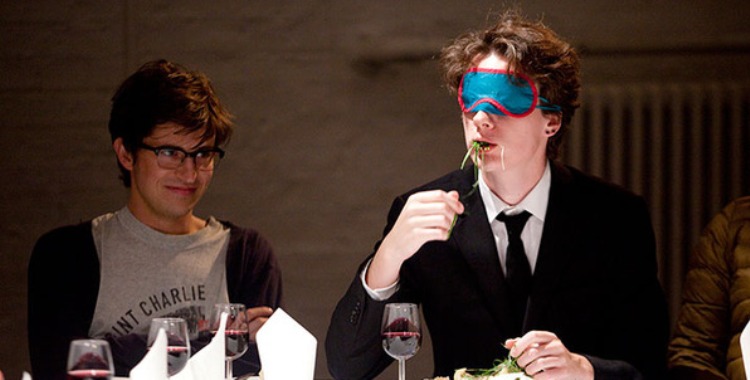
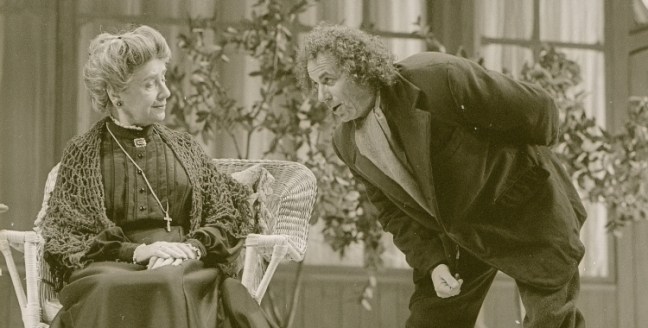
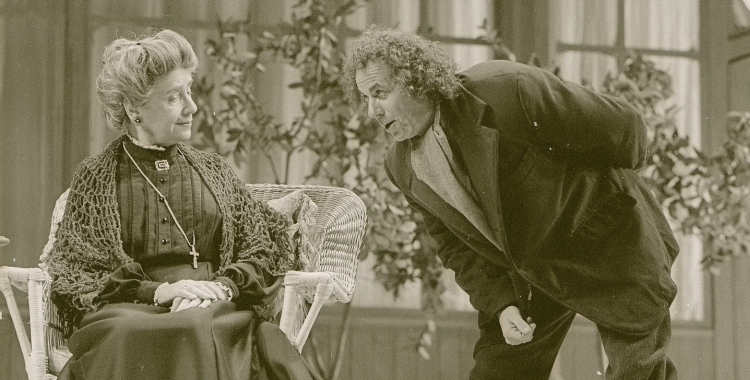
Photo: RSC Archive. From the 1981 production of All’s Well That Ends Well.
Glasshouse, Battersea Arts Centre

web_GLASSHOUSE_176_view

Ever been to one of those dinner parties where it feels like people just keep saying the same thing? At The Honest Crowd’s surreal culinary experience, they actually do. Here, the dinner guests are bludgeoned with small talk and the anecdotes are set to repeat. It’s like being stuck inside a DVD, relentlessly rewinding, fast-forwarding, pausing and skipping.

Glasshouse starts ordinarily enough. After being led into one of BAC’s many small side rooms, we seat overselves at a series of tables arranged in a square, facing one another across the gap in the centre. Our places are laid with plates, serviettes, glasses of wine. Five performers are seated in our midst, while a waitress lingers at the edge of the room. And then the conversation starts, following a plausibly familiar path as the guests discuss wine, films, quirky stories on the news. In fact, everything is pointedly normal; even the acting style is understated, while the audience’s gradual sips of wine lull us into the rhythm of a recognisable social situation. We know what’s going on here – we can do this.

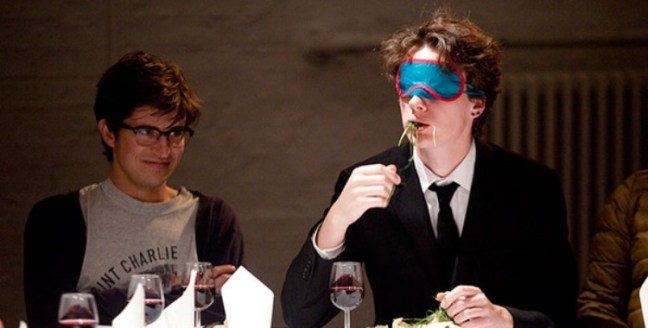
Of course, as most of us probably anticipate even as we enjoy our wine, there’s a lot more to Glasshouse than social ritual. Suddenly, the conversation is rudely truncated and reset. We hear the same questions, the same answers, the same laughs at exactly the same moments. From this moment onwards, the same snippet of prosaic conversation is played out again and again in seemingly endless, grating variations, as the circling waitress pours wine into overflowing glasses and adds more and more ridiculous items to the guests’ plates – lemons, grass, chili peppers, sponges. The dialogue jumps and intercuts, skittering like a broken record, while the performers’ table manners become more and more repulsive. Grass is flung across the table and saliva oozes down chins.

Throughout this surreal spectacle, every last giggle, gasp and grimace of our fellow audience members is deliberately visible across the room. Although the level of audience involvement could be more carefully thought through (our role in this space and in the bizarre universe of the characters is not entirely clear, while I could feel irritation radiating from the actor next to me when I dared to ask him to pass the butter), our arrangement within the space is cannily calculated for maximum impact. Just as the increasingly animalistic habits of the actors reveal something uglier beneath the gloss of small talk, perhaps our reactions reveal something about us as they catch us off guard.

The piece’s implicit nods to absurdism and its borrowed elements of live art – putting the performers through genuine physical ordeals before our eyes – might be more obvious reference points, but what I find myself reminded of is Cheek by Jowl’s recent production of Ubu Roi. Framing the crude extremes of Alfred Jarry’s text within a teenage boy’s frustrated fantasy, the company used this disruptive narrative as a sort of theatrical grenade thrown into the centre of a pristine dinner party, which carried on blithely amid the accumulating mess of the production. The Honest Crowd show the same stubborn, illogical attachment to social norms while everything else unravels around them, simultaneously upturning the very conventions they cling to.

At the same time as it decimates its social setting, however, Glasshouse is in danger of pulverising its point – if, indeed, it seeks to make one. Perhaps the point, if there is any, is the sheer, ridiculous futility of these social routines, exposing the emptiness of the words we eat up as hungrily as the gourmet cuisine. Like Ubu’s oblivious guests, we sip wine and trade anecdotes while the world crashes down around us. This implicit comment on vacuous middle class dinner party culture might not be new, but the mess and vigour of its delivery makes it difficult to forget in a hurry.

Photo: Ludo Des Cognets.

The Strange Undoing of Prudencia Hart, Royal Court Theatre Local

1069380_10151698714439099_1041612077_n

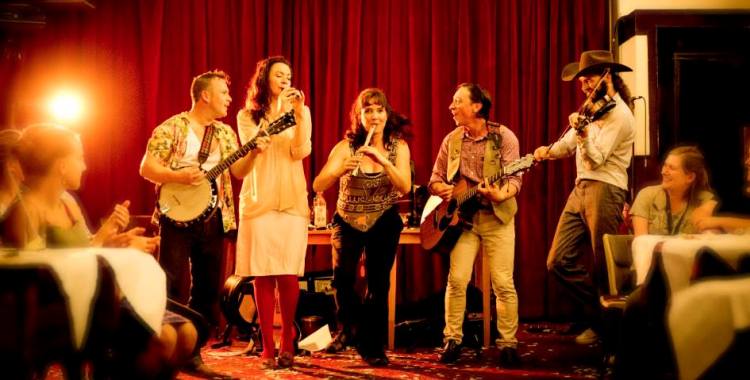
However you do it, there’s something a bit odd about thrusting yourself headfirst into imaginary winter in the midst of sweltering summer heat. As pipe-playing actors stubbornly tell us it is December 2010 while sweat trickles slowly down their foreheads, the prelude to the National Theatre of Scotland’s The Strange Undoing of Prudencia Hart has something of the school play about it; well meaning, big hearted and determinedly blind to its own obstacles – but it’s not fooling anyone. Fans continue to whirr valiantly away, while theatregoers gulp down drinks with a fervour not usually witnessed outside the Edinburgh Fringe.

Then something sort of magical happens. As the actors begin their story, we’re instructed to throw handfuls of improvised paper ‘snow’ into the air, settling on heads and tables and floor. Melody Grove (dressed in so many layers I’m impressed she makes it through the show without fainting) sits atop another performer’s shoulders as a mimed steering wheel, a gleefully waving windscreen wiper, and a tax disc, rearview mirror and two torches held aloft instantly conjure a car. It’s the simplest kind of theatrical illusion, but the rough and raucous spirit in which it’s done brilliantly sets the tone for the show that follows. The heat doesn’t abate, and we’re not quite transported to the snow-blanketed landscape of the Scottish borders, but all of a sudden our sweaty environs seem to matter a little less.

This effervescent little firework of a show is the joint creation of playwright David Greig and director Wils Wilson, joyously embracing both the traditional ballad form and the rowdy pub setting – in this instance, the intimate (and uncomfortably muggy) Welsh Centre bar. Greig’s text takes the form of a ballad about ballads, encompassing everything from lively folk sessions to dry academia, but its knowing self-referentiality never sacrifices a vital sense of fun. At the heart of the piece, effortlessly marrying form and content, is a tension between the purity of tradition and the inclusiveness of a form that morphs to appropriate new cultural phenomena – two camps into which Greig’s bickering gaggle of academics are firmly divided.

One of these academics is the eponymous Prudencia Hart, a prim and reserved traditionalist specialising in the topography of hell, for whom fashionable attempts to intellectualise Facebook statuses and football chants are little short of blasphemy. The story begins at a midwinter conference in Kelso, a small Scottish border town, where Pru’s purism is decidedly in the minority, up against post-post-structuralism and theses on Lady Gaga. Tradition is out of vogue. Adding inconvenience to humiliation, Pru then finds herself stranded with her colleagues in a snow-surrounded pub, trapped somewhere between the drunken locals and the horror of the karaoke machine.

Rattling through academic papers and beer-drenched revelry with equal ease, the first half of the show is mostly hilarious scene-setting, affectionately poking fun at its characters and drawing its audience into the circle of the story. This is narrative at its simplest and most familiar: a yarn down the pub. We are made to feel that the story belongs to everyone, as the narrative is shared and passed between the five performers, who in turn pass through the audience. Actors dance on tables and leap up onto the bar, while several audience members find themselves roped in as props or extras (fellow critic Dan Hutton, incidentally, makes an excellent motorbike). Greig and Wilson find a popular form, populate it and turn it inside out.

The action only begins to drag in an extended sequence featuring four drunken locals, who might be realistically hammered but add little to the gathering story; it’s the one point at which the production feels indulgently overlong. It’s not surprising, then, that Prudencia wants to get away, escaping the drink and drug-fuelled hedonism of the pub for the snow-covered town and a suspiciously friendly B&B owner. Nick, it turns out, collects rare books – and souls. As Prudencia’s academic subject swiftly becomes her reality, it soon transpires that she is the devil’s latest prize, condemned to eternity in a tartan-filled bungalow next to the Asda car park.

Pru’s subsequent ‘undoing’ in the second half offers both a transformational narrative of self-discovery and a movement towards reconciling the two sides of the argument established by Greig in the first part. As the verse that has propelled the story thus far is abandoned in favour of prose, Prudencia learns over several millennia that a life without passion and poetry – no matter how many books you surround yourself with – is no life at all. This section of the show, settling into a quiet rhythm after the raucous first half, is certainly strange. But it’s also sort of beautiful. In one gorgeous, startling sequence, the devil (played by both Paul McCole and David McKay in a slick and surprisingly effective bit of shape-shifting) finally surrenders to poetry, melting together with his captive in a slow and intimate dance.

This section also provides an opportunity for the excellent Grove to become a captivating central anchor for the piece, as her Prudencia gradually reveals an unknown, passionate facet of her otherwise reserved character. Her undoing refers less to a tumble into sin than an unstitching of her distant, sedate exterior. This is paired with Pru’s visual disrobing, as her meticulously neat layers are discarded one by one, leaving her in just slip and tights, while her hair cascades down from its prim bun. Transformation runs through the form, too, as prose gives way to a torrent of poetry and the explosive power of a collective football chant unites the ballad with its modern cousins. There’s even a bit of Kylie thrown in for good measure.

Alongside the production itself, it feels worth pausing to consider its context. Prudencia’s specialist subject might be the topography of hell, but the specifics of this production concern far more earthly locations. Like many of Vicky Featherstone’s early moves as the new artistic director of the Royal Court, this programming has the feel of a statement, and a multi-layered statement at that. Firstly, it’s a bridge of sorts between Featherstone’s role with the National Theatre of Scotland – for whom she commissioned this piece – and her new home at the Royal Court. Secondly, the fact that this show from a theatre without walls is being presented outside the brick and mortar of the Court, as part of its Theatre Local season, suggests a continuation of that gesture of opening up that has so far characterised Featherstone’s tenure. More and more I think that only an artistic director with the experience of not being shackled to a building could give as much thought to what a building really means as Featherstone has already.

Then of course there’s the fact that this show from the National Theatre of Scotland, engaging with Scottish folklore, is being presented at the Welsh Centre in London, England (all that’s missing is a slice of Northern Ireland). And it’s a show about border ballads, in which the narrative itself floats, flitting from performer to performer and only briefly settling. At a time when British identity is increasingly under pressure, this implicit stretching and questioning of nationality feels significant, inviting us to reconsider our connection with our country and our past. It’s also fascinating to see this ahead of Northern Stage’s Bloody Great Border Ballad Project at St Stephen’s in Edinburgh, offering another modern, border-crossing take on this form.

The pub setting, too, is vital to the rowdy sense of community that emerges in the room by the end of the night. As already mentioned, the forms that Greig and Wilson are recruiting to tell this story are very much popular forms, from ballads to folk music to karaoke. There is the sense that, wound together in this way and planted in a familiar social setting (ideally oiled with a few drinks), this marriage of popular forms both old and new offers a new and yet old way to share our stories with a group of people gathered together in a room, breaking through many of the stifling conventions that often hamper theatre. The Strange Undoing of Prudencia Hart is, like the tale round the campfire or the roaring anecdote told over pints at the pub, a basic but accomplished lesson in storytelling. And it’s devilishly infectious fun.

Photo: Johan Persson.

Putting the Spotlight on the Audience

leo_cinicolo_photography-1361 (2)

Originally written for The Stage.

As the power of data rapidly grows, we are now used to an increasingly tailored customer experience, whether that might be through personalised online shopping recommendations or targeted email campaigns. What is perhaps more surprising to learn is that the theatre industry is moving steadily in the same direction.

This growing emphasis on audience data and understanding has been reinforced by the recent announcement that Clive Humby and Edwina Dunn, the co-founders of the data analytics company behind Tesco’s Clubcard scheme, are to invest a seven-figure sum into audience research agency Purple Seven. This move into the cultural sector is in response to what the duo identifies as a big opportunity for theatres to better understand, segment and target their audiences, learning from the innovations that have been made in other sectors.

Thanks to developments in digital technology, the audience information potentially available to theatres is now vast. In addition to box office data, which can inform theatres about their patrons’ booking habits, theatrical tastes, pricing preferences and post codes, theatres are now able to gather insight from social media, online questionnaires and the outcomes of digital advertising campaigns, all of which can be broken down through ever more sophisticated analytics programmes such as those offered by Purple Seven. This is not to mention the old-fashioned tactics of focus groups, paper surveys and direct engagement with audiences at the venue.

With new sources of information come new opportunities. Richard Huntrods, client services director at arts marketing agency AKA, is enthusiastic about the possibilities of recent digital developments: “The growth of social media is a fantastic resource for us to understand whether the types of people we were expecting or hoping to attract are the sort of people we really are attracting, because we can see them talking about the show on a minute by minute basis.”

The Arts Marketing Association (AMA), which provides support, training and development for arts marketing professionals, also points to a wide variety of activities that theatre marketers are currently using to glean audience intelligence. These include gathering feedback from existing audiences, implementing and evaluating market research projects, establishing and understanding market segments, and developing and maintaining customer databases. According to AMA’s head of programme Cath Hume, “we have a better understanding than ever of who is engaging with us”.

While there is no doubting the quantity of information and analysis now available to theatres, the link between insight and implementation has not always been clear. As the AMA points out, it’s all very well having the data, “but what to do with it is key”. It is for this reason that the Association has launched CultureHive, a new online knowledge hub of best practice resources for arts marketers. The project, funded by Arts Council England’s Audience Focus initiative and mounted in partnership with the Audience Agency, aims to bring together audience insight technologies and strategies for feeding this insight back into the process of reaching potential audiences. It is an approach that seems to be spreading.

“Understanding audiences is essentially a foundation for any campaign,” says Huntrods, emphasising the importance of a holistic strategy. He explains that AKA’s process for marketing any show begins with looking at previous research for similar productions, followed by identifying five or six different audience segments that they hope to target. Then, using all the various sources of data available to them, the agency will build up a detailed picture of target audiences, helping them to identify how best to reach these potential punters. Huntrods describes this whole process as “rich and creative”.

For those working in the arts, creativity is key, even as audience analysis becomes increasingly scientific. Despite the wealth of data now available at marketers’ fingertips, the theatre industry continues to rely heavily on tried and tested methods, emphasising the importance of direct communication with target audiences. Huntrods explains that focus groups, for instance, remain essential for AKA’s campaigns, and that this feedback often influences the marketing images, copy and pricing strategy for a show. He is also keen to stress the value of firsthand engagement with audiences.

“No other industry has quite the advantage we do – namely, being able to see its customers in one place and at every performance,” Huntrods says. “One of the most important parts of the research we do is going to the theatres and actually seeing the audiences and talking to them firsthand. You can really understand a hell of a lot by just seeing people.”

Similarly, Purple Seven have found that some of their most successful results have been informed by direct audience feedback. Their survey function, for example, provides instantaneous feedback for theatres straight after a performance, allowing them to make immediate adjustments – to sound, for instance – during the run. The company’s co-founder Stuart Nicolle is clear that the desire for a genuine understanding of audiences lies at the heart of what Purple Seven does, saying that “when we understand that actually we’re trying to build relationships with audiences, then we can start to communicate with them in the right way”.

The expertise and investment offered by Humby and Dunn is to be put towards making this understanding even more sophisticated. Whereas historically Purple Seven’s audience analysis has been fairly linear and query-specific, Nicolle explains that the new data modelling they are developing will “make it much more of a story, so you get to understand the customer holistically rather than the different elements that make it up”.

Nicolle hopes that this refined data will then allow the company to advise theatres on programming decisions, such as the length of runs and which shows to programme alongside one another. This is an area that Nicolle admits offers potential conflict with the artistic impetus of venues, but he insists that Purple Seven’s work “isn’t about commercialising the arts”.

However, not everyone in the sector agrees that improvement is needed. Refuting Humby and Dunn’s claims that the cultural sector needs to catch up with other industries, Huntrods argues that theatres are in fact ahead of the curve in understanding their audiences. He points to the example of digital advertising, in which theatre campaigns often deliver twice the average return on investment, and to the success of direct mail. “The return that theatre gets relative to the spend is phenomenal,” he claims, “and I think that’s because we understand our audiences so well and we’ve got such great data on them.”

While there may be differing opinions on the specifics of audience analysis, the one point of agreement is that data and research offer a vital opportunity for theatres to assess who is coming through their doors and why. As Nicolle puts it, “the ethos behind it all is to really get a full understanding of who the audience is for each organisation”.

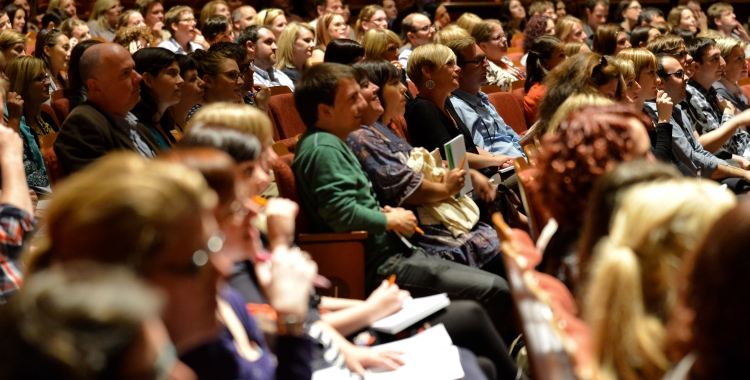
Photo: Leo Cinicolo.

Cush Jumbo

cushjumbo

Originally written for IdeasTap.

Actress Cush Jumbo has appeared in a wide range of stage and television roles, including Lois Habiba in Torchwood. Her latest project, Josephine and I, is a one-woman show that tells the extraordinary life story of Josephine Baker. She shares her tips on training, research and how to cope with pressure…

How important do you think it is to train as an actor?

I really loved my training experience. I think it probably depends on the kind of person you are and what your plan is; what kind of career you’d like to have. I was very interested in learning the technical aspects of my job; the craft of it, the voice, the movement and how to actually do this job day to day. That’s the bit that I think you can be taught. The other bit is the raw talent part, which you can’t be taught. I personally found my training really useful and I’ve continued to find it useful since graduating.

Was there a point at which you felt your career really took off?

I didn’t have a rocket launch of a start. For the first couple of years I really was a jobbing actor and I had to deal with all the strain and the pressure of having absolutely no stability. I think after I did Torchwood things changed a lot, but for me it’s been a gradual process. It’s only really in the last two years that I have been booked up with work.

There’s something positive to be said for both ways. It’s nice to be constantly in work, but it also has an impact upon your life because you can’t fit anything else in – you can’t take a holiday, you can’t go to a friend’s wedding, you can’t make plans. Sometimes when you have those gaps you can do those things.

Did you feel any pressure when you were cast in Torchwood?

I don’t recall thinking that at the time, I recall being ecstatically happy that I could pay my rent for the next three months! In a way, actors thrive on pressure. Part of our job is about being able to take on stress and pressure, deal with it and turn it into another kind of energy. Things can change every day, nothing stays the same, lines get cut, lines get added, jobs get taken, you get rejected. You have to thrive on pressure and on the ability to change. If you sat there and thought about pressure then you’d never get any jobs done.

What advice would you give for coping with the pressure and instability of acting?

At drama school, nobody really talks about how to deal with the mental anxiety of being out of work. It can put you in a very lonely, very low, very blue, very depressed state. One way of dealing with that is to remember that there is always going to be somebody else who’s going through that same stage and that you should talk to people about it. Don’t let it get to the stage where you’re feeling so low that you feel completely alone. Otherwise, when that audition comes up, you’re not on top of your game. You need to be ready to go.

It’s a brilliant idea to give yourself your own routine. So you’re doing your boring day job, but you’re still trying to go to classes, you’re still trying to learn accents. Get together with a group of other actors and run lines from a play, or do a bit of writing, or go to a gig – try to take in as much artistic stuff as you can, because working in a job you hate is going to kill your soul. You need to find ways of keeping the creativity running so that when that phone call comes for that audition you’re at your peak.

In Focus: Researching Josephine and I

I’ve always been interested in Josephine Baker since I was a kid. She has an unbelievably fascinating life; it’s so mythic. I read a lot of books and biographies, I watched a lot of movies. I had a really good idea in my head by this point of who this woman was – although the fabulous thing about her is that she can be played a million different ways because she was always changing herself, she was always changing her identity. It’s great to do her in a one-person show because you can be all those different people and all the other characters, but somebody else could do this show and play her in a completely different way.